
Best Practices for Supplier Risk Management in Healthcare
Post Summary
Managing supplier risks in healthcare is critical to ensuring patient safety, data security, and regulatory compliance. This process involves identifying, evaluating, and addressing risks tied to third-party suppliers, such as medical device manufacturers, cloud providers, and software vendors.
Key takeaways:
- Supplier Risk Management (SRM) focuses on assessing risks throughout the supplier lifecycle, including cybersecurity risks (C-SCRM).
- Strong collaboration with suppliers, clear governance frameworks, and continuous monitoring can reduce vulnerabilities.
- Regulations like HIPAA, FDA Section 524B, and ISO 13485 mandate strict controls for managing supplier risks.
- Tiering suppliers by risk level (e.g., critical, high, medium, low) helps prioritize assessments and allocate resources effectively.
- Tools like Censinet RiskOps™ streamline risk assessments, evidence tracking, and incident response.
Why it matters: Supplier failures can disrupt clinical operations, compromise patient data, or lead to costly breaches. A structured approach to SRM minimizes these risks while ensuring compliance and operational continuity.
Healthcare Third-Party Risk Management Course
sbb-itb-535baee
Building a Governance Framework for Supplier Risk
Creating a governance framework helps establish clear roles, consistent risk assessments, and standardized procedures, ensuring every critical supplier is accounted for. This structured approach builds on earlier risk identification efforts to support continuous supplier risk management.
Creating a Supplier Risk Management Policy
A well-documented Supplier Risk Management (SRM) policy ties supplier oversight directly to an organization's broader cybersecurity strategy. It outlines key aspects like assigned roles, risk tolerance levels, evaluation metrics, and mitigation steps. To stay effective, this policy should be reviewed regularly - at least every 365 days or sooner if significant changes occur, as required by CMS guidelines. Keeping the policy up-to-date ensures it remains relevant and ready for audits.
Using Established Frameworks as a Guide
Established frameworks provide a solid foundation for supplier risk management. Some key ones include:
- NIST SP 800-161r1: This framework offers a comprehensive approach to Cyber Supply Chain Risk Management (C-SCRM), providing strategies and detailed guidance for integrating supplier risks into broader risk management efforts [1].
- NIST Cybersecurity Framework (CSF): This framework maps supplier risks to essential security functions such as Identify, Protect, Detect, Respond, and Recover, offering a structured way to address risks [2].
- ISO 27001: As a globally recognized standard for information security management, ISO 27001 includes controls specifically designed for managing third-party relationships.
"Organizations can no longer protect themselves by simply securing their own infrastructures since their electronic perimeter is no longer meaningful; threat actors intentionally target the suppliers of more cyber-mature organizations to take advantage of the weakest link." [2]
By using these frameworks, healthcare delivery organizations (HDOs) can create a cohesive and layered risk management program while avoiding redundant efforts. Incorporating these standards into a multi-departmental committee further enhances the governance structure.
Setting Up Cross-Functional Governance Committees
Supplier risk management touches multiple areas, such as IT, clinical engineering, and procurement. Establishing a cross-functional committee ensures thorough evaluations throughout the product lifecycle [2]. For example, these committees can collaboratively review Software Bill of Materials (SBOMs), network integration plans, and incident notification clauses in contracts.
To maintain security and accountability, implement a two-person rule for system changes. This ensures no unauthorized modifications occur and provides a clear audit trail [1].
Standardized Risk Assessment and Supplier Tiering
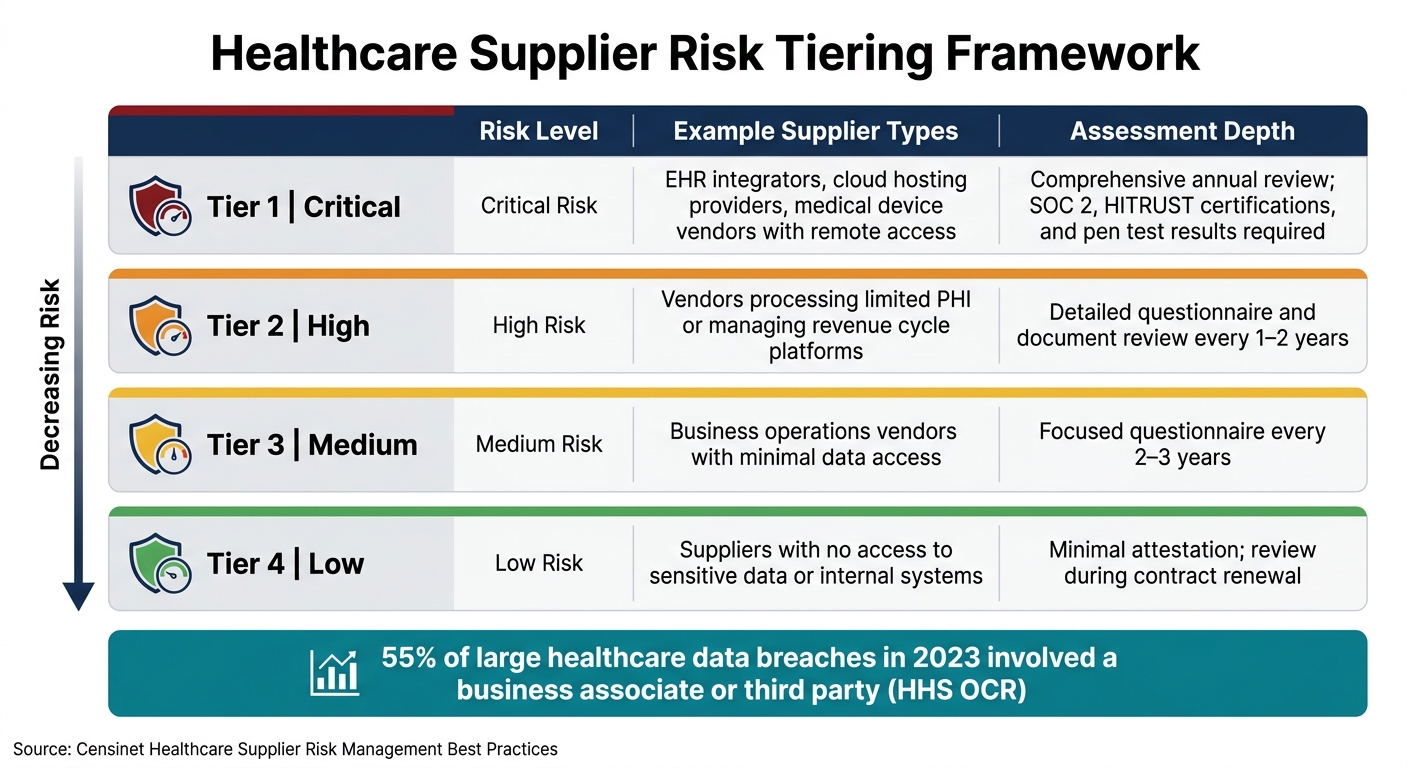
Healthcare Supplier Risk Tiering Framework: Assessment Levels by Risk Category
With clear governance in place, it's crucial to evaluate every supplier consistently, focusing on the actual risks they pose.
Building and Maintaining a Supplier Inventory
A well-organized supplier inventory lays the groundwork for consistent risk assessments. The inventory should include key details such as the supplier's legal name, services provided, the business and contract owner, contract renewal dates, the types of data handled (like PHI, PII, or payment data), the systems they access, and their granted permissions.
This inventory shouldn't be limited to just IT vendors. It should also cover medical device manufacturers, cloud service providers, billing vendors, staffing agencies, and even nonclinical providers like waste management companies - any entity that interacts with sensitive processes or could impact operational continuity.
To keep the inventory accurate and up-to-date, procurement and contract workflows should integrate directly with it. For instance:
- New vendor onboarding should capture details about data access and system integrations.
- Contract renewals should trigger a review for any changes.
- Regular reconciliations across procurement, finance, and security records can help identify suppliers added outside formal processes but who may still have active access to systems.
Once the inventory is complete, you can focus your assessment efforts by categorizing suppliers based on their risk level.
Grouping Suppliers by Risk Level
Using the supplier inventory as a foundation, categorize suppliers by their risk level rather than just their contract value. A tiered model can help prioritize assessments effectively. Here's an example:
| Tier | Risk Level | Example Supplier Types | Assessment Depth |
|---|---|---|---|
| Tier 1 | Critical | EHR integrators, cloud hosting providers, medical device vendors with remote access | Comprehensive annual review; evidence like SOC 2 compliance documentation, HITRUST certifications, and pen test results required |
| Tier 2 | High | Vendors processing limited PHI or managing revenue cycle platforms | Detailed questionnaire and document review every 1–2 years |
| Tier 3 | Medium | Business operations vendors with minimal data access | Focused questionnaire every 2–3 years |
| Tier 4 | Low | Suppliers with no access to sensitive data or internal systems | Minimal attestation; review during contract renewal |
Suppliers are assigned to higher-risk tiers based on factors such as their access to PHI, integration with clinical or revenue-cycle systems, privileged network access, or the potential to disrupt patient care if unavailable. These tiering criteria should be documented in policy to ensure consistent application across departments.
The importance of this risk-based approach is evident in the data. In 2023, 55% of large healthcare data breaches reported to HHS OCR involved a business associate or third party rather than the covered entity itself [3]. For example, a catering vendor with no system access poses far less risk than a cloud-based scheduling platform that integrates with patient records and sends appointment reminders.
Streamlining Risk Assessments with Censinet RiskOps™
Manual spreadsheet-based assessments often lead to inconsistencies. Tools like Censinet RiskOps™ can help streamline the process by centralizing risk scoring and evidence tracking. This platform consolidates questionnaires, evidence collection, scoring, and remediation tracking into a single workflow tailored for healthcare needs. It allows risk, security, privacy, procurement, and business teams to access a unified record, reducing inconsistencies and simplifying audits.
Censinet RiskOps™ also supports a "one-to-many" model, enabling vendors to complete a single assessment and share it with multiple healthcare organizations. This eliminates redundant efforts. Additionally, Censinet AI™ speeds up the process by helping vendors complete security questionnaires in seconds, summarizing evidence, and drafting risk summary reports. This approach balances efficiency with the necessary human oversight, ensuring risks are addressed without cutting corners.
Collaborative Security and Privacy Practices
Once you've completed risk assessments and supplier tiering, the next step is ensuring that security and privacy controls are actively implemented and maintained. It's not enough to simply assess risks - you need to make sure the collaboration between healthcare delivery organizations (HDOs) and suppliers translates into real, operational security measures.
Defining Shared Security Responsibilities
One common issue in healthcare supply chains is confusion over who is responsible for specific security controls. When responsibilities are unclear, gaps can form that leave systems vulnerable. To avoid this, use a RACI matrix (Responsible, Accountable, Consulted, Informed) to clearly define control ownership for each supplier relationship.
Here’s how responsibilities typically break down across five key security domains:
| Domain | HDO Responsibilities | Supplier Responsibilities |
|---|---|---|
| Identity & Access Management | Managing user lifecycles, defining roles, approving access | Enforcing RBAC, implementing MFA, integrating SSO/SAML |
| Data Protection | Setting classification policies, retention rules, and legal bases for PHI | Encrypting data at rest and in transit, ensuring data segregation |
| Infrastructure Security | Handling endpoint security, network segmentation, and API controls | Managing patches, addressing vulnerabilities, and hardening environments (SaaS) |
| Monitoring & Logging | Aggregating logs, correlating data in SIEM systems | Generating audit logs and supporting export to HDO's SIEM |
| Incident Management | Leading incident response, notifying regulators | Detecting incidents, containing breaches, conducting forensics, and reporting breaches within agreed timeframes |
This RACI matrix should be included in contracts or business associate agreements (BAAs) to ensure both parties are aligned. Keeping these responsibilities visible and documented helps embed security controls into daily operations rather than treating them as an afterthought.
Embedding Shared Controls into Contracts and Workflows
A vague BAA that says "the supplier will protect PHI" doesn’t cut it. The Office for Civil Rights (OCR) has emphasized that treating BAAs as mere formalities can lead to enforcement actions, highlighting the need for HIPAA-compliant vendor risk management. Instead, contracts should include a detailed security and privacy schedule. This schedule should reference established frameworks like NIST CSF or HITRUST CSF, outline specific control requirements, and define enforceable timelines.
For instance, breach notification clauses should specify exact timeframes, such as "no later than 24 hours after discovering a suspected PHI incident." Similarly, high-risk findings uncovered during assessments should require written corrective action plans, with clear ownership and deadlines - typically within 30 to 90 days, depending on the severity.
To ensure these controls are more than just words on paper, integrate them into operational workflows. Before a supplier goes live, a joint security checklist should confirm that:
- Single sign-on (SSO) is fully configured.
- Logging is integrated with the HDO’s SIEM.
- Default credentials have been changed.
- Administrative roles have been reviewed.
For major updates - like infrastructure migrations or API changes - implement a joint change approval process that includes a security impact assessment. These steps ensure that security remains an ongoing process, not a once-a-year box to check.
Using Censinet RiskOps™ to Monitor Shared Controls
Defining and embedding shared controls is only part of the battle. The real challenge is maintaining visibility into whether those controls are consistently enforced, especially when working with dozens - or even hundreds - of suppliers.
This is where Censinet RiskOps™ comes in. It provides a centralized platform that connects HDOs and suppliers in real time. Risk teams can easily access vendor evidence like SOC 2 reports, HITRUST certifications, and attestations throughout the contract lifecycle. By eliminating the need for manual reconciliation, Censinet RiskOps™ makes it easier to ensure that shared controls are upheld over time. For HDOs managing large supplier networks, this kind of continuous oversight is what separates effective risk programs from those that only appear functional on the surface.
Continuous Monitoring and Incident Response
Completing a supplier risk assessment during onboarding is just the beginning - supplier risks are not static. A vendor that seemed dependable six months ago might now face challenges like staff turnover, new subcontractors, or unresolved vulnerabilities. In healthcare, these shifts can directly affect patient safety, the confidentiality of PHI, and clinical operations. Regular monitoring ensures you stay updated on potential risks.
Tracking Supplier Performance and Security Posture
Monitoring suppliers effectively means keeping an eye on both their operational performance and security measures. Operational metrics include uptime, adherence to SLAs, and responsiveness to support issues. On the security side, it's important to track patching schedules, vulnerability disclosures, and certification renewals. The frequency of these reviews should align with the supplier's level of risk. For example, a cloud-based EHR platform managing PHI might require quarterly reviews combined with continuous threat intelligence, while a lower-risk vendor might only need an annual reassessment.
Establish key thresholds for metrics that trigger escalation. Relying solely on vendor self-reporting isn’t enough. A more complete picture comes from combining internal performance data with external sources like threat intelligence feeds, CISA advisories, and checks for dark web exposure. According to HHS data, the average time to detect a breach in healthcare can exceed 200 days, with delays often linked to insufficient monitoring of third-party systems [3][4]. These insights naturally strengthen your incident response capabilities.
Including Suppliers in Incident Response Plans
Continuous monitoring plays a crucial role in building a proactive incident response (IR) strategy. Many traditional IR plans fail to account for supplier involvement, yet 46% of large healthcare breaches have been tied to business associates [3]. By integrating suppliers into your IR plans, you can ensure faster, more coordinated responses when incidents occur.
Start by identifying vendors critical to your operations - those whose disruptions could impact patient care, revenue cycles, or essential clinical systems. Your IR runbooks should include these vendors' escalation contacts, defined notification timelines (e.g., within 24–48 hours of discovery), and their responsibilities for sharing logs, assisting with forensic analysis, and helping contain any issues. Contracts should clearly outline the details required in a breach notification, including the scope of the incident, types of affected data, preliminary root cause analysis, and steps taken to address the issue.
Regular tabletop exercises, such as simulating a ransomware attack or PHI exposure, can uncover weaknesses like unclear escalation paths or delays in evidence sharing. After each exercise or real incident, conduct a post-incident review to update contracts, SLAs, and technical controls as needed.
Using Censinet RiskOps™ to Support Incident Response
When an incident strikes, the last thing you want is to scramble through spreadsheets or emails to figure out which vendors are affected and what controls are in place. Censinet RiskOps™ simplifies this process by offering a centralized view of third-party risk information. This tool allows teams to act quickly, identifying impacted suppliers, tracking remediation efforts, and coordinating communication.
For healthcare organizations managing a wide range of vendors - covering PHI, clinical applications, medical devices, and supply chains - a single system of record eliminates manual follow-ups and ensures a consistent, effective response when it matters most.
Conclusion: Strengthening Supplier Risk Management in Healthcare
Supplier risk management is an ongoing effort aimed at protecting patient safety and ensuring seamless care delivery. The strategies discussed here function as a system: governance establishes clear rules, tiering prioritizes critical suppliers, shared controls close accountability gaps, and continuous monitoring helps identify risks early.
By combining strong governance with effective tiering, healthcare organizations can move beyond treating suppliers as just vendors. Instead, viewing them as partners creates shared accountability, improves communication, and enables joint planning for potential incidents. This collaboration strengthens the entire healthcare ecosystem. After all, a single supplier issue - be it a security threats in healthcare’s third-party vendor relationships - can ripple across clinical operations. Structured partnerships reduce that risk.
The stakes are high. Recent statistics show the average cost of a healthcare data breach is around $11 million per incident, making it the most expensive of any industry [3][4]. These figures emphasize why proactive and adaptable risk management is essential.
Tools like Censinet RiskOps™ simplify risk assessments, improve vendor collaboration, and provide better oversight of complex supplier networks, including those involving PHI, clinical applications, medical devices, and supply chains.
To ensure your processes are robust, consider conducting a maturity check. Review your supplier inventory, risk tiering, and contract controls to determine if your monitoring systems are capable of catching potential issues before they disrupt patient care. Resilient supplier risk management starts with these streamlined and proactive practices.
FAQs
How do I determine a supplier’s risk tier?
Classifying suppliers into risk tiers involves assessing their impact on patient safety, data sensitivity, and operational importance. Here's how you can approach this:
- Start with a Vendor Inventory: Begin by compiling a comprehensive list of all your vendors. This serves as the foundation for assessing their risk levels.
-
Evaluate Key Factors:
- Access to Protected Health Information (PHI): Vendors handling PHI are inherently higher risk because of the sensitive nature of this data.
- Criticality of Services: Suppliers involved in essential clinical roles or operations carry more weight in your risk assessment.
- Cybersecurity Posture: Assess the vendor’s security measures to identify potential vulnerabilities.
- Assign Risk Tiers: Vendors with access to PHI or those playing critical roles in clinical services typically fall into higher-risk categories. On the other hand, suppliers offering non-sensitive or ancillary services are generally lower risk.
- Conduct Regular Reviews: Risk is not static. Periodic evaluations and monitoring ensure that your risk classifications remain accurate and up-to-date.
By following these steps, you can create a structured approach to managing supplier risks effectively.
What should a healthcare vendor contract require for security?
A healthcare vendor contract must include strong security requirements to protect sensitive information. These should cover encryption of Protected Health Information (PHI) both during transmission and while stored, ensuring data remains secure at all times. The contract should also mandate breach reporting within 24-72 hours, giving healthcare organizations the ability to respond quickly to potential threats.
Vendors must comply with HIPAA security standards, and any subcontractors they use should be held to the same requirements. Additionally, the agreement should grant the healthcare organization audit rights, ensuring transparency and accountability. Upon termination of the contract, the vendor should guarantee secure data destruction to prevent unauthorized access to PHI. Lastly, the contract should align with established cybersecurity frameworks, providing a structured approach to managing security risks effectively.
How can we monitor supplier risk between annual reviews?
Healthcare organizations can stay on top of supplier risks by using automated tools that deliver real-time alerts and risk scores. For instance, platforms like Censinet RiskOps™ offer dashboards and notifications that flag critical events, such as security breaches or expiring certifications. Beyond that, trigger-based assessments after major changes, regular updates to supplier risk profiles, and monitoring key risk indicators (KRIs) help maintain consistent oversight and enable quick responses even between formal review periods.

