
How STRIDE Enhances Medical Software Security
Post Summary
STRIDE is a security framework introduced by Microsoft in 1999, designed to identify and mitigate six key threat categories: Spoofing, Tampering, Repudiation, Information Disclosure, Denial of Service, and Elevation of Privilege. It uses Data Flow Diagrams (DFDs) to map system components and analyze vulnerabilities. This method is particularly useful in healthcare, where software failures can have life-threatening consequences.
Key Benefits of STRIDE in Medical Software:
- Identifies Risks: Pinpoints vulnerabilities in medical devices like insulin pumps or monitoring systems.
- Supports Compliance: Aligns with FDA, HIPAA, ISO 14971, and IEC 62304 standards.
- Improves Patient Safety: Links threats to clinical risks, ensuring critical issues are addressed.
- Lifecycle Integration: Applies across design, development, and postmarket monitoring.
Example Applications:
- Insulin Pumps: Prevents tampering that could alter dosage.
- Bluetooth Monitors: Secures data transmission to protect patient information.
- Cloud Systems: Mitigates risks in Electronic Health Records (EHRs) and telehealth platforms.
STRIDE is becoming essential for regulatory compliance and patient safety in healthcare. Tools like Microsoft's Threat Modeling Tool (TMT) and platforms like Censinet RiskOps™ streamline its application, making it scalable for complex healthcare systems. By integrating STRIDE early and updating it throughout the software lifecycle, organizations can better manage risks and meet evolving cybersecurity standards.
Threat Modeling and Risk Assessment Webinar
sbb-itb-535baee
How STRIDE Improves Medical Software Security
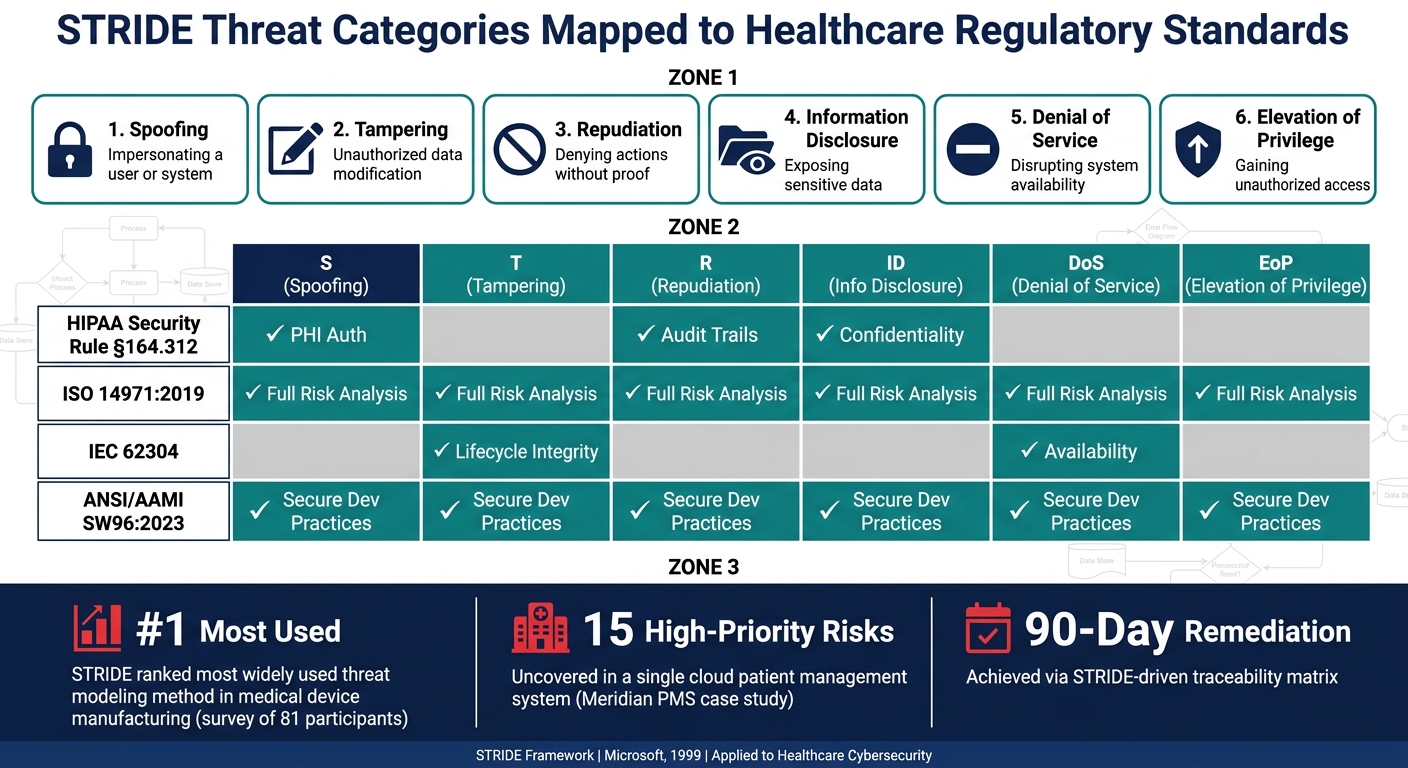
STRIDE Threat Categories Mapped to Healthcare Compliance Standards
How STRIDE Identifies Threats More Effectively
STRIDE offers a structured, step-by-step method that replaces the guesswork of ad hoc security reviews. By applying its six threat categories to individual system components - guided by Data Flow Diagrams (DFDs) - teams can ensure no vulnerabilities are left unchecked.
In a survey of 81 participants from medical device manufacturing, STRIDE emerged as the most widely used threat modeling method in the industry [6]. This popularity makes sense, given the unique risks tied to medical software. Think about Bluetooth-enabled monitoring devices, cloud-based Electronic Health Records (EHRs), or third-party telehealth tools. Generic security reviews often miss these specific attack surfaces. STRIDE, however, requires teams to meticulously trace patient data flows, pinpointing trust boundaries - the spots where data changes its trust level, like during API calls or when users input data [4].
This level of detail not only highlights vulnerabilities but also simplifies the process of meeting regulatory requirements.
How STRIDE Supports Regulatory Compliance
STRIDE isn't just a useful tool - it’s becoming a necessity for regulatory approval. The FDA's 2025 cybersecurity guidance mandates that manufacturers of "cyber devices" (essentially any networked product with software) must show systematic threat identification and risk management in premarket submissions [7]. STRIDE fits this requirement perfectly.
It also aligns with key regulatory standards:
| Regulatory Standard | Relevant STRIDE Category | How It Aligns |
|---|---|---|
| HIPAA Security Rule §164.312 | Information Disclosure, Spoofing, Repudiation | Ensures PHI confidentiality, proper authentication, and audit trails [1][5] |
| ISO 14971:2019 | All categories | Feeds STRIDE threats into comprehensive risk analysis [1] |
| IEC 62304 | Tampering, Denial of Service | Addresses software lifecycle integrity and availability [1] |
| ANSI/AAMI SW96:2023 | All categories | Strengthens secure medical device software development practices [1] |
Real-world examples demonstrate how STRIDE translates these standards into actionable results.
Take the case of "Meridian PMS", a cloud-hosted patient management system running on AWS. In April 2026, security researcher Noah Frost used STRIDE to model threats for the system. The analysis uncovered 15 high-priority risks, including authentication bypass and data exposure, each mapped to specific HIPAA Security Rule sections. The outcome? A 90-day remediation plan and a traceability matrix that gave compliance officers a clear view of how architectural flaws could lead to regulatory issues [5].
"STRIDE maps directly to the spoofing, tampering, repudiation, information disclosure, denial of service, and elevation of privilege categories that matter most for a healthcare platform handling PHI." - Noah Frost, Security Researcher [5]
STRIDE's Effect on Patient Safety and Clinical Risk
By identifying threats and tying them to regulatory standards, STRIDE directly impacts patient safety by addressing clinical risks. Security vulnerabilities in medical software aren’t just technical problems - they can have life-or-death consequences. STRIDE connects these threats to the security properties they compromise, which naturally link to patient safety outcomes.
Imagine the stakes: a Tampering threat targeting an infusion pump’s dosage calculation software could result in an overdose. A Denial of Service attack on a wireless monitoring system could block nurses from receiving critical alerts. STRIDE forces development teams to consider these real-world scenarios during the design phase, long before they can reach patients [1][2].
To prioritize threats based on clinical risk, some healthcare teams pair STRIDE with the DREAD model (Damage, Reproducibility, Exploitability, Affected Users, Discoverability). This scoring system helps rank threats by their potential to harm patients, ensuring that the most critical issues are addressed first [3]. This combination makes STRIDE not just a tool for security but a framework for protecting lives.
Applying STRIDE in Healthcare Settings
STRIDE in Clinical Workflows and Interoperability
Bringing STRIDE into healthcare begins with creating Data Flow Diagrams (DFDs) that track the journey of Protected Health Information (PHI) through clinical systems. Every point where PHI is entered, stored, transmitted, or accessed needs careful scrutiny. This becomes even more critical in interoperable environments where data flows seamlessly across multiple systems - like Electronic Health Records (EHRs), lab platforms, billing software, and connected devices.
Mapping trust boundaries, where data moves between different trust levels, is essential. Once mapped, STRIDE is applied to each element of the DFD. For example, external entities like patient portals are analyzed for risks such as Spoofing and Repudiation. Data flows between systems are reviewed for threats like Tampering, Information Disclosure, and Denial of Service. Meanwhile, processes like dosage calculation engines are examined across all six STRIDE categories [1].
"In the healthcare sector... a single failure can endanger patients' lives and expose their confidential data." - Antoine Béland and Yanik Magnan, Tech Leads, CLEIO [2]
This methodical approach naturally ties into established risk management frameworks.
Combining STRIDE with Existing Risk Frameworks
Rather than replacing existing frameworks, STRIDE enhances them. A prime example is its integration with ISO 14971, the global standard for medical device risk management. Threats identified through STRIDE feed directly into ISO 14971's risk analysis, where teams can assess clinical impact and decide on appropriate controls [1].
For instance, a vulnerability in a diagnostic tool that could lead to incorrect results is not just a cybersecurity issue - it’s a direct patient safety concern. Such risks must be documented in both the security and ISO 14971 risk files.
"A cybersecurity vulnerability that could cause the software to produce incorrect diagnoses is a patient safety risk and must appear in both [the security and ISO 14971] documents." - Lizaveta Dabrynskaya, Regulatory Affairs Consultant [8]
STRIDE also aligns with standards like IEC 62304 and ANSI/AAMI SW96, making it easier to maintain consistent documentation across the compliance ecosystem [1]. This alignment ensures that security measures evolve alongside the software’s lifecycle.
Using STRIDE Across the Medical Software Lifecycle
STRIDE isn’t just a tool for the design phase - it plays a role throughout the entire software lifecycle, from development to postmarket monitoring. Early in the design process, STRIDE helps minimize unnecessary connections, such as limiting Bluetooth endpoints or API access [2]. This "security by design" approach is increasingly becoming a regulatory expectation. By 2026, inadequate security documentation is projected to be one of the top non-conformities for Software as a Medical Device (SaMD) [8].
As software evolves, STRIDE threat models must be updated with every new feature or release. Postmarket monitoring adds another layer of vigilance. Teams refine threat models to account for new vulnerabilities, emerging threats, and system updates. Maintaining an up-to-date Software Bill of Materials (SBOM) supports this process by enabling automated vulnerability checks, keeping STRIDE relevant at every stage [8]. For AI-powered medical software, threat models now need to address risks like adversarial machine learning and data poisoning, especially with the EU AI Act coming into effect in August 2026 [8].
Scaling STRIDE with Purpose-Built Platforms
Tools That Support STRIDE Threat Modeling
Using whiteboards or spreadsheets for STRIDE threat modeling might work for a single application, but it quickly becomes impractical when applied across larger systems. That’s where specialized tools come into play, making it easier to scale STRIDE for complex environments like healthcare systems.
Microsoft's Threat Modeling Tool (TMT) is a popular choice. It simplifies the process by automatically generating STRIDE-based threats from Data Flow Diagrams (DFDs). It also integrates seamlessly with Azure DevOps and CI/CD pipelines, enabling continuous threat modeling. Plus, it’s free, which makes it a great starting point for teams looking to establish a structured approach to threat modeling [11][12].
For organizations seeking more automation, IriusRisk is a powerful option. It includes pre-built healthcare-specific threat libraries and API integrations, allowing teams to generate threat models directly from architecture descriptions. This is particularly useful for scaling across multiple systems, such as EHR modules, telehealth platforms, and connected devices, without having to start from scratch every time [11][12].
The best STRIDE tools for healthcare share a few essential features:
- Visual DFD modeling with templates suited for clinical systems
- Threat catalogs tailored to healthcare assets like HL7/FHIR interfaces and PACS systems
- Reporting that aligns with U.S. regulations, including HIPAA and NIST SP 800-53 [11][12][13]
These tools not only streamline the process but also help integrate STRIDE findings into broader risk management strategies, as demonstrated by platforms like Censinet RiskOps™.
How Censinet RiskOps™ Extends STRIDE Outputs
While threat modeling tools are designed for security engineers, their findings - such as spoofing risks in patient portals or vulnerabilities in medication order systems - need to be actionable for a broader audience, including CISOs, compliance officers, and clinical leaders. Censinet RiskOps™ bridges this gap by turning STRIDE outputs into structured, trackable risk records.
The platform organizes threats into a consistent risk register, linking them to specific vendors, applications, or devices. Each risk is assessed with metrics for likelihood, clinical impact, and control effectiveness, mapped to frameworks like HIPAA, NIST CSF, or HITRUST [11][12][13]. This approach ensures that identified threats directly inform risk mitigation strategies.
Some standout features of Censinet RiskOps™ include:
- Automated Corrective Action Plans (CAPs): These ensure security gaps identified by STRIDE are addressed rather than left unresolved in reports.
- Delta-based reassessments: By focusing only on changes, reassessment times are cut to under a day [10].
- Cybersecurity Data Room™: This feature maintains a detailed, ongoing record of risk data and remediation activities, ensuring threat models evolve alongside software updates.
Another advantage is the Censinet Digital Risk Catalog™, which includes over 50,000 pre-assessed vendors and products [10]. This allows organizations to benchmark recurring risks, such as spoofing or information disclosure, against industry-wide data. By identifying systemic issues, healthcare leaders can focus on fixing root causes rather than chasing isolated problems.
"Medical Device Security ranks last in coverage across all ten HICP best practices areas in HDO cybersecurity programs." - The Healthcare Cybersecurity Benchmarking Study [9]
This underscores the importance of integrating STRIDE findings into an enterprise-wide risk platform. With modern healthcare environments averaging over 10 connected devices per patient bed [9], it’s essential to consolidate threat models into a unified view rather than keeping them siloed by individual teams or projects.
How Censinet AI Advances STRIDE Implementation
While tools like Censinet RiskOps™ structure and communicate threat data, Censinet AI takes it a step further by automating much of the analysis process.
STRIDE modeling often involves time-consuming tasks like drafting DFDs, reviewing threat libraries, and translating findings for different stakeholders. Censinet AI addresses these challenges by analyzing vendor documentation, integration specs, and architecture diagrams to propose initial threat lists. It can even identify potential risks - like spoofing or information disclosure - before a single DFD element is created [11][12][13].
The AI also simplifies communication by tailoring summaries to different audiences. For instance:
- Clinicians might see: "Top three ways this decision-support tool could impact patient safety if compromised."
- Governance committees might receive draft updates on operational risks, such as delays in lab results or disruptions to surgical schedules.
By automating these complex tasks, Censinet AI allows teams to focus on critical decision-making that directly impacts patient safety.
Importantly, Censinet AI follows a human-in-the-loop model. While automation handles repetitive tasks like evidence validation and policy drafting, risk teams maintain oversight through configurable review processes. This balance is crucial in healthcare, where automated decisions can have significant consequences.
One notable feature, Connect Copilot, speeds up vendor updates and flags inconsistencies - such as a vendor claiming strong encryption while STRIDE findings reveal unencrypted test environments. This ensures issues are addressed before audits [10][11][12][13].
Conclusion and Key Takeaways
STRIDE's Role in Strengthening Healthcare Cybersecurity
STRIDE offers a systematic way to enhance the security of medical software, helping developers and security teams identify vulnerabilities before they can impact clinical environments. By categorizing threats with severity levels from "Negligible" to "Severe", teams can better prioritize fixes [2].
Another advantage is its alignment with regulatory requirements like those from the FDA, HIPAA, and international standards [1][5]. This means STRIDE not only helps internally but also provides documentation that’s ready for audits.
When integrated early in the Software Development Life Cycle (SDLC) and paired with tools like Censinet RiskOps™, STRIDE findings can evolve into trackable risk records. This transforms threat modeling into an ongoing safety practice rather than a one-time compliance task.
While the benefits are clear, continued research is needed to adapt STRIDE to emerging challenges in healthcare cybersecurity.
Opportunities for Further Research
Although STRIDE has proven its value, there are still areas where it can grow to meet modern demands. For instance, while it supports compliance and patient safety, it must evolve to address challenges like AI integration and the complexities of supply chains.
One promising area is AI-assisted threat modeling. Automating tasks like Data Flow Diagram (DFD) analysis and matching threats to libraries could save time and reduce the effort required from cross-functional teams [1][4]. Another important area is understanding the long-term impact of STRIDE on clinical outcomes. Most current research focuses on benefits during the design phase, leaving gaps in how it influences patient safety over time [1].
Additionally, healthcare supply chain security challenges and ecosystem-wide modeling are critical gaps. As medical software increasingly relies on third-party components, open-source tools, and cloud-based systems, threat models confined to individual devices fail to address much of the attack surface [1][5]. Future research should explore how STRIDE can connect with supply chain risk data and expand to include mobile apps, hospital networks, and cloud services - reflecting the interconnected nature of today’s healthcare technology.
FAQs
How do I start STRIDE for a medical device or SaMD?
To use STRIDE for a medical device or SaMD, begin by crafting a Data Flow Diagram (DFD). This diagram should outline how data moves through the system, highlighting external entities, processes, data stores, and trust boundaries. With the DFD in place, apply the STRIDE model to assess potential threats across its categories.
Document each identified threat with detailed attack scenarios and corresponding risk levels. Then, devise mitigation strategies tailored to address these risks effectively. Finally, integrate these findings into your risk management documentation to strengthen both security and compliance efforts.
What should a healthcare DFD include for PHI and trust boundaries?
A healthcare data flow diagram (DFD) needs to outline trust boundaries - the points where data moves between varying security levels, like shifting from local devices to cloud-based systems. It should clearly detail data flows, assets, and attack surfaces to help identify potential vulnerabilities that could affect protected health information (PHI) and the system's trust zones.
How do STRIDE findings map to FDA and HIPAA documentation?
STRIDE findings align closely with FDA and HIPAA requirements by providing a detailed framework for identifying and managing cybersecurity risks. This structured threat inventory can be integrated into a device's risk management file, ensuring compliance with regulatory standards. It also establishes clear traceability between identified threats, the controls put in place, and the mitigations applied, meeting the expectations outlined in FDA guidance and HIPAA risk analysis protocols.

