
A healthcare AI system can pass an ethics review and still leave some patient groups with less access to care. That is the main point.
If I had to sum up the article in plain English, I’d put it this way:
- AI ethics asks: Is the system safe, transparent, private, and under human review?
- Healthcare equity asks: Who gets helped, who gets missed, and do access gaps get smaller or worse?
- A model can do well on overall performance and still fail groups by race, income, language, disability, geography, insurance type, sex, or gender identity.
- This often happens when models learn from past spending, past use, zip code, portal use, or patchy records instead of direct health need.
- One well-known U.S. risk model used across 200 million+ people cut Black patient identification for high-risk care by more than half because it used cost as a proxy for need.
- High-risk uses like ICU triage, readmission scoring, chronic care enrollment, telehealth routing, and specialty referrals need subgroup testing before launch and checks after launch.
- Looking only at AUROC or overall accuracy is not enough. Teams need to track error rates, calibration, referral rates, wait times, denials, and overrides by subgroup.
- Governance should include clinicians, compliance, privacy, security, legal, data science, and patient/community voices.
- Security and vendor failure matter too. If systems go down, delays often hit patients with the fewest backup options the hardest.
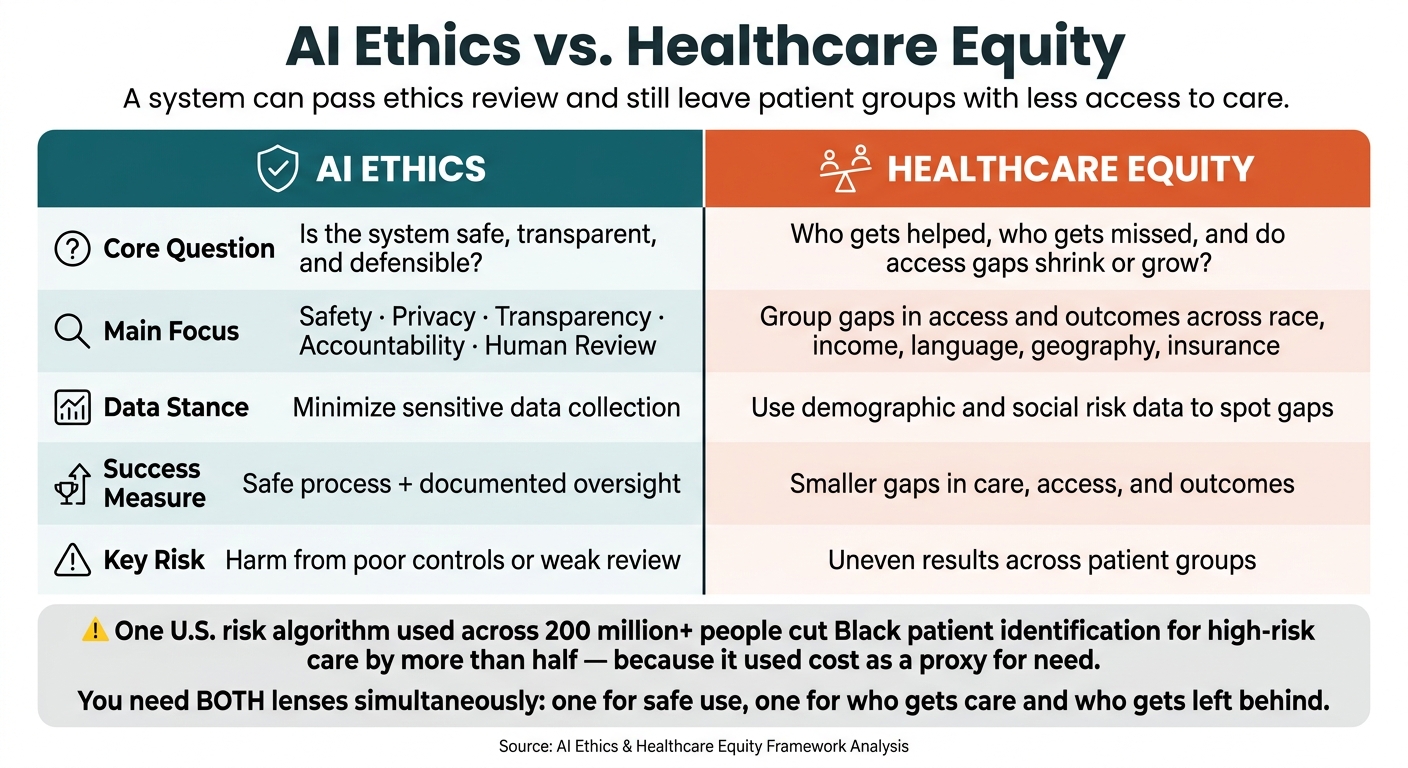
AI Ethics vs. Healthcare Equity: Key Differences in Healthcare AI
Confronting Bias in Healthcare AI: Trust, Equity, and the Future of Medical Technology
sbb-itb-535baee
Quick Comparison
| Area | AI Ethics | Healthcare Equity |
|---|---|---|
| Main question | Is the system defensible? | Is access shared fairly in practice? |
| Main focus | Safety, privacy, transparency, accountability, human review | Group gaps in access and outcomes |
| Data stance | Limit sensitive data when possible | Use demographic and social risk data to spot gaps |
| Success measure | Safe process and documented oversight | Smaller gaps in care, access, and outcomes |
| Main risk | Harm from poor controls or weak review | Uneven results across patient groups |
So, if you use AI in care delivery, you need both lenses at the same time: one for safe use, and one for who gets care first and who gets left behind.
AI ethics vs. healthcare equity: goals, values, and tradeoffs
These two frameworks aim at different end points. AI ethics asks whether an allocation system is safe and defensible. Healthcare equity asks whether that system improves access and outcomes across groups. In plenty of cases, one system can do both. But the priorities don’t always match. And in resource allocation, that gap shows up fast in who gets help first.
Here’s where the two approaches line up - and where they split - on the principles that shape how AI allocates care resources. The next problem is what happens when biased data gets baked into those rules.
| Principle | AI Ethics Priority | Healthcare Equity Priority | Allocation Effect |
|---|---|---|---|
| Justice | Fair process; no individual discrimination | Reduce group-level disparities | Uniform rules can preserve unequal access |
| Data use | Collect only needed data | Use demographic and SDOH data to find gaps | Missing demographic data hides bias |
| Autonomy | Informed consent and transparency | Community input on deployment | Consent alone is not enough |
| Accountability | clear responsibility for harm | Track and close access gaps | Governance must address inequitable outcomes |
| Beneficence | Maximize clinical benefit | Prioritize highest-need groups | Efficiency can miss unmet need |
Where the two approaches overlap
When AI tools shape referrals, eligibility screening, or the ranking of limited services, both ethics and equity push for strict validation, clear decision logic, and governance that can step in when something goes wrong.
The AMA's Trustworthy Augmented Intelligence in Health Care framework explicitly lists promoting health equity as a core requirement alongside safety, privacy, and accountability.[4] Ethics review and equity oversight often chase the same safety aim, but they judge success in different ways.
The split starts when fairness means one of two things: the same rules for everyone, or better outcomes for groups that have been underserved.
Where the two approaches differ
An ethics-first approach often leans on data minimization: collect only what is needed, and limit the use of sensitive attributes like race or housing status. That makes sense from a privacy standpoint. But an equity-first approach makes a different point. Without demographic data and social risk data, it gets much harder to see where the system is failing specific groups.[1][5][6]
A transplant eligibility model that leaves out race and socioeconomic data may satisfy privacy goals while also masking structural disadvantage.[11][12][13]
The sharpest conflict sits in distributive justice. Many allocation frameworks try to maximize total benefit, such as saving the most life-years. Equity frameworks push back on that logic because it can keep resources flowing to groups the system already favors.[7][8][9][10] That’s where things get tricky: biased data and hidden proxies can make those tradeoffs easy to miss.
Data, bias, and model risk in AI resource allocation
That gap shows up in the data itself: what gets recorded, what gets missed, and what patterns a model learns from U.S. healthcare records.
When biased data passes ethics checks but still leads to unequal outcomes
U.S. healthcare data is often split across EHR systems, payer claims, and specialty registries. The result is patchy patient histories, especially for people with less access to care and less complete long-term records.[19] A model can follow privacy and security rules and still learn the wrong lesson. Instead of learning who needs care, it may learn who received care.[16][19]
The clearest case on record involved a commercial risk algorithm used on more than 200 million people in the U.S. It treated healthcare spending as a stand-in for health needs. That sounds reasonable at first glance, but it broke down in practice. Because Black patients had often received less intensive - and less costly - care than White patients with similar illness levels, the model gave them lower risk scores. The result was stark: it cut Black patient identification for high-risk care management by more than half, even when illness levels were similar.[2][3][21] When researchers changed the model so it predicted health needs directly instead of costs, the racial bias disappeared.[21] That's the core problem with cost proxies: they reflect prior access, not clinical need.
The same issue shows up in diagnostic AI. Chest X-ray AI systems have been found to underdiagnose conditions for Black, Hispanic, female, younger, and Medicaid patients.[22][18] The gap gets worse when identities overlap, including for Hispanic women. This won't appear in a privacy audit. It appears later, at the bedside, as worse care for people who were already getting less of it. Allocation tools make this pattern especially easy to see.
Allocation use cases that need the most review
Some resource decisions need more scrutiny than others. When a wrong prediction affects ICU access, referrals, or care program enrollment, the cost of error is much higher. And in many of these cases, the data feeding the model is uneven from the start.
| Use Case | Ethics-Focused Controls | Equity-Focused Data Strategies |
|---|---|---|
| ICU triage support | Secure handling of critical-care data; clear documentation of intended use | Avoid utilization/cost proxies; audit triage recommendations by race, ethnicity, and insurance type; use physiologic severity markers, such as lab values, over access-dependent features |
| Readmission risk scoring | PHI protection; model validation on aggregate performance | Evaluate discrimination and calibration by race, ethnicity, payer, and language; adjust thresholds so high-need subgroups aren't systematically under-flagged; non-Hispanic Black Medicare patients have the highest 30-day readmission rate at 19.4%, compared to 13.8% for non-Hispanic White patients[23] |
| Chronic care program enrollment | Consent and transparency requirements | Replace raw utilization features with social risk indicators such as transportation, housing, and broadband access; stratify enrollment outcomes by income and language |
| Telehealth vs. in-person access | HIPAA-compliant platform requirements | Account for broadband and device access gaps; patients over 55 were 25% less likely to successfully complete a telemedicine visit, and non-English-speaking patients were 16% less likely to engage successfully[17] |
| Specialty referral prioritization | Accountability for referral logic | Review referral rates by race and payer; flag zip code or portal use as potential proxies for socioeconomic status |
What to measure before launch and during monitoring
Launch checks are only the beginning. Patient populations change. Practice patterns shift. A model that looks fair on day one can drift later.
Before go-live, organizations need subgroup testing, not just overall AUROC or accuracy. They should check discrimination and calibration by race, ethnicity, age, payer, language, and disability status.[16][19][21] False positives and false negatives matter most when an error changes access to something limited, like an ICU bed or a care management slot. Each input feature should also be reviewed for proxy risk. Costs, zip codes, portal use, and prior visit frequency are common examples.[16]
Data completeness needs its own review. Before training or deploying an allocation model, organizations should profile missing data by demographic group and document which groups are underrepresented in the training set.[16][19] If records for Medicaid patients are less complete, the model will be less dependable for people who may already face the most risk.
After deployment, monitoring should focus on allocation outcomes, not just model scores. That means tracking who actually gets ICU admission, care management enrollment, or specialty referrals, then comparing those patterns before and after the model goes live.[14][15][17][20] Teams should set escalation thresholds in advance. For example:
- Trigger a governance review when subgroup gaps in allocation rates or error rates pass a set percentage.
- Trigger review when any subgroup shows a statistically significant increase in adverse outcomes.
And that review can't stop at documentation. It should lead to action, such as temporary suspension, recalibration, or retraining, instead of becoming just another logged issue.
Managing AI risk also calls for cybersecurity and third-party risk reviews that test data quality, representativeness, and subgroup fairness.
Governance: ethics review vs. equity oversight in healthcare organizations
AI governance in healthcare needs two separate review tracks: clinical safety and equitable access.
About 74% of healthcare organizations have set up dedicated AI governance committees to oversee AI use cases and deployment.[27] That sounds like progress, and it is. But a committee on paper doesn't mean both ethics and equity are getting the attention they need. In many organizations, compliance is still treated like the endpoint when it should be the floor.
Who should review AI systems that affect care allocation
When bias or performance gaps show up, governance has to do more than note the issue. It needs to assign clear ownership for review and correction. If an AI system affects triage priority, referrals, admissions, or program eligibility, the review process has to be multidisciplinary. One team alone can't judge medical, legal, security, and equity risk.
Clinicians look at whether the model's recommendations make medical sense and fit day-to-day care workflows. Compliance leaders review alignment with rules and internal policy. Privacy officers examine how PHI is handled, stored, and accessed across the system's lifecycle. Security teams assess cyber risk, vendor access, and integration weak points. Data scientists explain what the model learned, where it may break down, and which input features may act as proxies. Legal counsel looks at liability exposure, especially when allocation decisions touch protected classes. Patient and community advocates bring forward access barriers that internal teams often miss - language barriers, transportation barriers, and distrust of the healthcare system - that can shape whether a model's recommendations lead to care at all.
Taken together, these groups pressure-test whether a model is clinically sound, safe to run, and fair across patient groups.
The table below shows how ethics review and equity oversight differ in practice:
| Governance Focus | Ethics-Led Review | Equity-Led Review | Operational Requirement |
|---|---|---|---|
| Data review | PHI handling, intended use documentation, known limitations | Training set composition, subgroup representation, proxy variable audit | Document demographic gaps before go-live |
| Performance review | Overall validation, clinical performance, error documentation | Subgroup calibration, false-positive and false-negative rates by race, ethnicity, insurance status, language, and geography | Require stratified performance results |
| Ongoing monitoring | Incident reporting, model version tracking | Access rates, wait times, referral completion, denial rates, and override rates by subgroup | Set disparity thresholds and remediation triggers |
| Accountability | Defined approval authority, audit trail, informed use policies | Exception analysis, adverse outcome review, escalation paths | Assign one owner for each finding |
| Community input | Patient rights and informed use policies | Access barrier identification, community representation in review | Include patient/community advocates |
Why cyber risk and third-party risk matter for equitable AI use
When AI platforms go down because of ransomware, vendor integration gaps, or unvetted third-party access, the damage doesn't land evenly. The patients hit hardest are often the ones already dealing with transportation, language, or insurance barriers, and they're least able to absorb delays or work around broken systems.[24][25][26] In practice, that means security and vendor oversight belong inside equity governance. They aren't separate lanes.
Censinet RiskOps™ can centralize third-party and enterprise risk reviews for AI systems that affect care allocation.
How human oversight should work
Human oversight only works if reviewers have the authority to override, escalate, and document decisions. Exceptions and adverse outcomes should be reviewed in a consistent way, not just flagged and filed away. If frontline staff believe a model's recommendation clashes with clinical judgment or the patient's actual situation, that concern needs a direct path to the AI governance committee.
Some findings should trigger immediate formal review. A sudden spike in denial rates for a specific demographic group is one example. A pattern of missed escalations is another. In both cases, the response timeline should already be defined, so action doesn't get stuck in limbo.
The point is simple: governance should catch harm early and force follow-through.
Conclusion: Bringing ethical AI and equitable access together
Ethical AI is the starting point, not the end goal. That distinction shows up most clearly when AI helps decide who gets limited care first. Privacy, transparency, accountability, and safety controls can cut real harm, including unsafe recommendations, misuse of patient data, and black-box decisions. But those steps, by themselves, do not fix gaps in who gets care and who gets left waiting.
One well-documented commercial risk algorithm makes the point plain: it cleared standard review and still underestimated illness severity in Black patients.
That gap between safe systems and fair outcomes is exactly why disparity testing, subgroup performance review, and outcome tracking matter. These should be baseline checks for AI systems that shape referrals, care management enrollment, ICU bed access, and other scarce resources. In plain terms, launch checks by themselves are not enough.
Ethics review and equity oversight need to work side by side, not as separate efforts that barely meet. Access metrics, wait times, and allocation patterns broken out by race, ethnicity, insurance status, and geography should sit next to model accuracy in the same governance discussion. And there’s another piece here: equity risk goes up when systems or vendors fail. That’s why managing threats to patient care through security review needs to sit inside AI governance too. A vendor failure can delay care, trigger denials, or break outreach at the exact moment vulnerable patients have the fewest backup options.[28][29] Censinet RiskOps™ can help healthcare organizations combine third-party and enterprise risk reviews with equity impact analysis.
Organizations that handle this well will require, measure, and enforce both ethics and equity across the full AI lifecycle.
FAQs
Can an AI system be ethical but still inequitable?
Yes. An AI system can be ethical by design and still lead to unfair outcomes.
It might look like it works well on the whole, yet miss the mark for certain patient groups. That often happens when the training data doesn’t reflect enough diversity or when the system relies on biased proxies.
To keep care fair in practice, organizations need ongoing monitoring, input from a mix of stakeholders, and rigorous bias testing.
Why can healthcare cost data bias AI decisions?
Healthcare cost data can skew AI decisions when it stands in for clinical need. Cost and illness severity are not the same thing. A patient may need a lot of care even if past spending on that patient was low.
That gap matters. In many cases, less money has been spent on marginalized groups over time. If an AI system learns from that pattern, it may label those patients as healthier or less in need of help, even when that isn't true.
For fairer resource allocation, organizations should rely on direct clinical markers instead. Things like chronic condition counts give a clearer picture of patient need than spending data alone.
What should hospitals monitor after an AI tool goes live?
Hospitals should monitor AI performance after go-live by subgroup, not just top-line metrics. A single average can hide trouble spots.
Track:
- sensitivity and specificity
- false positive and false negative rates
- error rates
- fairness measures
They should also watch clinical control signals, like rising override rates and changes in alert volume. On top of that, review logs and audit trails for drift, new bias, and compliance with approved use. And for any recommendation that can affect care, keep human oversight in the loop.
