
I sort AI requests by their highest-risk factor - not an average score. Check 4 things first: data sensitivity, effect on patient care, system access, and whether someone can check and reject the output. Screening sets the review path; it does not approve deployment.
I use these 4 tiers to route requests:
- Tier 1: Public-data drafting and low-risk administrative tasks may qualify for fast-track review.
- Tier 2: Confidential business data and restricted connections need added checks.
- Tier 3: PHI, patient-record summaries, and clinician-reviewed care recommendations need in-depth assessment.
- Tier 4: Autonomous high-risk actions, broad write access, or unresolved safety controls mean holding deployment and escalating.
<u>Human review alone does not lower the tier.</u> I document the owner, data flows, vendor terms, safeguards, and decision in an AI inventory. PHI also needs privacy and security review; clinical tools may need a separate FDA assessment.
Then I revisit the decision whenever the tool, data, permissions, or workflow changes. That keeps low-risk requests moving without letting patient-safety checks slip.
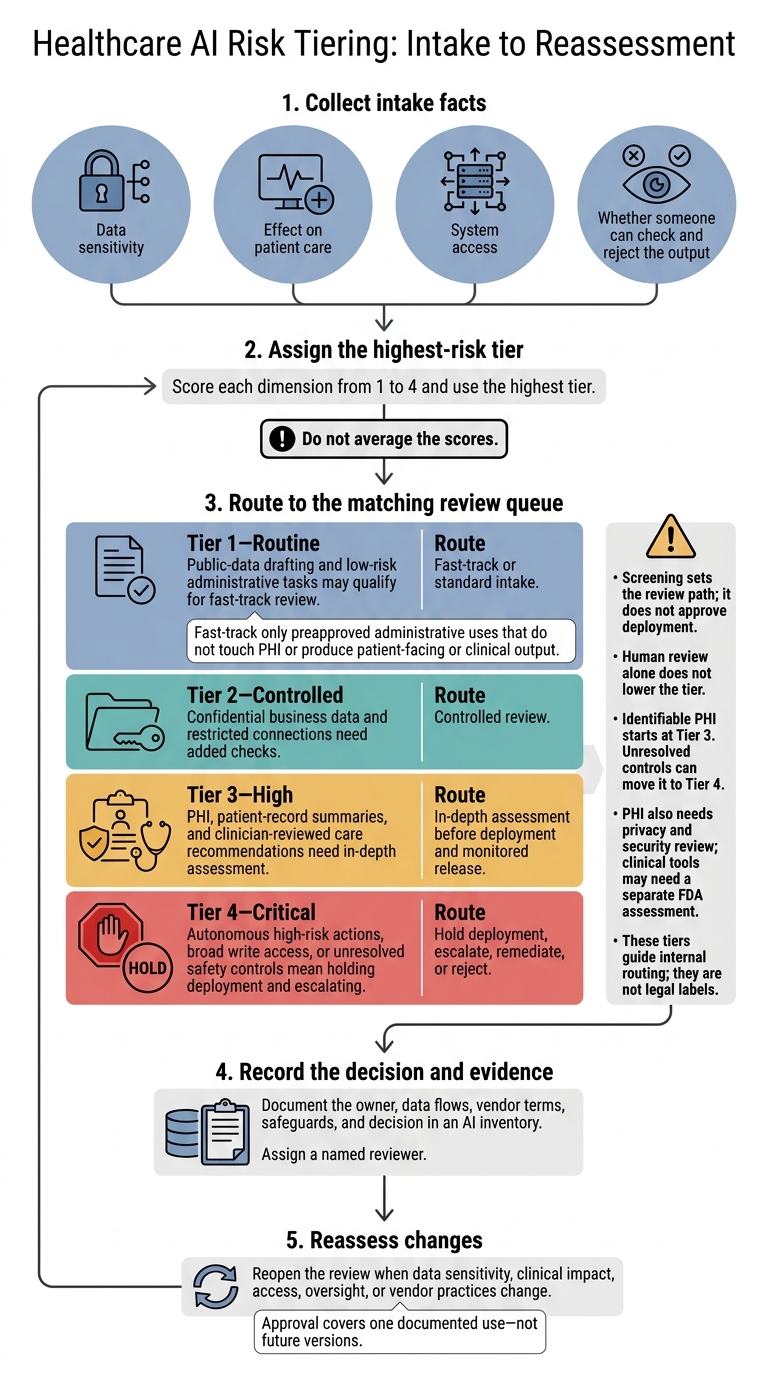
Healthcare AI Risk Tiering: Intake to Reassessment
AI Cybersecurity Risks and Compliance for Healthcare Organizations
sbb-itb-535baee
Set the Initial Tier by the Highest-Risk Factor
Once you’ve collected the intake facts, score each dimension from 1 to 4 and use the highest tier. Do not average the scores. These tiers guide internal routing; they are not legal labels. Set thresholds based on your risk appetite, regulatory duties, contracts, and clinical governance.
Compare the 4 Risk Tiers
Use this rubric as a starting policy. Approval roles and review intervals are policy choices, not universal legal requirements. Identifiable PHI starts at Tier 3. Unresolved controls can move it to Tier 4.
| Tier | Data sensitivity | Clinical or business impact | Permissions | Human review | Approval owner | Required evidence | Reassessment | Review route |
|---|---|---|---|---|---|---|---|---|
| 1 - Routine | Public, synthetic, or nonconfidential data | Low-impact administrative or productivity work with no patient-care effect | Stand-alone or narrowly limited access; no clinical-system write access | User reviews output before use | Business owner and designated technology or privacy reviewer | Intended use, data-flow summary, vendor terms, basic security check, user instructions | At least annually and after scope, data, vendor, or permission changes | Fast-track or standard intake |
| 2 - Controlled | Confidential organizational data or limited sensitive data; PHI only under approved controls | Moderate business, operational, or indirect patient-care impact | Restricted integrations; least privilege; no unsupervised high-impact action | Trained user verifies output before distribution or downstream use | Business owner plus policy-defined privacy, security, compliance, or procurement reviewers | Data flows, access controls, retention and deletion terms, validation, training, incident process | Every 6–12 months or after material change | Controlled review |
| 3 - High | PHI, large sensitive datasets, highly sensitive categories, or transfer to an external model service | Direct clinical, safety, legal, financial, or reputational consequences | EHR or other production integration; privileged access; ability to influence orders, diagnoses, triage, or patient communications | Qualified clinician or responsible professional independently verifies output; usable, documented override | Policy-defined AI, clinical, privacy, security, legal, compliance, and business owners | Intended use, representative-data validation, limitations, bias and subgroup analysis, security assessment, monitoring, downtime and incident procedures, change controls | At least quarterly and after model, workflow, data, or vendor changes | In-depth assessment before deployment and monitored release |
| 4 - Critical | Highly sensitive data with uncontrolled or unclear handling; unresolved PHI controls | Severe patient harm, large-scale disruption, discrimination, or major regulatory exposure | Autonomous or broad production actions; write access; action without case-specific authorization; unclear external sharing | Review is absent, nominal, too late, or ineffective | Executive risk owner and clinical-governance or enterprise-risk authority; legal and compliance where required | Safety case, independent validation, security and privacy assessments, governance decision, rollback plan, continuous monitoring, accountability | Continuous monitoring; formal review at least monthly or at every material change | Hold deployment, escalate, remediate, or reject |
Use the assigned tier to choose the review path.
Apply Escalation Rules
Human review alone does not justify a lower tier. Assess PHI, clinical impact, and broad permissions as separate risk factors. Require evidence that reviewers can inspect source data, catch errors, reject outputs, and stop the workflow. Check whether review works through training records, review logs, error sampling, and override tracking. Enforce access limits through technical controls - not just instructions.[6][8][9]
Route autonomous high-consequence actions, broad write permissions, uncontrolled external sharing, or unresolved safety controls to Tier 4 until resolved. Keep requests with unresolved controls in Tier 4 until supporting evidence is provided. Hold deployment if data handling or oversight ownership remains unclear. Record the blocking question, the responsible owner, and the evidence needed to release the hold.
For clinical decision support, keep regulatory review separate from operational tiering. A tier does not determine device status or replace FDA assessment.[4][7][10]
Apply the Tiers to 3 Healthcare AI Use Cases
The same tiering rules apply across these common requests, but the tier depends on the data, access, and clinical risk involved.
Administrative Writing Assistants
Start with data sensitivity. Tier 1 fits public, nonclinical drafting in an approved account, provided staff edit the output and auto-send is off.
Confidential budget documents or a restricted, read-only document connection move the request to Tier 2. Document permissions, retention, deletion, and sharing settings.
PHI, patient-specific messages, or writes to a source system require at least Tier 3. Verify access and distribution controls, audit logs, and an approver. PHI use also requires privacy and security review, including BAA status and risk analysis.[11][5]
Patient-Record Summarizers
Check clinical impact alongside PHI use. Patient-record summaries start at Tier 3 - even as drafts - because they use PHI. Require source records and dates, plus clinician review before use.
Test for hallucinations, missing allergies, medication changes, misattribution, and stale data. Log sources, reviewer, version, and timestamp. Define controls for access, retention, correction, and incident reporting.
Independent record updates, orders, or treatment actions without clinician approval move the workflow to Tier 4. Hold deployment pending escalation.
Clinical Decision-Support Applications
Check autonomy and oversight. Tier 3 fits bounded recommendations with independent clinician review. Tier 4 fits autonomous action or no effective human review.
Require local validation, population limits, subgroup and bias testing, and explainable outputs. Measure false positives, false negatives, and alert burden - not just accuracy.
Name the clinician with final decision authority. Track drift and safety incidents, and document version changes and rollback procedures. Use representative local data and continued monitoring; vendor benchmarks do not replace local validation.[13][12]
Route Requests by Risk
Once you set the tier, send the request to the matching review queue and assign a named reviewer. Put patient safety and sensitive access ahead of arrival order.
Fast-Track Approved Low-Risk Uses
Fast-track only preapproved administrative uses that do not touch PHI or produce patient-facing or clinical output. Record the owner and restrictions. A familiar tool does not make a new use low-risk.
Assess Sensitive or New Uses in Depth
Use this review path for Tier 2–3 requests involving sensitive data, production access, clinical outputs, new uses, or unclear contract terms. PHI requests start at Tier 3.
Assign one review lead to coordinate cybersecurity, privacy, legal, compliance, and clinical leadership as needed. Before deployment, document safeguards and required conditions. Confirm that contracts prohibit using PHI for training and spell out update terms and liability for outputs.[14]
Escalate Unsafe or Unapproved Use
Use this path for Tier 4 requests and active workflows that fail review or cannot yet be approved safely. Escalate immediately if you suspect PHI disclosure or find unapproved use, unexplained clinical outputs, unsafe actions, missing ownership, or bypassed controls.
Define who can stop use in advance: the named owner can suspend the workflow, cybersecurity can revoke access, and clinical leadership can halt patient-care use.
Keep use suspended until accountable reviewers accept evidence that the problems have been corrected. Require a documented intended use and assessment, an audit trail detailed enough to reconstruct the event, and proof that runtime controls now work.
For agents, verify that controls can detect hidden instructions in incoming data. Before restoring clinical software use, confirm that it does not send direct patient-facing output and that a physician can independently review its output before use.[14]
Record Decisions and Reassess Changes
Once you assign the initial tier, record the decision and watch for changes that affect risk. Approval covers one documented use - not future versions. Reopen the review when data sensitivity, clinical impact, access, oversight, or vendor practices change.
Maintain an AI Inventory and Review Triggers
Use the AI inventory to track what should trigger another review. Record the approved use, required human review checkpoints, and safeguards tied to approval.
Reassess when a vendor changes how it handles PHI, its retraining terms, or the subcontractors that touch the data. Suspend use if an update removes required human oversight or enables patient-facing clinical output. Also reassess any agent that reads untrusted inputs and acts on backend databases.
For higher-risk tools, use session-level logs to investigate changes during reassessment. These logs should show what entered the context window and what the system returned for a specific patient interaction.
Coordinate Reviews Through Censinet RiskOps™
Centralized tracking helps keep change-triggered reviews from getting lost. Use Censinet RiskOps™ to keep assessment records, evidence, workflows, and routing in one place.
Launch the Intake-to-Reassessment Workflow
Build the intake form around the four risk factors, define reassessment triggers, and route escalations to clinical safety and regulatory reviewers. Fast triage does not replace clinical safety review.
FAQs
What if a vendor cannot answer our intake questions?
Escalate the issue to your AI governance committee. The committee will decide what happens next. That may mean pausing pilots, requiring independent testing, or referring the issue to legal if regulatory duties are at risk [1].
Do not proceed with procurement until intake and preliminary tiering are complete [2]. If the vendor’s status is unknown or required documentation is missing, put go-live on hold until the status is cleared [3].
Can de-identifying patient data lower an AI tool’s tier?
Yes. Data sensitivity is a key factor in an AI tool’s risk tier. Tools that use only de-identified or synthetic data in a contained setting generally carry less risk than those that process identifiable protected health information (PHI).
Tools that use only de-identified or aggregated data for administrative or operational tasks typically need less intensive review and oversight. Tools that directly inform clinical decisions or access large amounts of PHI often fall into a higher risk tier.
How do we prioritize tools within the same risk tier?
Within the same risk tier, prioritize tools based on how much care delivery depends on them, how much protected health information (PHI) they handle, and their potential to harm patients. The tier determines review depth and governance requirements. Also consider each tool’s use case, data sources, and how complex it is to integrate into clinical workflows.
Tools that act autonomously, directly influence clinical decisions, or depend on shared infrastructure whose failure could have serious consequences need deeper assessment and more frequent monitoring.
