
A medical device can pass basic software checks and still give different clinical outputs after a library update. That is the core problem. When I use outside AI models, runtimes, frameworks, or cloud services in an FDA-regulated device, I am not just adding code. I am adding supply-chain risk that can affect cybersecurity, patient safety, and compliance at the same time.
Here’s the short version:
- I need to treat third-party AI libraries as in-scope product components
- I need a complete SBOM that includes direct and transitive packages
- I need to verify model files, weights, configs, and artifacts with hashes and signed downloads
- I need to watch for drift from updates, runtime changes, hardware changes, and wrapper-code edits
- I need approval gates tied to evidence, not vendor claims
- I need postmarket monitoring for CVE alerts, support status, tampering, and output drift
- I need a replacement plan before support ends or risk gets too high
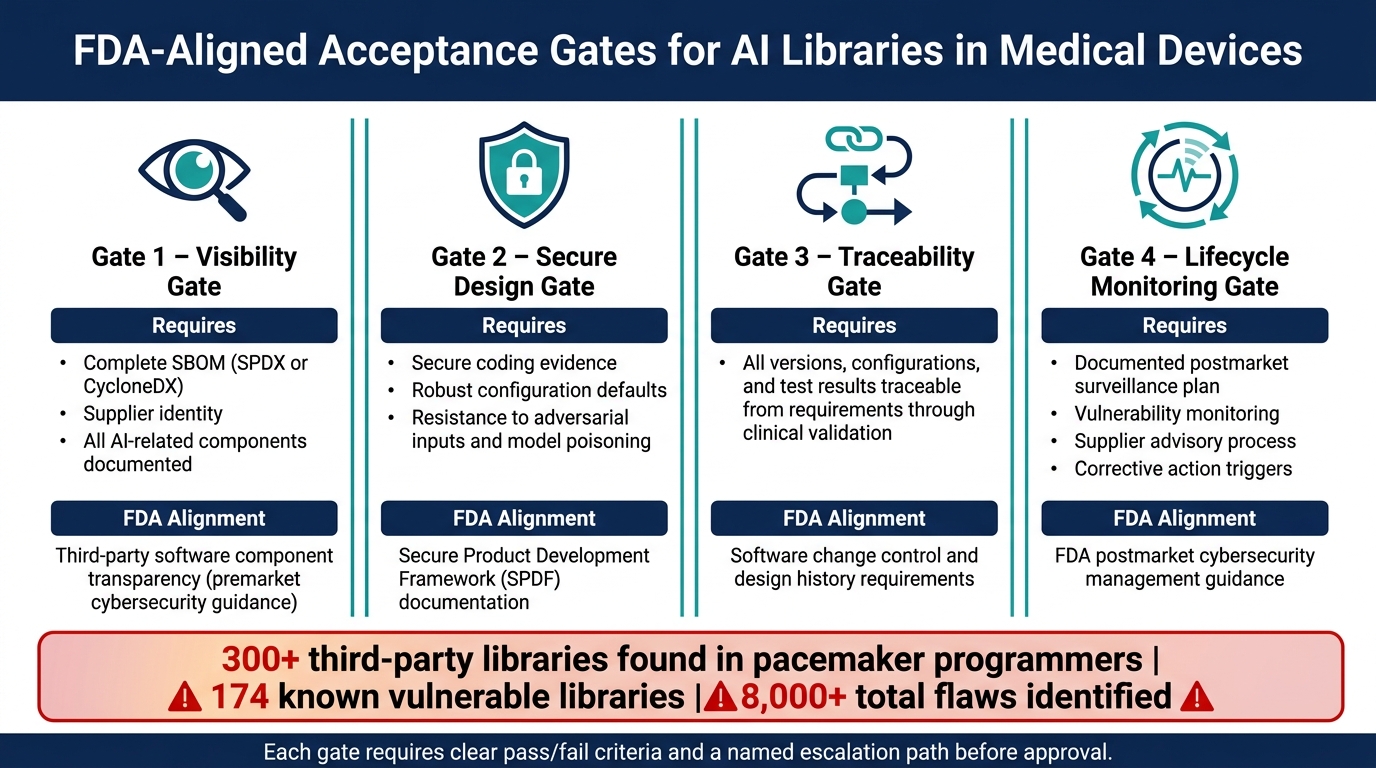
One data point shows why this matters: a study of pacemaker programmers found 300+ third-party libraries, 174 known vulnerable libraries, and 8,000+ total flaws. That is a big attack surface, and AI components add another problem: they may change behavior quietly instead of failing in a way that is easy to spot.
If I boil the article down to one line, it’s this: AI library risk in medical devices is a third-party vendor risk management lifecycle control problem, not just a procurement task. I have to manage visibility, integrity, validation state, monitoring, and retirement from pre-integration through postmarket use.
A quick view of the main risk areas:
| Risk area | What can go wrong | What I need to do |
|---|---|---|
| Dependency visibility | Hidden or unsupported packages stay in the device | Keep a machine-readable SBOM and track supplier status |
| Artifact integrity | Models or configs are altered, or PHI leaks through weak controls | Verify hashes, signatures, and locked-down data paths |
| Validation drift | Outputs change after updates or runtime shifts | Use change control, regression testing, and baseline checks |
So before I approve any outside AI component, I should ask a plain question: Can I prove what it is, where it came from, how it behaves, and how I will monitor it after release?
Why Medical AI Still Needs a Human in the Loop | Tyler Harmon | Ep 80
sbb-itb-535baee
The Failure Modes That Matter Most
AI library failures often show up in quiet, easy-to-miss ways: hidden dependencies, tampered artifacts, or validation drift. The problem is that any one of these can trigger three headaches at once: a cybersecurity incident, a patient safety event, and a compliance problem. These represent significant enterprise risks for healthcare organizations.
At a high level, the main failure modes fall into three buckets: dependency visibility, artifact integrity, and validation drift.
Vulnerable, Unsupported, or Hidden Dependencies
One of the biggest risks is exposure you don’t know you have. Transitive, vendored, or embedded dependencies often slip past procurement and integration reviews, which means weak components can sit inside a system unnoticed.
Unsupported libraries make things worse. When a component reaches end of support, security fixes stop. And in medical devices, change control is often slow and tightly managed. So even after a flaw becomes public, fixing it can take time.
A partial SBOM makes the whole situation harder. Without a complete, machine-readable SBOM that includes AI artifacts and transitive dependencies, teams can’t quickly answer basic questions:
- Where are we exposed?
- How far does the impact spread?
- Was the fix applied and verified?
That delay slows patching and incident response. It can also turn into a compliance issue.
Once dependency visibility is in place, the next checkpoint is artifact integrity.
Model Tampering, Data Leakage, and Unverified Artifacts
Model weights, inference settings, and related files all carry risk if no one verifies their integrity. If there’s no signature or hash check, you can’t trust a model update. It’s that simple.
Medical imaging research has shown how dangerous this can get. Imperceptible perturbations and backdoored models can flip benign findings to malignant with high confidence.
At the same time, confidentiality risk runs right beside integrity risk. AI libraries often handle sensitive inputs such as medical images, physiological waveforms, device telemetry, and other protected data. That data can leak through logs, caches, telemetry, or insecure APIs. When PHI leaks through an AI component, it’s both a HIPAA issue and a clear sign that the security boundary failed.
If the artifact can be trusted, the next question is whether the integration still matches the state that was originally validated.
Integration Drift and Validation Gaps
Validation can disappear even when the library code itself doesn’t change. A library can drift outside its validated state because of upstream model updates, operating system changes, hardware differences, or wrapper-code changes that preprocess inputs or postprocess outputs. Any of those can shift inference behavior beyond what the original validation package covered.
That’s why validation is a state, not a one-time event. The table below maps common drift scenarios to impact and detection.
| Risk type | Likely impact | Common detection method |
|---|---|---|
| Configuration drift | Changed model behavior or degraded output quality | Configuration baseline checks and change review |
| Upstream component update | Loss of validation status or unexpected behavior | Version monitoring and regression testing |
| Hardware or runtime mismatch | Performance issues or inference errors | Environment validation and compatibility testing |
| Wrapper code change | Altered inputs, outputs, or safety controls | Code review, traceability checks, and verification testing |
These failure modes shape the approval evidence a library needs to clear before integration.
FDA-Aligned Criteria for Approving an AI Library
AI Library Risk in Medical Devices: 4 Acceptance Gates & Key Controls
Approval has to come from documented evidence, not vendor marketing. These checks set the baseline for both integration and monitoring.
Pre-Integration Evidence to Require
Ask for evidence in nine areas:
- Supplier documentation: Intended use, architecture, supported platforms, and known constraints. Check each item against your design documentation and risk analysis.
- Version history and change logs: Semantic versioning, functional changes, security fixes, and model updates. These should trace back to configuration baselines and design history files.
- Maintenance cadence: Update frequency matters because it affects patch timing. If updates come in fits and starts, the library may not fit a high-risk connected device.
- Support status: Get written support terms and a clear end-of-support date.
- Vulnerability status: Review SBOM-based vulnerability scans and supplier advisories. Any open issues should be tracked in the risk management process.
- Cryptographic integrity: Require signed artifacts, checksums, and verified download channels. Build automated verification into the build pipeline.
- License review: Confirm the component can be used legally in a regulated, clinical setting.
- Intended use boundaries: Define supported indications, patient populations, data modalities, and operating conditions. Tie these limits to hazard analyses and usability studies.
- Complete, machine-readable SBOM: Use SPDX or CycloneDX format to capture all direct and transitive dependencies, with NTIA minimum elements and lifecycle details such as support status and end-of-support dates.
Acceptance Gates Tied to FDA Cybersecurity Expectations
Approval should happen only after the library clears four explicit gates. Each one maps to FDA cybersecurity expectations and your internal quality system. Think of them as plain pass/fail checkpoints.
| Acceptance gate | What it requires | FDA alignment |
|---|---|---|
| Visibility gate | Complete SBOM, supplier identity, all AI-related components documented | Third-party software component transparency in premarket cybersecurity guidance |
| Secure design gate | Secure coding evidence, robust configuration defaults, resistance to adversarial inputs and model poisoning | Secure Product Development Framework (SPDF) documentation |
| Traceability gate | All versions, configurations, and test results traceable from requirements through clinical validation | Software change control and design history requirements |
| Lifecycle monitoring gate | Documented postmarket surveillance plan, vulnerability monitoring, supplier advisory process, corrective action triggers | FDA postmarket cybersecurity management guidance |
Each gate needs clear pass/fail criteria and an escalation path. Before approval, document residual risk in plain terms. Name the hazards, such as model misclassification or dependency vulnerabilities. Record the controls already in place, including compensating controls for any unresolved SBOM gaps. Then state the remaining risk in language FDA reviewers can assess during a premarket submission review or an audit. Regulators want to see that residual risks were knowingly accepted, not waved through.
Replacement planning should also sit inside the approval package. If the supplier's support horizon is shorter than the device's expected service life, that gap needs a documented mitigation plan before approval. Waiting until a critical vulnerability appears leaves you with no clear remediation path, and that's a bad place to be.
Once a library clears approval, integration controls and postmarket monitoring take over.
Controls for Secure Integration, Monitoring, and Remediation
Approval is only a point-in-time check. Secure integration and steady monitoring are what keep a library inside its validated state.
This is why these controls are grouped by lifecycle phase. Engineering, security, quality, and postmarket teams each need a clear lane. The goal is simple: keep the AI component locked to the exact version, configuration, and runtime state that was approved.
Integration Controls That Protect Validation Boundaries
Pin every AI library, framework, and model to an exact version in manifests and build scripts. Don’t allow floating versions like >=2.1 or latest. A version change that slips in without review can change output or safety behavior without setting off any formal review.
Three controls help hold the validated state in place:
- Isolate AI components in containers or sandboxes
- Expose them only through controlled APIs
- Limit OS and network privileges to the minimum required
Keep secure configuration settings under version control too. That includes disabled debug endpoints, restricted PHI logging, and controlled model update paths. Doing this helps apply the same hardened baseline across every environment instead of letting one setup quietly drift from another.
Reproducible builds matter here as well. Signed model files, containers, and SBOMs should be required, and any artifact that fails a hash or signature check should be rejected. On top of that, any library, configuration, or dependency change needs to go through formal change control, impact assessment, regression testing, and documented approval. That’s how you stop quiet, unreviewed changes from affecting output or safety behavior.[7][8][9]
Once that validated state is locked down, the next job is to watch for drift as early as possible.
Postmarket Monitoring Signals and Response Triggers
Monitor continuously. Vulnerability feeds, SBOM-based scans, and supplier advisory channels should all run with named owners and clear response actions for each signal type. That includes dependency changes, artifact tampering, and performance drift.
| Monitoring signal | Responsible owner | Required response action |
|---|---|---|
| New critical vulnerability in a dependency | Product security team | Patch, apply compensating control, or disable affected function |
| Supplier support status changes | Procurement and quality teams | Reassess risk and initiate replacement planning |
| Unexpected model output or performance drift | Clinical, engineering, and quality teams | Investigate root cause, validate clinical impact, and restrict or adjust use if needed |
| Unauthorized package or artifact change | Security and DevOps teams | Block deployment, verify integrity, and restore a trusted version |
| Dependency version change in build pipeline | Engineering and release management | Trigger formal change control, risk analysis, and regression testing |
Clinical feedback, complaint trending, and automated performance dashboards that track accuracy and false-positive rates against validated baselines act as the day-to-day early warning system for drift. If drift shows up, move the AI to advisory-only mode while the team investigates the root cause - whether that’s a data shift, a model update, or an environment change - and completes revalidation.
Any signal that changes performance, integrity, or supplier support should start the replacement path.
Retirement and Replacement Planning Before Risk Becomes Urgent
Set retirement triggers before deployment. Those triggers should include an unpatched critical vulnerability, supplier end-of-support, sustained performance loss against validated baselines, or an unmet regulatory change.[6]
The replacement path should already include fallback modes, signed staged updates, rollback, impact assessment, and quality sign-off. Each part should tie back to supplier support status, vulnerability exposure, and loss of validation. Before deployment, communicate what changed, why it changed, and what it means for operations.
Governance and Conclusion: Treating AI Library Risk as a Supply Chain Process
Once the technical controls are in place, governance is what keeps them owned, funded, and ready for audit.
Third-party AI library risk should be handled like a supply chain process that runs across the full product lifecycle. That means identifying in-scope components, checking for tampering, leakage, and drift, setting approval gates based on evidence, enforcing integration controls, and watching for retirement triggers. FDA's February 2026 guidance puts this plainly: manufacturers keep custody of device source code and third-party AI components throughout the lifecycle.[1] SBOM coverage, threat modeling, and postmarket monitoring all need to sit inside those lifecycle controls.[3][2][12]
Shared Accountability Across Security, Quality, Clinical, and Procurement Teams
That ownership can't sit with one team alone. It has to be shared across the groups that touch risk, safety, and release decisions.
- Security handles threat modeling, SBOMs, CVE tracking, and incident response.[4][5]
- Quality and regulatory handles design controls, risk files, and submission documentation.[3][2]
- Clinical teams handle acceptable performance thresholds and patient-safety impact.[10][4]
- Procurement handles support terms and replacement timing.
Shared ownership breaks down fast if handoffs are vague. Each handoff needs a clear approval gate.
Use three gates: pre-integration, release, and change. For each one, assign a named owner, define a pass/fail rule, and set an escalation path. That way, when something changes, nobody is left asking who makes the call.
Leadership also needs to watch whether the process works in day-to-day use, not just whether a policy document exists. Focus on three metrics: SBOM completeness, time to remediate disclosed vulnerabilities, and AI-related incidents and near misses.[3][4][11] Those numbers give leadership a concrete view of whether governance is doing its job.
FAQs
Why are AI libraries treated as regulated device components?
AI libraries are treated as regulated device components because they’re core software parts inside cyber devices. In FDA terms, those are medical devices with software that connect to a network or the internet.
Under Section 524B of the Federal Food, Drug, and Cosmetic Act, those libraries aren’t treated like side tools or optional add-ons. They’re part of the device’s safety and effectiveness.
That matters for a simple reason: AI libraries can behave like black boxes. If a manufacturer can’t clearly show what’s inside the software stack, it gets harder to spot weaknesses, track dependencies, and understand how a flaw could affect patient safety.
That’s why the FDA requires SBOM transparency. The goal is to make it easier to identify and manage vulnerabilities, software dependencies, and any patient safety risks tied to those components.
What should an SBOM include for AI in medical devices?
For AI-enabled medical devices, an SBOM should list every software component in the product. That includes open-source code, commercial software, third-party packages, and transitive dependencies.
At a minimum, it should include the NTIA minimum elements. It should also include lifecycle metadata, such as support levels and end-of-support dates, plus a machine-readable format like SPDX or CycloneDX.
For AI, the SBOM should go a step further. It should point out AI-capable features, model dependencies, third-party AI services, and related vulnerability and VEX data.
How can teams detect AI output drift after release?
Teams should rely on continuous, automated monitoring rather than random spot checks. The goal is simple: keep a close eye on how the AI is performing over time, not just every now and then.
That means tracking metrics like accuracy, precision, recall, false positive and false negative rates, and decision confidence against set baselines. If those numbers start to shift, that's your signal to look closer.
Dashboards and validation tools can help flag anomalies and spot data drift or concept drift early, before small issues turn into bigger ones. Just as important, these checks should connect to formal change control, with clear thresholds for intervention and defined escalation paths.
