
SOC 2 compliance is no longer a yearly task - it’s now an ongoing requirement for healthcare organizations. Manual methods are time-consuming, error-prone, and costly. AI-powered tools are stepping in to simplify the process, cutting audit preparation time by up to 80% and reducing compliance costs by as much as 40%.
Here’s what you need to know:
Healthcare organizations now have a way to meet growing compliance demands while minimizing effort and costs. AI tools are changing the way SOC 2 audits are done, making them faster, easier, and more effective.
Automating HIPAA & SoC2 Compliance for Startups with AI Powered Solutions
sbb-itb-535baee
1. Traditional Automation Tools
Before diving into how AI-powered solutions are reshaping SOC 2 reporting, it’s worth understanding where traditional automation tools fall short.
Traditional automation tools connect with platforms like AWS, GitHub, and Okta to automatically collect logs and configurations around the clock. They flag policy violations in real time, helping organizations stay on top of compliance requirements [3][4].
Speed and Efficiency
While these tools do speed up evidence collection, they often stumble when faced with the complexity of healthcare compliance. For example, SOC 2 Type 2 audits require observation periods ranging from 3 to 12 months. Traditional tools, though capable of continuous monitoring, often struggle to fully support these extended timelines. This limitation can lead to frantic, last-minute efforts to gather evidence during tight observation windows [1].
Accuracy and Evidence Depth
In today’s distributed systems, manually analyzing evidence from various sources can be a logistical nightmare. SOC 2 reports are becoming more complex, with nearly 50% now covering 100 or more controls and 15% exceeding 200 controls [1]. Traditional tools also have difficulty keeping up with the rapid pace of cloud updates, architectural changes, and evolving policies. As a result, mapping these changes to specific controls becomes a challenge [5]. When evidence is scattered across disconnected platforms like email and spreadsheets, managers lose real-time visibility. This lack of oversight often leads to gaps that auditors uncover. In fact, only 2% of SOC 2 Type 2 reports are entirely free of exceptions, meaning 98% require some form of remediation [1].
Healthcare-Specific PHI Handling
Healthcare organizations face unique compliance hurdles that traditional automation tools weren’t built to handle. For instance, HIPAA mandates strict tracking of all Protected Health Information (PHI) access and modifications. Manual processes often fail to provide the real-time visibility needed to consistently enforce these safeguards [2]. Additionally, managing 30–100 third-party vendors, complete with Business Associate Agreements (BAAs) and security assessments, can overwhelm spreadsheet-based tracking systems. This reactive approach often leads to last-minute chaos rather than proactive PHI management [2][6].
Scalability and Adaptability
Traditional SOC 2 audits typically rely on a 1:1:1 ratio of senior managers, managers, and auditors. This model is increasingly unsustainable, especially amid staffing shortages [1]. Healthcare organizations are also demanding more comprehensive "SOC 2+" reports that incorporate frameworks like ISO 27001 or HITRUST. Traditional tools aren’t equipped to handle these expanded requirements. On top of that, clients now expect year-round compliance support for tasks like vendor questionnaires and cyber insurance renewals - needs that extend well beyond the formal audit window. Traditional automation tools simply weren’t designed for this level of continuous oversight [1].
These challenges highlight the need for more advanced solutions, paving the way for AI-driven tools that can provide the scalability and round-the-clock support healthcare organizations require.
2. AI-Powered Solutions like Censinet AITM
AI-powered platforms such as Censinet AITM tackle the shortcomings of traditional automation, streamlining SOC 2 reporting processes. These tools go beyond mere data collection - they analyze context, anticipate compliance gaps, and adapt to the unique demands of the healthcare sector.
Speed and Efficiency
AI-powered solutions drastically improve efficiency compared to traditional methods. They can automate 90% of evidence collection, monitoring, and audits [7]. By integrating directly with systems like AWS, Azure, GCP, identity providers, and HR platforms, these tools gather and categorize evidence continuously, without needing human input. They also issue real-time alerts for issues such as disabled multi-factor authentication [1].
To put this in perspective, preparing for a first SOC 2 audit manually can take 300-500 hours. AI-driven platforms slash this effort by 80%, enabling organizations to become audit-ready in just a few weeks instead of the typical 6-9 months [2]. As Vivek Thomas, CEO of Quantarra, aptly states:
The future of compliance is AI-driven and autonomous
.
Accuracy and Evidence Depth
AI removes the uncertainty from evidence mapping. With intelligent mapping, one piece of evidence can satisfy multiple compliance requirements. For instance, multi-factor authentication logs can meet both SOC 2 Security criteria and HIPAA Technical Safeguards at the same time [2][9].
Censinet AITM offers healthcare-specific policy templates, including Breach Notification Procedures and HIPAA Privacy Policies, tailored to an organization’s risk profile [2]. Additionally, features like Auditor Portals provide secure, read-only access to evidence, cutting down the back-and-forth during final audit reviews [2][9].
Healthcare-Specific PHI Handling
Protecting Protected Health Information (PHI) is critical, as HIPAA violations can result in penalties of up to $1.5 million per category [2]. AI-powered platforms automate PHI identification and enforce encryption standards across cloud systems, ensuring compliance with both SOC 2 and HIPAA requirements [9].
These tools also manage vendor risk by identifying all third-party vendors accessing PHI and flagging missing Business Associate Agreements (BAAs), which are essential for healthcare compliance [2]. Continuous monitoring offers real-time visibility into PHI access logs and privilege escalations, replacing outdated manual snapshots with 24/7 oversight [2][9]. By automating these processes, platforms like Censinet AITM can cut compliance costs by as much as 40% [6].
Scalability and Adaptability
AI-driven platforms are designed to scale effortlessly across multiple frameworks. They can automatically map shared controls across SOC 2, HIPAA, ISO 27001, and GDPR, removing the need for duplicate evidence collection [2][9]. This capability is essential for healthcare vendors, simplifying the audit process and enabling automated reporting.
These tools also handle 30-100+ third-party vendors by automating vendor discovery, assigning risk scores based on PHI exposure, and tracking Business Associate Agreements [2]. For smaller and mid-sized companies, initial implementation costs range between $20,000 and $50,000, with annual platform and support fees between $15,000 and $40,000 [8]. This represents a fraction of the expense associated with manual compliance efforts.
While these solutions offer impressive advantages, they also introduce certain trade-offs, which will be explored in the following section.
Advantages and Disadvantages
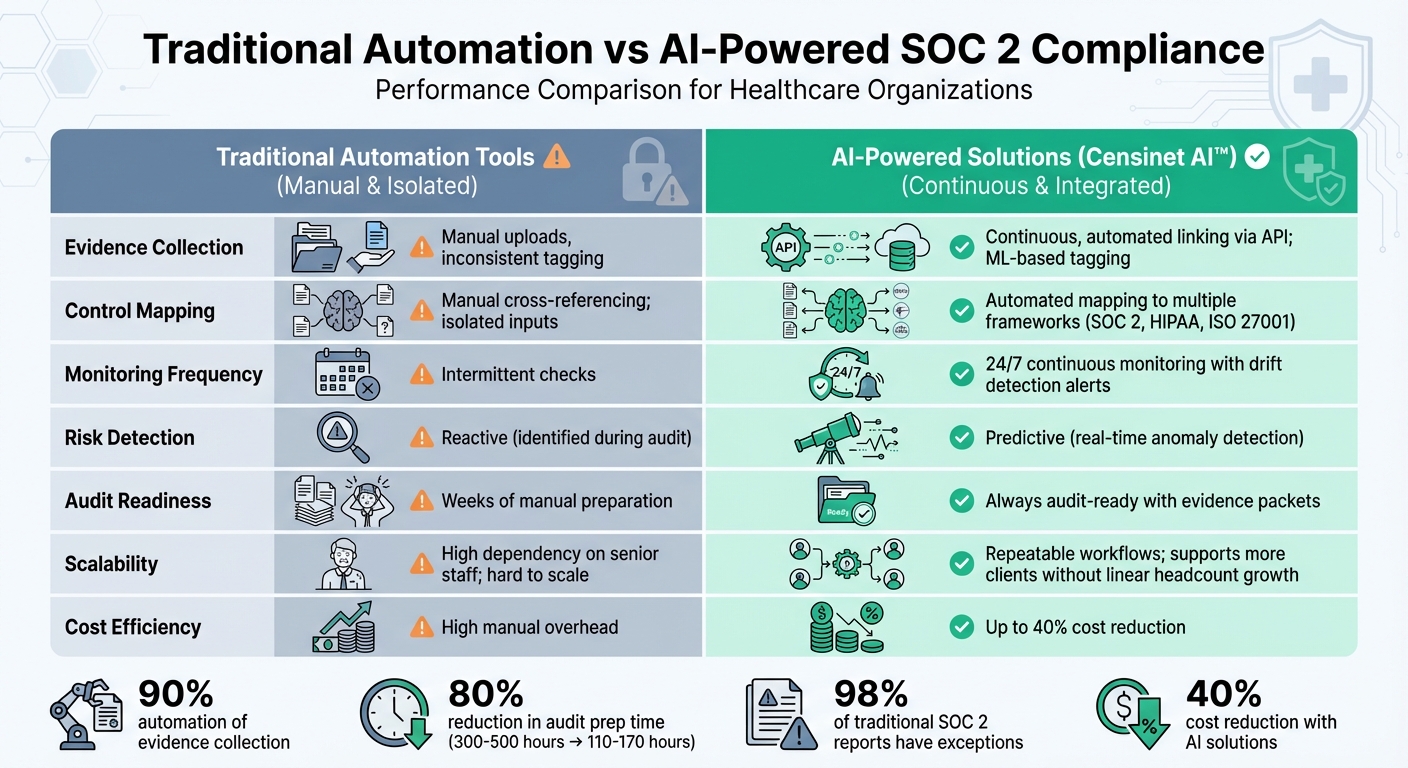
Traditional vs AI-Powered SOC 2 Compliance: Performance Comparison
When healthcare organizations assess SOC 2 compliance tools, it’s important to weigh the differences between traditional automation methods and AI-driven platforms like Censinet AITM. Traditional systems rely heavily on manual processes, such as tagging evidence and uploading it periodically, while AI-powered solutions like Censinet AITM automate evidence collection and organization on an ongoing basis.
For compliance teams using traditional tools, the workload can be substantial - manually capturing screenshots, cross-referencing spreadsheets, and assembling evidence packets. These systems typically function on a stop-and-go basis, leaving organizations scrambling to gather proof of compliance just weeks before an audit. On the other hand, AI-powered platforms like Censinet AITM integrate with cloud providers, identity systems, and HR platforms through APIs. This allows for continuous evidence collection and organization without manual effort, addressing the time crunch that often accompanies traditional audit cycles [6]. By automating these processes, AI-based solutions simplify workflows and tackle persistent compliance challenges.
Here’s a side-by-side look at how these approaches measure up across key performance areas:
Manual uploads, inconsistent tagging
Continuous, automated linking via API; ML-based tagging
Manual cross-referencing; isolated inputs
Automated mapping to multiple frameworks (SOC 2, HIPAA, ISO 27001)
Intermittent checks
24/7 continuous monitoring with drift detection alerts
Reactive (identified during audit)
Predictive (real-time anomaly detection)
Weeks of manual preparation
Always audit-ready with evidence packets
High dependency on senior staff; hard to scale
Repeatable workflows; supports more clients without linear headcount growth
High manual overhead
Up to 40% cost reduction
One of the standout benefits of AI-powered platforms is their ability to reduce subjective bias in compliance processes. Unlike human-led audits, which can sometimes be influenced by personal judgment, AI algorithms validate control data objectively and flag inconsistencies in real time [6].
That said, AI isn’t a replacement for professional expertise. As Amanda Waldmann from Fieldguide puts it:
"AI functions as an audit-grade assistant that enhances efficiency and consistency while auditors validate outputs using professional skepticism"
.
This highlights the importance of maintaining human oversight. Healthcare organizations must rely on professionals to apply contextual knowledge, validate AI-generated outputs, and make critical decisions, particularly when handling sensitive patient data or navigating complex regulations. By combining AI’s efficiency with human judgment, organizations can improve both operational effectiveness and cost management, creating a more robust compliance framework.
Conclusion
AI is transforming SOC 2 compliance from a periodic audit process into a system of continuous, automated monitoring. This shift directly tackles a pressing issue in the industry: a staggering 98% of SOC 2 Type 2 reports include exceptions that need to be addressed [1].
For healthcare organizations, SOC 2 compliance should no longer be seen as an annual task but rather as an ongoing operational priority. AI-powered platforms like Censinet AITM play a pivotal role by automating key tasks such as evidence gathering, control mapping, and real-time exception detection. This automation can free up around 8.5% of practitioners' time, allowing them to focus on higher-value activities.
To overcome the challenges of manual evidence collection, organizations should start with framework mapping to align controls with SOC 2 Trust Services Criteria and healthcare-specific standards like HITRUST. Following this, AI-driven gap assessments during off-peak periods can identify areas for improvement. Continuous monitoring and automated validation within a GRC platform can then proactively flag exceptions, reducing the need for last-minute fixes.
The economic advantages are hard to ignore. Automation has doubled audit capacity, slashed on-site travel by 75%, and cut compliance costs by up to 40%. With the SOC reporting market projected to hit $9.1 billion by 2033, the financial incentives for adopting AI-driven solutions are clear [1].
FAQs
How do AI tools keep SOC 2 evidence audit-ready all year?
AI tools keep SOC 2 evidence audit-ready throughout the year by automating key processes like collecting, validating, and continuously monitoring compliance evidence. These tools can instantly highlight issues, such as unencrypted data or disabled multi-factor authentication, helping teams address problems as they arise rather than scrambling at the last minute. By taking over repetitive tasks - like pulling access logs or validating controls - AI ensures evidence remains accurate and current, making the audit process smoother and more reliable.
Can one set of evidence meet SOC 2, HIPAA, and ISO 27001 at once?
Yes, one set of evidence can address requirements for SOC 2, HIPAA, and ISO 27001 all at the same time. Modern AI-driven compliance tools make this easier by identifying shared controls across these frameworks and organizing them within a single system. This not only simplifies the compliance process but also minimizes repetitive work, making it more efficient to meet multiple standards simultaneously.
What should we validate manually when using AI for SOC 2?
When applying AI to SOC 2 compliance, it's crucial to prioritize manual validation to confirm that governance controls are being actively enforced during runtime. Simply having policies in place isn't enough - ensure there’s clear evidence that these controls are functioning as AI handles transactions and interacts with sensitive data. This approach helps maintain both compliance and security throughout AI-driven operations.
