
AI helps healthcare teams score vendors faster and keep those scores up to date. That matters when 35% of healthcare breaches involved third parties, the average healthcare organization works with about 1,950 vendors, and ransomware drove about $21.9 billion in downtime costs between 2018 and 2024.
If I had to boil this down, here’s the answer:
- Static vendor reviews are too slow for healthcare risk today.
- AI scoring works best when it combines risk assessment questionnaires, security data, incident history, and business impact data.
- Rules and machine learning should work together, not compete.
- People still need to review high-impact vendor decisions, especially when PHI, EHR access, medical devices, or patient care are involved.
- Governance matters as much as the model, including validation, audit logs, bias checks, and clear override rules.
Put another way: AI can help me sort through a large vendor base, flag changes, and focus review time where it matters most. But I still need clean vendor data, clear scoring logic, and human review for high-risk cases.
A few numbers make the case clear:
- Third-party-related healthcare breaches grew from 74 in 2018 to 254 in 2023
- Only about 1,276 vendors are formally assessed out of roughly 1,950
- One health system saw manual assessments take more than 60 days
- Other systems cut review time from 5–6 weeks to less than 1 week or by 65% after adding AI support
| What changes | Static scoring | AI-supported scoring |
|---|---|---|
| Review timing | Once or twice a year | Continuous updates |
| Inputs | Mostly questionnaires | Questionnaires, documents, telemetry, incidents |
| Scale | Limited by staff time | Handles large vendor volumes |
| Main weakness | Scores get old fast | Needs controls, validation, and review |
| Best use | Baseline checks | Triage, ranking, and change detection |
So if I’m building or reviewing a healthcare vendor risk program, the goal is simple: use AI to sort and update risk, but keep people in charge of major decisions.
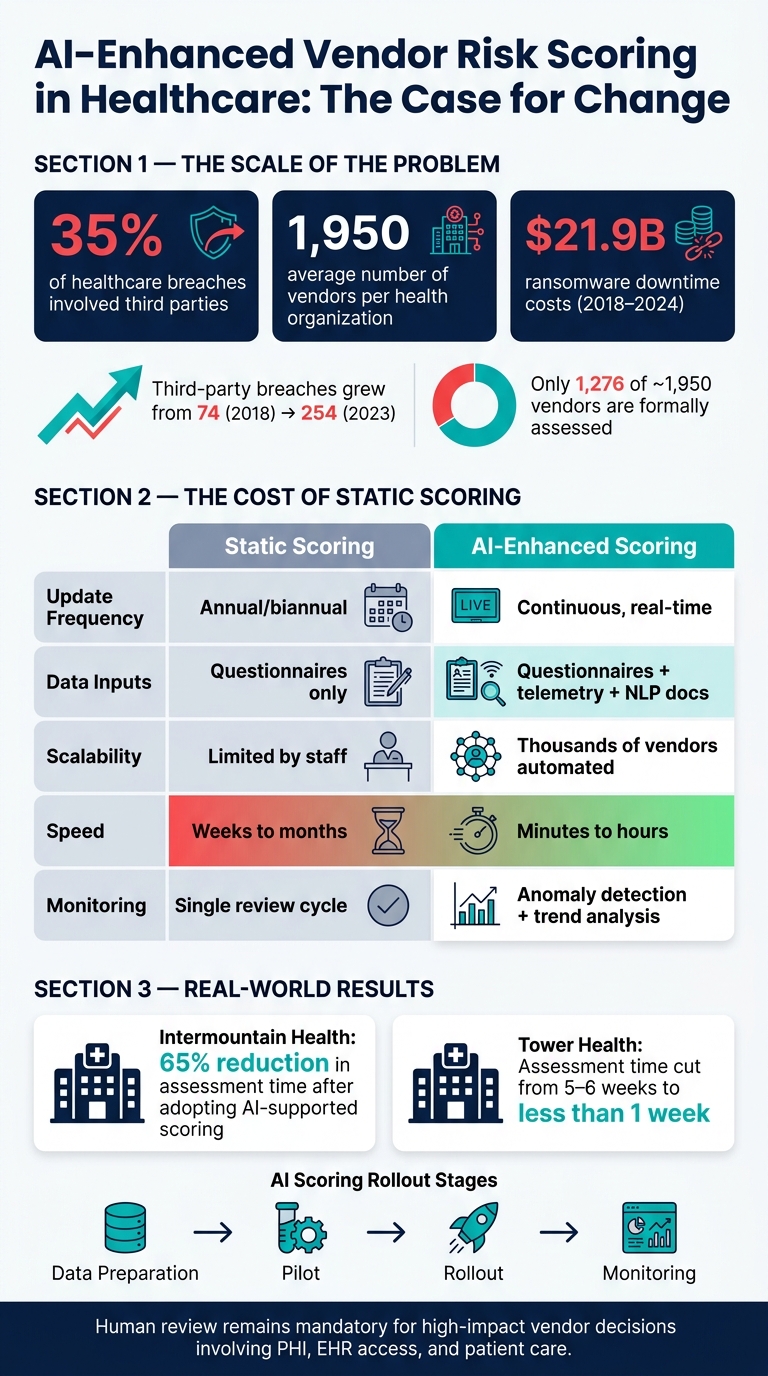
AI vs. Static Vendor Risk Scoring in Healthcare: Key Stats & Outcomes
Practical AI TPRM Masterclass: How to Evaluate Third-Party AI Systems
sbb-itb-535baee
Core components of AI-enhanced risk scoring models
AI scoring only works if the model has solid data, reads that data the same way every time, and gives teams a score they can actually use. That’s the difference between a score that looks good in a spreadsheet and one that reflects day-to-day operating risk.
Data sources that improve vendor risk visibility
Scoring quality starts with data quality. In healthcare, that means using a broad mix of structured and unstructured data, not just an annual questionnaire.
The first place to look is PHI access and clinical connectivity. Security questionnaires like HECVAT or HITRUST-aligned formats, SOC 2 Type II reports, control attestations, and certifications such as ISO 27001 and HITRUST CSF all help show how a vendor handles PHI, which controls it has in place, and what duties exist under a Business Associate Agreement (BAA), including breach notice and subcontractor use.
Documentation alone won’t tell the whole story. External attack surface data, like exposed services, misconfigured cloud buckets, and expired SSL certificates, gives teams a steady stream of technical signals about vendor posture. Add threat intelligence feeds and prior incident history, including OCR breach portal entries, and the model starts to reflect actual risk instead of just reported controls.
Integration details matter too. If a vendor has direct EHR access, VPN connectivity, API access, or device connectivity inside clinical networks, the damage from a breach can be much higher. Fourth-party dependencies and a vendor’s tie to patient care help show the full downstream effect.
One detail that often gets overlooked: use a master vendor ID across legal, procurement, IT, and security systems. If each team names the same vendor differently, the model ends up with broken, partial risk profiles.
Once that data is normalized, AI can score, classify, and flag changes at scale.
AI methods used to score and prioritize vendors
Most healthcare vendor scoring relies on three AI methods. Each one supports a different job: predict, extract, or flag.
Supervised learning models, such as gradient boosting machines or random forests, use historical data to predict incident likelihood or expected impact. Inputs can include questionnaire scores, exposure metrics, PHI volume, criticality scores, and remediation velocity. The result is usually a probability or risk category, like "high likelihood of a security incident in the next 12 months." That gives teams a clearer sense of which vendors need deeper review or compensating controls.
Natural language processing (NLP) deals with the document-heavy side of vendor risk. It can pull risk signals from long reports, policies, and BAAs. For example, NLP can identify whether a BAA limits subcontractor PHI access, whether an audit found weak logging across several review cycles, or whether a document mentions multi-factor authentication or data loss prevention as a control, exception, or limitation.
Anomaly detection focuses on change over time. A sudden jump in externally exposed services, an abrupt shift in remediation timelines, or unexpected new internet-facing endpoints can all point to a change in posture, even if the vendor’s last formal review looked clean. For high-impact vendors such as EHR platforms or imaging systems, this kind of continuous monitoring can catch trouble long before the next scheduled assessment.
These methods tend to outperform static scoring in speed, coverage, and how often the score can change.
Static scoring vs. AI-enhanced scoring: a comparison
The gap here is operational, not just technical. Annual scoring can miss changes in exposure, access, and incident history that happen between reviews.
| Feature | Static Scoring | AI-Enhanced Scoring |
|---|---|---|
| Update Frequency | Annual or biannual assessments | Continuous, real-time ingestion |
| Data Variety | Primarily self-reported questionnaires | Questionnaires + telemetry + NLP-parsed documents |
| Scalability | Low; limited by analyst headcount | High; automates processing across thousands of vendors |
| Speed | Weeks to months per assessment | Minutes to hours for initial scoring, with rapid updates |
| Explainability | High (rule-based, traceable) | Variable; requires transparent features and documented thresholds |
| Monitoring Depth | Single review cycle | Longitudinal trend and anomaly detection |
Explainability matters because regulated teams need to trace every flag back to a documented feature, threshold, or control. That’s why explainable AI elements, such as transparent feature importance, documented thresholds, and alignment with frameworks like NIST AI RMF, are now treated as a governance requirement, not just a model design choice.
How to design scoring models that fit healthcare risk
Once you've picked the data inputs and AI methods, the next job is turning them into healthcare-specific categories, weights, and thresholds.
Risk categories, weights, and thresholds
A good scoring model starts with categories that match the way healthcare runs day to day, not some generic cyber checklist. The categories that usually matter most are PHI protection, clinical application and medical device security, identity and access management, network and third-party connectivity, and resilience and business continuity.
Each category should be built from structured inputs, such as survey responses, attestations, incident records, and telemetry. That keeps scoring steady across vendors instead of turning each review into a judgment call.
Weights decide how much each category affects the final score. In practice, that means blending input from clinical, security, and compliance leaders with evidence from past incidents. One healthcare vendor tiering method assigns 25% to PHI access and volume, 25% to clinical criticality, 20% to connectivity and attack surface, 15% to regulatory exposure, 10% to financial and concentration risk, and 5% to change velocity.[1] Those weights should be written down and checked on a set schedule as incident patterns change.
Thresholds turn scores into action. A normalized 0–100 scale is one simple way to handle this, with bands like these:
- 0–30: low risk, standard contracting
- 31–60: medium risk, targeted remediation plan
- 61–80: high risk, mandatory security controls
- Above 80: critical risk, not approved without executive override
Each band should connect to a clear workflow. If a vendor crosses a line, teams shouldn't have to guess what comes next.
Training, validation, and false-positive control
The model is only as good as the features going into it. Useful inputs include the number of unresolved critical CVEs, average time to patch, whether MFA and network segmentation are in place, PHI volume handled, the count and severity of past incidents, and how much patient-critical work depends on that vendor.
Features tied to HIPAA safeguards, HITECH requirements, and FDA guidance for medical devices can improve the model's ability to surface vendors most likely to cause PHI exposure, clinical disruption, or device-related risk.
Labeled incident data is what makes a model predictive instead of just descriptive. In plain terms, that means records linking specific vendors to documented breaches, outages, or clinically relevant disruptions. Validation should use later incidents through time-based validation. Before deployment, clinical and security reviewers should also sample predictions to check that they line up with known incidents and disruptions.
False positives can wreck trust fast. If the model tags too many vendors as high risk, analysts start tuning it out. The fix is part technical, part operational: adjust decision thresholds with validation data, penalize missed high-risk vendors more than false alarms, and use tiered alerts so borderline cases get a light review instead of a full remediation cycle.
A few operating signals tell you whether the model is being taken seriously or ignored:
- Alert volume
- Time to review
- Analyst acceptance rates over time
Rule-based vs. machine learning scoring: a comparison
Use rules to enforce minimum controls. Use machine learning to rank vendors that already meet the baseline.
Rules are good for logic like "if PHI volume exceeds 500,000 records and the vendor lacks encryption at rest, assign high risk." That's stable, easy to explain, and doesn't need training data.
Machine learning helps when risk shows up as a mix of signals rather than one hard failure. For example, patching delays, rising external threat intelligence, and a recent minor incident may not trigger a rule on their own. Put together, though, they can point to higher future risk.
| Feature | Rule-Based Scoring | Machine Learning Scoring |
|---|---|---|
| Auditability | High; each flag traces to a documented rule | Moderate; requires feature documentation and threshold logging |
| Control Enforcement | Direct; rules block or escalate on specific control failures | Indirect; ML ranks residual risk after baseline controls are met |
| Maintenance Effort | High; rules need manual updates | Lower; adapts as new data arrives |
| Data Requirements | Specific, structured criteria | Large volumes of assessment and telemetry data |
Governance should then spell out who can override a score and how often the model is recalibrated.
Governance, compliance, and implementation in U.S. healthcare
Compliance and governance controls for AI-supported scoring
AI-supported scoring doesn't replace compliance work. It has to fit inside it.
In U.S. healthcare, that means tying your scoring program to the HIPAA Security Rule, NIST CSF, NIST SP 800-53, NIST HICP, and HSCC guidance on third-party and AI risk. Those frameworks set the bar for vendor oversight, control documentation, and risk analysis.[2][3][4][5]
HSCC guidance also says health systems should ask AI vendors for Model Cards. These give a short summary of intended use, limits, training data, and performance. If a vendor can't provide one, that's a warning sign. Inside your own program, teams should run bias reviews too, so the model doesn't keep over-penalizing smaller vendors or certain regions.[6]
This can't sit with one team. Security, compliance, legal, procurement, and clinical leaders all need clear roles. When you pair documentation, bias review, and audit logs, vendor scores are easier to defend under regulatory review. And that's the point: a score only matters if people trust it enough to use it.
| Governance Control | Objective | What It Covers |
|---|---|---|
| Model documentation | Transparency | Purpose, input sources, scoring logic, known limitations, retraining triggers |
| Approved use cases | Scope control | Defines where AI scoring applies and where human judgment is required |
| Bias and performance review | Reliability | Checks for systematic over- or under-scoring by vendor type, size, or region |
| Validation cadence | Accuracy over time | Quarterly review, annual validation, and post-change reassessment |
| Audit logging | Auditability | Timestamped records of AI decisions, score changes, and human overrides |
| Cross-functional oversight | Regulatory alignment | Security, compliance, legal, procurement, and clinical participation in model governance |
Governance by itself isn't enough. High-impact vendor decisions still need manual review.
Human-in-the-loop workflows for high-impact vendor decisions
AI should flag vendors and help rank them. It should not decide whether to end a contract or apply compensating controls to a system tied to direct patient care. For moves like that, human review is mandatory.
Escalation should kick in when a vendor supports direct care delivery, handles PHI, lacks recent evidence, shows conflicting questionnaire responses, or gets a score that could trigger a major remediation step. A qualified reviewer should check the evidence, document the decision, and record any exception.
AI can miss the messiness of day-to-day operations. That's why every high-impact decision needs a named owner, a review record, and an audit trail. When exception handling connects back to vendor tiering and remediation workflows, governance starts shaping action instead of just sitting on paper. It also helps teams handle edge cases the same way each time.
Implementation example: operationalizing AI with Censinet
Censinet RiskOps™ shows how healthcare-focused tooling can bring AI into third-party risk work without taking people out of the loop. Censinet AI™ speeds up vendor assessments by helping vendors complete security questionnaires in seconds, automatically summarizing evidence, capturing product integration details and fourth-party exposures, and generating risk reports.
Key findings and related tasks are sent to designated stakeholders, including members of an AI governance committee, for review and approval through centralized review routing. Risk teams keep control through configurable rules and review processes, so automation supports decision-making instead of taking it over. A centralized AI risk dashboard pulls together real-time data across all AI-related policies, risks, and tasks, which gives governance committees the visibility needed for continuous oversight.
A practical rollout usually moves through four stages, each with healthcare-specific checkpoints:
| Stage | Healthcare-Specific Checkpoints | Operational Focus |
|---|---|---|
| 1. Data preparation | Complete vendor inventory; tier by PHI access and clinical criticality; map to HIPAA and NIST requirements | Centralize vendor data and confirm BAA coverage |
| 2. Pilot | Test AI scoring on a defined vendor subset; validate outputs against manual assessments; review false-positive rates | Use AI to summarize evidence and generate initial risk profiles for review |
| 3. Rollout | Integrate AI scoring into procurement and contract renewal workflows; establish escalation triggers for clinical systems | Automate questionnaire completion; capture fourth-party exposures |
| 4. Monitoring | Conduct quarterly bias and model performance reviews; trigger reassessment after incidents or major vendor changes | Use real-time dashboards for benchmarking; maintain audit trails for all AI-driven decisions |
With governance in place, the next step is deciding what AI should improve and what should stay with human judgment.
Conclusion: What AI improves and what healthcare leaders still need to control
AI makes third-party risk scoring faster, broader, and more responsive. Intermountain Health cut assessment time by 65% after adopting Censinet RiskOps™.[8] Tower Health reduced assessments from 5–6 weeks to less than one week.[7] That kind of time savings comes from automating repetitive assessment work. But speed means little if the scores behind it don't hold up.
For scoring to be useful, the model needs complete, explainable data. That starts with complete vendor data, including fourth-party relationships, along with explainable scoring logic and governance controls that people use in practice. If the vendor inventory is incomplete or key dependencies are missing, the scores can point teams in the wrong direction. The same problem shows up when a model can't explain why a vendor was marked high risk. If risk teams and clinical leaders can't make sense of a score, they're not going to act on it.
For high-impact vendors, AI should help with triage, not make the final call. Vendors tied to core clinical workflows, medical devices, or large PHI volumes still need human review. People should validate the score, approve exceptions, and decide whether compensating controls make sense.
In the first year, the focus should be on operational progress, not just model output. In the first 6–12 months, track:
- Shorter assessment cycles
- Broader vendor coverage without adding staff
- Fewer unmanaged high-risk vendors
- A false-positive rate low enough that security teams trust the alerts
Governance maturity matters just as much. That includes documented policies, regular model validation, and escalation workflows that people follow when issues come up.
The organizations that get the most from AI-enhanced scoring use it as one part of a broader program, not as a substitute for one. The system handles volume and speed. Healthcare leaders still set risk tolerance, make the hard calls, and review the model over time.
FAQs
How accurate are AI vendor risk scores?
AI-driven vendor risk scores shouldn't be judged on accuracy alone. That can be misleading, especially when most vendors fall into the low-risk bucket.
A better way to judge performance is to look at precision, recall, and calibration. These metrics show whether the model is flagging high-risk vendors well, missing threats, or assigning probabilities that line up with what happens in practice.
AI can also stumble in gray areas or reflect bias in the data behind it. That's why human review still matters. People need to check the results, pressure-test the model's calls, and make the final risk decisions.
What data is needed to build a useful scoring model?
You need a complete vendor inventory and clear, consistent assessment criteria tied to measurable risk factors.
Start by collecting objective evidence. That includes cybersecurity controls, compliance documentation and certifications, incident or breach history, and the vendor’s operating context. In plain terms, you want to know things like:
- whether the vendor can access PHI
- how critical the vendor is to your business
- which data, apps, or connected systems the vendor touches
From there, score each factor the same way across every vendor. Then apply weights based on your organization’s priorities so you can calculate both inherent risk and residual risk ratings.
Think of it like building a scorecard. If one vendor handles sensitive patient data and connects to core systems, that vendor should carry more risk than one with limited access and no link to key operations. The point is to make the process consistent, measurable, and easy to defend when someone asks, “Why did this vendor get that rating?”
When should humans override an AI risk score?
Humans should override an AI risk score in high-stakes or high-risk situations. The same goes for exceptions, but only after checking the AI’s findings first.
That matters most when the case isn’t clean-cut - like when there are anomalies, gray areas in compliance rules, or moments that call for expert clinical or compliance judgment. In a human-in-the-loop model, AI helps move review and scoring along faster. But the risk team still makes the final call and can adjust decisions based on governance thresholds and oversight protocols.
