
If an AI vendor fails, your health system still carries the risk. In healthcare, that means patient harm, HIPAA trouble, breach notices, and high costs - including average breach costs of $9.8 million and the fact that 43% of healthcare breaches involved business associates by early 2026.
If I had to boil this down, I’d say healthcare groups need six minimum rules for AI vendors:
- Assign one owner for each AI use case
- Classify the tool by risk before approval
- Check vendor proof for security, privacy, model testing, and subprocessor use
- Put duties in the contract for incidents, model changes, audits, suspension, and PHI deletion
- Test the tool locally before it affects care
- Track performance, bias, access, and changes after go-live
A few points stand out fast:
- AI risk is not just about cyber events. It also includes bad outputs, bias, drift, and silent vendor changes
- A tool approved once is not approved forever
- High-risk tools need clinical sign-off, human review, and local validation
- If a vendor cannot explain its subprocessors or data use, I’d treat that as a stop point
- For equity checks, the article points to one case where fixing bias would have increased Black patients receiving added care from 17.7% to 46.5%
Here’s the simple takeaway: vendor promises are not enough; you need proof, records, review paths, and a clear shutoff plan.
| Area | What I’d require |
|---|---|
| Ownership | Named decision-maker plus IT, security, legal, compliance, and clinical review |
| Risk level | Low, moderate, high, or critical |
| Due diligence | Security docs, model testing, privacy terms, subprocessor list |
| Contract | BAA, audit rights, change notices, breach timing, suspension, exit terms |
| Before go-live | Local testing, workflow checks, override rules, access checks |
| After go-live | Metric review, bias checks, access logs, incident response, reassessment |
So if you’re buying or reviewing healthcare AI, I’d use this as a simple rule: own it, test it, document it, watch it, and be ready to stop it.
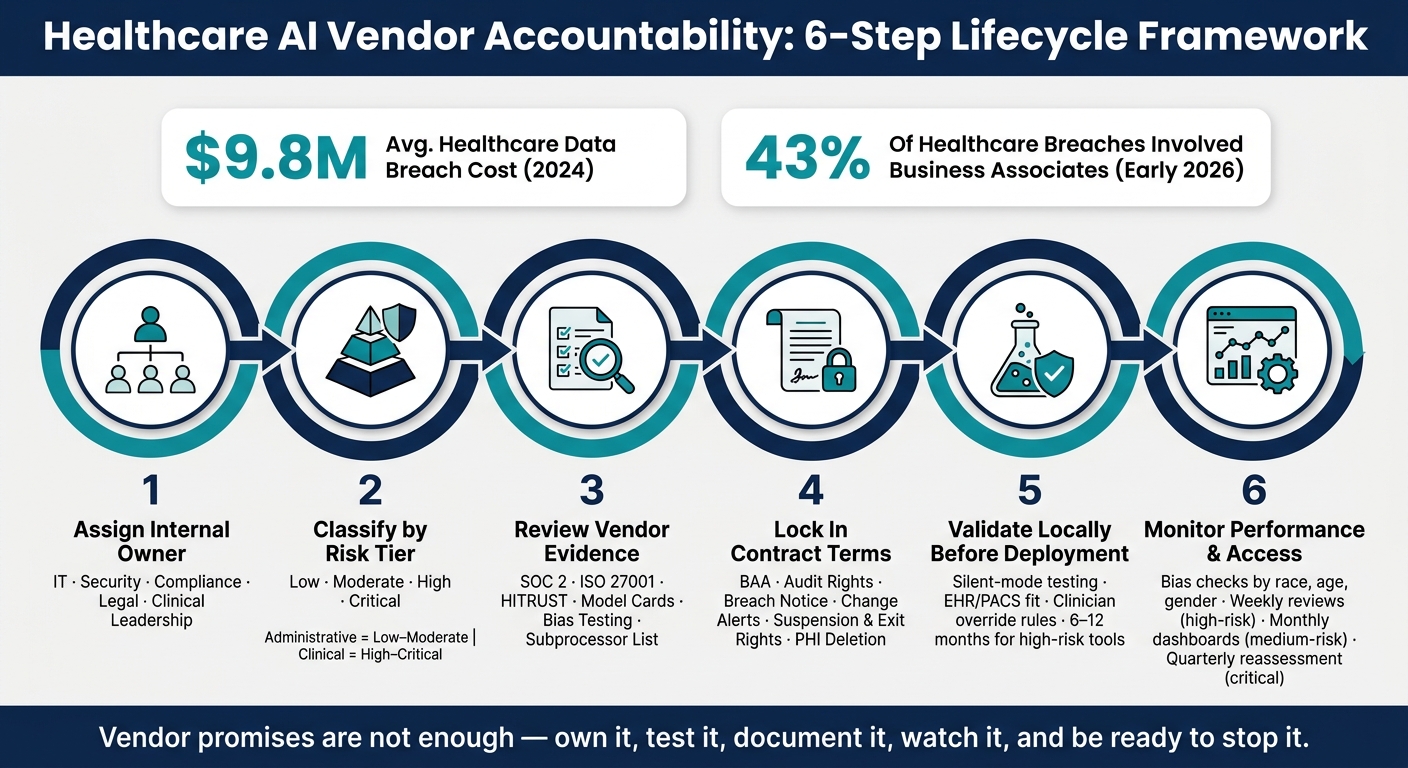
Healthcare AI Vendor Accountability: 6-Step Lifecycle Framework
Accountability in Practice Responsible AI Use in Healthcare
sbb-itb-535baee
Governance Ownership and Decision Rights
Before approval, name the accountable owner. If no one owns the decision and no one has clear authority, AI approval can drift into a procurement-led process. That sounds neat on paper, but it leaves holes in clinical, security, legal, and compliance review. Each approval needs a named owner, plus a record of who decided what. That starts with clear decision rights.
Assign Accountable Owners Across IT, Security, Compliance, Legal, and Clinical Operations
Every AI vendor approval should include sign-off from several functions:
- IT
- Security
- Compliance/privacy
- Legal
- Clinical leadership
Clinical leadership should review any use case that touches patient care. They should also have the authority to pause or override a deployment when clinical concerns come up. Put simply, ownership should match the risk of the AI use case.
An AI governance committee should sit above this group. Its job is to handle escalations and set policy for higher-risk use cases. For the highest-risk AI tools, especially those that directly affect diagnosis, triage, or treatment decisions, executive or board-level sign-off should be a formal requirement, not something teams can skip.
Once owners are in place, assign each use case to a risk tier.
Classify AI Use Cases by Risk and Intended Impact
Not all AI tools carry the same level of risk, so they shouldn't go through the same review path. A practical starting point is a four-tier classification: low, moderate, high, and critical. Tier placement should reflect clinical impact, autonomy, data sensitivity, and how easy or hard it is to reverse harm.[2]
Administrative tools like scheduling or billing automation usually land in the low-to-moderate range. Those tools still need standard security and privacy review. Clinical AI tools that affect diagnosis, treatment, triage, patient communication, or PHI exposure belong in the high-to-critical range. They need clinical leadership sign-off, explainability documentation, bias monitoring, and human-in-the-loop oversight.[3][4]
| AI Use Case Type | Examples | Risk Tier | Key Review Requirements |
|---|---|---|---|
| Administrative | Scheduling assistants, billing automation | Low–Moderate | Security review, privacy assessment |
| Clinical | Triage support, risk prediction, diagnostic AI | High–Critical | Clinical sign-off, explainability, bias monitoring, human oversight |
Use the tier to decide how deep the review should go and what evidence the team must provide.
Set Review Gates and Documentation Requirements
Require documentation before approval. Before any AI vendor moves to contract or deployment, the health system should require a defined documentation package as a condition of approval. Procurement should not move forward until the governance, security, compliance, and clinical reviews are done.
At a minimum, require a risk register, impact assessment, model card, and monitoring plan. Teams should also provide evidence of security, privacy, and model governance controls. These artifacts should serve as the approval package for due diligence, contracting, and monitoring.
Vendor Due Diligence and Contract Controls
Once governance signs off, the next step is simple in theory and hard in practice: check the vendor’s proof and turn what you find into contract language. Don’t take promises at face value. Use the approved risk tier to decide how far the review should go.
Review Vendor Evidence for Security, Privacy, Model Governance, and Fourth-Party Risk
A structured evidence review should cover four domains: technical validation, regulatory and compliance posture, security controls, and corporate and legal posture.[9] Higher-risk vendors need a deeper review. Lower-risk vendors can go through a lighter screen.[8]
Ask for SOC 2, ISO 27001 or HITRUST, penetration test results, and vulnerability reports.[12] For the model itself, request model cards, bias testing summaries, performance validation studies, and details on training-data composition and demographic mix.[8][11] If the vendor handles PHI, verify where the data lives, whether the vendor uses it to retrain the model, how long it keeps the data, and how deletion works when the contract ends.[10][15]
Fourth-party risk often slips through the cracks. A vendor may rely on cloud hosting providers, data labeling services, and analytics partners that touch PHI or model inputs without showing up in a basic vendor review. Require a full subprocessor list and confirm that the same security duties flow downstream.[7][8] If a vendor can’t map its subprocessors, stop the review.
Require Contract Terms That Assign Responsibility for AI Performance and Risk
Evidence review shows what the vendor is doing now. The contract is where you lock those expectations in. It should spell out data use limits, breach notice timing, audit rights, advance notice of material model changes, retention and deletion terms, service levels, indemnification, and suspension rights.[5][6][8]
A Business Associate Agreement (BAA) is required for any vendor that handles electronic PHI, and it should clearly define security safeguards, breach notification responsibilities, and subcontractor oversight obligations.[15][13] Beyond the BAA, the main contract should state whether the vendor can use customer data for model training, how fast it must report a security incident or a material model update, and what happens if the AI produces inaccurate or biased outputs that create a compliance problem.
Suspension and exit rights need close attention. Healthcare organizations need a clear way out if an AI tool becomes unsafe or noncompliant. The agreement should allow immediate suspension when a safety or compliance issue comes up. It should also define what happens to PHI, logs, backups, and model artifacts after termination, including verified deletion.[8]
Platforms like Censinet RiskOps™ support this process by helping healthcare organizations run structured third-party AI risk assessments, capture and summarize vendor evidence, and route findings to the right governance stakeholders - including AI governance committee members - for review and approval before contracts move forward.
Contract Controls vs. Operational Controls: Key Differences
Contracts set obligations. Operations make sure those obligations are carried out. They’re connected, but they’re not the same thing. Mix them up, and gaps appear fast.
For example, a contract may require advance notice of a material model update. That does not approve the update by itself. The operational control is the internal review workflow that decides whether the update is safe to accept. In short, contract terms define obligations; operational controls enforce them.
| Control Area | Contract Controls | Operational Controls |
|---|---|---|
| Change management | Notice periods for material model updates | Internal review and approval workflow for updates |
| Auditability | Audit rights | Periodic review |
| Security incidents | Breach notification windows | Incident triage, containment, and escalation |
| Performance | Service level commitments | Local testing and monitoring |
| Data handling | Data use, retention, and deletion terms | Access reviews, logging, and PHI monitoring |
After contracting, validate the vendor's performance in your own environment.
Validation Before Go-Live and Ongoing Monitoring
After contracting, validation and monitoring turn paper controls into day-to-day accountability. Once the contract is signed, the next question is simple: does the AI work safely in your own setting?
Validate AI in Your Local Healthcare Environment Before Deployment
Vendor performance data usually comes from controlled settings. That may not match your patients, your staff, or your workflows. Local validation is how you find that out before patient care is affected [18].
Pre-deployment validation should confirm the intended use case, the patient population, and workflow fit. That includes how the tool works inside your EHR, PACS, or clinical decision support workflow, and how it handles latency, errors, and alert routing. Clinical leaders, especially service line chiefs, the CMIO, the CNIO, and quality leaders, should set clear thresholds for acceptable false positive and false negative rates based on clinical risk and workflow burden. Those thresholds should be documented in governance minutes and in a formal validation report.
A good place to start is silent-mode testing on prospective local data. For high-risk tools, full workflow integration may need 6–12 months of local validation [18].
Before go-live, take a few guardrail steps:
- Label AI outputs
- Require documented clinician overrides
- Block autonomous ordering or diagnosis in high-risk tools
- Validate role-based access controls so only the right staff can see outputs, and sensitive predictions stay limited to roles with a legitimate need [18]
Only after local validation should the tool move into live monitoring.
Monitor Performance, Drift, Access, and Model Changes After Go-Live
After go-live, the job shifts from approval to surveillance. Model performance does not stay fixed. Patient populations change, coding practices shift, EHR upgrades alter data inputs, and vendors may retrain models without enough notice.
The core monitoring framework should track output quality trends, including sensitivity, specificity, and PPV recalculated on recent cases. It should also track override rates and reason codes, user complaints and help-desk tickets tied to the AI tool, daily access-log checks for unusual logins, odd access times, or unexpected locations, and PHI handling behavior.
Set a monitoring cadence that matches risk. Monthly dashboards make sense for medium-risk tools. High-risk tools should get weekly reviews. Results should go to a multidisciplinary committee.
For high-risk tools, performance should also be tracked by race, age, gender, language, insurance, and site of care. One widely cited example shows why this matters: a risk-prediction algorithm used across U.S. health systems showed significant racial bias, and fixing that bias would have increased the share of Black patients receiving additional care from 17.7% to 46.5% [1][16][17]. Monitoring for equity is part of patient safety.
Treat any algorithm, data, feature, or threshold change as a material change and review it before use. Define triggers for metric breaches, safety events, security incidents, and unapproved changes. Responses may range from parameter adjustments to partial or full suspension.
High-risk tools should be refreshed at least twice a year, with the highest-risk reviewed quarterly. Each refresh should pull updated security reports, bias testing, incident logs, and retraining records [18].
Use Centralized Workflows to Scale AI Vendor Oversight
As the number of tools grows, centralized third-party vendor risk management helps prevent gaps between teams. Censinet RiskOps™ centralizes AI vendor assessments, evidence, benchmarking, and stakeholder routing for HDOs managing multiple AI vendors [14].
Incident Response, Suspension Rights, and Conclusion
Plan for Incidents, Containment, Suspension, and Exit
When monitoring flags a breach, model drift, or unsafe output, move at once from watching to acting. In healthcare, third-party incidents are a major source of risk: 43% of all healthcare breaches involved business associates by early 2026 [25], and the average healthcare data breach cost hit $9.8 million in 2024 [23]. In plain terms, every minute counts.
If an incident is suspected, use a simple response path: trigger, classify, contain, escalate, and document. Start with severity. Then tighten human review and check for drift before suspending the tool - unless patient harm or another critical risk is already clear [27]. Your contract should back this up. It needs to support immediate containment, escalation, and documentation as soon as an incident is suspected. And if suspension becomes necessary, you need an explicit right to suspend access.
Manual fallback can't be an afterthought. Every AI-assisted clinical step should have a matching manual process. Teams should document how to turn off or bypass AI recommendations inside the EHR or PACS, and they should confirm that clinicians can still see the full patient record without AI help. If an AI system may have played a role in a patient harm event, capture AI metadata right away so the organization can reconstruct what the system did at that moment and support accountability [29]. On exit, revoke access, export needed records, and verify deletion of PHI, logs, backups, and model artifacts. If the AI tool qualifies as a regulated device, match your reporting process to FDA postmarket surveillance expectations [26][28]. These steps should sit inside the same governance workflow used for approval, monitoring, and reassessment.
How to Apply This Guide in Procurement and Oversight
Use this guide as a lifecycle checklist.
- Intake: Classify the AI use case by clinical risk and assign a named owner across IT, security, compliance, legal, and clinical operations.
- Due diligence: Collect vendor evidence on model governance, security controls, and fourth-party risk.
- Contracting: Add clauses for performance metrics, transparency, incident reporting timelines, audit rights, change notices, suspension and exit rights, and PHI return or deletion duties [19][20][21][22][23][24].
- Validation: Run local validation before go-live and document the results in governance records.
- Monitoring and reassessment: Set a review cadence based on risk level. Repeat the evidence review and update the risk rating during the annual reassessment or whenever a material change occurs.
Censinet RiskOps™ supports this lifecycle by bringing assessments, evidence, stakeholder routing, and AI risk dashboards into one place across all AI vendors in your portfolio. Used this way, the guide becomes an operating standard instead of a document that just sits on a shelf.
Conclusion: The Minimum Accountability Standard for Healthcare AI Vendors
The minimum accountability standard for healthcare AI vendors comes down to six requirements: assign internal ownership, do evidence-based due diligence before contracting, put accountability terms into the contract, validate the tool locally before it touches patients, monitor performance and access after go-live, and keep clear suspension and exit rights with PHI return duties. Every one of these steps is required.
FAQs
How do we decide an AI tool’s risk tier?
Assess three factors: patient harm, data sensitivity, and clinical impact. Many teams score them on a 1–5 matrix, often alongside operational criticality.
Then use a four-tier model to place the tool by function, from non-clinical tools with no PHI up to autonomous or semi-autonomous clinical tools. The risk tier goes up when the tool affects clinical decisions, handles large amounts of PHI, relies on external models, takes autonomous actions, or falls under FDA oversight.
What proof should we require from an AI vendor?
Require audit-ready proof, not taglines or broad security promises.
Ask for an AI Bill of Materials that spells out:
- model dependencies
- training data sources
- subcontractors
- open-source assets
You should also request Model Cards or Fact Sheets that explain intended use, limits, update history, and performance across patient demographics.
On the compliance side, require a signed BAA that covers AI inputs, outputs, and logs. Ask for HIPAA, SOC 2, or HITRUST documentation as well.
Then go a step further. Request proof of testing for:
- bias
- data poisoning
- adversarial attacks
- model evasion
And make sure the contract includes terms for audit rights, update notices, and AI-specific incident response.
That’s the kind of paper trail that lets you check what a vendor says against what they can actually show.
What should trigger suspension of a healthcare AI tool?
A healthcare AI tool should be suspended when monitoring shows clinical harm, major safety risks, or critical security incidents.
A pause also makes sense when there’s persistent performance drift, bias, harmful outputs that can’t be fixed fast, vendor failure to meet performance metrics, use outside approved cases, or unresolved compliance failures.
Clear escalation paths and governance protocols should guide both the pause and the safe restoration.
