
ISO 27001 risk assessments often fail when they don’t align with the core goals of healthcare organizations. This misalignment can lead to wasted resources, overlooked threats, and compliance gaps. For healthcare providers, protecting patient data and ensuring uninterrupted care are top priorities, but treating ISO 27001 as a simple compliance checklist undermines these objectives.
Here’s the key takeaway: Effective risk assessments require clear objectives tied to real-world needs like measuring patient safety and operational stability. Use Clause 6.2 to set measurable goals, involve stakeholders across departments, and replace manual tracking with automated tools like Censinet RiskOps™. This approach ensures resources are focused on the most critical risks, improving security and compliance outcomes.
Key Points:
- Common Issues: Misaligned risk priorities, wasted budgets, and compliance failures.
- Clause 6.1 & 6.2: Use these to connect risk assessments to business goals.
- Automation Advantage: Tools like Censinet RiskOps™ streamline tracking and audits.
- Action Steps: Define SMART objectives, automate processes, and conduct regular reviews.
Aligning risk management with organizational goals transforms ISO 27001 from a checkbox exercise into a meaningful tool for protecting patients and ensuring resilience.
ISO 27001 Clause 6.1.2 Risk Assessment Explained
sbb-itb-535baee
Why Risk Outcomes and Objectives Don't Match
The gap between risk assessment results and strategic goals isn't just a coincidence. It often happens because organizations use ISO 27001 primarily as a compliance tool. When healthcare organizations treat risk assessments as mere checklists, the entire Information Security Management System (ISMS) ends up offering little practical value. This issue becomes particularly noticeable in how Clause 6.1 is applied.
Clause 6.1: When Risk Assessments Ignore Business Goals
Clause 6.1 asks organizations to identify and evaluate risks by considering their likelihood and impact. However, this process often misses the mark when it doesn't tie back to the organization's specific business needs. For example, focusing solely on protecting Protected Health Information (PHI) can leave critical assets like research data and partner APIs overlooked.
The situation worsens when organizations fail to define risk criteria tailored to healthcare. Without clear benchmarks for areas like clinical systems, Electronic Health Records (EHR), and medical device safety, risk assessments often produce subjective results that don't align with operational priorities. For instance, a risk assessment might focus on securing administrative file servers while ignoring medical device security risks that could directly affect patient care. This disconnect leads to a Statement of Applicability that doesn't reflect the organization's real threat landscape, making security controls ineffective where they are needed most.
Wasted Resources and Overlooked Threats
These missteps not only distort risk priorities but also waste valuable resources. Manual risk tracking often leads to "spreadsheet chaos", where current risks are obscured by scattered and disorganized data. Compliance teams can spend countless hours hunting for evidence across fragmented systems.
The financial consequences can be severe. In 2022, Interserve faced a fine of about $5.5 million (approximately £4.4 million) due to significant gaps in their risk management processes that manual spreadsheets failed to address [1]. When budgets are spent on ineffective security tools or controls that don't align with real risks, healthcare organizations face a double-edged problem: wasted funds on low-priority issues and critical vulnerabilities left unaddressed. Without aligning risk outcomes with business objectives, leadership and external partners may begin to question the relevance of the security program. This erosion of trust makes it difficult to measure performance or achieve meaningful improvements. Fixing these misalignments is crucial for connecting risk outcomes to strategic goals.
How to Align ISO 27001 Risk Outcomes with Your Goals
Connecting risk assessments to your strategic priorities takes thoughtful planning. ISO 27001 can be more than just a compliance framework - it can become a tool that supports your organization's mission. The first step? Define clear security objectives that guide every risk-related decision.
Create SMART Objectives Under Clause 6.2
Clause 6.2 acts as the link between your ISMS and your broader business strategy. For healthcare organizations, this means setting objectives that are Specific, Measurable, Achievable, Relevant, and Time-bound. Vague goals won’t cut it. Instead, focus on measurable targets like "reduce phishing incidents by 20% within 12 months" or "achieve 100% encryption of patient data at rest across all clinical systems by Q3 2026."
These objectives need to be monitored for effectiveness and should reflect risks identified during your Clause 6.1 assessment. At the same time, they should align with business priorities like patient safety, regulatory compliance, and operational stability. Achieving this alignment requires input from various stakeholders - not just IT and security teams, but also HR, legal, operations, and clinical leadership. When security goals are treated as isolated "IT tasks", they often fail to address what truly matters to the organization.
Well-defined objectives also simplify the certification process. They provide evidence of compliance for audits, showing auditors your intent and progress against measurable targets. This not only streamlines certification but also proves that your ISMS delivers value beyond just meeting regulatory requirements. Clear goals also pave the way for automation and real-time monitoring, making ongoing alignment more practical.
Using Censinet RiskOps™ to Connect Risk and Strategy
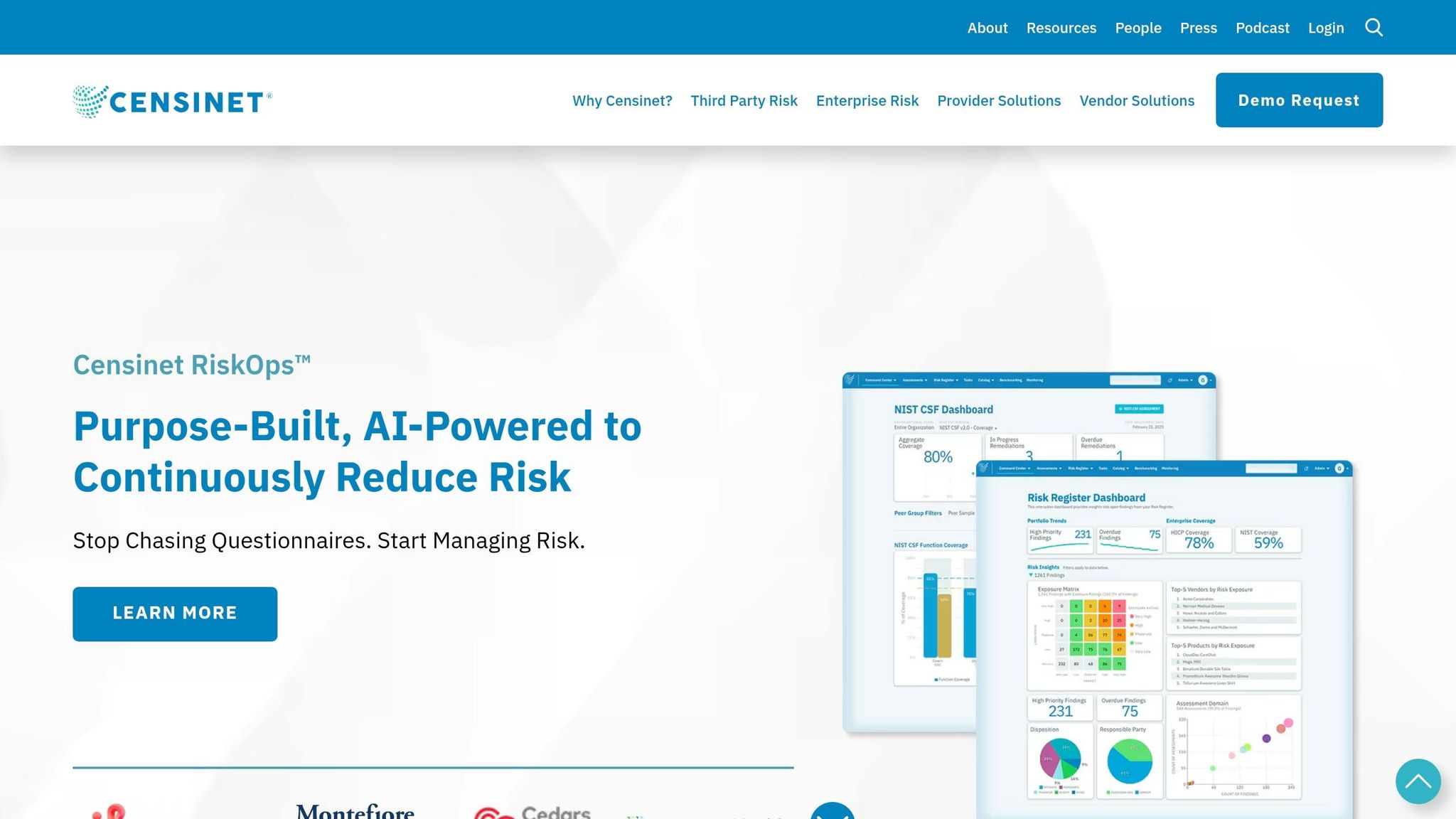
Relying on static spreadsheets for tracking risks is inefficient and outdated. Censinet RiskOps™ solves this by automating the connection between risk assessments and strategic goals. Through visual dashboards and real-time data aggregation, the platform helps healthcare organizations monitor risks tied to patient data, PHI, clinical applications, medical devices, and supply chains - all in one centralized system.
With automated workflows, the platform reduces the time spent gathering evidence. Instead of juggling fragmented systems and manually updating risk registers, RiskOps™ offers a unified view that links identified risks to your documented objectives. This visibility allows leadership to allocate resources effectively, focusing on vulnerabilities that could most impact patient care and organizational goals. The platform’s risk visualization tools also make it easier to demonstrate alignment during management reviews and audits. By combining aligned objectives with automated insights, staying on track becomes far more manageable.
Monitor and Update Risk Management Continuously
Maintaining alignment between risk outcomes and strategic goals isn’t a one-time task - it requires ongoing monitoring and updates. ISO 27001 Clause 9.3 mandates formal management reviews to ensure your ISMS remains effective as threats and regulations evolve. These reviews should assess whether your objectives still align with current priorities and whether your risk treatments are delivering the desired results.
Regular updates to your risk register help your organization stay responsive to new challenges. As healthcare models shift with digital initiatives, new medical devices, or telehealth expansion, your security objectives must evolve too. This cycle of assessment, objective-setting, and review ensures your risk management program consistently addresses what your organization needs most to protect.
Manual vs. Automated Risk Alignment Methods
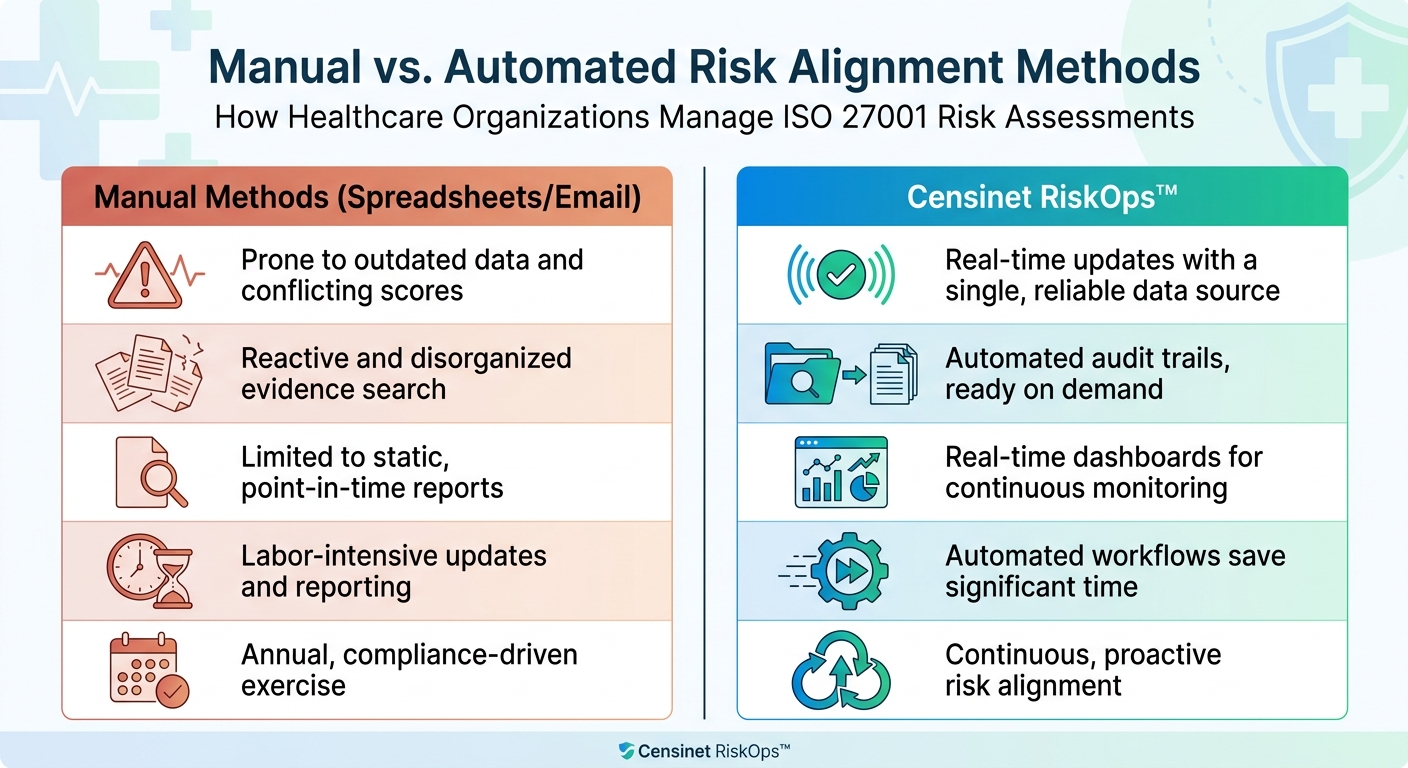
Manual vs Automated Risk Management: Feature Comparison for Healthcare ISO 27001 Compliance
Healthcare organizations often start their risk management journey with manual tools like spreadsheets and email threads. While this approach may seem manageable initially, it quickly becomes a logistical headache. Version control issues pop up, risk scores conflict, and synchronization across teams becomes inconsistent. With multiple departments involved, it's easy for everyone to end up working off different versions of the same document, leading to blind spots in third-party vendor risk management. When audit season rolls around, teams scramble to piece together evidence scattered across email threads, local drives, and even paper files.
Automated platforms, such as Censinet RiskOps™, tackle these challenges head-on. These tools centralize risk data into a single, reliable source of truth. Real-time dashboards provide up-to-date insights into risk levels, control effectiveness, and remediation needs. Version control issues? Gone. Evidence collection? Automated, with audit trails readily available. This turns the once chaotic audit preparation process into a streamlined, stress-free routine.
Comparison: Manual Methods vs. Censinet RiskOps™
Here’s a side-by-side look at how manual methods stack up against Censinet RiskOps™:
| Feature | Manual Methods (Spreadsheets/Email) | Censinet RiskOps™ |
|---|---|---|
| Data Accuracy | Prone to outdated data and conflicting scores | Real-time updates with a single, reliable data source |
| Audit Preparation | Reactive and disorganized evidence search | Automated audit trails, ready on demand |
| Visibility | Limited to static, point-in-time reports | Real-time dashboards for continuous monitoring |
| Time Investment | Labor-intensive updates and reporting | Automated workflows save significant time |
| Risk Management Cycle | Annual, compliance-driven exercise | Continuous, proactive risk alignment |
Switching from manual to automated risk management doesn’t just make life easier - it transforms the entire approach. Instead of treating risk management as a once-a-year compliance checklist, organizations can make it an ongoing, strategic process. With automated platforms, healthcare providers can react swiftly to new threats, allocate resources more effectively, and align their risk strategies with broader organizational goals.
Conclusion: Better Results Through Aligned Risk Management
When healthcare organizations approach ISO 27001 risk assessments as more than just a compliance checkbox, they turn security into a strategic advantage. This approach directly supports patient safety, regulatory compliance, and smoother operations. By aligning risk management outcomes with business priorities, resources are directed toward addressing the threats that truly impact the organization's mission, rather than wasting effort on generic issues that don't make a difference.
Switching from manual spreadsheets to automated platforms like Censinet RiskOps™ ensures this alignment is sustainable. With real-time risk visibility, organizations can quickly adapt to shifting priorities, rather than waiting for annual audits to reveal vulnerabilities.
These changes highlight the importance of clear, actionable steps to maintain progress.
What Healthcare Leaders Should Remember
Aligning risk management with strategic goals delivers measurable benefits. Here are three essential steps to keep the momentum going:
- Set SMART objectives: Under ISO 27001 Clause 6.2, establish specific, measurable, achievable, relevant, and time-bound goals tied to healthcare priorities like safeguarding patient data and ensuring uninterrupted care. This makes it easier to track and demonstrate progress.
- Leverage automated tools: Move away from manual tracking methods. Automation isn't just about saving time - it's about eliminating version control issues, creating audit-ready documentation, and freeing up security teams to focus on high-value tasks instead of administrative work.
- Commit to continuous risk reviews: Regularly revisit risk assessments to ensure they stay aligned with evolving organizational goals. This keeps risk management efforts focused on what matters most.
When healthcare organizations get this alignment right, they see real improvements: fewer audit findings, quicker response times to incidents, and smarter resource allocation. Treat risk management as an ongoing strategy that drives business success.
FAQs
How do we pick risk criteria that match patient care priorities?
Healthcare organizations should center their risk assessments around critical assets like patient data and medical devices to align risk criteria with patient care priorities. By evaluating risks based on their likelihood and their potential impact on patient safety, organizations can ensure their mitigation efforts are both effective and aligned with their overarching goals. This strategy not only safeguards patient safety and data integrity but also supports broader organizational objectives.
What ISO 27001 objectives should we set under Clause 6.2?
Clause 6.2 of ISO 27001 emphasizes the importance of setting specific, measurable, and relevant information security objectives that align with an organization’s strategic goals. In the healthcare sector, these objectives often focus on three key areas:
- Protecting patient data: Safeguarding sensitive information from unauthorized access or breaches.
- Ensuring regulatory compliance: Meeting standards like HIPAA to avoid penalties and maintain trust.
- Maintaining clinical system integrity: Ensuring systems remain functional and secure to support patient care.
Examples of such objectives might include reducing the number of data breaches, achieving compliance within a defined timeframe, or improving incident response times. These goals should reflect the organization’s unique risks and priorities, ensuring they address the most critical challenges effectively.
How can Censinet RiskOps™ reduce ISO 27001 audit work?
Censinet RiskOps™ streamlines the ISO 27001 audit process by automating risk assessments, simplifying how you track compliance, and providing real-time dashboards. With these tools, you can cut down on manual documentation and enable continuous monitoring, making audits faster and far less tedious.
