
Most U.S. healthcare groups have AI committees, but only 12% use a formal risk framework. That gap matters when AI touches diagnosis, coverage decisions, patient data, and legal risk.
If I had to sum up this topic in one line, it would be this: healthcare teams need one clear process for reviewing, approving, and checking AI tools before and after use. The main frameworks in this article each do a different job:
- NIST AI RMF helps me set governance, inventory tools, test bias, and track issues
- WHO guidance helps me ask whether an AI use case should be used at all, especially when equity, safety, and transparency are at stake
- ISO/IEC 23894 gives me a step-by-step risk process for review, treatment, and monitoring
- AMA, Joint Commission, and WHO guidance for large multimodal models help me apply those ideas inside hospitals, clinical workflows, and generative AI use cases
The article also points to the main risk areas healthcare teams cannot ignore:
- Clinical bias that changes care by race, ethnicity, age, sex, disability, language, payer status, or geography
- Privacy risk when PHI is used for model training without the right agreements
- Documentation gaps that leave clinicians unsure whether a model fits the patient in front of them
- Legal exposure when algorithm errors lead to harm
- Shadow AI when staff use unapproved tools outside formal review
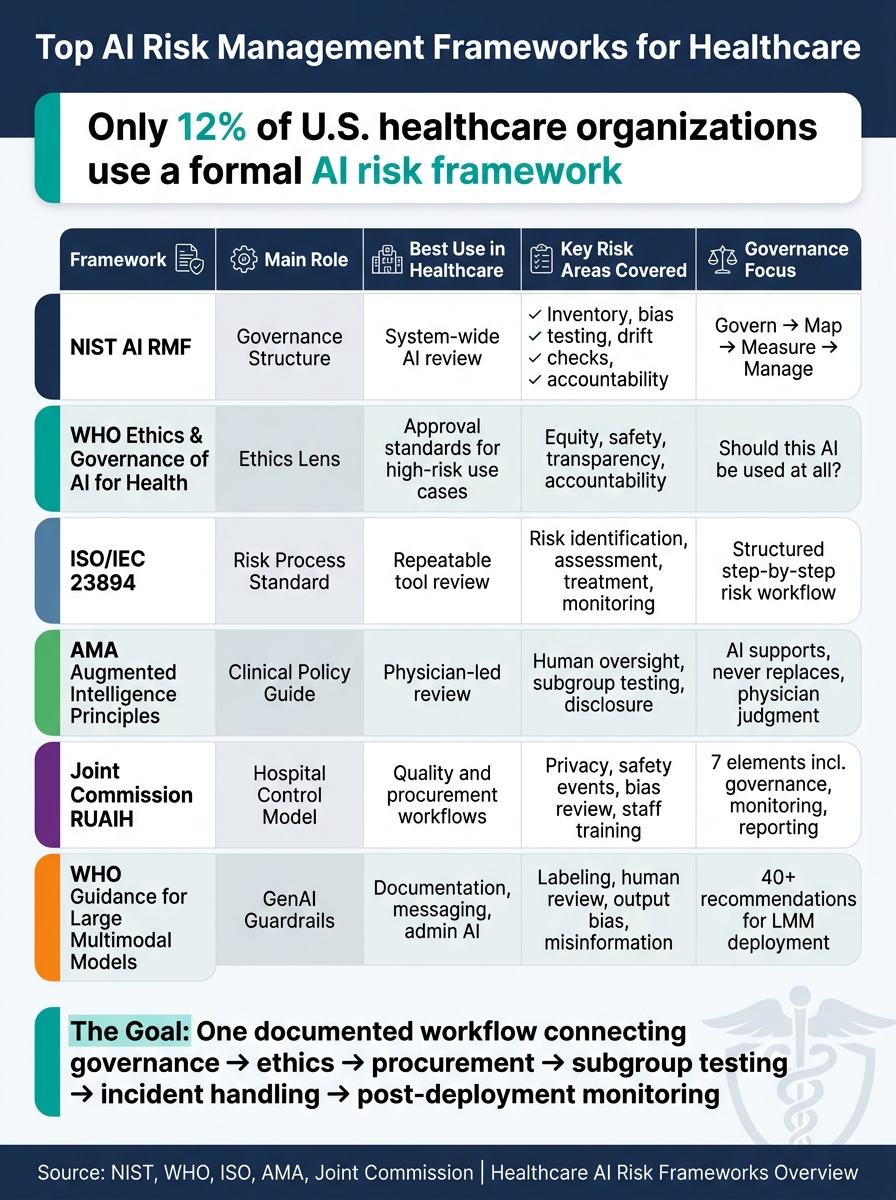
Top AI Risk Management Frameworks for Healthcare: Side-by-Side Comparison
From Deployment to Oversight: Strengthening AI Risk Management and Patient Safety in Health Care
sbb-itb-535baee
Quick Comparison
| Framework | Main Role | Best Use in Healthcare | What It Helps Me Check |
|---|---|---|---|
| NIST AI RMF | Governance structure | System-wide AI review | Inventory, bias testing, drift checks, accountability |
| WHO Ethics and Governance of AI for Health | Ethics lens | Approval standards for high-risk use cases | Equity, safety, transparency, accountability |
| ISO/IEC 23894 | Risk process | Repeatable tool review | Risk identification, assessment, treatment, monitoring |
| AMA augmented intelligence | Clinical policy guide | Physician-led review | Human oversight, subgroup testing, disclosure |
| Joint Commission RUAIH | Hospital control model | Quality and procurement workflows | Privacy, safety events, bias review, staff training |
| WHO guidance for large multimodal models | GenAI guardrails | Documentation, messaging, admin AI | Labeling, human review, output bias, misinformation |
Bottom line: if you work in U.S. healthcare, you do not need more policy papers. You need one documented workflow that connects governance, ethics, procurement, subgroup testing, incident handling, and post-deployment checks.
That’s the lens I’d use to read the rest of the article.
1. NIST AI Risk Management Framework
NIST AI RMF gives healthcare organizations a practical way to reduce bias, document decisions, and show that controls are in place. In a hospital or health tech setting, governance can't be vague. It needs documented decisions, clear owners, and evidence that stands up to review. That's why NIST often becomes the main framework for hospitals and vendors trying to manage fairness risk across many tools and teams.
The framework centers on four core functions: Govern, Map, Measure, and Manage.
How NIST AI RMF addresses fairness and bias
The Measure function is where fairness and bias controls get tested. It calls for algorithmic bias assessments, equity impact analyses, and asks teams to review fairness, accountability, validity, equity, and safety [1]. That matters because top-line accuracy can look fine while certain groups get worse results.
So hospitals and vendors need to test performance across subgroup lines, including race, ethnicity, age, sex, disability, language, payer status, and geography.
How hospitals and vendors can apply NIST AI RMF
| NIST Function | Healthcare Fairness & Governance Tasks |
|---|---|
| Govern | Establish AI governance committees; define accountability; create AI charters and approval workflows |
| Map | Build a complete AI inventory; identify shadow AI; document intended use; map tools to FDA, ONC, and CMS requirements; conduct gap analyses |
| Measure | Run algorithmic bias assessments; perform clinical validation across demographic subgroups; conduct equity impact analyses; audit validity and safety |
| Manage | Implement post-market drift monitoring; maintain incident response playbooks; update AI vendor BAAs to address PHI use in model training and breach notification protocols; maintain model and vendor change logs |
A smart place to start is a shadow AI scan. Before a team can govern anything, it has to know what's already in use, especially unapproved AI tools in clinical and operational workflows.
The hard part isn't naming the framework. It's putting it to work across tools, vendors, and day-to-day processes.
Using Censinet to support NIST-based assessments
Censinet RiskOps™ helps route AI assessment findings to the right stakeholders and keeps a centralized record of policies, risks, and tasks. That evidence trail supports the documented, repeatable oversight that FDA, ONC, and OCR reviews require. NIST provides the operating model; the next framework adds a global ethics lens.
2. WHO Guidance on Ethics and Governance of AI for Health
NIST gives teams a way to manage AI. WHO sets a different bar: should this system be used in the first place? That distinction matters.
Where NIST focuses on governance steps, WHO focuses on ethics. WHO's Ethics and Governance of AI for Health is the global ethics lens for healthcare AI. It is not a technical standard. It asks harder questions: who gets left out, and who gets hurt when a system fails?
WHO principles most relevant to equitable care
WHO identifies six core principles for AI in health.[3][5][6][9] For equity in U.S. healthcare, four stand out: ensuring inclusiveness and equity, human well-being and safety, ensuring transparency, explainability, and intelligibility, and fostering responsibility and accountability.[3][5][8]
Ensuring inclusiveness and equity is the clearest starting point. WHO says AI should be designed to support broad, fair access across age, sex, gender identity, income, race, ethnicity, sexual orientation, ability, and other protected characteristics. It also says these systems should not bake in bias that puts clear groups at a disadvantage.[2][4][5][8]
In the U.S., that hits close to home. Gaps tied to race, income, geography, and insurance status are well documented. So before rollout, teams need to ask a plain question: does this tool work differently for Black patients, Hispanic patients, rural patients, or Medicaid-enrolled patients? Recent reviews show that AI can worsen racial disparities when training data and validation are incomplete.[11][12][13]
Transparency, explainability, and intelligibility matter for a simple reason: if a tool is a black box, bias can sit there unnoticed. Clinicians cannot spot a pattern of error across patient groups if they cannot see how the system behaves.[5][6][7]
Responsibility and accountability deal with ownership. If AI plays a part in harm, someone has to be responsible for what happens next. There also needs to be a clear path for escalation and remediation.[5][6][9]
Human well-being and safety keeps the focus where it belongs: on patient health goals, not just hospital workflow or vendor aims.[3][5][6][9]
How U.S. healthcare teams can apply WHO guidance
The practical move is to turn these principles into approval rules, not broad statements on a slide deck. The table below shows how U.S. healthcare teams can map WHO guidance to third-party risk controls.
| WHO Principle | Practical Governance Controls for U.S. Healthcare |
|---|---|
| Inclusiveness & Equity | Require approval only when equity gaps are documented, explained, and assigned an owner for remediation |
| Transparency & Explainability | Mandate model cards summarizing data sources, subgroup performance, intended use, and do-not-use scenarios; require explainability features for high-stakes clinical tools |
| Responsibility & Accountability | Assign a named clinical sponsor and technical owner for each AI system; define escalation paths for safety and equity concerns; integrate AI incidents into existing quality improvement workflows |
| Human Well-Being & Safety | Require pre-deployment hazard analyses; enforce human-in-the-loop decision-making for clinical AI; keep AI recommendations advisory, with clinicians retaining final authority |
For high-impact use cases like diagnostic support, triage algorithms, and treatment recommendations, these principles should lead to tighter approval gates. That means equity testing across patient subgroups, documented human oversight, and clear disclosure to patients when AI meaningfully shapes their care.[3][4][5][6][8]
A good rule here is simple: require every AI submission to include a plain-language summary of training populations, validation settings, and out-of-scope use cases.
That ethical baseline starts to work in practice when it is paired with technical risk standards.
3. ISO/IEC 23894 and Related Technical Risk Standards
ISO/IEC 23894 gives AI governance a repeatable risk process.
What ISO/IEC 23894 adds to healthcare AI governance
In healthcare, that matters because AI risk often breaks down in day-to-day use, not in policy documents. Ethics and governance set the direction. But teams still need a workflow they can use every time they review a tool.
ISO/IEC 23894 brings that process into focus. It standardizes how teams identify, assess, treat, and monitor AI risk. For healthcare teams, that includes subgroup validation, bias tracking, and ongoing drift monitoring.
That kind of structure helps turn AI review from a one-time exercise into something teams can actually use across tools and over time.
How ISO, NIST, and WHO work together
WHO provides the ethical lens, NIST lays out the governance functions, and ISO/IEC 23894 puts the review process into practice.
In other words, these frameworks do different jobs but fit together neatly. ISO/IEC 23894 works best as the process layer under governance and ethics frameworks. It helps organizations keep AI risk review consistent, instead of relying on one-off decisions that are tough to audit.
That added process layer also makes the healthcare-specific frameworks that come next easier to use in clinical settings.
4. Healthcare-Specific Frameworks to Add to the Core Stack
For hospitals, the next step is turning these standards into controls people can actually enforce. That’s where the work gets real: procurement, clinical workflow, and day-to-day monitoring. These frameworks matter most when they move off the policy page and into how AI tools are bought, reviewed, used, and checked over time.
AMA principles on augmented intelligence in health care
The AMA treats AI as augmented intelligence. In plain English, AI should support clinical care, not replace physician judgment. Its policy calls for tools that are ethical, equitable, responsible, accurate, transparent, and evidence-based. For provider organizations, that means risk-tiering tools before deployment, asking for stricter validation when the use case carries more risk, and testing performance across race, ethnicity, sex, age, language proficiency, and insurance status.[14][15][16][18][20] For provider organizations, this shapes clinical governance, staff policy, and disclosure rules.
That policy layer starts to matter when hospitals turn it into review criteria and clear monitoring triggers.
Joint Commission Responsible Use of AI in Healthcare framework
The Joint Commission's Responsible Use of AI in Healthcare framework turns broad risk ideas into hospital-level controls. It focuses on seven elements: enterprise risk governance, privacy and transparency, data security, ongoing quality monitoring, blinded safety-event reporting, risk and bias assessment, and staff training.[19][21][23] Its certification applies to organizations, not products. That makes it useful for quality committees and procurement reviews.
For third-party risk and procurement teams, the practical questions are pretty direct:
- How was the tool tested and validated?
- How were biases checked and reduced?
- Can the model be tuned or validated on data that matches the local patient population?[24][25][26]
That kind of operating base helps hospitals govern AI tools that write, summarize, or send messages on behalf of clinicians.
WHO guidance for large multimodal models in health
As generative AI moves into documentation, messaging, and admin work, WHO's guidance on large multimodal models becomes much more relevant. It covers clinical care, patient-facing use, administrative tasks, education, and research, and it includes more than 40 recommendations.[17][27][28][29]
For U.S. organizations, the main controls are straightforward: clearly label AI-generated content for clinicians and patients, keep human review and override in place, and test for output gaps tied to language and demographics.[17][10][22][8][9][4]
At a glance, the three frameworks put their attention in slightly different places:
| Framework | Governance | Bias Review | Transparency | Monitoring |
|---|---|---|---|---|
| AMA augmented intelligence principles | Risk-based oversight tied to level of harm; physician-led accountability | Explicit equity requirements and subgroup analysis across race, sex, age, and language | Disclosure to clinicians when AI is used; clinically meaningful information about limits | Ongoing monitoring for safety, accuracy, reliability, and equity |
| Joint Commission RUAIH | Policies and governance structures built into hospital governance | Structured, repeatable risk and bias assessments | Patient privacy and transparency; clear communication about AI use | Ongoing quality monitoring and voluntary, blinded reporting of AI safety events |
| WHO LMM guidance | Governance for development, deployment, and oversight of LMMs | Systematic evaluation of outputs for biased results, especially in patient communication and education | Clear labeling and disclosure of AI-generated content | Continuous monitoring for hallucinations, misinformation, and inequitable effects |
Together, these frameworks line up across policy, operations, and oversight for generative AI.
Conclusion: Building a Practical AI Risk Program for Healthcare
These frameworks matter only when they turn into one working process. In healthcare, a practical AI risk program runs on repeatable governance workflows, not policy documents sitting on a shelf. And many teams still have work to do here: a 2025 Censinet and CHIME Foundation survey shows that most organizations still lack formal approval and automated monitoring.[1]
Censinet RiskOps™ brings AI, vendor, and enterprise risk reviews into one place for cases involving PHI. It sends findings to the right stakeholders and keeps policies, risks, and tasks together in a single system. That includes shadow AI discovery.
The aim is simple: one documented workflow for reviewing, approving, and monitoring AI across every tool and vendor that touches patient care. Bias and subgroup issues need to be flagged early, so uneven performance is found before it reaches care delivery.
FAQs
Which AI framework should a hospital start with?
Start with the NIST AI Risk Management Framework 1.0 as your day-to-day model for AI risk and trustworthiness. Its Govern, Map, Measure, and Manage functions help you set decision rights, build an AI inventory, track validation and bias, and put controls and incident playbooks in place across clinical and administrative workflows.
Use ISO/IEC 42001 after that if you need a formal, audit-ready management system to scale governance across your full AI portfolio.
How do these frameworks reduce bias in patient care?
Frameworks like the NIST AI Risk Management Framework and ISO 42001 help cut bias by putting clear governance around the full AI lifecycle.
That means teams don’t just check a model once and move on. They’re expected to run demographic impact assessments, test the model locally against a healthcare organization’s own patient population, and monitor it over time for model drift and bias.
Why does that matter? Because a model that looks fine at launch can start to behave differently later, especially as patient data changes. These frameworks push organizations to spot inequities early and fix them before those issues shape clinical decisions.
What is shadow AI in healthcare?
Shadow AI is the use of AI tools, features, or services inside a healthcare organization without formal IT review, procurement, or approval. That can mean consumer AI apps, or new AI features slipped into software updates and then used for clinical or administrative work.
Because it sits outside normal governance and security controls, shadow AI can increase the risk of PHI exposure, data leakage, and unmonitored bias.
