
If I had to boil this down to one point, it’s this: healthcare teams should pick vendor risk tools that score PHI exposure well, explain how the score works, and keep people in charge of final calls.
In the source article, the main takeaway is simple. Healthcare vendor risk management is getting harder to track as breaches keep piling up, AI features show up inside vendor products, and regulators expect close review of third parties. In 2024 alone, 663 large healthcare breaches were reported, affecting 243 million people. And while business associates made up only 16% of those incidents, they were tied to about 85% of affected people. That tells me the biggest risk often sits with vendors, not just inside the hospital or health system.
If you’re comparing tools, here’s what matters most:
- Healthcare fit: Does it understand PHI, EHR links, and clinical vs. non-clinical vendors?
- Score logic: Can you see why a vendor got a certain score?
- Document review: Can it read questionnaires, SOC 2 reports, and pen test files?
- Monitoring over time: Can it spot breaches, exposure shifts, or product changes between reviews?
- Human sign-off: Does the tool help analysts, instead of replacing them?
- Reporting: Can it support board, audit, and regulator conversations?
The article looks at five tool groups or options:
- Censinet RiskOps + Censinet AI
- BluePrint Protect
- CORL + RiskRecon
- CyberStackHub
- External threat scoring platforms
AI-Driven Third-Party Risk Management: Turning Vendor Data into Real-Time Intelligence
sbb-itb-535baee
Quick Comparison
| Tool | Best for | Healthcare focus | Main strength | Main limit |
|---|---|---|---|---|
| Censinet RiskOps + Censinet AI | Full vendor scoring, evidence review, AI review flows | High | Built only for healthcare, with human review in the loop | Less useful outside healthcare |
| BluePrint Protect | Questionnaire scoring and PHI-focused reviews | Medium | Good for focused HIPAA-style assessment work | Less portfolio depth |
| CORL + RiskRecon | Managed reviews plus outside-in scoring | Medium to high | Mix of service support and external monitoring | Works best when your process is already defined |
| CyberStackHub | Low-cost, simple assessment help | Low | Easy starting point for small teams | Thin healthcare risk logic |
| External threat scoring platforms | Internet-facing vendor exposure checks | Varies | Shows issues vendors may not report | Needs internal review to turn scores into action |
What I like about the article is that it does not treat every AI tool as the same. Some tools help with questionnaires. Some help with external exposure checks. Some do both. So the right choice depends on the job you need done right now.
The article’s short recommendation path is also clear:
- Start with AI-assisted assessments
- Add external monitoring
- Then build AI review workflows and portfolio-level visibility
That order makes sense because many teams are still early in automation. The article cites a 2026 survey showing that nearly half of teams report only moderate automation maturity.
So if you want the shortest possible version: pick a tool with clear scoring, PHI-aware logic, and human approval points - and match it to your program stage instead of buying the biggest feature list.
How This Roundup Evaluates AI Tools for Vendor Risk Scoring
Vendor risk doesn’t sit still. A vendor that looked fine three months ago can look very different today. That’s why this roundup uses one consistent framework to compare tools. The focus stays squarely on healthcare: PHI exposure, clinical workflows, and governance that can stand up to outside scrutiny.
Core evaluation criteria for U.S. healthcare organizations
Each tool was reviewed across eight areas tied to what matters in U.S. healthcare risk programs.
Healthcare alignment looks at whether a tool fits the day-to-day reality of care delivery. That includes vendor and product inventories shaped for healthcare, clinical vs. non-clinical classification, and critical-function mapping. If a tool can’t tell the difference between a clinical vendor and a non-clinical one, it’s not a strong fit for healthcare.
HIPAA and PHI coverage looks at how well a tool finds and scores risks linked to protected health information. Vendors that touch PHI should be tiered by actual exposure, not spend. A small vendor with access to clinical notes can create more risk than a much larger vendor with no PHI access at all [1][2].
Scoring transparency looks at how scores are produced and how clear the method is. Some tools create a pre-assessment inherent-risk score using structured factors, which gives teams a clearer starting point.
Continuous monitoring and evidence analysis were reviewed together because both help teams spot change between formal reviews. Tools score better here when they can automatically flag new breach activity, find embedded AI inside previously approved vendor products, and process SOC 2 reports or penetration test results without forcing staff to do all the work by hand.
Workflow automation and human review controls were also treated as a pair, not as competing ideas. Automation should cut repetitive work. But analysts still need the final say on high-stakes calls.
Reporting fit looks at whether outputs work for board, audit, and regulator reporting. Governance and privacy looks at audit trails, remediation routing, and isolated deployment environments. Those details matter because they shape whether a tool can be used in a way that’s defensible with regulators, not just useful inside the company.
Comparison table: scoring features, healthcare fit, and governance controls
The table below sums up the evaluation lens.
| Evaluation criterion | What we looked for | Healthcare relevance |
|---|---|---|
| Healthcare alignment | Inventory and workflows built for care delivery, clinical/non-clinical classification, and critical-function mapping | Helps identify chokepoints in clinical and business operations |
| HIPAA and PHI coverage | Risk tiering based on PHI access, EHR connectivity, and privacy exposure | Supports more accurate triage for sensitive vendors |
| Scoring transparency | Deterministic inputs, transparent weighting, and pre-assessment scoring | Gives CISOs and boards a shared language for exposure |
| Continuous monitoring | Alerts on breaches, posture changes, and vendor risk shifts | Reduces reliance on point-in-time reviews |
| Evidence analysis | Summarization of SOC 2 reports, penetration tests, and remediation evidence | Cuts manual review time while improving consistency |
| Workflow automation and human review | Automation for repetitive tasks with analyst approval at key decision points | Preserves governance and defensibility |
| Reporting fit | Board-ready, audit-ready, and regulator-ready outputs | Supports oversight and compliance |
| Governance and privacy | Audit trails, remediation routing, and isolated deployment environments | Important for defensible use in healthcare settings |
A few patterns stand out. Tools built just for healthcare often score better on PHI weighting and clinical workflow mapping. But there’s still a big gap in how much AI is doing actual analysis versus simply sorting and presenting inputs.
Governance controls were weighted heavily in this review. Audit trails, remediation routing, isolated deployment environments, and no customer data used for model training can make the difference between a tool that looks good in a demo and one that holds up under regulator review. Keep that lens in mind as you read the tool profiles below.
Top AI Tools for Vendor Risk Scoring in 2026
The tools below fit these criteria in different ways. Some are built for healthcare from the ground up, some combine assessments with outside-in monitoring, and some lean into fast AI-generated output.
Censinet RiskOps and Censinet AI
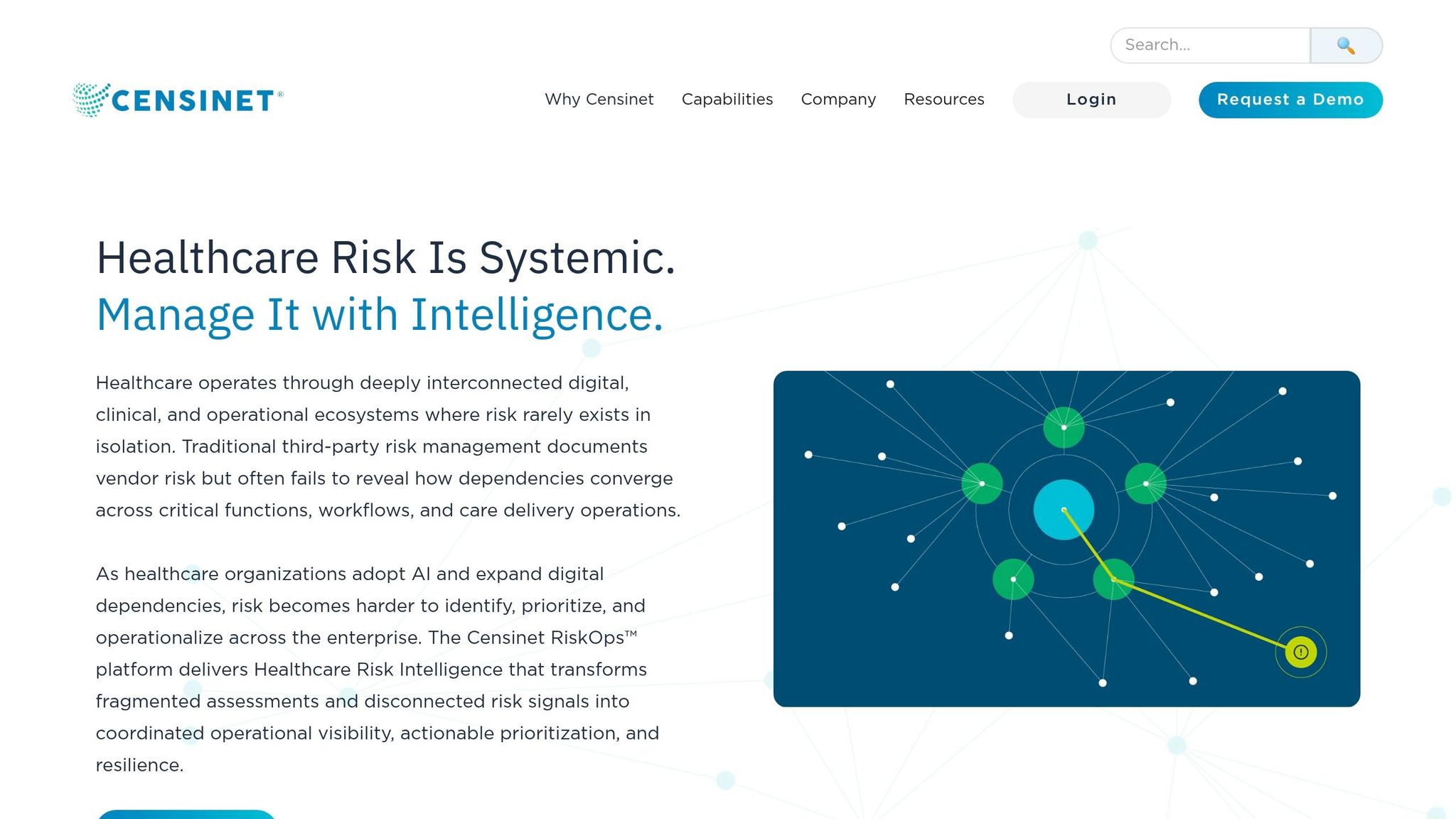
Censinet is built ONLY for healthcare. Its FICO-style 300-to-850 inherent risk score uses 11 healthcare factors, including PHI access, EHR connectivity, AI use, cloud hosting, and breach history. Vendors are also mapped to 17 critical healthcare functions, including pharmacy operations and clinical laboratory services, so teams can spot concentration risk more easily. The platform draws on a network of 55,000+ vendors and products across more than 200 healthcare organizations.
Censinet AI helps move assessments along with less manual work. AI agents automate questionnaire completion, summarize SOC 2 and penetration test evidence, capture fourth-party exposure, and draft risk summaries. Human analysts review and approve AI-generated findings before final scoring. AI Telemetry adds evidence-based reasoning for product classifications, which gives risk teams a clear way to check why a vendor was flagged as AI-capable or not.
Censinet also supports AI governance by routing key findings to the right stakeholders, including AI governance committee members, for review and approval. Pricing is custom and comes in Platform, Hybrid Mix, or Managed Services.
BluePrint Protect, CORL plus RiskRecon, and CyberStackHub
Here’s the short version:
- BluePrint Protect: Geared toward structured HIPAA Security Rule and PHI-mapping assessments, with AI-assisted questionnaire scoring and anomaly flags.
- CORL + RiskRecon: Combines outsourced questionnaire and evidence review with outside-in technical scoring for continuous monitoring.
- CyberStackHub: A free AI assistant that generates vendor assessments, questionnaires, and contract recommendations. Best for small teams that need fast, low-cost output.[3]
AI-enabled external threat scoring platforms used in healthcare
External threat scoring platforms use technical signals like exposed services, DNS misconfigurations, certificate health, breach data, and internet-facing vulnerabilities to produce vendor risk scores. For U.S. healthcare, the most useful capabilities include sector-specific scoring models tuned for hospitals, health systems, and payer environments. It also helps when the platform can tag vendors as HIPAA business associates and flag those with repeat PHI-related exposures, such as misconfigured cloud storage or publicly accessible remote desktop services.
A good way to think about these tools: they act like a continuous signal layer in the background. Then you compare them based on use case, oversight needs, and how mature your vendor risk program is.
How to Compare These Tools in Practice
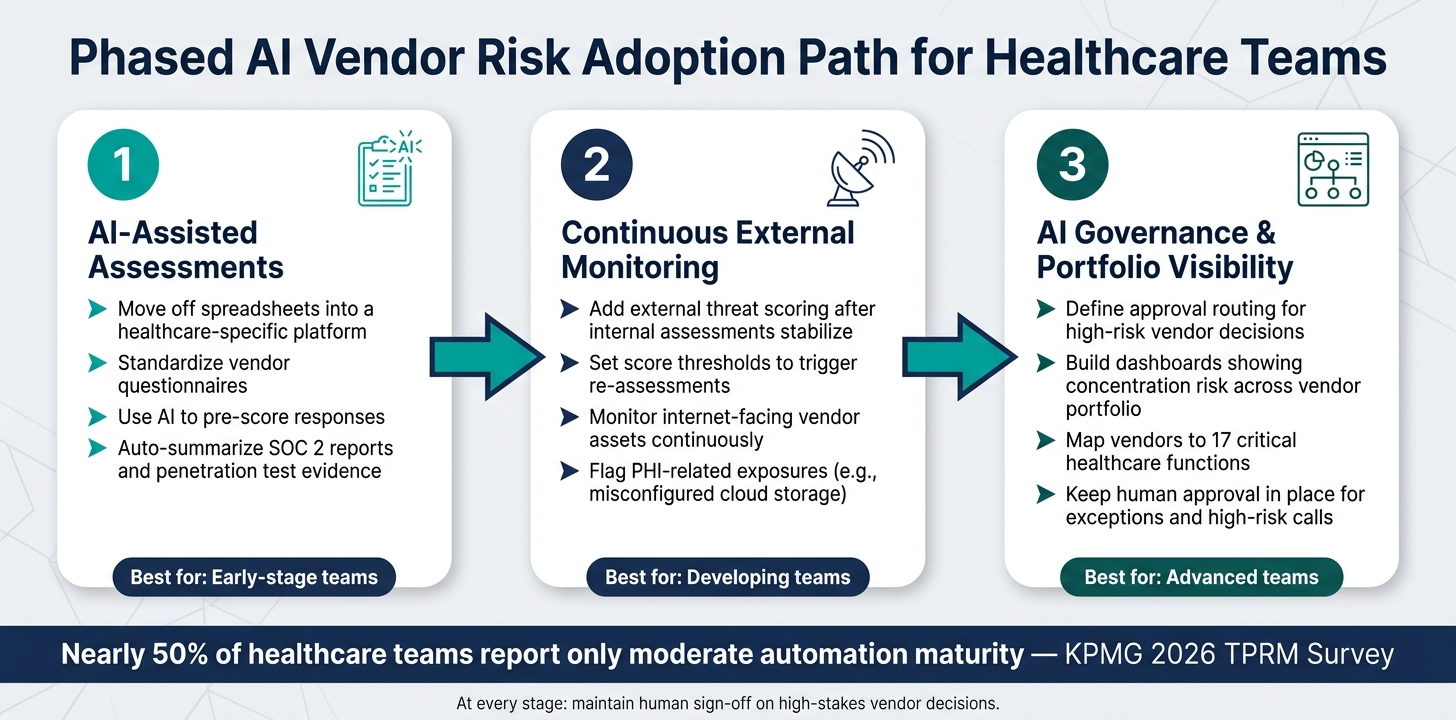
Phased AI Vendor Risk Adoption Path for Healthcare Teams
Use the scoring criteria above to line up each tool with your program’s maturity, team capacity, and governance needs. The goal is simple: pick the tool for the job it needs to do.
Comparison table: best fit by use case, maturity, and oversight needs
| Tool | Primary Use Case | Best-Fit Maturity | Healthcare Specificity | Pros | Cons |
|---|---|---|---|---|---|
| Censinet RiskOps + Censinet AI | Questionnaire scaling, evidence review, AI governance, concentration risk | All levels, especially developing to advanced | Built exclusively for healthcare | Healthcare-native workflows with human-in-the-loop AI | Narrower applicability outside healthcare |
| BluePrint Protect | Targeted questionnaire and evidence-review automation | Early to developing | Moderate healthcare fit | Useful for narrow workflow automation | Limited portfolio visibility |
| CORL + RiskRecon | Managed assessments plus continuous external monitoring | Developing to advanced | Healthcare-oriented monitoring | Combines outsourced review with ongoing attack-surface scoring [4] | Best for teams with defined workflows [4] |
| CyberStackHub | Light questionnaire and analytics support | Early-stage | Limited healthcare specificity | Quick to adopt for simple workflows | Limited depth for healthcare-specific risk logic |
| External threat scoring | Continuous monitoring of internet-facing vendor assets | Any, as a complementary layer | Varies by platform; strongest when tuned for healthcare sectors | Reveals exposures vendors may not self-report | Requires internal processes to interpret and act on ratings |
Before you buy anything, assign each tool a primary role. That step matters more than it sounds. A platform built for questionnaire scale won’t solve every monitoring problem. And a monitoring tool won’t magically fix a messy intake process. If you skip that distinction, you can end up paying for a lot of features while still patching gaps by hand.
A phased adoption path for healthcare vendor risk programs
After you have a shortlist, match the tool to the stage your vendor risk program is in now. Most teams don’t build a polished program all at once. KPMG’s 2026 TPRM survey found that nearly half of respondents report only moderate automation maturity.[5] That’s a good reminder to take this in steps instead of trying to do everything at once.
Start with AI-assisted assessments. Get the basics under control before adding more layers. For many healthcare teams, that means moving off spreadsheets and into a healthcare-specific platform that standardizes questionnaires, uses AI to pre-score responses, and summarizes vendor evidence documents. This is the part where things stop feeling scattered.
Then move to continuous external monitoring. Once internal assessments are running in a steady way, add external threat scoring. Set clear thresholds upfront so your team knows when a lower external score should trigger a re-assessment or an escalation. Otherwise, the data just sits there and creates noise.
The next step is integrated AI governance and portfolio visibility. At this stage, define approval routing for high-risk vendor decisions and build dashboards that show concentration risk across your vendor portfolio. This gives leaders a clearer view of where risk is piling up, instead of forcing them to piece it together case by case.
Through all three stages, keep human approval in place for exceptions and high-risk decisions. That guardrail matters in healthcare, where one bad call can carry a long tail.
Conclusion: Choosing the Right AI Tool for Vendor Risk Scoring
No single tool comes out on top in every category. The right pick depends on what your program needs today - and what it may need as it grows.
From the comparison above, U.S. healthcare teams should focus on explainable scores, PHI-aware workflows, and human review.
That balance matters. AI works best when it helps teams move faster without stripping away accountability. Platforms like Censinet RiskOps™ are built with that in mind, helping healthcare organizations scale third-party risk assessment and enterprise risk assessments while keeping reviewers in charge.
When you evaluate options, look for tools that can:
- map vendors to clinical functions
- surface concentration risk
- produce board-ready scores
With that lens, the best tool isn’t just the one with the most features. It’s the one your team can actually put to work - one that fits healthcare risk workflows and keeps humans in control when the stakes are high.
FAQs
How do AI vendor risk scores handle PHI exposure?
They begin by measuring inherent risk based on the vendor’s role, which clinical systems they can access, and how much PHI they handle.
From there, that starting score gets adjusted based on security controls such as encryption, multi-factor authentication, and HITRUST or SOC 2 certifications. The result is a residual risk score.
AI then keeps watch for changes, flags high-risk findings, and helps teams decide which vendors need reviews more often to support HIPAA alignment.
What should a healthcare team automate first?
Start by looking at what you’re dealing with right now: how many vendors you have, the level of risk each one brings, and which compliance rules apply.
Then automate the basics that will save the most time first. That usually means:
- A central vendor inventory
- Vendor criticality categories, such as PHI access or clinical impact
- Repeat tasks like questionnaire distribution, evidence collection, and compliance report generation
This approach keeps things simple at the start and helps teams focus on the work that eats up time day after day.
Why is human review still needed?
In healthcare vendor risk management, human review still matters. A lot. Patient safety and regulatory compliance leave very little room for guesswork.
AI can help with the heavy lifting. It can speed up evidence collection and summarize documentation, which saves time and cuts some of the manual work. But in high-stakes cases, people still need to validate findings, look into anomalies, and make the final risk calls.
That human layer also matters when teams need to interpret HIPAA and FDA requirements. Rules on paper can look clear until you hit a gray area in practice. People are the ones who can weigh context, manage vendor relationships, and spot possible model bias before it turns into a bigger problem.
