
If your medical device has software and any path to connect or transfer data, FDA cybersecurity is now part of the job. As of February 2026, FDA expects manufacturers to show a documented process for security from design through postmarket work, and weak files can slow 510(k), De Novo, and PMA reviews.
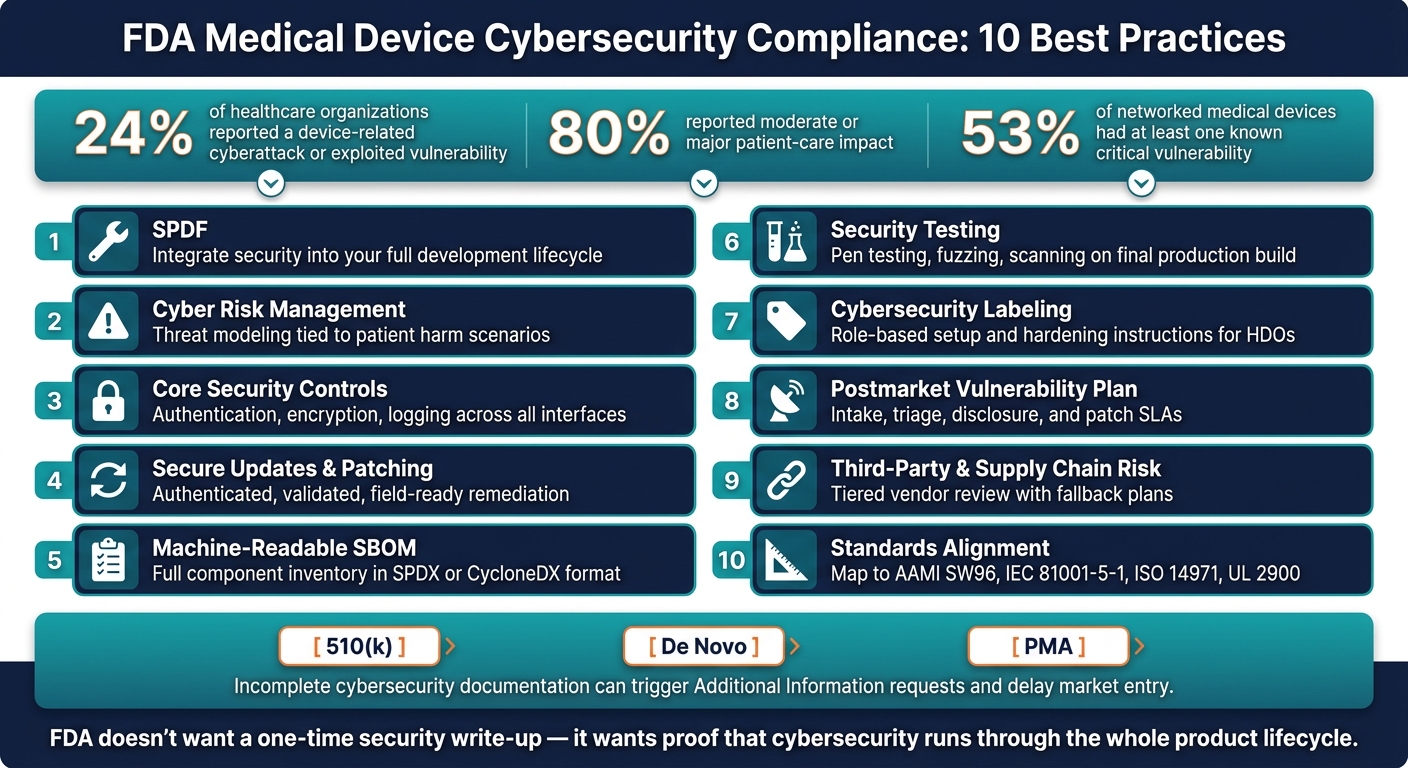
Here’s the short version: if I were building a submission plan today, I’d make sure it covers these 10 areas:
- SPDF tied to design controls and QMS
- Cyber risk management and threat modeling
- Core security controls across the architecture
- Secure updates and patching
- Machine-readable SBOM
- Security testing and verification
- Cybersecurity labeling and setup instructions
- Postmarket vulnerability response and disclosure
- Third-party and open-source risk
- Standards mapping to FDA-recognized frameworks
A few facts make this hard to ignore:
- 24% of healthcare organizations reported a device-related cyberattack or exploited vulnerability
- 80% reported moderate or major patient-care impact
- 53% of networked medical devices had at least one known critical vulnerability
This article boils FDA’s current view down to a simple idea: show your process, show your evidence, and show how cyber issues connect to patient harm. That means clear traceability from threat to control to test to postmarket action.
FDA Medical Device Cybersecurity Compliance: 10 Best Practices
Webinar: Master Medical Device Cybersecurity: Avoid FDA Delays
sbb-itb-535baee
Quick Comparison
| Practice | What I need to show FDA | Why it matters |
|---|---|---|
| SPDF | Lifecycle security process | Shows security is built into development |
| Risk management | Threats, harms, mitigations | Links cyber issues to patient safety |
| Security controls | Control mapping by interface and asset | Shows risks were addressed in design |
| Updates and patching | Update method, patch timing, recovery | Shows the device can be fixed after release |
| SBOM | Machine-readable software inventory | Helps track affected components fast |
| Testing | Pen test, scanning, fuzzing, V&V results | Shows controls work in the shipped build |
| Labeling | Setup, hardening, patch, and risk instructions | Helps hospitals use the device safely |
| Postmarket plan | Intake, triage, fixes, disclosure steps | Shows how new flaws will be handled |
| Supplier risk | Healthcare supply chain security challenges and fallback plans | Helps control outside software and vendor risk |
| Standards alignment | Mapping to FDA-recognized standards | Makes the submission easier to follow |
If I had to sum it up in one line, it would be this: FDA doesn’t want a one-time security write-up; it wants proof that cybersecurity runs through the whole product lifecycle.
Why FDA Cybersecurity Compliance Matters for Medical Device Manufacturers
Section 524B(a) says submissions must include information showing that the device meets cybersecurity requirements. For manufacturers building connected or software-enabled products, that makes early planning a must - for submission readiness and for patient safety.[8][15][6]
What FDA Means by a Cyber Device
Under Section 524B(c), a cyber device is a medical device with sponsor-authorized software in or on the device, direct or indirect internet connectivity, and features that could be vulnerable to cyber threats.[3][13][17]
That reaches much farther than many teams expect. It can include software as a medical device running in the cloud or on mobile phones, hardware with firmware or programmable logic, and devices with common wireless, wired, and removable-media interfaces - even when internet access is not intended.[2][16][14][17] In plain terms, if a device has software plus some path for connection or data transfer, it may fall within scope. That’s why manufacturers need to sort out connectivity and software features early, not halfway through a submission.
How Cybersecurity Affects 510(k), De Novo, and PMA Reviews
Incomplete cybersecurity documentation can slow down 510(k), De Novo, and PMA review. FDA expects submissions to include:
- a hazard analysis and medical device security risks assessment
- threat modeling
- verification and validation evidence
- an SBOM
- a postmarket cybersecurity management plan
- software supply chain integrity information[5][18][19]
When that package is complete and easy to follow, review tends to move more smoothly. When it’s thin or disorganized, FDA may send Additional Information requests, and that can push back market entry.[15][18][19]
Complete evidence is the difference between a clean review and a delayed submission.
Why Cybersecurity Must Connect to Design Controls and QMS
FDA expects cybersecurity to be built into design controls and QMS processes, not dropped in as a separate appendix. Section 524B(b)(2) requires manufacturers to design, develop, and maintain processes and procedures that provide reasonable assurance that the device and related systems are cybersecure.[6] That ties cybersecurity work directly to design controls under 21 CFR 820.30.
In practice, that means cybersecurity requirements should show up as design inputs, then carry through architecture documents and specifications as design outputs, and then be checked through documented test protocols in the design history file.[5][6][19] The thread needs to hold from start to finish. If a team claims a control exists, the file should show where it was defined, how it was built, and how it was tested.
Risk management files should also combine safety and security assessments. The goal is to show how cyber risks could lead to hazardous situations, and how those risks are controlled or reduced to acceptable levels.[18][6][19] QMS records matter here too. Change control and CAPA records should address vulnerability remediation, software updates, and changes to third-party components.[5][6]
That traceability starts with a secure product development framework.
1. Establish a Secure Product Development Framework (SPDF)
This is where design controls turn into a repeatable cybersecurity process. An SPDF is a structured, end-to-end way to build cybersecurity into a device from the first concept all the way through design, verification, release, and postmarket maintenance. FDA's final guidance defines it as "a set of processes that reduces the number and severity of vulnerabilities throughout the device lifecycle".[30][28][33] In plain English, it's the day-to-day system behind FDA cybersecurity compliance.
Alignment with FDA Guidance and Section 524B
Under Section 524B, cyber device submissions must include an SPDF narrative, a postmarket vulnerability monitoring and patch plan, and a software bill of materials (SBOM).[26][24] That means this can't live as an informal checklist or a few scattered SOPs. It needs to be documented in the QMS and used to produce the evidence FDA wants to see.
Align the SPDF with 21 CFR 820/QMSR, ISO 13485, IEC 62304, AAMI SW96, and IEC 81001-5-1.[7][24][31][34] Then audit it and maintain it like any other QMS process. If the framework exists on paper but doesn't shape how teams design, review, test, and maintain the device, it won't do much when submission time comes.
That framework also needs to create evidence that is ready to submit, not just policy language.
Premarket Submission Readiness
A working SPDF should produce the artifacts FDA reviewers expect in an eSTAR submission: a risk management file, threat model, security architecture views, SBOM, security test reports, vulnerability management plan, labeling, and traceability documentation. These artifacts are often managed through automated vendor solutions to ensure consistency across the supply chain.[7][25][31][32]
Stage gates matter here. Don't move into verification until security requirements, threat models, and mitigation plans have been approved. That kind of discipline helps keep the submission package complete before it lands at FDA, instead of turning review prep into a last-minute scramble.
Lifecycle Traceability from Design Through Postmarket
The same framework has to carry that evidence across the full product lifecycle. Every cybersecurity requirement should tie back to a specific threat, a control in the architecture, a verification test, and a postmarket monitoring activity. That link matters.
When a vulnerability shows up after launch, traceability helps the team see which devices, software versions, and clinical environments are affected. It also makes response work faster and less messy. Common gaps include unclear ownership, weak design-control integration, and uneven handling of third-party and open-source components.[31][33]
Patient Safety and Clinical Risk Reduction
An unauthenticated infusion-pump interface or a weak update mechanism isn't just an IT problem. It can lead to patient harm. A 2026 Medical Device Cybersecurity Index update found that 24% of healthcare organizations experienced a device-related cyberattack or exploited vulnerability, and 80% reported moderate or significant patient-care impact.[10][23]
An SPDF helps cut that risk by linking technical vulnerabilities to clinical harm scenarios from the earliest design stages. That connection is a big deal. It pushes teams to ask not only, Can this be exploited? but also, What happens to patient care if it is?
2. Perform Cybersecurity Risk Management and Threat Modeling
Once your SPDF is in place, threat modeling and risk management are where the work gets practical. These are not one-time tasks. They continue through design, verification, and postmarket monitoring. In plain English, risk management connects design controls to the evidence you later hand to FDA.
Alignment with FDA Guidance and Section 524B
FDA's final guidance treats cybersecurity risk assessment and threat modeling as core activities across the total product lifecycle.[26][39] Under Section 524B, submissions for cyber devices need to show a documented process for identifying, analyzing, and mitigating cybersecurity risks - not just a list of threats.[42][27][44]
FDA also leans toward exploitability instead of probability, because cyber threats shift as attackers, tools, and conditions shift.[26][43] That matters. A risk file can't sit there like a snapshot from six months ago. The output from this work should feed straight into security controls, verification testing, and the risk file.
Premarket Submission Readiness
Reviewers want to see your method, your gaps, and a clear line from threat to control to safety risk.[39][40] You can use a known approach like STRIDE, attack trees, or MITRE's four questions: what are we working on, what can go wrong, what will we do, and did we do it well? These should be backed by data flow diagrams and trust boundaries.[35][37]
Each threat you identify should tie directly to:
- a security control
- a verification test
- an ISO 14971 harm entry
Those artifacts should read like one connected story, not a pile of separate files.
Patient Safety and Clinical Risk Reduction
For FDA, cyber risk management has to point to patient harm, not just IT security. So each threat scenario needs to map to a plausible clinical outcome, such as therapy interruption, incorrect dosage, missed alarms, or device unavailability.
A well-known case shows why this matters. In June 2019, Medtronic MiniMed insulin pumps were found vulnerable to unauthorized changes in pump settings, with the potential to cause hypoglycemia or ketoacidosis through altered insulin delivery.[9] That's the kind of link FDA wants to see: not just what could be hacked, but what could happen to a patient if it is.
That same mapping should stay active after launch.
Lifecycle Traceability from Design Through Postmarket
An old threat model can turn into a problem fast. Manufacturers need a living risk register that links each cyber risk to threat scenarios, affected assets, exploitability, clinical impact, and residual risk after controls are applied.
When software changes, new third-party components get added, or a postmarket vulnerability comes to light, that register should trigger a reassessment.[36][38][41] In practice, that record should guide incident logs, patch decisions, and follow-up reviews. That's how you keep risk management current as the device changes and the threat landscape shifts.
3. Apply Core Security Controls Across the Device Architecture
Threat modeling shows you where the risk lives. Core security controls are what bring that risk down across the device architecture.
Once you identify risks, map a control to each interface, data flow, and trust boundary. FDA premarket cybersecurity guidance expects manufacturers to put specific, risk-based controls in place across firmware, interfaces, cloud services, and mobile components. And FDA doesn't just want a written explanation. Submissions should include annotated architecture diagrams that show how controls map to assets, data flows, and trust boundaries. That kind of control map makes design review and the submission package much easier to trace.
Alignment with FDA Guidance and Section 524B
FDA guidance groups expected controls into a few main buckets:
- Authentication
- Authorization
- Cryptography
- Code and data integrity
- Confidentiality
- Event detection and logging
- Resiliency and recovery
- Updatability and patchability
The right level of control depends on the device's connectivity and the level of possible patient harm. A connected infusion pump and a low-risk offline device should not be treated the same way.
Section 524B also reinforces the need for monitoring, vulnerability management, and coordinated disclosure. So the architecture should support logging, update handling, and postmarket maintenance from the start - not as an afterthought.
Premarket Submission Readiness
A control implementation matrix gives FDA reviewers a straight line from hazard to mitigation. It links each identified risk to a threat, a specific control, a verification test, and a residual risk assessment.
This matters because reviewers need traceability, not guesswork.
Hard-coded or default credentials are a common FDA concern. At a minimum, manufacturers should remove them, enforce credential rotation, and make sure passwords can be changed in the field. Data in transit and at rest should be protected with modern cryptography. Firmware should use secure boot and signed images to block unauthorized modification.
Patient Safety and Clinical Risk Reduction
Each control should tie back to a documented hazard, a test, and a residual-risk result.
That link to patient safety is where this gets very concrete. Access controls help prevent unauthorized changes to therapy parameters. Integrity protections help stop tampered firmware from changing measurement algorithms or control logic. Availability controls - such as graceful degradation and denial-of-service resistance - help lower the chance that a life-sustaining device goes offline during a cyber incident.
Time-synchronized, integrity-protected logs also matter. They help clinical teams and security staff spot suspicious activity and respond before a patient is harmed.
Lifecycle Traceability from Design Through Postmarket
Give each control a requirement ID so later component changes map to specific retest actions.
That sounds simple, but it saves a lot of pain later. When a component changes or a new vulnerability appears, the traceability record shows which controls are affected and what needs to be retested. Those same controls should also support secure update and remediation paths, which the next practice covers.
4. Design for Secure Updates, Patching, and Vulnerability Remediation
Controls on paper don't mean much if the device can't take trusted updates after it ships. Secure updates and patching need to be built into the design and the quality system from the start. They are not something to bolt on after launch. If a device can't receive authenticated, integrity-protected updates in the field, that gap can lead to FDA review issues and postmarket risk.
Alignment with FDA Guidance and Section 524B
FDA premarket cybersecurity guidance expects manufacturers to show a repeatable way to remediate issues, not just say they'll patch problems later. Section 524B pushes that point further for covered cyber devices: manufacturers must support updates and patches on a justified regular patch cycle, and they must support out-of-cycle updates for critical vulnerabilities that could cause uncontained patient risk.[6][47]
Premarket Submission Readiness
Describe the update path in plain, concrete terms. That includes authentication, integrity checks, rollback, and failure recovery. FDA reviewers want to see that these capabilities connect back to your threat model and design controls, not sit off to the side as a separate feature.[3]
Be specific about your patch process:
- State the regular patch cycle.
- Define what triggers an out-of-cycle release.
- Explain the reason for each timeline.[47]
- If updates need to fit clinical downtime windows, say whether they are remote or service-based and explain how authorization works.
Patient Safety and Clinical Risk Reduction
Fixing a flaw can still create a new problem. A patch that interrupts therapy, causes an unexpected reboot, or changes alarm behavior can add risk even as it removes an old weakness. That is why each update has to be validated to show that it preserves essential performance and does not introduce clinical harm.
In practice, staged rollout, compatibility checks, and coordination with clinical maintenance windows can help cut risk in hospital settings. That kind of planning matters because the update itself becomes part of the safety story.
Lifecycle Traceability from Design Through Postmarket
After a fix is validated, the work isn't over. You need traceability from discovery through release and field communication. Track each vulnerability from initial discovery to affected versions, the fix, retesting, and the field notice. Patch decisions should also tie back to your SBOM so that if a vulnerability is disclosed in an open-source library, you can quickly identify which product lines and device versions are affected and set the right remediation priority.[46][3]
5. Prepare a Complete, Machine-Readable Software Bill of Materials (SBOM)
Secure updates start with a simple fact: you need to know exactly what software ships in the device.
An SBOM is a machine-readable inventory of every software component, library, and dependency shipped with the device. For FDA-defined cyber devices, a machine-readable SBOM is a statutory requirement for premarket submissions under Section 524B(b)(3) of the FD&C Act. That applies to 510(k), De Novo, and PMA pathways. [26][55]
Alignment with FDA Guidance and Section 524B
Use SPDX or CycloneDX in machine-readable form. Do not rely on PDFs or spreadsheets for this. The NTIA Minimum Elements set the baseline and should capture:
- Component name
- Version
- Supplier
- Unique identifiers
- Dependency relationships
It also helps to include component hashes and vulnerability references. [48][51][15][52]
Premarket Submission Readiness
A partial SBOM can lead to Refuse to Accept or a deficiency finding. That’s why the file should include proprietary, commercial, open-source, and transitive components in one machine-readable record. This level of transparency is essential for effective third-party risk management across the healthcare supply chain. [50][48][15][51]
The smart move is to build SBOM generation into your Secure Product Development Framework from the start. Then check for completeness during design verification, not right before submission. Waiting until the last minute is how gaps slip through.
Patient Safety and Clinical Risk Reduction
When a vulnerability shows up in a component, a machine-readable SBOM helps manufacturers and healthcare delivery organizations figure out the impact fast. They can see which devices include the component, which versions are in use, and how those pieces connect inside the device architecture. [52][53][5][2][3]
That speeds up triage, impact review, and field notices. It also supports coordinated vulnerability disclosure obligations under Section 524B by helping determine whether a vulnerability affects safety or essential performance. [52][53][5][2][3]
Lifecycle Traceability from Design Through Postmarket
FDA treats the SBOM as a lifecycle artifact, not a one-and-done submission document. During design, it links selected components to risk management decisions. During verification, it should be reconciled against build outputs so the listed components and versions match what is actually shipped. Update it whenever the shipped software changes. [5][49][52]
In practice, that means tying SBOM work to the way the product is built and released:
- Automate SBOM generation in CI/CD
- Version-control each file
- Link it to the device configuration and UDI
That traceability makes root-cause analysis faster during incidents and shows FDA that cybersecurity is built into the quality system. [5][49][52]
That inventory also gives verification a precise build target.
6. Run Cybersecurity Testing and Verification
Once the SBOM is in place, testing shows whether the controls work in practice. The SBOM tells you what’s inside the device. Testing tells you if those protections hold up under pressure.
Alignment with FDA Guidance and Section 524B
FDA’s premarket cybersecurity guidance and Section 524B call for evidence-based security verification. That includes penetration testing, vulnerability scanning, fuzzing, and static and dynamic analysis, all tied straight to the device’s threat model and security risk file.[5][29][58][59]
Test every interface and system element. That means firmware, mobile apps, cloud services, hospital network connections, and physical interfaces like USB, UART, and JTAG.[56][57][7] FDA also expects a matrix that maps each trust boundary to the tests used for it.[56][57][7]
That point matters more than it may seem. If an interface is left out of scope, it can lead to deficiency letters or RTA holds.[7][56]
Use testers who are independent from the development team. And test the final build, or a production-equivalent build, not a prototype.[57][56]
Premarket Submission Readiness
Your submission package should include structured test reports that spell out:
- scope
- methodology
- tester credentials
- findings
- exploit demonstrations
- remediation status
- residual risk
All of that should trace back to design requirements and the security risk file.[57][58][61]
A traceability table that links each cybersecurity requirement to its test cases and outcomes gives FDA reviewers a clear way to check coverage. It also makes your submission easier to review because the logic is visible, not buried in separate files.
If a vulnerability remains unremediated, document it clearly and explain why it does not affect clinical performance.
Patient Safety and Clinical Risk Reduction
The stakes here are not abstract. The FBI's Cyber Division reported that 53% of networked medical devices have at least one known critical vulnerability.[60][11]
So start with the threats that can hit clinical function directly. Focus first on risks like incorrect therapy delivery, loss of monitoring, or manipulation of diagnostic data. In plain terms, if a cyber event can change what the device does for a patient, that test belongs near the top of the pile.
Safe failover matters too. Under cyber stress conditions - such as account lockout or network disruption - you need to verify that the device still maintains safe clinical operation.
Lifecycle Traceability from Design Through Postmarket
Cybersecurity testing is not a one-and-done premarket checkpoint. Build a requirements traceability matrix that links security requirements, design elements, test cases, and residual risk assessments. Then, when software or firmware changes, retest the controls affected by that change and record what was retested and why.[61][5]
Postmarket findings should feed back into the same system. If you learn something through coordinated disclosure or a field incident, push that input into the threat model and risk register, then create new test cases to close the loop.
Carry those results into labeling and secure configuration instructions.
7. Write Clear Cybersecurity Labeling and Secure Configuration Instructions
After verification, turn the results into instructions HDOs can use during installation and maintenance. Testing shows that the controls work. Labeling shows HDOs how to keep those controls working in day-to-day clinical use.
Alignment with FDA Guidance and Section 524B
Section 524B requires manufacturers to give users a plan to monitor, identify, and address vulnerabilities [3][64]. FDA treats cybersecurity labeling as a residual-risk control.
At a minimum, the labeling should spell out:
- secure installation and network placement
- recommended firewall rules
- authentication settings
- role-based access control
- how updates and patches are delivered and verified
- known residual risks
- a clear contact path for reporting suspected vulnerabilities
Put this information in a dedicated Cybersecurity section or a standalone Security Guide. Don't bury it across a general user manual. Hospital IT, clinical engineering, and clinicians should each be able to find what applies to them fast, without digging through pages that don't fit their role.
Patient Safety and Clinical Risk Reduction
Write in plain, operational language. Include a role-based secure setup checklist that covers network placement, password changes, unused ports, firewall rules, logging, and time synchronization. Split the instructions by role so IT teams, clinical engineering staff, and clinicians each get a clear set of actions. A single dense document with no owner usually means steps get missed.
When the labeling ties a configuration step to a clinical consequence, staff can see why it matters, not just what button to click. That small shift can make a big difference in how carefully setup steps are followed.
Lifecycle Traceability from Design Through Postmarket
Keep labeling under change control and update it when device behavior, patching, or residual risk changes. If a change affects secure setup, patch verification, or residual risk, the labeling needs to change too. Ship revised labeling with any update that changes setup steps, patch verification, or residual risk.
Also include instructions for:
- how users verify patch integrity
- what to do if an update fails
- the device's security support end date
That last point matters because HDOs use it in their own risk planning. Postmarket findings, including those from coordinated disclosure, should feed back into this same system just as testing findings do.
These instructions should stay synchronized with your vulnerability-response process in the next section.
8. Build a Postmarket Vulnerability Management and Coordinated Disclosure Plan
Once labeling is in place, you need a live process for handling newly found vulnerabilities. A postmarket vulnerability management plan lays out how your team will detect, triage, remediate, and disclose vulnerabilities after release.
Alignment with FDA Guidance and Section 524B
Section 524B requires manufacturers to monitor, identify, and address postmarket cybersecurity vulnerabilities and exploits in a reasonable time, including a formal coordinated vulnerability disclosure (CVD) process.[3][6][2] For cyber devices, this plan has been part of the premarket submission package since March 29, 2023.[3]
In plain terms, this can't be loose or informal. You need written SLAs for both noncritical and critical vulnerabilities, plus out-of-cycle remediation for urgent issues. Public disclosure timing should line up with remediation readiness and communication with affected customers, using an embargoed process when needed.[65][4][63] Your procedures should spell out both paths and track whether teams follow them. They also need to make clear who decides severity, timing, and disclosure.
Patient Safety and Clinical Risk Reduction
Every vulnerability should be mapped to clinical impact and the care setting it touches. Then triage should go through clinical stakeholders, not just engineering.[65][63][22]
That matters because a software flaw in a hospital setting isn't just a bug on a screen. It can change care, workflow, and enterprise risk to patients. Set escalation thresholds for unpatched risk so your team knows when residual risk calls for immediate corrective action, a safety notice, or a field correction.[65][63] Recent FDA actions on patient monitors show how postmarket vulnerabilities can lead to public correction or field action.
Lifecycle Traceability from Design Through Postmarket
Each postmarket vulnerability should trace back to the affected design element, DHF artifacts, and risk analysis.[65][6][63][22] And each patch should link to the vulnerability, the risk assessment, and the verification evidence.[6][66][1]
This kind of recordkeeping does more than satisfy paperwork. It helps teams spot patterns. Postmarket findings should feed back into your threat models, SPDF, and verification protocols to help stop the same issue from showing up again.[6][4][66][1][22] Those records can also reveal supplier and component problems that should move into third-party risk reviews.
9. Manage Third-Party, Open-Source, and Supply Chain Cyber Risk
Medical devices rely on vendors, open-source code, cloud services, and manufacturing partners. FDA expects manufacturers to control those outside cyber risks before submission. In practice, supplier risk needs to sit inside the same control system as design, verification, and postmarket monitoring.
Alignment with FDA Guidance and Section 524B
FDA expects manufacturers to handle supplier risk through the SPDF, complete SBOMs, and postmarket controls. Section 524B requires manufacturers to maintain processes and procedures to keep the device and related systems cybersecure, provide a complete SBOM, and sustain postmarket vulnerability management.[6][62]
For third-party and supply chain components, suppliers need contractual duties to support timely security updates. Submissions also need to show contingency plans for cases where a key supplier reaches end-of-life or does not respond to vulnerabilities.
Not every supplier needs the same level of review. High-risk suppliers need tighter assessment, stronger contract terms, and backup plans. Lower-risk suppliers should have controls that match their level of risk.
Premarket Submission Readiness
Start with one component inventory that covers every software library, firmware module, cloud service, and hardware element with network connectivity or data exchange in the device. That inventory should do more than list parts. It should assign owners, risk levels, and remediation deadlines for each supplier dependency.
FDA guidance says that all software, whether proprietary or third-party, must be assessed for cybersecurity risk, with risks either mitigated or accepted with documented rationale.[6][62]
For vendor risk, a tiered model helps keep the review focused:
- Tier 1: Safety-critical components
- Tier 2: Supporting infrastructure
- Tier 3: Low-impact services
Higher tiers need closer review, including security questionnaires and targeted evidence from higher-risk suppliers. A premarket submission should also include documented vendor assessments and clear risk treatment actions for high-risk suppliers.
That same supplier inventory should support patient-impact review, not just procurement paperwork. If a component fails, the key question is simple: what happens to care?
Patient Safety and Clinical Risk Reduction
Supplier failures can affect care in direct ways. Open-source risk can spread fast across devices and versions. Analysis of software supporting four well-known pacemaker programming machines uncovered 8,000 known security vulnerabilities in open-source libraries,[68] and HHS has warned that a vulnerability in a single open-source library can propagate across thousands of applications and devices.[67]
When a dependency fails, the fallout can include:
- Therapy interruption
- Alarm failure
- Device unavailability
- Unsafe update exposure
For safety-critical components, document the risk, the remediation plan, and the regression test results that show no effect on clinical function.
Lifecycle Traceability from Design Through Postmarket
After launch, supplier risk still needs to stay tied to fielded device versions and current vulnerability status. Every third-party and open-source component should have a unique identifier that appears the same way across design specifications, risk analysis, and security test cases.
Then, when a postmarket vulnerability appears - through internal testing, a public advisory, or coordinated disclosure - you can quickly trace which devices and versions are affected, which clinical workflows are at risk, and what mitigations are already in place.
This traceability loop applies to suppliers too. If a postmarket finding points to a vendor or component issue, that finding should flow back into third-party risk reviews, just as it flows back into threat models and the SPDF. The same records should let you trace a supplier issue from the original design choice to the fielded device and the corrective action.
10. Align Your Program With FDA-Recognized Standards and Healthcare Cybersecurity Frameworks
After third-party risk, connect the full program to recognized standards so every artifact uses the same standardized control language. FDA-recognized standards give your cybersecurity program a shared control baseline for design, testing, and postmarket work.
Alignment with FDA Guidance and Section 524B
FDA's February 2026 guidance points manufacturers to standards that line up with premarket evidence needs, including ANSI/AAMI SW96, IEC 81001-5-1, IEC 62443-4-1, UL 2900, ISO 14971, and IEC 62304.[5][21][12][69][70][6][72][73][71]
Map each FDA and Section 524B requirement to a specific standard clause, then use that traceability matrix in your submission package. Put simply: your standards map should feed straight into the evidence FDA reviews.
Premarket Submission Readiness
Standards alignment helps reviewers trace each requirement to a control and test result. If a 510(k) or PMA submission shows that threat modeling follows an IEC 81001-5-1-based process, that risks are folded into the ISO 14971 risk management file, and that mitigations are checked with UL 2900-aligned test methods, reviewers get a much clearer evidence trail.
A traceability matrix that links each risk to a control and then to a test result makes that review process easier. It also cuts down on the back-and-forth that can happen when evidence lives in separate files with different wording.
Patient Safety and Clinical Risk Reduction
Aligning with NIST CSF and HICP ties device security to hospital operations.[30][20] That matters because HICP is built around common healthcare threat scenarios. When you use those same scenarios in hazard analysis, the mitigations tend to be more realistic and easier for care settings to use.
The same idea applies to secure configuration guidance. If recommended settings map to HICP controls, hospital teams can fit the device into current policies with less friction and lower the odds of misconfiguration that could disrupt therapy or expose patient data. Managing these complex requirements across the ecosystem is often streamlined through a healthcare risk exchange that connects manufacturers and providers.
Lifecycle Traceability from Design Through Postmarket
Standards keep cybersecurity documentation consistent from design through postmarket monitoring. Cybersecurity requirements drawn from SW96 or IEC 81001-5-1 should show up across the full premarket package - SPDF, risk management file, SBOM, verification testing, and vulnerability management plan - using the same terminology.
That consistency pays off later. When a postmarket issue shows up, the shared terminology makes it easier to trace the issue back through the same standards-based framework. A living SBOM, a standards-based vulnerability plan, and periodic reassessments show the program is continuous, not one-time.[26][73]
Use the tables below to turn these standards into a submission checklist.
Tables to Support Reader Clarity
These tables help connect each cybersecurity practice to the records FDA reviewers want to see. Start with the SPDF. It sets the base for the rest of the evidence trail.
SPDF Lifecycle Elements vs. FDA Expectations
Each phase of a Secure Product Development Framework (SPDF) should produce clear records. FDA expects lifecycle traceability from design through postmarket monitoring.[54][76]
| SPDF Phase | Key Activities | Artifact Produced | FDA Expectation Supported |
|---|---|---|---|
| Concept & Requirements | Define cybersecurity scope and foreseeable misuse | Cybersecurity requirements spec | Security by design; risk management integration |
| Design & Architecture | Threat modeling, define security objectives, select controls | Threat model and security architecture views | Identification and mitigation of foreseeable vulnerabilities[7][74][75] |
| Implementation | Secure coding, SBOM generation, cryptographic integrity enforcement | SBOM, implementation records | Security controls implemented as designed |
| Verification & Validation | Penetration testing, static and dynamic analysis, fuzzing, attack surface analysis | V&V test reports | Evidence that controls work as intended |
| Release & Deployment | Secure configuration guidance, hardening instructions, cybersecurity labeling | Labeling and secure configuration instructions | Residual risk documentation; safe use instructions |
| Postmarket Monitoring | Vulnerability intake, coordinated disclosure, patch strategy, end-of-life planning | Vulnerability management and coordinated disclosure plan | Ongoing safety and effectiveness post-launch |
Core Security Controls and Implementation Examples
This table gives a plain-English bridge between control categories and what they can look like in a medical device.
| Control Category | Medical Device Implementation Example |
|---|---|
| Authentication | Unique user credentials per role; certificate-based device-to-cloud authentication; time-limited service technician access |
| Authorization | Role-based access separating clinical, service, and admin functions |
| Cryptography | Encryption of data at rest and in transit; TLS for network communications |
| Code/Data/Execution Integrity | Signed firmware; secure boot; checksums on configuration files |
| Confidentiality | Data encrypted in storage; access restricted by role and session |
| Event Detection & Logging | Tamper-evident audit logs capturing logins, failed authentication attempts, configuration changes, and update events with timestamps |
| Resiliency & Recovery | Fallback modes that preserve essential device function during a security event |
| Updatability & Patchability | Authenticated patch packages delivered through a verified, secure update path |
SBOM Required Fields and Common Formats
Under FD&C Act §524B, SBOMs are mandatory for cyber devices. FDA aligns with the NTIA minimum elements, which set seven baseline data fields per component, and adds two more for lifecycle visibility.[77][52][79]
| SBOM Field | Description | Notes |
|---|---|---|
| Supplier Name | Organization that created or maintains the component | Required by NTIA baseline |
| Component Name | Name of the software package or library | Required by NTIA baseline |
| Version | Exact version string | Required |
| Unique Identifier | CPE, package URL (purl), or hash | Enables automated vulnerability correlation |
| Dependency Relationship | Whether the component is a direct or transitive dependency | Required by NTIA baseline |
| Author of SBOM Data | Person or tool that generated the SBOM entry | Required by NTIA baseline |
| Timestamp | Date and time the SBOM was created or last updated | Required by NTIA baseline |
| Software Level of Support | Active, legacy, or abandoned maintenance status | FDA-specific addition |
| End-of-Support Date | Date the supplier stops providing security updates | FDA-specific addition; supports vulnerability response |
SPDX and CycloneDX are common machine-readable formats used to structure this data in FDA premarket filings.[78] In practice, that means your SBOM should stay current, stay machine-readable, and stay tied to your vulnerability response process.
Premarket Cybersecurity Deliverables Checklist
Use this as a submission checklist, not as proof of compliance. Think of it as the packet that shows FDA how your cybersecurity work was done, documented, and carried through the product lifecycle.
| Deliverable | What It Should Show | Submission Stage |
|---|---|---|
| SPDF Narrative | How cybersecurity is integrated across the full development lifecycle | Premarket |
| Threat Model | Identified threats, attack surfaces, and mitigations using a documented methodology | Premarket |
| Cybersecurity Risk Assessment | Risks linked to controls, with residual risk decisions documented | Premarket |
| Security Architecture Views | Global System, Multi-Patient Harm, Updateability/Patchability, and Security Use Case views[7][74][75] | Premarket |
| SBOM | Machine-readable component inventory with all nine fields listed above | Premarket |
| Vulnerability Assessment | SBOM-linked analysis referencing sources such as CISA's Known Exploited Vulnerabilities catalog[78] | Premarket |
| Verification and validation evidence | Test results tied to specific threats and controls | Premarket |
| Cybersecurity Labeling | Secure configuration instructions and intended operating environment assumptions | Premarket |
| Postmarket Vulnerability Management Plan | Vulnerability intake, coordinated disclosure process, patch/upgrade strategy, and end-of-life planning | Premarket; executed postmarket |
Where Third-Party Risk Management Platforms Fit
Once you’ve identified supplier risk, the next step is figuring out how to manage it without drowning in spreadsheets, emails, and scattered files. FDA does not require any specific TPRM platform. What FDA does expect is a clear, repeatable process to assess, document, and monitor cyber risk across software components and suppliers over the full device lifecycle.
Support for Vendor and Supply Chain Assessments
Handling vendor risk by hand gets messy fast, especially as the number of suppliers grows. TPRM platforms help by putting vendor profiles, standard security questionnaires, evidence artifacts, and risk scoring into one place.
For manufacturers, that matters because these tools can connect supplier findings to threat models and hazard analyses. If a component vulnerability shows up, automated workflows can flag the affected vendors and keep an audit trail. That saves time, but just as important, it makes the process easier to follow later during review.
One example is Censinet RiskOps™, which supports healthcare organizations and vendors with third-party and enterprise risk assessments, cybersecurity benchmarking, and collaborative risk management.
Why This Helps but Is Not an FDA Requirement
A TPRM platform can make the work more consistent and a lot less chaotic, but it does not take over the manufacturer’s regulatory duties. FDA looks at the manufacturer’s documented cybersecurity processes and submission evidence, not the platform itself. The manufacturer still has to perform device-level threat modeling, define and justify security controls, and build cybersecurity into design controls and the QMS.
Treat platform outputs as inputs, not final answers. A vendor may say a control is in place, but that claim still needs to be checked through testing, code review, or penetration testing. The point is to handle evidence faster, not hand off accountability.
Conclusion
FDA cybersecurity compliance isn't just a submission checkbox. It's a documented, repeatable way of working that starts with the first design choice and continues through postmarket support.
Those practices create the evidence FDA expects across the full device lifecycle. And that matters for a simple reason: cybersecurity failures can affect clinical care, not just regulatory status.
Healthcare is still a top target for cyberattacks, and those attacks often disrupt patient care. For manufacturers, the job is to turn that risk into a documented SPDF and a submission-ready evidence package.
Teams that build these practices in early tend to end up with cleaner documentation, fewer deficiency requests, and stronger traceability across design controls, risk analysis, and mitigations.[80][3][81]
Define your SPDF, map it to FDA's 2026 guidance and Section 524B, identify gaps, and build a prioritized remediation roadmap before your next 510(k), De Novo, or PMA submission.[80][5][81][29][45][27]
FAQs
Does my device qualify as an FDA cyber device?
Under Section 524B of the FD&C Act, a product is a cyber device if it:
- includes manufacturer-validated, installed, or authorized software
- connects directly or indirectly to the internet or other networks
- has features that could be vulnerable to cybersecurity threats
Devices without software or network connectivity are generally left out. If you're unsure whether your product fits this category, the FDA recommends clearing that up before submission to help avoid delays or refusal-to-accept issues.
What documents should be ready before submission?
Before you submit a premarket package, have clear documentation that shows the device meets Section 524B cybersecurity requirements.
That package should include a Cybersecurity Management Plan, Security Risk Management Plan, and Postmarket Maintenance Plan. You’ll also need threat modeling, architecture and data flow diagrams, a traceability matrix, a machine-readable and human-readable SBOM, vulnerability test reports, and cybersecurity labeling.
To keep things clean and easier for FDA review, organize the full package using the FDA’s eSTAR template.
How often should we update the SBOM and risk file?
The FDA expects the SBOM and risk file to be living documents, not one-and-done compliance paperwork. That means you should update the SBOM with every software release, patch, or component swap so it reflects the exact configuration used in the field.
The risk file needs the same treatment. Update it whenever the SBOM changes, new exploits come to light, or a component reaches end of support. And don’t handle those updates off to the side - keep them inside your formal change control and quality management system.
