
If I had to sum it up in one line: biometrics are best for fast repeat sign-ins, tokens are best for revocable access, and high-risk medical IoT often needs both.
Medical device security risks are not just about logging in. It affects patient safety, ePHI protection, staff workflow, and HIPAA/NIST fit. And the tradeoff is not small: clinicians spend about 8.6 minutes per 12-hour shift on authentication, which adds up to roughly 43 hours per year and about $6,450 per clinician each year in lost productivity.
Here’s the short version:
- Biometrics fit repeat access on the same device by the same person
- Tokens fit shared devices, remote access, and admin work because they can be revoked
- Biometrics can fail with gloves, masks, poor lighting, noise, injury, or bad sensor reads
- Tokens can fail when they are lost, shared, forgotten, or left in a device
- Emergency care needs a fallback like a PIN, badge, or supervised override
- Hybrid setups often make the most sense for ICU, ED, vendor access, device admin, and controlled-substance workflows
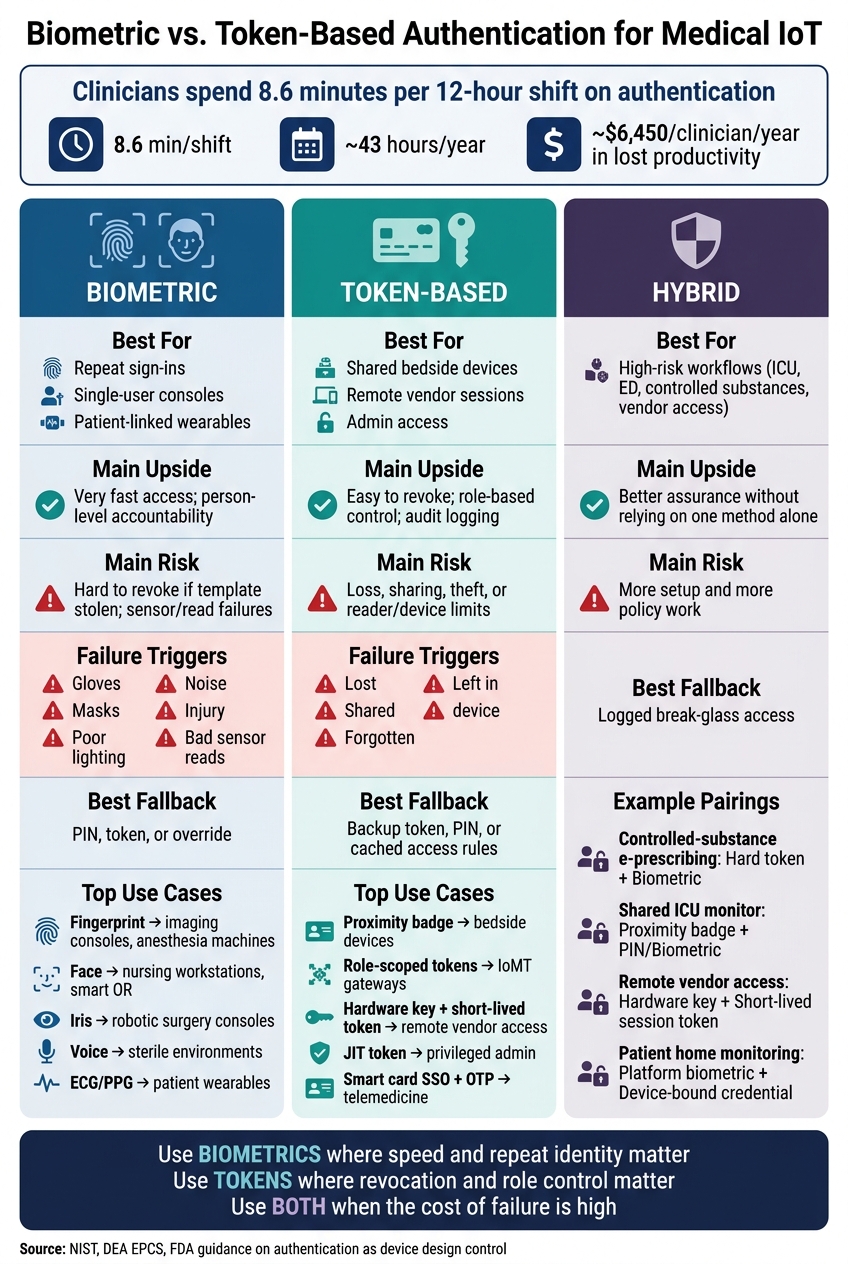
Biometric vs. Token-Based Authentication for Medical IoT: Side-by-Side Comparison
Quick comparison
| Method | Best for | Main upside | Main risk | Best fallback |
|---|---|---|---|---|
| Biometric | Repeat sign-ins, single-user consoles, patient-linked wearables | Very fast access and person-level accountability | Hard to revoke if template is stolen; sensor/read failures | PIN, token, or override |
| Token-based | Shared bedside devices, remote vendor sessions, admin access | Easy to revoke, role-based control, audit logging | Loss, sharing, theft, or reader/device limits | Backup token, PIN, or cached access rules |
| Hybrid | High-risk workflows | Better assurance without relying on one method alone | More setup and more policy work | Logged break-glass access |
So if you’re choosing between the two, I’d keep it simple: use biometrics where speed and repeat identity matter, use tokens where revocation and role control matter, and use both when the cost of failure is high.
sbb-itb-535baee
Biometric Authentication for Medical IoT
Biometric authentication uses a person’s physical or physiological trait to check them against an enrolled template. In medical IoT, it tends to work best when the same person comes back to the same device again and again. The main options here are fingerprint, face, iris, voice, and physiological-signal methods such as ECG- or PPG-based features in wearables.[10][15][16] NIST includes these among the biometric traits used to verify a user at sign-in.[15][16]
Where Biometrics Work Well
Biometrics make sense in repeat sign-ins tied to clinical work where accountability matters. On shared workstations and medical consoles, such as imaging systems and anesthesia machines, fingerprint or face recognition can cut sign-in time from tens of seconds down to one or two seconds.[3][10] Over the course of a packed shift, that time savings isn’t small.
There’s another upside. When each action is tied to one person instead of a shared account, audit trails get better for incident review.[2][10] That matters a lot in operating rooms and procedure suites, where it helps to know exactly who started or confirmed a device action.
For remote monitoring, ECG- or PPG-based biometrics can help confirm that readings belong to the enrolled patient when those readings must be linked to the right person.[10][17] But the same convenience can also become the main problem: if the trait can’t be captured well, the system can fail.
Where Biometrics Create Risk
The biggest issue is simple: biometrics are hard to revoke. If a template is stolen, the user can’t change it the way they’d change a password. A stolen template can also put other systems at risk if they use similar representations.[4][6][7][9]
Day-to-day conditions can also get in the way. Gloves, masks, background noise, and poor lighting can all hurt biometric performance.[2][3][11] Some patients may not get a clean fingerprint read because of edema, skin conditions, or injuries. Face and voice systems can also struggle with facial paralysis or speech impairments.[4][5]
Then there’s spoofing. Fake fingers, printed photos, and deepfakes mean systems need liveness detection, which adds hardware and processing demands.[4][8] Bias is another concern. Face recognition systems have shown higher false-reject rates for some racial and ethnic groups, older adults, and people with disabilities or atypical physiological traits.[4][5]
That’s why the key question isn’t just, “Should we use biometrics?” It’s which biometric fits this setting, if any.
Best-Fit Medical IoT Use Cases for Biometrics
| Modality | Best Uses | Limits |
|---|---|---|
| Fingerprint | Imaging consoles, anesthesia machines, medication dispensing cabinets | Gloves, worn or damaged skin, hygiene concerns |
| Face | Nursing workstations, smart OR systems, touchless sign-in | Masks, variable lighting, camera hardware requirements |
| Iris | Robotic surgery consoles, controlled imaging suites | Requires user cooperation and specialized optics |
| Voice | Sterile environments, home-care hubs for patients with limited mobility | Background noise, illness, spoofing risk |
| ECG/PPG | Patient-linked wearables, continuous remote monitoring | Motion artifacts, sensor placement, signal variability |
Biometrics are a poor match when conditions change from minute to minute or when emergency access comes first. During a resuscitation or inside an isolation room, staff can’t stop and fiddle with a failed fingerprint scan. In those cases, there should be a fast fallback, such as a PIN, token, or supervised override.[2][17][18] NIST treats biometrics as a factor that should support, not replace, a physical authenticator in high-risk settings.[12][14][15]
Where those conditions don’t hold, token-based authentication is usually the better fit.
Token-Based Authentication for Medical IoT
Token-based authentication works well in medical IoT when access needs to be revocable, limited by role, and easy to audit. It relies on something you have, such as a smart card, proximity badge, hardware security key, or a short-lived cryptographic token issued after login.[13][30][31] In medical IoT, that can mean badges, hardware security keys, and short-lived access tokens for device, EHR, or cloud access.[13][30][31]
Unlike biometrics, tokens rely on possession, expiration, and revocation, not a physical trait.
Where Tokens Work Well
One big plus is control after the fact. If a token is lost or reassigned, teams can revoke it from a central system.[13][29] They don't need the user in the room, and they don't need to enroll that person again.
Tokens also fit neatly with role-based access control (RBAC). You can tie each token to a role, then limit that role to the devices and functions it should reach.[19][25][26] Just-in-time tokens can also give temporary elevated access for approved maintenance work.[27] That cuts down on standing privilege and links higher access to a specific approval event.
This matters a lot for vendor and remote service access. Hardware security keys and time-limited access tokens can limit remote access to approved sessions and defined tasks.[23][27] Teams can also log token issuance and usage for audit and forensic review.[21][24][27]
That said, this level of control can come with workflow friction.
Where Tokens Create Friction
Tokens can fail in simple, human ways: people lose them, forget them, or share them.[22][26] Badge sharing weakens individual accountability and makes audit trails less reliable.[22][26] And if someone leaves a hardware key plugged into a shared workstation, another person may be able to misuse it if there's no second check in place.[23]
For home users, token handling can be a hurdle. Older adults or people with cognitive impairment may have trouble managing a smart card or OTP app, and losing a token can block access to monitoring systems or telehealth services.[21]
There are device-side limits too. Some constrained devices may not support full token validation. Offline settings, like remote clinics or network outages, can make things even trickier. In those cases, teams may need pre-provisioned tokens or cached validation data so critical functions stay available without opening the door to unlimited offline use.[20][24][28]
Best-Fit Medical IoT Use Cases for Tokens
| Use Case | Token Type | Key Benefit |
|---|---|---|
| Bedside devices (infusion pumps, ventilators, monitors) | Proximity badge / smart card | Per-clinician attribution for every setting change; centrally revocable |
| IoMT gateways and edge servers | Role-scoped session tokens | Differentiated access for nursing, biomedical, and IT roles; least-privilege enforcement |
| Remote vendor / third-party service access | Hardware security key + short-lived access token | Time-bounded sessions that expire after maintenance is complete |
| Privileged device administration (firmware updates, config changes) | Just-in-time token with explicit approval workflow | Temporary elevated access tied to a specific approval event; full session audit trail |
| Telemedicine and eHealth platforms | Smart card SSO + mobile OTP | Single sign-on across multi-server environments with per-application logging |
These tradeoffs stand out even more when you compare tokens against other options for security, workflow, and compliance.
Biometric vs. Token-Based Authentication: Security, Workflow, and Compliance
The better method depends on the medical device, the setting, and the cost of failure. The comparison below turns those use cases into clear decision points.
Security and Device-Constraint Tradeoffs
Biometrics are hard to share. Tokens are easier to shut off fast when something goes wrong. That sounds simple, but each one breaks in its own way.
Constrained devices often don't have biometric sensors or liveness checks. Tokens shift cryptography into the token itself, which makes them easier to roll out on low-power devices.[34][36][21]
| Dimension | Biometric | Token-Based |
|---|---|---|
| Main security advantage | Resistant to phishing and credential sharing; vulnerable to template compromise and spoofing | Hardware-backed cryptography; vulnerable to physical theft, cloning, or poor lifecycle controls |
| Workflow fit | Fast, hands-free re-authentication; friction with PPE, gloves, or sensor degradation | Efficient with badge or proximity workflows; friction if the token is lost, forgotten, or requires manual insertion |
| Deployment burden | Requires sensors, drivers, liveness detection, template storage, and fallback enrollment | Requires issuance, inventory tracking, reader infrastructure, and deprovisioning discipline |
| Revocability | Difficult - the underlying trait cannot be changed; relies on preventive controls and fallback methods | High - credentials can be disabled centrally within minutes of loss or compromise |
| Privacy risk | Biometric traits are permanent; requires consent, template encryption, retention limits, and state-law compliance | Lower inherent privacy risk; governance focuses on issuance, audit, and deprovisioning |
| Best-fit device scenarios | Patient-worn monitors, single-clinician workstations, point-of-care identity verification | Shared bedside devices, remote service access, privileged administration |
Security isn't the only thing that matters here. Clinical speed matters. So does regulatory fit.
Workflow, Accessibility, and Emergency Access
In urgent care, perioperative, and ICU settings, biometrics often come out ahead because they're fast and don't require a separate credential.[32][31] But that edge can vanish fast. A nurse wearing gloves, a surgeon with wet hands, or a patient with limited facial movement can turn a smooth login into a delay.
Tokens tied to existing badge systems can support tap-and-go workflows that are almost as fast, without the sensor reliability issues.[32][35] They still need a break-glass path. In a code or other emergency, care can't sit around waiting for authentication. Log the override, then review it later.
Home users add another layer. Some may have limited dexterity, low vision, or restricted facial movement. In those cases, biometrics can become a roadblock, and token-based options need to be simple enough to use the same way every time.
When speed and assurance both matter, the answer often isn't one or the other. It's both.
When a Hybrid Approach Is the Better Choice
High-risk workflows often need two factors. DEA EPCS already requires two-factor authentication for controlled-substance e-prescribing, with a hard token or qualifying biometric as one factor.[1][31] That tells you something important: healthcare already leans on layered authentication when the stakes are high. Many systems pair a biometric with a device-bound key in a secure enclave or hardware key.[33][34][35]
The main design rule is pretty plain: don't pile extra steps onto time-critical clinical work. A hybrid setup should improve assurance without slowing people down in the moments that matter most.
| Medical IoT Scenario | Primary Factor | Secondary Factor | Rationale |
|---|---|---|---|
| Controlled-substance e-prescribing | FIPS 140-certified hard token | Biometric (21 CFR 1311.116) | Meets DEA EPCS |
| Shared bedside monitor (ICU/ED) | Proximity badge (token) | Local biometric or PIN | Fast and revocable |
| Remote vendor device access | Hardware security key | Short-lived session token | Time-bounded access |
| Patient-worn home monitoring device | Platform biometric | Device-bound credential | Hands-free for patients |
| Privileged device administration | Short-lived token | Biometric verification | Higher assurance for admin tasks |
| Telehealth platform access | Smart card or security key | Mobile biometric (platform authenticator) | Phishing-resistant remote access |
Building a Risk-Based Medical IoT Authentication Strategy
How to Assess and Govern Authentication Decisions
Once you’ve mapped the tradeoffs, the next step is simple in theory and harder in practice: match authentication to device risk and clinical workflow.
A good place to start is device classification across four dimensions:
- Patient safety impact
- ePHI exposure
- Connectivity profile
- Service workflow characteristics
The point is to fit authentication to risk, not force the same rule onto every device.
After that, set clear downtime limits, emergency override rules, and fallback behavior. Then document the rationale, compensating controls, and audit needs in a central risk register. That record becomes the reference point for exceptions, overrides, and audits. Review it once a year or anytime there’s a major change.
Cross-functional ownership matters. Security, compliance, IT, clinical engineering, and frontline clinical staff all need a seat at the table. An authentication method may look solid on paper and still fail on the hospital floor if it slows care or breaks under pressure.
Key Takeaways for Healthcare Leaders
With governance in place, leaders can standardize how decisions are made without forcing the same authentication method onto every device. Method-by-method alignment beats one-size-fits-all standardization.
Biometrics can improve speed and tie access to a specific person, but they also bring privacy duties and revocation problems. Tokens give strong cryptographic control and are easier to replace, but they add handling friction. In many cases, hybrid models give the best balance for high-risk devices and workflows.
The table below shows how common risk scenarios line up with the controls that address them most directly.
| Risk Factor | Biometric | Token-Based | Hybrid (Combined) |
|---|---|---|---|
| Lost or stolen credential | Traits are tied to the user, so they are not lost like a token | Requires rapid revocation if lost or stolen | Token revoked; biometric remains available |
| Template or credential compromise | Traits are permanent, so template protection is essential | Certificate or key can be replaced | A token as a second factor can help offset biometric compromise |
| Credential sharing among staff | Non-transferable user binding | Individual tokens can be assigned and monitored | Strong deterrent - both factors must match the same individual |
| Device theft / unauthorized physical access | Helps prevent casual misuse | Supports strong cryptographic protections for remote access | Layered: local biometric plus token for remote or admin actions |
| Emergency access delay | Sensor failure can block access; requires override protocol | Lost token can block access without backup | Override path logs the event; both factors provide fallback options |
FDA guidance treats authentication as a risk-based device design control, including on-device authentication and reauthentication matched to risk [37][38]. That changes the conversation. Instead of asking, "which method is more secure in general", teams should ask, "which method fits this device, this setting, and this user role?" That’s the standard that should guide each new device added to the fleet.
FAQs
How do we choose by device risk?
Choose authentication based on device risk. The goal is to balance security with clinical workflow, not make staff jump through hoops for every device.
Start by sorting devices by:
- how critical they are
- how sensitive the data is
- what a security failure could do to patient safety
For high-risk devices, use stronger methods like asymmetric-key protocols or multi-factor authentication. For low-risk routine devices, focus on fast access with basic protection, such as badge tap-and-go with PINs.
Tools like Censinet RiskOps™ can help speed up risk reviews and manage access policies.
What is the best fallback in emergencies?
In emergencies, the best fallback is a controlled break-glass process. It gives people the access they need right away, while still keeping automated logs for audit and review.
With tiered authentication, there should be a backup layer, such as smart cards or badges, plus strong passwords or PINs as the last option. These access paths need to be clearly documented and tested on a regular basis.
When should medical IoT use both methods?
Medical IoT should use both methods as part of multi-factor authentication to balance security with smooth clinical workflows.
This setup works especially well in shared workspaces and busy areas like the ICU or emergency department. Staff can use fast, token-based access for routine sign-ins, then add biometric verification for sensitive actions. The result is less login fatigue and fewer delays in care.
