
Cyber risk belongs in the CEO’s office when it can stop care, delay cash flow, and trigger HIPAA action. In healthcare, that point is already here: 72% of attacked U.S. healthcare groups reported patient-care disruption, the Change Healthcare attack affected about 100 million people, and response costs reached about $2.4 billion.
If I had to boil this article down to a few plain points, it’s this:
- I should talk to executives in business scenarios, not security jargon
- I should show what could stop, for how long, and what it could cost
- I should track a small set of board-level metrics, not dozens of IT stats
- I should use a risk register built for decisions, with named owners and clear asks
- I should brief leaders on a set schedule, tied to budget, vendor, AI, and growth decisions
- I should connect cyber risk to patient safety, revenue, compliance, and third-party vendor risks
- I should use NIST CSF, HICP, and peer benchmarks to frame budget requests
A simple way to think about it: if ransomware can take down EHR access for 36–48 hours, pause claims for 3–5 days, or defer $5 million–$10 million in cash inflow, the conversation is no longer about patches. It’s about business risk, board tolerance, and who approves the next move.
The article’s core message is clear: the CISO’s job is not just to report security activity. It is to help the CEO and executive team make risk decisions with plain language, trend data, and one clear action at the end of every meeting.
Why CISOs Struggle to Explain Cyber Risk to the Board
sbb-itb-535baee
How to Turn Technical Findings Into Executive Risk Language
Once executives understand what's at stake, the next move is simple: turn technical findings into decisions they can actually make.
A lot of security reports hand over a vulnerability list and call it a day. That's where they fall short. CISOs need to translate those findings into business scenarios that show what could happen, what it could cost, and what decision is needed.
In U.S. healthcare, those findings often include unpatched clinical systems and medical devices, unsupported operating systems, weak EHR access controls, poor email security, weak third-party risk controls, and backup and recovery testing that hasn't been proven in practice. These issues can disrupt care delivery, billing, and compliance.
Reframe Vulnerabilities and Control Gaps as Business Scenarios
Every major technical finding has a business story behind it. Tell that story through four lenses: operational impact (which services stop and for how long), financial impact (deferred revenue, overtime costs, recovery spend), compliance exposure (HIPAA breach reporting, OCR investigations, CMS audit risk), and patient safety (delayed diagnoses, medication errors, care deviations).
Take a common issue like weak network segmentation around the EHR. On paper, that's a control gap. In the boardroom, it sounds very different: if ransomware spreads from a compromised workstation into the EHR, the result could be 36-48 hours of downtime across three hospitals, affecting 800 inpatient beds and 1,500 daily outpatient visits, deferring $2 million-$3 million in revenue and increasing patient safety risk.
Over-privileged EHR accounts raise the risk of improper PHI access, OCR scrutiny, HIPAA penalties, and reputational damage.
A weak billing-vendor connection can create another kind of pain. Claims submission could stop for 3-5 days, defer $5 million-$10 million in cash inflow, and force staff into manual workarounds.
Pick a Small Set of Executive Metrics That Show Exposure and Direction
Once the scenario is clear, track only the metrics that show exposure and movement. Executives do not need 40 metrics. They need 8-10 that answer two basic questions:
- How exposed are we right now?
- Is that exposure getting better or worse?
Keep those metrics steady from quarter to quarter so leaders can spot direction, not just look at one-off snapshots.
For exposure, focus on top 5-10 risk scenarios ranked by residual risk, the percentage of critical services tied to high-risk vendors, estimated maximum downtime for EHR, PACS, OR scheduling, and revenue cycle systems, and the share of PHI records exposed in worst-case scenarios.
For direction, track residual risk against tolerance, the quarter-over-quarter trend in high-risk vendors, mean time to remediate high-severity findings on Tier 1 systems and vendors, backup and recovery test pass rates, and the drop in expected financial loss for top scenarios after mitigation projects.
Present each metric with a simple green/amber/red threshold tied to board-approved risk appetite. Then add a trend arrow showing movement over the last 12-18 months.
Use this table to translate technical metrics into executive language.
| Technical Metric | Business Translation | Healthcare Example |
|---|---|---|
| Number of critical unpatched systems | Downtime and canceled procedures | 12 unpatched OR scheduling servers → risk of surgery delays across 6 ORs for 1-2 days |
| Mean Time to Patch (critical severity) | Speed of risk reduction vs. operational exposure | 45-day patch lag on EHR servers → prolonged window for ransomware impacting all inpatient units |
| Phishing click-through rate | Revenue cycle and EHR disruption risk | 9% click rate among billing staff → higher risk of claims submission halt and cash-flow disruption |
| High-risk vendors (Tier 1) | Vendor concentration risk | 5 high-risk vendors supporting 70% of revenue cycle → material single points of failure |
| Failed backup/recovery tests | Reliability of business continuity | 2 of 6 EHR recovery tests failed → risk of multi-day downtime without reliable restoration |
| Privileged accounts without MFA | Probability of unauthorized PHI access | 150 admin accounts without MFA → increased risk of reportable HIPAA breach |
| Average time to detect incidents | Duration of undetected disruption or data access | 72-hour detection time → larger PHI exposure and more complex recovery operations |
| Open third-party findings past SLA | Ongoing regulatory and financial exposure | 20 unresolved vendor issues beyond 90 days → heightened OCR and payer audit scrutiny |
Build a Decision-Oriented Risk Register
Then capture each scenario in a register built for executive decisions, not technical tracking. A CEO-ready risk register should feel like a short decision memo, not a 200-row spreadsheet. Each entry fits on half a page and ends with a clear ask.
Each entry should cover eight elements, written in plain English:
- Risk statement: One sentence describing the scenario, such as "Ransomware causes a two-day EHR outage across our three hospitals, disrupting admissions, documentation, and billing."
- Accountable executive: The executive who owns the business outcome, such as the COO, CMO, CFO, or SVP Revenue Cycle, not the CISO or CIO.
- Service line: Emergency Services, Surgical Services, Oncology, Revenue Cycle, and so on.
- Likelihood: Low/Medium/High with a short reason, such as "Medium: two similar attacks in our region in the past 12 months."
- Impact: Quantified when possible, such as "$2.5 million-$3.5 million in deferred revenue and overtime costs per event; potential HIPAA breach reporting."
- Current safeguards: Main protections in plain terms, such as "24/7 monitoring, tested backups, EHR downtime procedures, phishing training."
- Residual risk vs. appetite: Whether the scenario sits within, near, or above board-approved tolerance.
- Treatment: Mitigate, transfer, accept, or defer.
Ownership matters just as much as format. Tie each scenario to the business capability at risk and the executive who owns that capability, not the IT asset by itself. Each scenario should also name the supporting technical owners, such as the CIO, CISO, or vendor management team, and spell out the decision needed at the next meeting, whether that's approving capital spend, accepting residual risk above appetite for 12 months, or directing vendor management to renegotiate SLAs.
That shift changes cyber risk from an IT topic into an operational and financial accountability issue. It also makes the scenarios and metrics fit for dashboards and briefings leaders can use at a glance.
How to Design Dashboards and Briefings Executives Can Use
Once the risk register is set, the next step is simple: turn it into a dashboard and briefing executives can scan in minutes. Each view should tie back to a named risk in the register. If it doesn’t, it probably doesn’t belong.
Build Board-Ready Dashboards Around Risk, Trend, and Tolerance
Use five views: current risk, quarterly trend, major incidents and recovery, third-party concentration, and tolerance breaches. Each one should connect straight to patient safety, revenue, compliance, or vendor dependency. And when you show whether a risk is in or out of tolerance, use the same thresholds already set in the risk register. No new scoring system. No translation layer.
| Dashboard Component | What It Shows | Key Executive Questions It Answers | Primary Decisions It Enables |
|---|---|---|---|
| Current Risk Posture Snapshot | Today's overall cyber and third-party risk level and top risks | Are we operating within acceptable risk? Which risks threaten care? | Accept, reduce, or transfer specific risks; set priorities |
| Trend by Quarter | Direction of risk over time for key indicators | Are we getting better or worse? Are investments effective? | Increase or decrease funding; adjust strategy and timelines |
| Incidents & Recovery | Recent significant events and recovery performance | How well do we respond when things go wrong? What residual risk remains? | Approve remediation plans; refine playbooks; adjust insurance coverage |
| Third-Party Risk Concentrations | Dependence and risk level across critical vendors | Where are we over-exposed to vendors? What happens if a key vendor fails? | Diversify vendors; renegotiate contracts; add contingency arrangements |
| Risk Tolerance Flags | Where current risk exceeds approved appetite | Where are we outside board-approved tolerance? How urgent is remediation? | Authorize remediation funding; formally accept or modify tolerance |
These views work only if the visuals are easy to read at a glance. A board packet is not the place for charts that need a walkthrough.
Choose Visuals That Add Clarity, Not Noise
The wrong chart muddies the message. The right one helps an executive get the point in seconds. Use heat maps for concentration, RAG ratings for tolerance, bar charts for side-by-side comparison, and line charts for trend over time.
| Visualization Type | Strengths in Executive Reporting | Limitations in Healthcare Context | Best Use in Healthcare Boards/C-Suite |
|---|---|---|---|
| Heat Maps | Show risk concentration across vendors and services at a glance | Can obscure underlying metrics; relies on clear legends and axis definitions | Mapping third-party risk vs. criticality; clinical service risk distribution |
| Traffic-Light (RAG) | Very intuitive; quickly flags areas outside risk tolerance | Risk of oversimplification without objective criteria for each color | Summarizing status of key risk domains: ransomware, PHI, vendors, medical devices |
| Bar Charts | Clear comparison of counts and volumes across units or time periods | Limited for multi-dimensional risk combining likelihood, impact, and tolerance | Number of high-risk vendors per department; incident counts; patching coverage rates |
| Line Charts | Shows direction over time; supports evaluation of program impact | Can become cluttered with too many indicators plotted together | Trend in critical vulnerabilities, incident volume, or recovery times quarter over quarter |
A quick rule of thumb: if the visual needs a paragraph of setup, it’s doing too much.
Use a Four-Part Executive Briefing Framework
Once the dashboard is done, the briefing explains what changed and what decision is needed. The dashboard shows exposure. The briefing asks for action. This alignment is critical for creating a culture of cybersecurity across the organization. That same four-part structure works whether you’re speaking to the full board, meeting the CEO one-on-one, or sitting down with the CFO before budget season.
Start with the current risk picture. Keep it to one or two slides. Show your overall risk level, the top three to five risks affecting operations or compliance, and what changed since the last briefing, such as a new high-risk vendor, a recent EHR outage, or updated OCR guidance. Lead with implications by measuring what matters, not raw findings.
Then cover security status across NIST CSF functions: Identify, Protect, Detect, Respond, and Recover. A simple RAG summary tied to healthcare-specific capabilities works well here. This is where you show, for example, that Recover is amber and explain what a multi-day outage would mean in practice.
The third part focuses on significant incidents or vendor changes since the last meeting. Spell out what happened, how it was handled, what residual risk remains, and whether vendor accountability or contract action is needed. Verizon's 2025 Data Breach Investigations Report notes that the share of breaches involving a third party doubled year over year.[1][2] That trend makes vendor concentration a standing board topic every cycle, not an optional add-on.
Close with specific asks. That could mean funding approval, policy sign-off, vendor action, or formal risk acceptance above tolerance. Every briefing should end with one clear decision tied back to the risk register.
These same views also give you the evidence base to map risk to NIST CSF and compare your position with peers.
How to Run a Repeatable CISO-to-CEO Risk Conversation
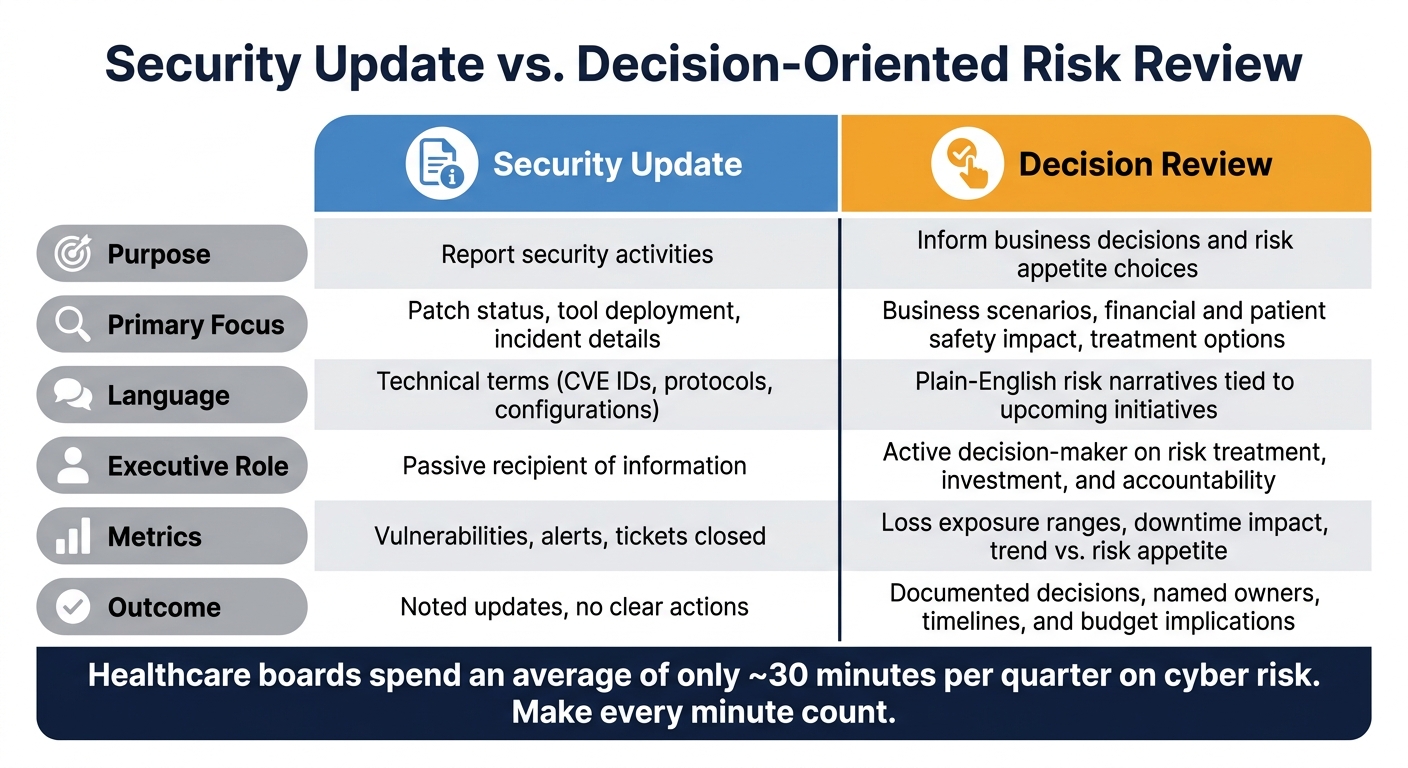
Security Update vs. Decision Review: CISO-to-CEO Communication Framework
Once the dashboard is live, the next move is simple: make the risk conversation a fixed part of executive governance.
A dashboard on its own doesn't do much. It only matters if leaders look at it on a set schedule and use it to make choices. If cyber risk comes up only once a year, or only after an incident, the whole process becomes reactive. That's not good enough.
Instead, treat cyber risk as a standing executive rhythm. Hold quarterly reviews tied to strategy and budget. Then add monthly check-ins for fast-moving issues like AI pilots and vendor changes.
Align Your Agenda to Upcoming Business Decisions
Build each agenda around business decisions that are coming up, not around a general security status update.
Use the risk register as the standing agenda. Then tailor it to the decisions already in motion. Before each meeting, check the executive calendar. Look for items such as a new clinical program, an AI rollout, telehealth expansion, an EHR upgrade, a vendor renewal, or merger due diligence. Each one brings cyber and third-party risk that leaders need to see before they commit.
For every initiative, prepare a short decision brief that covers:
- The business goal
- Key dependencies
- Top risks
- Estimated impact
That keeps the conversation tied to action, not just awareness.
Lead With the Bottom Line and End With Clear Decisions
Each executive review should begin the same way: start with the risk-register scenarios, then show only the metrics that changed.
Open with a plain-English summary in three or four sentences. It should answer three direct questions:
- Where does risk stand against appetite?
- What is driving the exposure?
- What decisions are needed to change the direction?
Overall, our cyber and third-party risk posture is stable but not yet where we want it given our growth in digital health and AI. The majority of our exposure right now arises from three high-dependency vendors without tested downtime procedures and from two legacy clinical systems that cannot be patched. We have clear options today: invest approximately $1.8M in resilience and vendor contingencies, adjust our risk appetite for certain non-critical systems, or accept the current residual risk with defined recovery plans.
Then walk the same risk through each leader's lens: financial exposure, care disruption, patient safety, and regulatory consequence.
Every meeting should end with one documented decision, one named owner, and one due date. After that, send a one-page decision log within 24–48 hours.
Ad Hoc Security Updates vs. Decision-Oriented Risk Reviews
The main difference isn't how much information you share. It's whether the meeting ends with a decision.
| Aspect | Security Update | Decision Review |
|---|---|---|
| Purpose | Report security activities | Inform business decisions and risk appetite choices |
| Primary focus | Patch status, tool deployment, incident details | Business scenarios, financial and patient safety impact, treatment options |
| Language | Technical terms (CVE IDs, protocols, configurations) | Plain-English risk narratives tied to upcoming initiatives |
| Executive role | Passive recipient of information | Active decision-maker on risk treatment, investment, and accountability |
| Metrics | Vulnerabilities, alerts, tickets closed | Loss exposure ranges, downtime impact, trend vs. risk appetite |
| Outcome | Noted updates, no clear actions | Documented decisions, named owners, timelines, and budget implications |
Sharing this table as a pre-read before the first structured review helps reset expectations. The CISO isn't there to give a status report. The CISO is there to help leaders make informed choices.
That distinction matters even more in healthcare, where boards spend an average of only about 30 minutes per quarter discussing cyber risk [3]. When the framing changes, a passive briefing can become a governance conversation that actually moves the needle.
Using Healthcare Frameworks, Benchmarking, and Censinet RiskOps to Support Executive Communication
Structured frameworks and peer comparisons give executive conversations a factual baseline. They turn risk claims into context leaders can act on. If a CISO can show that the organization sits below the sector median on HIPAA-compliant vendor risk management - and that vendor-related breaches cost an average of $4.88 million per incident - the discussion stops being abstract and starts pointing toward action.[4]
NIST CSF gives that discussion a common structure.
Map NIST CSF Functions to Executive Questions
NIST CSF 2.0 also includes Govern, but the table below focuses on the five operational functions most closely tied to care delivery and resilience. Each one lines up with a question executives already ask.
| NIST CSF Function | Executive Question | Supporting Metrics or Views |
|---|---|---|
| Identify | What do we depend on, and where are our biggest risk concentrations? | Top 10 critical services mapped to key vendors; high-risk vendor concentration by clinical function |
| Protect | Are our most critical systems and vendors operating with basic controls at an acceptable level? | MFA coverage for privileged access; patch compliance rate within 30 days for Tier 1 systems; backup test success rates |
| Detect | How quickly can we spot incidents that threaten patient care or sensitive data? | Mean time to detect (MTTD) for priority incidents; critical asset coverage by SIEM/EDR/logging |
| Respond | When something goes wrong, how fast can we contain the damage? | Mean time to respond (MTTR) for top incident types; status of tested incident playbooks for ransomware and vendor outages |
| Recover | How long until we can safely restore critical services after a major disruption? | Defined and tested RTO/RPO for core clinical and revenue platforms; number of services with validated manual fallback procedures |
HICP makes this more practical for provider leadership. HHS 405(d) Health Industry Cybersecurity Practices (HICP) outlines five top threats, including ransomware and social engineering, along with ten core practice areas such as email protection, endpoint security, access management, and incident response.[7][8] Those practice areas support the NIST mapping and give executives a steady healthcare-focused checklist.
Once that framework is in place, peer benchmarks make the case for spending much stronger.
Use Benchmarking to Build Investment Cases
Peer comparisons change the budget conversation from “we need more funding” to “here’s where we lag peers and what that gap may cost.”
A strong benchmark-based investment case usually has three parts:
- Show where the organization stands against peers with simple quartile visuals instead of heavy scoring tables.
- Tie the gap to financial and operational impact. Third-party-related breaches now cost an average of $4.88 million per incident, and 35% of healthcare data breaches in 2023 were directly linked to third-party vendors.[4][5][6]
- Link a specific spend decision to an expected outcome. Closing that gap can reduce breach-loss and downtime exposure based on current revenue and incident-cost benchmarks.
That gives executives a cleaner ROI story, grounded in current sector data.
These same views can be put to work in one platform.
Conclusion: Make Cyber Risk a Business Decision, Not a Technical Report
Censinet RiskOps pulls third-party and enterprise risk data into one place, maps it to NIST CSF and healthcare categories, and shows executive-level risk trends and owners. Benchmarking views let CISOs show how their organization’s vendor risk posture compares with peer health systems, filtered by facility, service line, or vendor category, so leaders can see risk through the lens of their own operational duties.
When cyber risk becomes a standing part of executive governance - grounded in frameworks, benchmarks, and decision-ready dashboards - the organization is in a stronger position to protect patients, keep operations running, and make smarter investment choices.
FAQs
How do I explain cyber risk to a CEO in plain business terms?
Turn technical security issues into business impact people can act on. That means showing the likely hit to revenue, operations, compliance, and patient care, not burying the point in security jargon.
Instead of terms like CVSS or zero-day, explain what could happen, what it might cost, and whether the risk is getting better or getting worse. For example, a flaw in a patient scheduling system isn't just an IT issue. It can delay appointments, slow staff, hurt cash flow, and in some cases affect care delivery.
Use simple, decision-focused tools that help leaders make choices fast:
- Dollar-based loss estimates to show likely financial exposure
- Maps between critical systems and clinical services so teams can see what disruptions would affect patient care
- High-level dashboards that show risk status at a glance
- Clear tradeoffs between security spend and lower expected loss
The goal is simple: make it easy for leaders to see where money, time, and action will reduce the most risk.
Which cyber metrics matter most to a healthcare executive team?
Healthcare executive teams should focus on metrics that show business harm, not just technical activity.
That means looking closely at:
- Ransomware and downtime: cost per hour, outage length, time to reach safe minimum operations, and time to full restoration
- PHI breach exposure: per-record breach cost, the effect of detection and containment, and any required notice
- Third-party risk: critical vendors assessed, how risk is spread across vendors, remediation time, downtime, and the number of affected patient records
It also helps to track recovery readiness, the aging of open high-risk items, and how these trends compare with the organization’s risk appetite.
How often should CISOs brief the board on cyber risk?
CISOs should move past once-a-year updates and set a steady board reporting rhythm. For healthcare organizations, quarterly reports should be the standard for tracking key issues, risk trends, and mitigation progress.
Quarterly reporting gives the board a solid baseline for oversight. But reviews of specific risk indicators should happen at a pace that fits system criticality and how fast new risks show up.
