
If a cloud incident hits your healthcare system, you need proof fast. In healthcare, that means logs, snapshots, identity records, storage metadata, and contract terms that let your team get evidence within HIPAA timelines.
Here’s the short version: I’d treat cloud forensic readiness as a vendor requirement, not an IT wish list. The article shows that healthcare teams should ask for immutable audit trails, time-synced logs, tenant-only evidence delivery, exportable records, live-system evidence options, and clear investigation SLAs. That matters because HIPAA breach notices may be due within 60 days, ransomware drove 67% of major HIPAA breaches in 2023, and one cited source says 82% of healthcare data breaches in 2023 involved cloud-stored data.
If I were reviewing a cloud vendor, I’d focus on these points first:
- Logging coverage: PHI access, admin actions, API calls, sign-ins, MFA, config changes
- Evidence protection: WORM storage, hashes like SHA-256 or SHA-3, chain-of-custody records
- Timeline accuracy: NTP-based clock sync across systems and regions
- Cross-system tracing: Standard log formats like JSON and fields that match across tools
- Low-impact forensics: Snapshots and memory collection that do not interrupt care
- Tenant isolation: Evidence access limited to your environment only
- Contract support: BAAs and SLAs that define response times, export methods, and provider duties
- Data location: Clear records of where logs and evidence are stored and processed
A simple way to read the full article is this: healthcare does not just need cloud security; it needs cloud evidence on demand. The rest of the piece explains what research, NIST guidance, and healthcare rules say you should require before signing a contract.
What Recent Research Says About Cloud Forensic Readiness
NIST’s Cloud Computing Forensic Reference Architecture (SP 800-201) arrived in July 2024. More recent reviews point to the same problem: cloud forensics still has gaps, and healthcare teams need to plan for them. In plain terms, these gaps shape what healthcare organizations should ask for from cloud vendors.
Main Challenge Categories from Cloud Forensics Research
Researchers keep coming back to one big issue: cloud systems are messy. A single environment can include virtual machines, containers, identity services, storage layers, and management planes. So when something goes wrong, the evidence may be scattered across many places at the same time.
That gets harder in multi-tenant setups. Investigators usually don’t get direct access to hardware, hypervisors, or full network telemetry. Old-school evidence collection methods don’t fit well here, and disk imaging often isn’t practical. In U.S. healthcare, there’s another layer to this problem: teams have to isolate the incident without exposing another tenant’s data.
Logging is another weak spot. Default logs often leave out details that matter, like IP addresses, identity data, or retention windows long enough for a healthcare investigation. Time sync is a problem too. If clocks drift or timestamps don’t line up across services, building a breach timeline becomes a lot harder.
Two other risk areas matter even more for healthcare. Anti-forensics tactics, such as log tampering, ephemeral resources, and abuse of encryption, are easier to pull off in elastic cloud setups. On top of that, unclear provider-tenant duties, contract gaps, cross-border storage, and missing forensic playbooks can slow an investigation right when speed matters most.
What Research Says About Forensic Readiness Frameworks
Research now leans toward forensic-by-design. The idea is simple: build evidence capture into the cloud environment before an incident happens. NIST SP 800-201 puts that idea into a formal structure and gives cloud architects, engineers, practitioners, and consumers a way to judge whether an environment can support a reliable investigation.
Across the main frameworks, the starting point is pretty consistent:
- Configurable logging
- Tamper-resistant preservation
- Standard evidence APIs
- Documented provider support for investigators
The catch is that provider maturity varies a lot. Recent studies point to gaps in cross-service log correlation, retention that doesn’t match regulatory needs, and weak support for end-to-end chain-of-custody. For healthcare organizations, that means forensic readiness can’t be treated as something the vendor probably has. It needs to be an explicit selection criterion, and it needs to show up in contracts and BAAs. Those baseline capabilities should also be part of vendor assessment criteria.
Evidence Types Healthcare Teams Need Most
For PHI investigations, research and healthcare guidance line up around a core group of evidence types. Access logs for EHRs and patient portals show which records were touched and who touched them. Identity and authentication events, including login attempts, MFA use, role assumptions, and token issuance, help teams figure out whether access was legitimate. Administrative activity logs show privileged actions like permission changes and deployment modifications, which often happen before a breach or help make one possible.
Storage metadata matters too. Object ownership, access control lists, encryption status, and data location help show how far data may have spread. Replication and backup timestamps help show when that movement happened.
One healthcare study used AWS CloudTrail and EventBridge to automate evidence capture for high-risk actions, including patient record changes and restricted-information access, with cross-account audits and rule-based filtering.[5][8]
Logging by itself isn’t enough. Evidence also needs to be retained, time-synchronized, immutable, and exportable for HIPAA and OCR review. For a healthcare buyer, that turns these evidence types into a practical vendor evaluation checklist.
Cloud Forensic Capabilities Healthcare Organizations Should Require
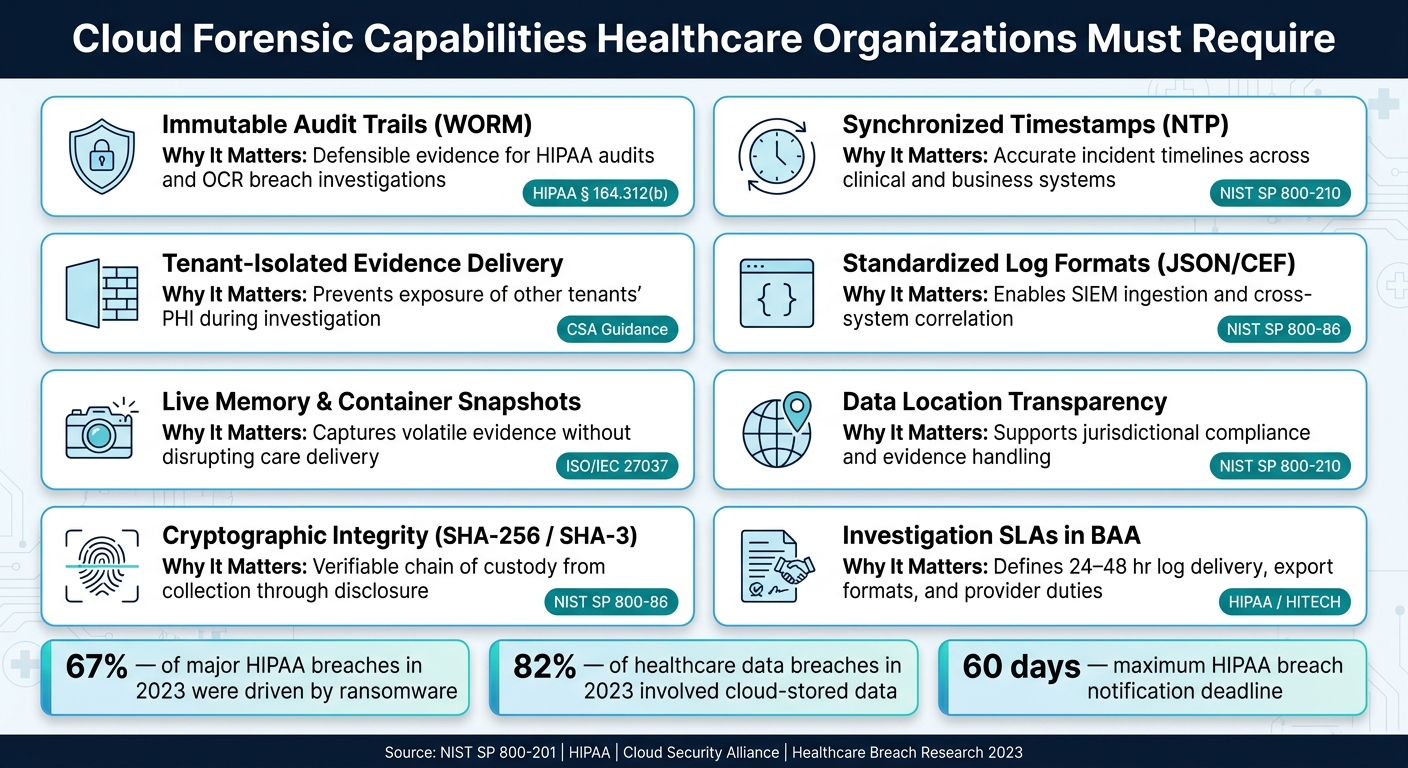
Cloud Forensic Capabilities Healthcare Organizations Must Require
Those research gaps need to turn into vendor requirements that healthcare teams put directly into contracts.
Evidence Collection, Preservation, and Chain of Custody
Everything starts with logging that investigators can trust. Cloud vendors should generate detailed, tamper-resistant logs for PHI-related activity across every service that touches PHI. That matters because many providers turn off detailed logging by default - for example, object-level access logs in cloud storage - to cut costs. So healthcare security teams need to switch those settings on before an incident happens [2][6].
Collection alone isn't enough. You also need to preserve evidence in a way that holds up under HIPAA review and legal scrutiny. Logs and snapshots should be stored in write-once-read-many (WORM) formats, with cryptographic hashing such as SHA-256 or SHA-3 applied at the moment of collection [1][6].
Each piece of evidence - whether it's a log file, VM snapshot, or exported record - should include a clear tag that shows:
- where it came from
- when it was collected
- who collected it
- its checksum
That's the chain of custody in plain terms. In multi-tenant cloud environments, vendors also need to show that evidence delivery is limited to the tenant being investigated. That can mean partitioned log buckets, tenant-specific accounts, or filtered query methods that block any exposure of another tenant's data [2][10].
Cloud agreements must allow the healthcare tenant or provider to perform forensics.
Without these controls, it's hard to prove what happened or when.
Cross-System Correlation Across Clinical and Business Environments
A breach almost never stays neatly inside one system. An attacker might get in through a business email account, move across an identity platform, and then reach EHR records or a medical device gateway. To follow that trail, logs from each layer need to line up.
Vendors should provide logs in standardized formats, such as JSON with consistent field names for user IDs, session IDs, device IDs, and resource IDs, so a SIEM or forensic platform can ingest and correlate them [6][9]. Synchronized timestamps through NTP across all cloud regions and connected systems are a hard requirement. Even small clock drift can wreck an incident timeline [1][9].
Investigators also need a way to connect cloud identities to EHR roles so they can trace PHI access with confidence. Without that link, following one threat actor across systems turns into guesswork. Vendors should preserve metadata integrity too, including source IP addresses, user-agent strings, and session IDs, as data moves between connected platforms like medical device gateways and cloud-hosted EHR systems [3][10].
Compliance and Continuity Support During an Investigation
Healthcare teams can't pause patient care just to investigate a breach. That means evidence capture has to happen without disrupting clinical operations. Vendors should support non-disruptive evidence acquisition, including the ability to snapshot VM memory and container states on secondary nodes or replicas, so forensic work stays off production clinical systems [3][10].
Volatile data is a big deal here. Running processes and in-memory encryption keys can vanish the second a container shuts down. That's why automated snapshot triggers tied to security alerts aren't a nice extra - they're a practical requirement [1][10].
Data location transparency also matters for compliance. Vendors should clearly document where logs are stored and processed, including the geographic region and jurisdiction [11][12][13].
| Capability | Why It Matters for Healthcare | Relevant Standard |
|---|---|---|
| Immutable Audit Trails (WORM) | Defensible evidence for HIPAA audits and OCR breach investigations | HIPAA § 164.312(b) |
| Synchronized Timestamps (NTP) | Accurate incident timelines across clinical and business systems | NIST SP 800-210 |
| Tenant-Isolated Evidence Delivery | Prevents exposure of other tenants' PHI during investigation | Cloud Security Alliance (CSA) guidance |
| Standardized Log Formats (JSON/CEF) | Enables SIEM ingestion and cross-system correlation | NIST SP 800-86 |
| Live Memory & Container Snapshots | Captures volatile evidence without disrupting care delivery | ISO/IEC 27037 |
| Data Location Transparency | Supports jurisdictional compliance and evidence handling | NIST SP 800-210 |
| Cryptographic Integrity (SHA-256 or SHA-3) | Verifiable chain of custody from collection through disclosure | NIST SP 800-86 |
BAAs should also spell out 24- to 48-hour log delivery during active investigations, defined export formats, and documented provider responsibilities.
sbb-itb-535baee
How to Evaluate Cloud Vendor Forensic Capabilities
Get documented forensic readiness before you sign the contract. Then keep checking it after go-live. The point is simple: use policies, SLAs, architecture diagrams, and test results, not sales copy. If a vendor can't preserve and export evidence, your healthcare team may have no clear way to piece together what happened or support a HIPAA review.
Due Diligence Criteria for Cloud Vendor Assessments
Ask vendors to show proof across five areas:
- Logging coverage: Confirm logs include admin actions, PHI access, API calls, authentication events, and configuration changes across every service that touches ePHI. [15][18][19][20]
- Retention and integrity: Check how long logs are kept, what format they're stored in, and what controls protect them from tampering.
- Evidence export and access: Ask which APIs, console tools, or snapshot options investigators can use. Also ask whether the vendor can do tenant-only collection actions, such as VM snapshots, and export them in a forensically sound format. [17][11][15]
- Multi-tenant isolation: Ask for documented segmentation testing results. PCI SSC Cloud Computing Guidelines recommend this testing at least every six months to confirm that one tenant's investigation can't expose another tenant's data. [14]
- Investigation SLAs: Make sure the contract spells out forensic support duties, including notification, identification, preservation, and access to evidence sources, plus escalation paths and provider responsibilities. [15][7][14]
Use those answers to score each vendor in the table below.
Turning Research Categories into Assessment Questions
A useful way to frame vendor reviews is to follow the same lens used in cloud forensics research. That research groups the main challenges into four areas: data collection, data analysis, legal and regulatory constraints, and organizational readiness. [7][16][4] Those four areas turn into direct vendor questions.
For data collection, ask which evidence sources the vendor controls and which ones you control, then ask how those sources are delivered during an investigation. For data analysis, ask what built-in tools, dashboards, or APIs they offer for querying, filtering, and correlating logs. For legal and regulatory constraints, ask how HIPAA-aligned retention, privacy, and breach notification duties show up in their policies, procedures, customer contracts, and BAAs. For organizational readiness, ask the vendor to explain its incident response and investigation team structure, escalation paths, and how privacy and compliance teams take part in investigations.
Use the table below to score each vendor the same way every time and keep the review grounded in evidence.
| Forensic Criteria | Vendor-Documented Capability | Verified Readiness | Remediation Status |
|---|---|---|---|
| Logging coverage (ePHI services) | Vendor policy/diagram | Verified in demo or audit | Risk rating + remediation plan |
| Log retention & integrity controls | SLA/contract language | Sample log review | Gap status |
| Evidence export methods | API docs / tooling list | Test export completed | Open/closed |
| Multi-tenant isolation | Segmentation test results | Architecture review | Risk rating |
| HIPAA-aligned contract and BAA language | BAA draft reviewed | Legal sign-off | Compliant/pending |
| Investigation SLAs | Defined in contract | Confirmed with vendor team | Tracked in TPRM platform |
| Cross-system correlation / SIEM integration support | Vendor documentation | SIEM integration tested | Risk rating |
Where Censinet Fits into Healthcare Risk Operations
For teams tracking many vendors at once, Censinet RiskOps™ can help standardize forensic assessment questions, compare vendor responses, and track remediation in one workflow. That makes continuous third-party risk management for forensic gaps much easier to run at scale.
Conclusion: A Research-Based Cloud Forensics Agenda for Healthcare
General-purpose cloud forensic models don’t fit U.S. healthcare. They miss HIPAA record-retention rules, the patient-safety impact of clinical downtime, and the messy mix of EHRs, imaging platforms, connected devices, and revenue-cycle systems that health systems rely on every day.
And the cost isn’t abstract. Studies show that 61% of cloud compromise incidents in healthcare result in disrupted patient care, and 36% are linked to increased patient mortality [21]. When evidence is missing, incomplete, or hard to get, investigations slow down. Breach scope can expand. Notification duties get harder to manage, and legal costs go up. That’s why forensic capability can’t live only in an incident response plan. It needs to be written into vendor contracts.
The research also points to a clear operating standard: evidence-ready cloud architectures. That means immutable, time-synchronized logs, retention periods lined up with regulatory timelines, and pre-authorized access to the evidence sources investigators are most likely to need.
More healthcare leaders now see cloud forensic gaps as a patient-safety issue, not just a compliance problem. That shift matters. If the standard stays at the level of discussion, nothing changes. It has to show up in contracts.
Key Takeaways for Healthcare Leaders
The biggest shift is this: cloud forensic readiness has to be treated as a continuous discipline, not something teams scramble to handle after a breach. Once you look at it that way, the job spreads across leadership teams:
- CISOs should set minimum logging standards for all cloud-hosted PHI systems. They should also build evidence preservation, chain of custody, and escalation paths into incident playbooks.
- CIOs should make forensic requirements part of architecture reviews and cloud migration approvals.
- Compliance and privacy leaders should confirm that audit trails, access records, and investigation documentation can stand up to OCR reviews and state AG inquiries under HIPAA and HITECH.
- Risk and vendor management teams should put forensic readiness checks into procurement templates and third-party risk questionnaires - and use platforms like Censinet RiskOps™ to track responses and spot gaps before contracts are signed.
A practical place to start is mapping logging coverage and vendor forensic support across top-tier clinical and PHI systems, then fixing the highest-risk gaps first. Building forensic readiness into risk management and procurement from day one helps healthcare organizations keep control when things go sideways.
FAQs
What cloud forensic capabilities are must-haves for healthcare?
Healthcare organizations need HIPAA-compliant audit trails that can’t be altered. Those logs need to track both user and system activity, but without exposing PHI in clear text. They also need to live in immutable, WORM-enabled repositories for at least six years.
There are a few other things that matter just as much:
- Real-time threat detection so teams can spot trouble as it happens
- Automated forensic workflows to cut down manual work during an investigation
- Chain-of-custody documentation backed by cryptographic hashing
- Centralized visibility across identity, access, and network flow logs
Put simply, healthcare teams need logging that does more than store records. It has to support security, investigations, and compliance at the same time.
How can we verify a vendor’s forensic readiness before signing?
Before you sign, don’t stop at a policy review. Ask for proof that the vendor can respond to an incident in a way that supports an investigation. That means third-party attestations like HITRUST CSF, SOC 2 Type II, or ISO 27001, along with the vendor’s Incident Response Plan and records showing regular testing or tabletop exercises.
The agreement should also spell out your access to audit logs and forensic evidence. That includes items like system snapshots or network flow logs, and those records should be kept in immutable formats such as WORM storage.
Why does time-synced, immutable evidence matter so much in healthcare?
In healthcare, time-synced, immutable evidence helps prove the integrity of protected health information (PHI) and supports regulatory compliance.
In distributed systems, inconsistent timestamps can break the sequence of events and weaken investigations. Immutable logs, protected by write-once-read-many (WORM) storage and cryptographic hashes, help show that forensic data was not altered and that incident response was legally defensible.
