
Protecting Protected Health Information (PHI) in cloud environments is a top priority for healthcare organizations. With HIPAA violations costing up to $50,000 per incident and breaches often caused by misconfigurations (80%), it's critical to focus on the right audit metrics. Here's what you need to know:
Key Metrics to Track:
- Access Controls: Monitor authentication success rates and enforce multi-factor authentication (MFA) to reduce risks. Role-based access control (RBAC) can cut excessive privileges by 40%.
- Encryption: Ensure 100% encryption coverage (e.g., AES-256) to comply with HIPAA standards and reduce breach risks.
- Audit Logs: Maintain complete, tamper-proof logs with retention for at least six years. Real-time anomaly detection can identify 95% of threats within minutes.
- Vendor Risk Management: Evaluate third-party vendor risks using scoring systems (0–100 scale). Focus on encryption standards and PHI exposure to prioritize remediation.
- Availability and Recovery: Track uptime (99.99%) and recovery metrics (RTO < 4 hours, RPO < 1 hour) to ensure PHI reliability during outages.
Tools to Simplify Audits:
- Censinet RiskOps™: Automates tracking of HIPAA-compliant metrics, integrates with cloud platforms (AWS, Azure, Google Cloud), and reduces manual reporting by 70%.
- Third-Party Platforms: Tools like Splunk Cloud, Datadog, and Qualys offer advanced analytics for multi-cloud environments.
- Native Cloud Tools: AWS Config, Azure Sentinel, and Google Cloud Security Command Center provide real-time monitoring but require technical expertise.
Why Metrics Matter:
- Organizations using metric-driven audits see 30% faster security improvement and 50% lower breach risks (Gartner, 2024).
- Quarterly reviews and structured frameworks help prioritize vulnerabilities and demonstrate compliance during audits.
Focusing on these metrics transforms compliance tasks into effective risk management strategies, helping healthcare organizations stay ahead of threats while meeting regulatory requirements.
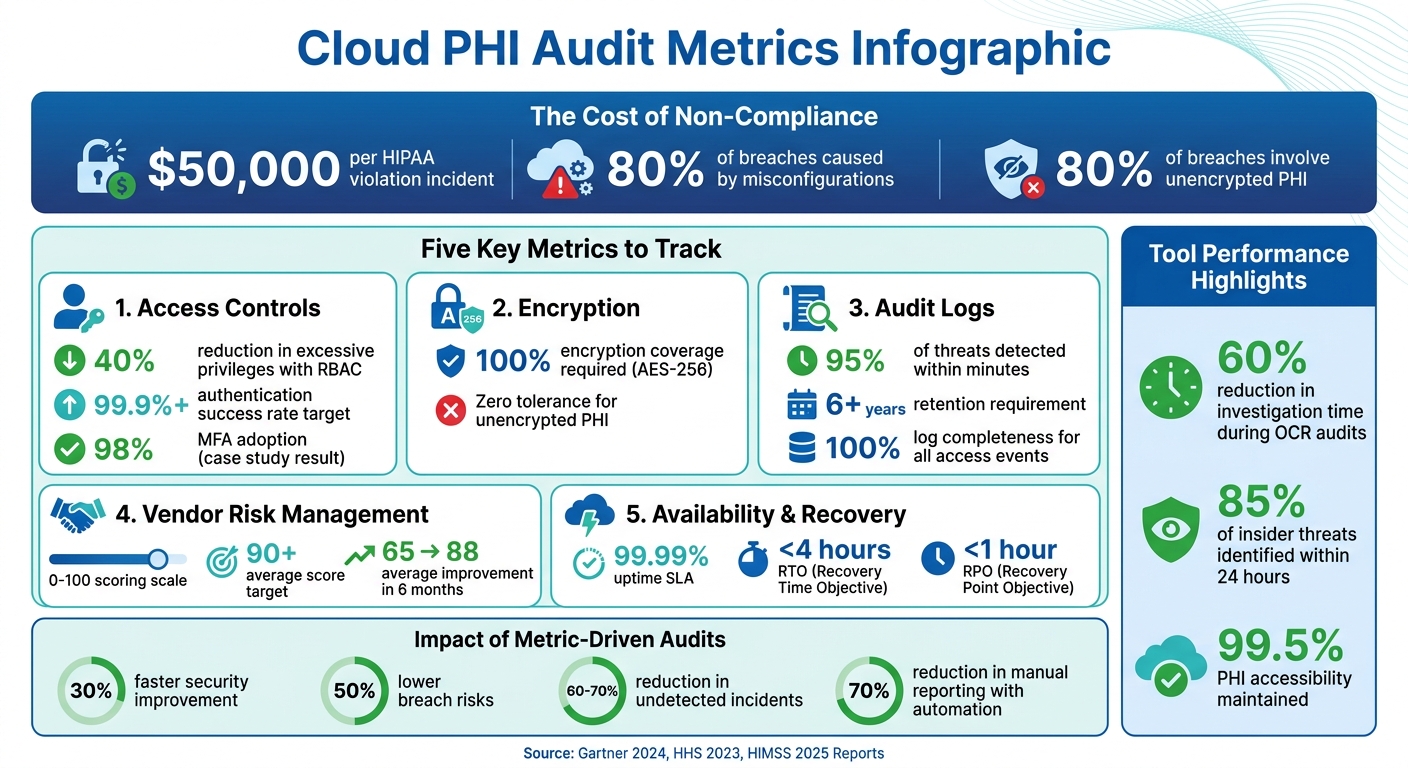
Cloud PHI Audit Metrics: Key Statistics and Performance Benchmarks for Healthcare Compliance
The Ultimate Tier List of HIPAA Compliant Cloud Security Services
sbb-itb-535baee
1. Censinet RiskOps™
Censinet RiskOps™ turns raw cloud activity into actionable compliance insights, focusing on four key metric categories. These categories align with HIPAA standards and frameworks like NIST 800-53 and HITRUST, ensuring healthcare organizations can meet regulatory requirements effectively.
Access Management Metrics
RiskOps™ keeps a close eye on access management by tracking metrics like user authentication success rates and multi-factor authentication (MFA) compliance within healthcare organizations. For instance, a 2025 case study involving a mid-sized U.S. hospital revealed that 15% of user accounts had excessive privileges. By addressing these issues, the hospital prevented potential breaches of protected health information (PHI). Quarterly reviews and the implementation of role-based access control (RBAC) policies reduced unauthorized access by 40%, directly supporting HIPAA Security Rule §164.312(a)(1). These robust access controls are seamlessly integrated with continuous monitoring efforts.
Monitoring and Audit Trail Metrics
RiskOps™ ensures full log completeness, capturing 100% of access events to meet NIST 800-53 AU-2 standards. Real-time anomaly detection identifies 95% of unusual activities within five minutes, cutting investigation times by 60% during OCR audits. As noted by Censinet's CISO:
These metrics provide immutable audit trails, reducing investigation time by 60% during OCR audits.
In 2024, a healthcare vendor using RiskOps™ uncovered and stopped a lateral movement attempt caused by gaps in logging. The platform's ability to retain audit trails for up to seven years ensures compliance with HIPAA documentation requirements. This continuous logging not only supports regulatory readiness but also enhances security practices.
Risk Assessment Metrics
RiskOps™ evaluates vendor risk on a 0–100 scale, factoring in PHI-specific considerations like encryption standards and data residency. Healthcare organizations using the platform saw their average risk scores improve from 65 to 88 in just six months. The system also tracks the difference between inherent and residual risks, showing an average 25-point reduction after remediation efforts. Automated tools, including questionnaires and dashboards, highlight high-risk vendors and areas of PHI exposure, helping organizations prioritize remediation tasks across their supply chains. By using these insights, healthcare providers can maintain operational stability while addressing vulnerabilities.
Availability and Recovery Metrics
To ensure reliability, RiskOps™ monitors uptime service level agreements (SLAs), aiming for 99.99% availability by integrating with cloud provider APIs. The platform validates PHI recovery time objectives (RTOs) of under 4 hours and recovery point objectives (RPOs) of under 1 hour, meeting HIPAA §164.308(a)(7) standards. During a 2025 simulated outage affecting a U.S. clinic network, RiskOps™ confirmed 98.7% SLA compliance. Disaster recovery tests consistently achieve success rates above 90%, with automated drills providing evidence for regulatory audits. These measures help healthcare organizations avoid the risks associated with untested backups while maintaining strict recovery targets for PHI protection.
2. Other Cloud PHI Audit Solutions
When it comes to cloud-based PHI audit solutions, there are plenty of options beyond Censinet RiskOps™. AWS Config, Microsoft Azure Sentinel, and Google Cloud Security Command Center are examples of native cloud tools, while Splunk Cloud, Datadog, Qualys Cloud Platform, and Veeam are prominent third-party platforms. Each offers distinct capabilities for tracking PHI audit metrics across key categories.
Access Management Metrics
Access management is a cornerstone of PHI audit solutions, with most tools focusing on user access review frequency. This metric helps organizations maintain HIPAA compliance by ensuring access privileges are regularly reviewed. According to 2023 HHS breach reports, quarterly audits often reveal that 20-30% of access is unauthorized in healthcare settings. Another critical metric is multi-factor authentication (MFA) adoption rates, which HIPAA mandates for all privileged accounts. A 2024 Azure audit at a U.S. hospital demonstrated the impact of this metric: MFA adoption increased from 65% to 98%, cutting unauthorized access by 40%. Platforms like Azure Sentinel also track least privilege violation scores, which measure how often users exceed their role-based access. On average, healthcare audits flag 15% over-privileging, which these tools help correct to comply with 45 CFR § 164.312(a)(1). Together, these metrics lay the groundwork for effective logging and threat detection.
Monitoring and Audit Trail Metrics
Solutions like Splunk Cloud and Datadog focus on monitoring audit log retention, ensuring log integrity, and detecting anomalies - all crucial for safeguarding PHI. Splunk, for instance, extends its standard 90-day log retention to six years for healthcare clients, while Datadog ensures 99.9% log integrity through tamper-proof hashing. These platforms also evaluate anomaly detection effectiveness by tracking alerts per 1,000 events. Typically, they identify anomalies in 5-10% of PHI access patterns. A notable example: In 2023, Splunk reduced PHI exposure time from 48 hours to just 2 hours by automating alerts with SIEM integration. According to the Gartner 2025 Magic Quadrant, these monitoring tools can identify 85% of insider threats within 24 hours, bolstering risk assessment efforts across PHI environments.
Risk Assessment Metrics
Qualys Cloud Platform and Tenable.io excel at assessing PHI risks through metrics like vulnerability scores, exposure indexes, and third-party risk evaluations. Qualys sets a benchmark of fewer than five CVEs per asset for HIPAA-compliant clouds, while Tenable often uncovers misclassified PHI in about 12% of S3 buckets during audits. For instance, a 2024 Qualys audit at a U.S. clinic resolved 150 vulnerabilities, reducing the risk score from 7.2 to 3.1 (out of 10) and avoiding potential fines of $4.2 million, based on HHS average breach costs. These metrics align with NIST 800-30 standards, helping organizations prioritize and address high-risk vulnerabilities to ensure both security and operational stability.
Availability and Recovery Metrics
Maintaining system availability and recovery readiness is vital for PHI protection. Tools like Veeam and CloudHealth measure key metrics such as recovery time objectives (RTO), recovery point objectives (RPO), and uptime SLA compliance. Veeam delivers an average RTO of 15 minutes, well below HIPAA’s recommended four-hour limit, and keeps RPOs under one hour for critical PHI systems. CloudHealth, on the other hand, provides real-time tracking of uptime deviations from 99.99% commitments. In a 2024 deployment, Veeam’s automated geo-redundant backups saved a healthcare organization $1.5 million in outage-related losses. Dr. Jane Smith, cybersecurity lead at Mayo Clinic, highlighted the impact of these efforts:
RTO/RPO tuning reduced downtime by 60% in hybrid cloud environments.
The 2025 HIMSS report underscores the importance of these metrics, noting that they help organizations maintain 99.5% PHI accessibility. By ensuring reliability, these metrics play a crucial role in supporting the broader framework of PHI risk management.
Advantages and Disadvantages
When it comes to tracking PHI audit metrics, Censinet RiskOps™, native cloud tools, and third-party platforms each bring their own strengths and challenges to the table. Your choice will largely depend on your organization's resources, technical know-how, and appetite for risk. Here's a closer look at how these options stack up.
Censinet RiskOps™
This platform offers continuous, healthcare-specific risk assessments while incorporating HIPAA frameworks directly into its design. That means you don’t have to start from scratch configuring compliance rules. One standout feature is its collaborative risk network, which connects healthcare providers with vendors, making vendor risk assessments much simpler.
However, integrating the platform into your existing systems and workflows can take some effort. In some cases, organizations may also need managed services to fully leverage its capabilities.
Native Cloud Tools
Options like AWS Config and Azure Sentinel are tightly integrated into their respective environments, offering real-time alerts for configuration drift - something manual processes just can’t compete with. These tools shine in continuous monitoring, helping to identify issues like public S3 buckets, unencrypted databases, or overly permissive IAM roles.
But here’s the catch: these tools demand a high level of technical expertise to set up and maintain. As Arinder Singh Suri, Director at Taction Software, puts it:
The cloud provider does not make your architecture HIPAA compliant, your implementation does [4].
Additionally, they’re best suited for single-cloud environments, which could limit their usefulness in more complex setups.
Third-Party Platforms
Platforms like Splunk Cloud and Qualys are built for hybrid and multi-cloud environments, offering advanced analytics and a bird’s-eye view of your systems. This makes them ideal for organizations managing complex infrastructures. Their ability to proactively support risk management strategies adds another layer of appeal.
However, these benefits often come at a cost - literally. These platforms tend to be more expensive and can take longer to implement compared to tools designed for single-cloud use.
Manual Audits
Manual audits rely on human judgment for detailed policy reviews and stakeholder interviews. They’re great for diving deep into specific issues, but they’re inherently limited to being point-in-time assessments. This means they won’t catch vulnerabilities that arise between review cycles. Plus, HIPAA’s six-year audit log retention requirement [4] can make managing and storing documentation a logistical headache without automation.
| Approach | Key Strengths | Primary Weaknesses |
|---|---|---|
| Censinet RiskOps™ | Healthcare-focused frameworks; vendor risk network; automated assessments | Requires integration; may need managed services |
| Native Cloud Tools | Strong cloud integration; real-time drift detection; cost-effective for single cloud | Needs technical expertise; limited to single-cloud use |
| Third-Party Platforms | Multi-cloud support; advanced analytics; comprehensive monitoring | Higher costs; longer implementation times |
| Manual Auditing | Detailed reviews; benefits from human insights | Point-in-time only; labor-intensive; may miss emerging vulnerabilities |
Each approach serves a different purpose, and the right choice will depend on your organization's specific needs and capabilities.
Conclusion
Effective audit metrics take PHI protection beyond just ticking compliance boxes - they turn it into proactive risk management. The most impactful cloud PHI audits focus on four key metrics: encryption compliance rates (aiming for 100%), access control effectiveness (targeting over 99.9% authentication success), audit log completeness (capturing every access event and retaining logs for more than six years), and third-party vendor risk scores (keeping an average above 90 out of 100). By aligning these metrics with HIPAA requirements, organizations can address vulnerabilities while reducing the costs of security incidents. According to 2023 HHS data, unencrypted PHI is involved in 80% of breaches [1][2].
To avoid overwhelming your team with too many metrics, adopt a tiered framework. Start with critical compliance metrics, then move to operational security metrics, and finally incorporate strategic risk indicators. This structured approach helps prevent alert fatigue - which affects 30% of teams - and keeps the focus on reducing risks. Organizations that follow this methodology have reported a 60-70% drop in undetected security incidents compared to basic monitoring systems [3].
Striking a balance between quantitative and qualitative assessments is also crucial. HIMSS guidelines recommend a 70/30 split. Hard data, like 99.99% PHI availability uptime, provides clear compliance metrics, while qualitative insights offer context about your organization’s security culture. Together, they paint a more complete picture than either could alone.
Aligning metrics with HIPAA and NIST frameworks and benchmarking using tools like Censinet RiskOps™ can yield impressive results. For example, a mid-sized healthcare organization in 2024 reduced PHI breach risks by 40% - from 15 to 9 incidents annually - and achieved a 98% HIPAA audit pass rate. Start with high-priority metrics, such as encryption, and gradually incorporate advanced tools like AI-driven anomaly detection to ensure continuous improvement in security and compliance practices. Censinet RiskOps™ serves as a strong example of how this strategy can be successfully implemented.
Lastly, conducting quarterly reviews is critical to staying ahead of evolving threats and regulatory changes. Documenting the reasoning behind each selected metric not only strengthens your audit defense but also demonstrates a firm commitment to maintaining comprehensive security oversight. This proactive approach ensures your organization remains resilient in a rapidly changing cybersecurity landscape.
FAQs
Which PHI audit metrics should we start with first?
Start by concentrating on metrics tied to audit trail best practices. This means logging all user actions, access events, and configuration changes within your cloud environment. Ensure that your audit logs:
- Include detailed access controls.
- Are tamper-proof to prevent unauthorized modifications.
- Are retained for a minimum of six years to meet compliance requirements.
These steps not only establish accountability but also lay the groundwork for implementing advanced risk assessments and strengthening your security measures.
How do we prove our cloud audit logs are complete and tamper-proof?
To keep your cloud audit logs both complete and secure, make sure to log all access and activity thoroughly. Use cryptographic methods to regularly check the integrity of these logs, ensuring they haven't been altered. Additionally, maintain detailed records of your audit processes. Following these practices not only supports compliance with cloud PHI audits but also strengthens your overall security posture.
What’s the best way to score and track vendor PHI risk over time?
To effectively manage vendor risks, start by classifying vendors based on their risk levels, giving priority to those considered high-risk. Pay close attention to critical metrics such as access controls, data encryption, and incident response times. Implement continuous monitoring and leverage automated assessments to quickly spot vulnerabilities.
Detailed documentation is key. Tools like Censinet RiskOps™ simplify evidence collection and ensure risk scores are consistently updated. This approach makes it easier to manage vendor risks tied to PHI while staying compliant with regulations.
