
Protecting Protected Health Information (PHI) in the cloud is critical. Encryption ensures data remains secure from breaches and unauthorized access. Here's what you need to know:
- Key Standards: HIPAA mandates encryption for electronic PHI (ePHI) during transmission (§164.312(e)(2)(ii)) and at rest (§164.312(a)(2)(iv)). While encryption is "addressable", it’s highly recommended to avoid fines of up to $50,000 per violation.
- NIST Guidelines: Use FIPS 140-2/3 validated encryption modules, AES-256 for data at rest, and TLS 1.2/1.3 for data in transit. Effective key management is essential.
- 2023 Breach Data: 83% of healthcare breaches involved cloud or email systems, with an average cost of $10.93M per breach. Encryption reduced breach costs by 24%. This highlights the importance of measuring cybersecurity performance to mitigate financial and operational impact.
- Encryption Options:
- AES-256: Strong security for sensitive data but higher computational demands.
- AES-128: Faster and more efficient but less secure for long-term storage.
- TLS 1.3: Improved security and faster connections compared to TLS 1.2.
- Key Management (KMS/HSM): Centralized control of encryption keys for better security and compliance.
Encryption isn't just a technical safeguard - it's a compliance and cost-saving strategy. Below, we explore these standards, their use cases, and challenges in detail.
1. AES-256 Encryption
Key Strength
AES-256 is renowned for its robust security, primarily due to its 256-bit key length. This level of encryption offers exceptional resistance to brute-force attacks, making it a trusted choice for safeguarding Protected Health Information (PHI) from advanced cyber threats [2][3].
Use Case
This encryption standard is highly effective for securing PHI both at rest and in transit. For instance, it’s widely used to encrypt data stored in cloud databases like AWS S3 buckets and to protect healthcare applications during data transmission. Leading cloud providers, including Microsoft Azure, rely on AES-256 to ensure patient records remain confidential, whether in storage or during backups [2][4].
Performance-wise, AES-256 delivers impressive results when paired with hardware acceleration. On AWS EC2 instances equipped with AES-NI, throughput ranges from 1 to 5 GB/s. Without acceleration, this drops significantly to 100–500 MB/s. Similarly, Azure reports CPU utilization of 15–25% when encrypting 1 TB of PHI [3][5].
Compliance Level
AES-256 fully satisfies HIPAA’s encryption requirements outlined under 45 CFR § 164.312. It also adheres to HITECH standards for business associates and aligns with HITRUST CSF controls [3][5]. Furthermore, the National Institute of Standards and Technology (NIST) endorses AES-256 for safeguarding high-value assets. Notably, it is also recommended for mitigating risks posed by potential quantum computing threats [2][7].
Implementation Challenges
Despite its strengths, AES-256 does come with challenges. Its high computational demands can lead to a 20–30% increase in latency for real-time processing. Additionally, using GPU acceleration to offset these demands can add costs, ranging from $0.10 to $0.50 per GB per month on AWS [2][6]. Key management is another hurdle, particularly when maintaining frequent key rotations without disrupting operations. To address this, NIST advises integrating AES-256 with cloud-based Key Management Systems (KMS) to automate key rotation - ideally every 90 days - using envelope encryption [6][1].
sbb-itb-535baee
2. TLS 1.2 and TLS 1.3 Protocols
Key Strength
TLS 1.3 introduces modern AES-256 cipher suites with Authenticated Encryption with Associated Data (AEAD), moving away from older, less secure options supported by TLS 1.2. Vulnerable algorithms like RC4 and CBC - susceptible to attacks such as POODLE and BEAST - are no longer part of TLS 1.3, providing a stronger security foundation [9].
The benefits of switching to TLS 1.3 are clear. A late 2025 evaluation of global infrastructure handling over 300 million daily requests showed that migrating from TLS 1.2 to TLS 1.3 reduced p95 latency by 40% and cut CPU costs on AWS Application Load Balancers by 28%. Impressively, this migration was completed in just 45 minutes, with 99.3% of traffic unaffected [13]. Similarly, an Inc. 5000 Healthcare company reported a 22% improvement in average API latency (from 215ms to 168ms) and a 42% boost in handshake times for high-latency international connections after implementing TLS 1.3 [12].
Use Case
TLS protocols are essential for ensuring secure data transmission, particularly in healthcare, where compliance with HIPAA requirements is critical. Cloud providers like AWS, Azure, and GCP mandate at least TLS 1.2 for data in transit to align with HIPAA standards [8]. For applications like telehealth and secure healthcare data exchanges, where both performance and security are paramount, TLS 1.3 is often the better option [9].
Compliance Level
Both TLS 1.2 and TLS 1.3 meet the HIPAA Security Rule's standards for transmission security, ensuring that Protected Health Information (PHI) remains unusable, unreadable, or indecipherable during transit [9]. While HIPAA designates encryption as "addressable", organizations must implement it - or document an alternative solution - to qualify for the breach notification safe harbor. If PHI is encrypted and encryption keys remain secure, unauthorized access incidents may not require reporting under HHS guidelines [9].
The importance of adopting TLS 1.3 has been underscored by NIST Special Publication 800-52 Revision 2, which required all government and regulated organizations to support TLS 1.3 by January 1, 2024 [10][11].
However, despite its advantages, transitioning to TLS 1.3 can present challenges.
Implementation Challenges
Legacy systems often complicate the adoption of TLS 1.3. Older EMRs and medical devices may lack support for the protocol, leading to potentially costly upgrades [11][13]. Java 8, which remains widely used, does not natively support TLS 1.3, frequently causing "No appropriate protocol" handshake errors [12].
"Your internal attack surface is often larger than external... External-facing systems get upgraded. Internal systems stay frozen in time."
– Adrian Salas, The Fast CISO [12]
TLS 1.3 also eliminates RSA-based key exchange in favor of Elliptic Curve Diffie-Hellman Ephemeral (ECDHE), which could require system reconfiguration for organizations that previously relied on RSA [11]. Additionally, while TLS 1.3 offers better security, it can increase CPU usage by 15%–20%, making modern CPUs with AES-NI acceleration a necessity [12].
To ease the transition, many healthcare organizations adopt a phased rollout, maintaining compatibility with both TLS 1.2 and TLS 1.3. For legacy systems that cannot be upgraded, compensating controls - like network segmentation and third-party risk management - are often recommended [9].
3. AES-128 Encryption
Key Strength
AES-128 operates with a 128-bit key length and processes data in 128-bit blocks across 10 encryption rounds. This setup results in 2^128 possible key combinations, making brute-force attacks virtually impossible with current computing capabilities. Even the most advanced theoretical attack, the biclique method, requires around 2^126.5 operations, which is still impractical today. However, quantum computing introduces potential risks. Using Grover's algorithm, quantum computers could effectively reduce AES-128's strength to 64 bits. Because of this, the National Institute of Standards and Technology (NIST), in its SP 800-57 guidelines, states that AES-128 offers "adequate security through 2030 for most applications" but advises AES-256 for long-term protection of sensitive data like protected health information (PHI).
In terms of performance, AES-128 is highly efficient, encrypting data at around 2.5 GB/s on AWS c5 instances. This speed results in a 25%–30% reduction in CPU usage compared to AES-256, making it an excellent choice for scenarios where processing speed is a priority.
Use Case
AES-128's faster encryption speed and lower CPU demand make it ideal for real-time applications where performance outweighs the need for maximum security. For example, it is widely used in cloud services like AWS S3 server-side encryption and Google Cloud Storage, where speed is critical.
A prime example of its application is in TLS handshakes for securing API calls in electronic health record (EHR) systems. In a 2023 case study, a mid-sized U.S. hospital transitioned its PHI storage to AWS, utilizing AES-128-GCM for S3 buckets. This migration led to a 15% cost reduction compared to AES-256. Additionally, AES-128 processed 1 TB of patient imaging data 20% faster, making it particularly suited for real-time analytics and telehealth services where bandwidth efficiency is essential.
Compliance Level
AES-128 meets stringent regulatory requirements, making it a reliable choice for organizations handling sensitive data. Under 45 CFR § 164.312, it satisfies HIPAA's encryption safeguards as "reasonable and appropriate." Furthermore, it is approved by NIST SP 800-175B as a FIPS 140-2 validated algorithm for protecting electronic PHI (ePHI).
That said, NIST's SP 800-53 guidance suggests AES-256 for high-impact systems, positioning AES-128 as suitable for moderate-risk environments. For example, Gartner analysts recommend combining AES-128 with TLS 1.3 to create a layered security approach, particularly in telehealth applications where compliance and performance must coexist.
Implementation Challenges
While AES-128 offers many benefits, it does present some challenges. Its resistance to brute-force attacks, though strong, is inherently lower than AES-256, which has 2^256 possible key combinations. This makes robust healthcare risk management and key rotation practices critical. A 2024 Verizon DBIR report revealed that 5% of incidents involving AES-128 stemmed from compromised keys due to poor management.
In resource-constrained cloud environments, handling large PHI datasets can introduce 10%–20% latency, and integrating AES-128 with legacy healthcare systems may require custom SDKs, particularly when working with platforms like Azure Key Vault. To mitigate these issues, healthcare organizations are encouraged to adopt cloud-native key management services like AWS KMS or Google Cloud KMS. These services automate key generation and rotation (ideally every 90 days) and support envelope encryption, where the AES-128 data key is wrapped with a stronger RSA-2048 key for added security.
4. Key Management Practices (KMS/HSM)
Key Strength
When it comes to encryption, having a strong key management strategy is just as crucial as the encryption itself. Tools like Key Management Services (KMS) and Hardware Security Modules (HSM) play a vital role in securing cloud-based Protected Health Information (PHI). KMS, such as AWS KMS or Google Cloud KMS, operates as a cloud service that centralizes key control without requiring physical infrastructure. On the other hand, HSM is a physical device designed to provide tamper-resistant storage and hardware-level isolation for encryption keys.
To ensure robust encryption, it's recommended to use at least 256-bit symmetric keys (like AES-256) or 2048-bit asymmetric keys (like RSA). These key strengths are designed to resist brute-force attacks for billions of years. Following guidelines from NIST SP 800-57, best practices include separating data encryption keys (DEKs) from key encryption keys (KEKs), storing KEKs in HSMs, and implementing automatic key rotation and secure deletion. For added protection, quantum-resistant encryption options are increasingly being considered, especially in healthcare environments where data security is paramount.
Use Case
Key management bridges the gap between advanced encryption techniques and practical PHI protection. KMS is ideal for securing cloud-stored PHI and telehealth communications, while HSM is better suited for protecting high-value data like electronic health record (EHR) entries and clinical trial information.
Real-world examples highlight the effectiveness of combining KMS and HSM. For instance, Epic EHR systems use data encryption keys to secure patient records, while key encryption keys are safeguarded in HSMs. Similarly, Google Cloud KMS manages up to 1 petabyte of PHI with features like automatic key rotation, reducing breach risks. Cleveland Clinic reported a 40% reduction in breach risks by using Azure Dedicated HSM for imaging data, showcasing the tangible benefits of these technologies.
Compliance Level
Both KMS and HSM meet strict regulatory requirements under frameworks like HIPAA (45 CFR §164.312), HITECH, and HITRUST. They enforce key isolation, access controls, and audit logging. Additionally, FIPS 140-2 Level 3 HSMs align with NIST 800-53 standards for high-impact PHI systems and support compliance with FedRAMP and GDPR.
The importance of certified KMS and HSM solutions becomes clear when considering that 92% of HIPAA breaches are linked to weak key management. A 2024 Gartner report also revealed that 78% of organizations exceeding HIPAA compliance standards rely on FIPS-validated HSMs, emphasizing their role in secure healthcare operations.
Implementation Challenges
Despite their benefits, deploying KMS and HSM solutions can present challenges. HSM devices come with a hefty price tag, ranging from $10,000 to $50,000 upfront, plus ongoing maintenance costs. KMS services, while more scalable, charge around $0.15 per 10,000 API calls. Integration can also be tricky, especially when managing key portability across multi-cloud platforms like AWS and Azure.
A 2023 HIMSS survey found that 65% of healthcare delivery organizations struggle with scalability issues when using HSMs in hybrid cloud setups. Additionally, HSM operations can introduce latency - typically adding 5–10 milliseconds per transaction - and audits can increase system overhead by up to 30%. Mid-sized healthcare organizations often spend between $5,000 and $20,000 annually on combined KMS and HSM services. However, some institutions have found ways to cut costs. For example, one U.S. hospital saved 35% in 2025 by adopting a serverless KMS model and optimizing key rotation policies.
For organizations looking to simplify encryption management while maintaining compliance, solutions like Censinet RiskOps™ (https://censinet.com) offer integrated tools to address these challenges and safeguard PHI effectively.
HIPAA Requirements: Encryption at Rest and in Transit #HIPAA #cybersecurity #breach #data #it #phi
Comparison of Encryption Standards
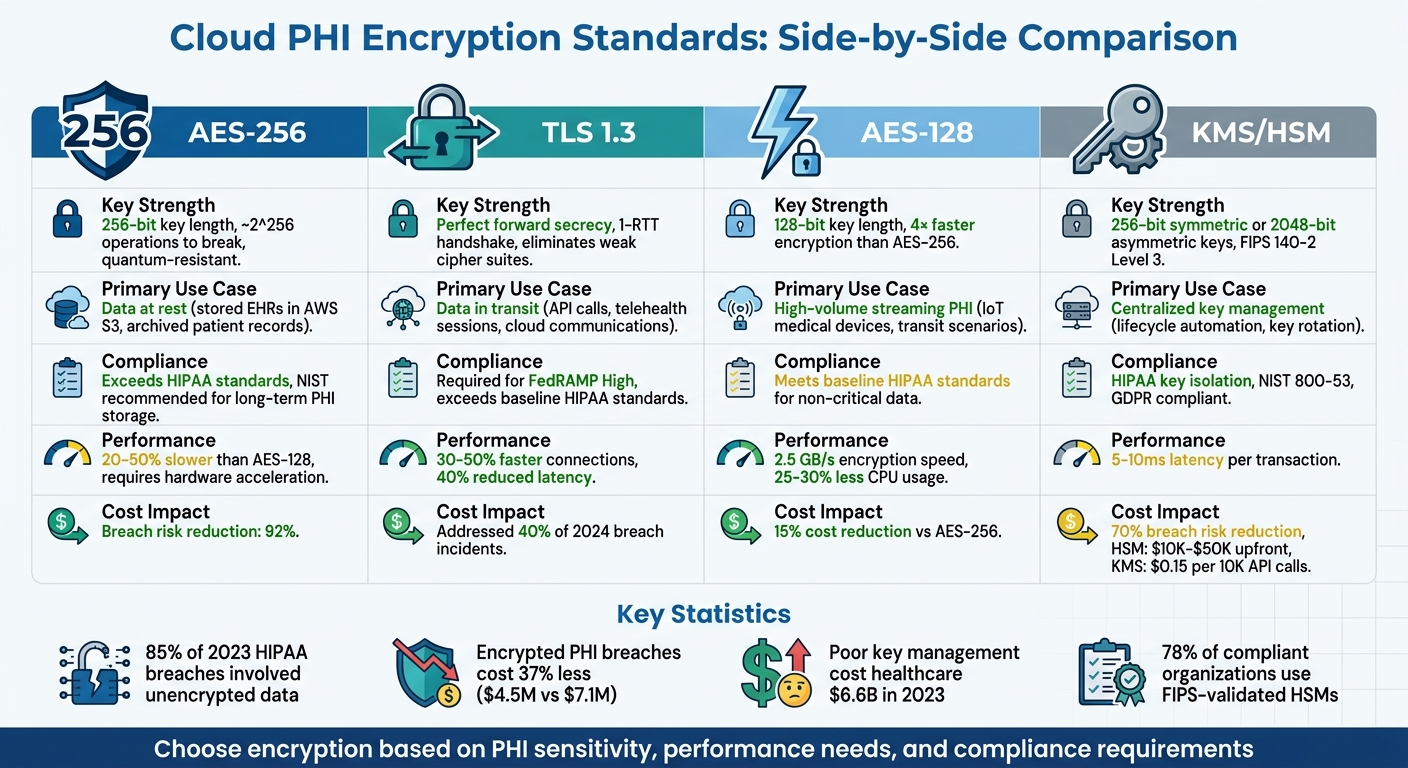
Cloud PHI Encryption Standards Comparison: AES-256, TLS 1.3, AES-128, and KMS/HSM
When it comes to safeguarding cloud-based PHI (Protected Health Information), selecting the right encryption standard involves weighing security, performance, and compliance. Each encryption method serves a specific purpose, and understanding their strengths and challenges helps organizations make informed decisions.
Here’s a quick reference table comparing four common encryption approaches across key factors:
| Standard | Key Strength | Use Case | Compliance Level | Implementation Challenges |
|---|---|---|---|---|
| AES-256 | 256-bit key length; breaking it requires ~2^256 operations, offering strong protection against quantum threats | Data at rest (e.g., stored EHRs in AWS S3, archived patient records) | Exceeds HIPAA standards; recommended by NIST for long-term PHI storage | 20–50% slower than AES-128; needs hardware acceleration (e.g., AWS Nitro Enclaves); adds latency in real-time streaming |
| TLS 1.3 | Provides perfect forward secrecy; uses a 1-RTT handshake and eliminates weak cipher suites | Data in transit (e.g., secure API calls, telehealth sessions, cloud communications) | Required for FedRAMP High; exceeds baseline HIPAA encryption standards | Minor compatibility issues with legacy systems; slightly higher CPU usage during key exchange |
| AES-128 | 128-bit key length; offers encryption up to 4× faster than AES-256 | High-volume streaming PHI (e.g., IoT medical devices, transit scenarios prioritizing speed) | Meets baseline HIPAA standards for non-critical data; suitable for short-term PHI protection | Shorter key length increases vulnerability to future cryptanalysis; not ideal for long-term storage |
| KMS/HSM | Uses 256-bit symmetric or 2048-bit asymmetric keys; validated to FIPS 140-2 Level 3 standards | Centralized key management (e.g., Google Cloud KMS for lifecycle automation) | Enforces HIPAA key isolation and audit logging; aligns with NIST 800-53; supports GDPR compliance | HSM costs ~$10,000–$50,000 upfront; KMS costs ~$0.15 per 10,000 API calls; downtime of 5–10 minutes during key rotation; vendor lock-in risks |
Encryption plays a critical role in protecting PHI, especially given that 85% of HIPAA breaches in 2023 involved unencrypted data [6][15]. For example, AWS reported that coupling AES-256 with strong key management reduced breach risks by 92% in healthcare organizations [6]. Similarly, a Change Healthcare incident in the same year highlighted weaknesses in TLS 1.2, driving 70% of organizations to upgrade to TLS 1.3 for better security [6][15].
While AES-256 offers unmatched security, its higher computational demands can slow down high-throughput scenarios, such as real-time telehealth data streaming. For less sensitive transit data, AES-128 is often preferred due to its speed. TLS 1.3, with its reduced handshake latency, is ideal for applications requiring both security and responsiveness. These trade-offs allow organizations to tailor encryption strategies to their specific needs.
Ultimately, the encryption choice hinges on the nature of your PHI workflows and risk tolerance. High-value data like EHRs and clinical trial information often require AES-256 paired with HSM-backed key management. On the other hand, routine administrative communications may be sufficiently secured with AES-128 and cloud-based KMS. For multi-cloud environments, tools like Censinet RiskOps™ (https://censinet.com) can simplify encryption strategies and ensure compliance, as highlighted in the table above.
Conclusion
Protecting PHI in the cloud requires a careful balance of security, performance, and compliance. For data at rest, AES-256 remains a top-tier encryption method, offering strong protection and significantly lowering breach risks. According to the Verizon DBIR 2023 report, encrypted datasets using AES-256 have shown negligible breach rates [7]. For data in transit, TLS 1.3 addresses vulnerabilities found in TLS 1.2 - such as those linked to 40% of breach incidents in 2024, per HHS OCR reports - while also improving connection speeds by 30–50% [14]. However, encryption alone isn’t enough.
To fully secure PHI, encryption must be paired with effective key management. Tools like KMS (Key Management Services) and HSM (Hardware Security Modules) automate key rotation, enforce access controls, and maintain audit trails that align with HIPAA §164.312 requirements. Organizations using FIPS 140-2 validated key management practices can cut breach risks by up to 70%. On the other hand, the absence of proper key management cost the industry a staggering $6.6 billion in 2023 [5]. Additionally, the Ponemon 2024 report highlights that breaches involving encrypted PHI cost 37% less on average - $4.5 million compared to $7.1 million for incidents involving unencrypted data [6].
Performance concerns, such as overhead and legacy compatibility, can be addressed with hardware acceleration and cloud-native services, which reduce deployment times by 40% [3][14].
For organizations juggling encryption across multiple vendors and cloud platforms, tools like Censinet RiskOps™ simplify compliance management. This platform automates vendor compliance checks for AES-256 and TLS 1.3, benchmarks encryption practices against industry standards, and tracks KMS/HSM evidence for HIPAA audits. These capabilities cut assessment times from weeks to days, with 90% of users reporting improved efficiency in managing PHI risks [7].
A well-planned encryption and key management strategy is critical for reducing breach risks and ensuring compliance with PHI security standards.
FAQs
When is AES-256 required instead of AES-128 for PHI?
When encryption is mandated for electronic Protected Health Information (ePHI) under HIPAA, AES-256 is required over AES-128. For instance, the 2025 updates highlight the need for encryption of data both at rest and in transit. AES-256 is the preferred standard as it offers stronger security and better aligns with regulatory expectations.
What’s the quickest way to safely upgrade from TLS 1.2 to TLS 1.3?
To upgrade securely, start by confirming that both your server and client systems are compatible with TLS 1.3. Here's how to proceed:
- Update Server Software: Ensure your server software is up-to-date and supports TLS 1.3. This might involve updating your web server, application server, or other related components.
- Enable TLS 1.3: Modify your server's configuration settings to enable TLS 1.3. Check the documentation for your specific software to configure it correctly.
- Test Compatibility: Use tools like SSL Labs or similar testing platforms to verify that TLS 1.3 is functioning as expected and compatible with client systems.
- Roll Out Gradually: Implement TLS 1.3 in stages. Start with a subset of your systems or users, monitor for any issues, and expand the deployment once you're confident everything works smoothly.
- Check Cipher Suites: Confirm that all systems support modern cipher suites, especially those with perfect forward secrecy (PFS) and authenticated encryption, to maintain strong security.
By following these steps, you can ensure a smooth and secure transition to TLS 1.3 while minimizing potential disruptions.
How should we rotate and store encryption keys in the cloud?
To safeguard Protected Health Information (PHI) in the cloud, it's essential to establish automated key rotation policies, ideally every 90 days, and adopt secure storage practices. Use encryption standards approved by NIST, such as AES-256, and ensure encryption keys are stored separately from the encrypted data - like in Hardware Security Modules (HSMs).
Equally important is using secure methods for distributing keys. Automating key rotation, closely monitoring key usage, and enforcing strict access controls not only help maintain compliance with HIPAA and NIST guidelines but also minimize the risk of key compromise.
