
If you only watch the device, you're missing part of the risk. Cloud services, APIs, user accounts, and PHI data paths can all affect care when something goes wrong.
I’d sum the article up like this: you need one monitoring scope, clear owners, centralized logs, and response playbooks tied to patient impact. That matters because recent figures in the article show 99% of hospitals have at least one device with an actively exploited flaw, 60% of devices are end-of-life, and 24% of healthcare groups reported attacks that hit medical devices.
Here’s the short version:
- I’d monitor five layers: device, network/connectivity, cloud, API, and PHI data flow
- I’d assign ownership across biomed, IT, cloud, app teams, API teams, and SecOps
- I’d collect logs from device consoles, cloud audit tools, IAM, API gateways, network sensors, and clinical apps
- I’d watch for identity misuse, cloud config drift, API misuse, missing logs, odd outbound traffic, and patch gaps
- I’d rank alerts by patient safety, PHI exposure, internet access, integration depth, and downtime impact
- I’d send all high-value telemetry into a single detection layer for correlation
- I’d build response steps for stolen portal credentials, exposed PHI, suspicious API calls, ransomware signs, and vendor outages
- I’d validate controls after firmware, identity, cloud, and network changes
A simple way to think about it: medical device security now includes the cloud systems around the device, not just the hardware itself. The rest of the article explains how to set that scope, what to log, what to alert on, and how to tie response back to care risk.
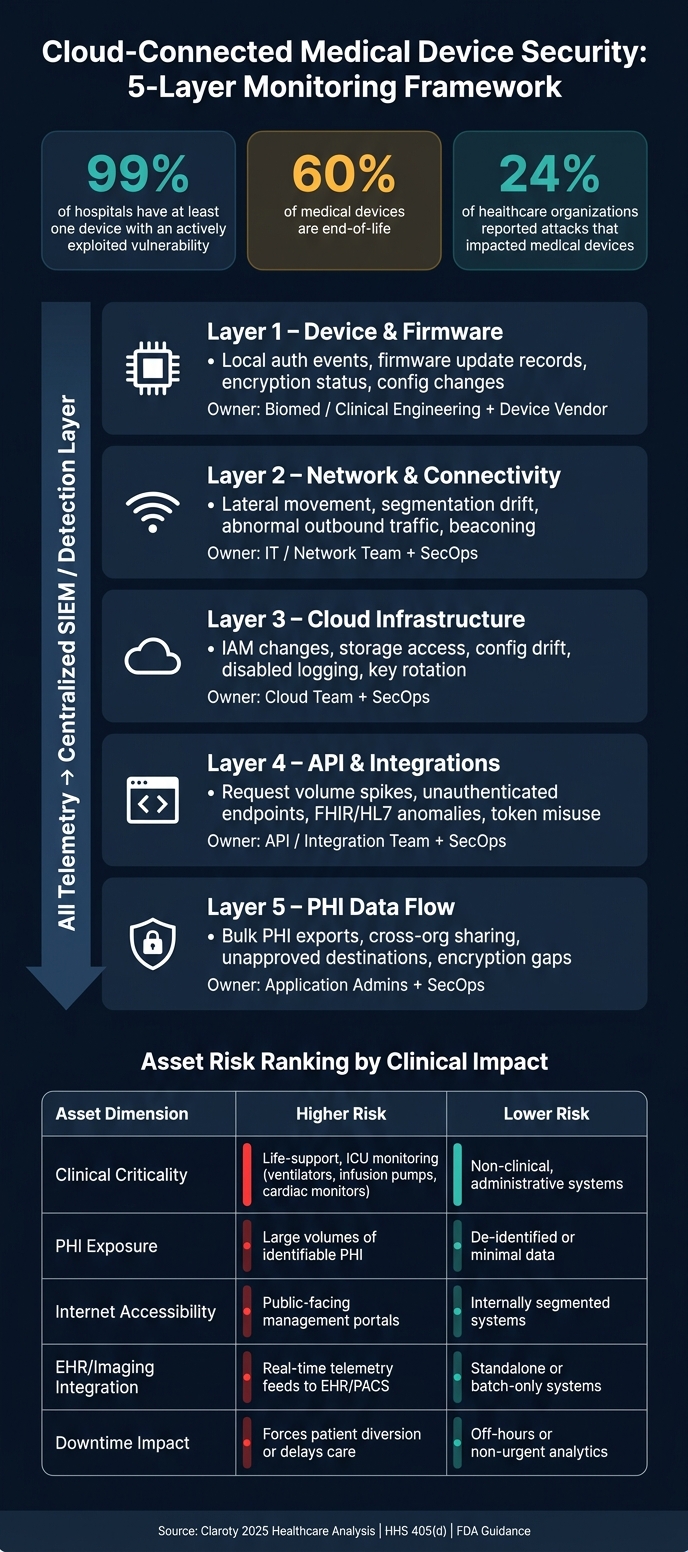
Medical Device Cloud Security: 5-Layer Monitoring Framework
Everything You Need to Know About Medical Device Cybersecurity
sbb-itb-535baee
Define Your Monitoring Scope and the Threats That Matter Most
Set your monitoring scope before you pick tools or build alerts. If you skip this step, the rest gets messy fast. And the scope isn't just the device. It shapes what telemetry you collect and how your alerts should behave.
Map the Monitoring Boundary Across Device, Cloud, API, and Data Layers
In practice, the monitoring boundary stretches across the embedded device and firmware, the connectivity layer like Wi‑Fi, cellular, and VPN, cloud infrastructure and platforms, SaaS applications, API gateways and integration points, and PHI data flows moving between systems. Each layer needs its own telemetry source, a named owner, and a path into central detection.
That ownership has to be explicit. Biomedical engineering should own device telemetry and updates. IT and cloud teams should own IAM and infrastructure logs. Application admins should own SaaS events. API teams should own gateway logs. Security operations should tie it all together through correlation. HHS 405(d) says this plainly: organizations should know who is responsible for security settings, software updates, compensating controls, and monitoring for each network-connected device.[3][4] If no one owns a layer, centralized monitoring falls apart.
You also need to trace how patient data moves from device to gateway to cloud destination, including EHRs, PACS archives, and analytics platforms. Mark each hop with its encryption status, access controls, and logging owner. That map helps you decide where alerts need to be tightest. The places where PHI is most concentrated or most exposed deserve the strictest thresholds.
Which Vulnerabilities and Attack Patterns to Track
Focus on the medical device security risks most likely to disrupt care or hit operations where it hurts.
Access and identity abuse should be near the top of the list. That includes repeated failed logins to device management portals, missing MFA on cloud consoles, shared or default accounts, and privilege escalation in cloud IAM or SaaS admin roles. Privilege escalation and lateral movement matter just as much, especially when a low-privilege account suddenly starts touching sensitive systems.
Cloud misconfigurations are another major source of risk. Watch for publicly exposed storage buckets, overly permissive security groups, disabled encryption at rest, and disabled logging or monitoring services. APIs need close attention too. Look for insecure and abused APIs, such as unauthenticated endpoints, excessive token scope, spikes in request volume, and attempts to bypass the gateway.
A few other signals deserve a place on your watch list:
- Abnormal outbound traffic from device networks or cloud workloads
- Device spoofing, such as multiple devices claiming the same identity or registering from impossible locations
- Audit log gaps or tampering
- Unapproved configuration changes to firewall rules or EHR integrations
You should also monitor CISA KEV and NIST NVD entries, then match them against your device and software inventory. That's not busywork. It's one of the clearest ways to stay ahead of supply chain risk. Claroty's 2025 analysis of 351 healthcare organizations found that 89% had medical systems vulnerable to publicly available exploits and insecurely connected to the internet, and 99% had at least some devices with known exploited vulnerabilities (KEVs).[1]
Rank Risk by Patient Impact and Operational Dependency
Risk ranking should start with patient safety and care continuity. A privilege escalation on an admin account that manages real-time ICU telemetry is a critical event. A failed login on a non-clinical training portal isn't in the same league.
Score each asset based on clinical criticality, PHI exposure, internet access, integration depth, and downtime impact. Life-support and ICU monitoring devices like ventilators, infusion pumps, and cardiac monitors belong in the top tier. Diagnostic and imaging systems fall in the middle. Back-office systems sit lower. FDA guidance backs this approach and recommends a separate security risk assessment alongside a safety risk assessment, so teams can catch patient harm scenarios that a plain technical severity score might miss.[2]
| Asset dimension | Higher risk | Lower risk |
|---|---|---|
| Clinical criticality | Life-support, ICU monitoring | Non-clinical, administrative |
| PHI exposure | Large volumes of identifiable PHI | De-identified or minimal data |
| Internet accessibility | Public-facing management portals | Internally segmented systems |
| EHR/imaging integration | Real-time telemetry feeds to EHR/PACS | Standalone or batch-only systems |
| Downtime impact | Forces patient diversion or delays care | Off-hours or non-urgent analytics |
Censinet RiskOps™ can help connect asset profiles to risk scores and response levels. With scope and priority set, the next move is to centralize telemetry and detection.
Build a Monitoring Architecture and Centralize Telemetry
Once you've identified high-risk assets, the next step is simple in theory and hard in practice: collect telemetry that shows when those assets drift from normal behavior.
Then make sure signals from every layer reach one team that can act. That means sending data into a single detection environment instead of leaving it scattered across vendor dashboards. If telemetry stops, detection stops, and patient-facing risk goes up.
Collect the Right Logs and Events for Continuous Monitoring
Use the monitoring boundary you defined earlier to decide what needs to be logged. The FDA expects event detection, logging, and clear documentation for forensic capture, log storage, and automated analysis.[5][6]
At the device layer, collect:
- Device logs
- Firmware update records
- Local authentication events
- Encryption status
At the cloud layer, collect cloud audit logs, IAM changes, key events, and PHI-related storage access.
For agentless devices, pull logs from vendor consoles through syslog, SFTP, or APIs. If that isn't possible, capture behavior with SPAN ports or NDR sensors.
At the cloud platform layer, turn on audit logging across every account and project, including AWS CloudTrail, Azure Activity Logs, and GCP Audit Logs. Put organization-level policies in place so logging can't be turned off without change control.
From the identity layer, collect SSO logins, MFA challenges, failed authentication attempts, and privilege escalations. Pay close attention to emergency admin accounts.
API gateway logs should record request metadata, client identifiers, error rates, and rate-limiting events. That includes FHIR and HL7 interface activity.
You should also collect network flow logs, vulnerability scan results, and patch status by device group.
Treat logs like sensitive data, because they are. Minimize PHI in logs whenever you can. If identifiers must stay, mask or tokenize them. Encrypt logs in transit and at rest, use append-only or WORM storage, and limit access with role-based controls. Retention should line up with HIPAA's six-year minimum.[7][8]
Once these feeds are centralized, correlation turns raw events into alerts.
Correlate Signals in a SIEM or Equivalent Detection Layer
Logs don't become useful alerts on their own. They need correlation.
Centralize telemetry in a SIEM or another detection platform so events can be tied together and turned into alerts.
Start with normalization. Map incoming events to a standard schema with shared fields like user, source IP, device ID, action type, resource, and outcome. That's how you correlate data across systems that were never built to talk to each other.
Then enrich each event with asset context, such as device criticality, vendor risk tier, facility location, and whether the device handles PHI.
From there, build detections around four main categories:
- Unusual access: failed logins followed by success from new geolocations, emergency admin account use outside approved windows, and privilege escalations tied to device administration roles
- Data exfiltration: bulk PHI exports from cloud storage or APIs that exceed normal volumes, odd FHIR query patterns, and large outbound transfers to unapproved IP ranges
- Control tampering: encryption, logging, or backup settings being disabled, or security tools being turned off on device servers
- Configuration drift: changes to firewall rules, security group settings, or IAM roles that move away from approved baselines
Severity scoring in the SIEM should reflect clinical risk, not just technical severity. A disabled logging service on a life-support device management server should trigger a very different response than the same event on a lower-risk analytics workload.
Monitoring Sources, What They Detect, and Who Owns Them
Map each telemetry source to the control it protects and the team that owns it.
| Monitoring Source | What It Detects | Primary Owner |
|---|---|---|
| Device system and application logs | Local auth events, firmware changes, device errors, config changes | Device vendor + Biomed/Clinical Engineering |
| Cloud audit logs (CloudTrail, Azure Activity Logs, GCP Audit Logs) | IAM changes, resource creation/deletion, PHI storage access, key rotation | Cloud team + SecOps |
| Identity provider logs | SSO logins, MFA challenges, failed auth, privilege escalation | IAM/IT team + SecOps |
| API gateway logs | Request volume, error rates, client identifiers, rate-limiting events | API/Integration team + SecOps |
| Network flow logs and NDR/IDS events | Lateral movement, scanning, abnormal outbound traffic, east-west anomalies | IT/Network team + SecOps |
| Vulnerability scanner and patch telemetry | CVEs affecting device OS/firmware, missing patches, unapproved versions | SecOps + Biomed |
| Key and secret management logs (KMS/HSM) | Key rotation, access by principals, cryptographic failures | Cloud team + SecOps |
| Clinical application logs (EHR, PACS, FHIR interfaces) | User activity, bulk data exports, cross-org data sharing, failed auth | Application admins + SecOps |
Device vendors should provide proprietary logs to the HDO under Business Associate Agreements. Clinical engineering shares ownership of asset inventory and criticality data. Device vendors, HDO IT and cloud teams, and SecOps all share responsibility for log access, correlation, and response.
Monitoring only works when every source has a named owner and a direct path into SecOps.
Apply Continuous Monitoring Controls Across the Device Lifecycle
Use centralized telemetry to track the controls that can change device risk after deployment. That means watching the full lifecycle: deployment, day-to-day use, patching, vendor access changes, and decommissioning. The goal is simple: spot control drift after a device goes live, not months later when the damage is already done.
Monitor Identity, Access, and Encryption Controls
Keep a close eye on identity, encryption, patching, and network controls because these are the ones that tend to drift over time. If any account with access to device management consoles or PHI systems lacks MFA, flag it at once. Also watch for service-account activity that breaks from its usual pattern, along with privileged role changes tied to device administration roles.
Alert on encryption changes or any disablement of data at rest or in transit. Add firmware integrity checks too, so firmware integrity stays under continuous monitoring. All of these control changes should flow into the same detection layer described above.
Track Vulnerabilities, Patches, and Supply Chain Exposure
Use SBOM mappings to identify affected devices when new CVEs or KEVs appear. Track patch SLAs by device group, and send vendor advisories into the same remediation workflow. This streamlines third-party risk management across the device fleet. If a device misses its patch SLA, flag it.
Known Exploited Vulnerabilities should get priority review, not just another entry in the standard patch queue. If patching has to wait, document the exception, apply compensating controls, and set a review date.
Watch Network Behavior and Alert on PHI or Availability Risk
Network behavior monitoring helps catch threats that slip past identity and endpoint controls. Watch for segmentation drift, unapproved outbound destinations, beaconing, and lateral movement between device and clinical segments.
Segmentation drift is especially dangerous in healthcare settings because many legacy devices depend on network isolation as their main control. If a configuration change lets a legacy device move outside its isolated segment, treat that as a critical alert.
Unusual outbound activity from a device segment that handles PHI or supports life-sustaining care should trigger immediate escalation. Route ransomware indicators to incident response. Then send those alerts into the incident response workflow next.
Operationalize Response, Validation, and Governance
Detecting a threat is only half the job. What happens next matters just as much. Response speed, post-incident validation, and day-to-day governance decide whether your program cuts risk or just piles up alerts.
Build Incident Response Playbooks for Cloud-Connected Devices
Generic playbooks fall apart with medical devices. Each one should map to the alert source and asset tier already identified earlier - IAM, API, cloud storage, and network telemetry - and should focus on the incident types that hit cloud-connected clinical tech most often.
That includes:
- Compromised credentials for device management portals
- Suspicious or unauthorized API calls
- Cloud misconfigurations that expose PHI
- Abnormal device-to-cloud traffic that points to command-and-control activity
- Vendor platform outages
- Availability failures that disrupt patient care workflows
Each playbook should cover detection, containment, eradication, recovery, and review. Containment should depend on asset criticality from monitoring. For devices used in therapy delivery or diagnostics, targeted isolation is often the better move than full disconnection, because it can preserve clinical connectivity that care teams still need.
Document that choice in a structured template. At a minimum, capture the severity tier, clinical criticality, and available backup options.
Recovery needs more than a quick check. Teams should reconfirm device outputs against known test cases, verify that alert thresholds and dosing parameters still match validated baselines, and bring in clinical engineering and medical leadership before putting any device back into production.
Playbooks should also include HIPAA breach assessment steps and note whether the event triggers FDA reporting duties under 21 CFR Part 806.
Validate Controls After Changes and Document Ongoing Assurance
Every change in a cloud-connected device environment needs documented post-change validation before the ticket can close. That includes firmware updates, cloud configuration adjustments, identity policy changes, and network segmentation modifications.
After a firmware update, run regression tests to confirm that logging, encryption, authentication flows, and secure boot checks still work as expected. After cloud configuration changes, combine automated policy scans with manual access review to confirm PHI stays restricted. After identity policy updates, test all relevant user roles - biomedical engineers, clinicians, and vendor support - to make sure least-privilege access and session controls are working.
Record each validation step in the change ticket for audit traceability.
Use Risk Operations to Sustain Monitoring at Scale
Incident data and alert trends should shape governance decisions, not just one-off fixes. A cross-functional governance group - security leadership, clinical engineering, IT, compliance, and clinical stakeholders - should meet on a regular basis to review curated risk summaries instead of raw dashboards.
That group should also set clear action triggers tied to the same clinical-criticality and PHI-risk thresholds used earlier in the guide. For example, if a device category goes beyond a set threshold of security alerts, that should automatically trigger a vendor review and a possible configuration change.
At scale, manual governance breaks down. Censinet RiskOps™ can centralize assessments, benchmarking, and shared remediation for device, application, and cloud risk, turning monitoring output into tracked vendor action and steady control tuning.
FAQs
Why isn’t device-only monitoring enough?
Device-only monitoring leaves blind spots across the rest of the system. That includes companion apps, backend services, update servers, and cloud connections where PHI, keys, settings, and telemetry move from place to place.
If you watch ONLY the endpoint, you can miss problems in data intake, storage, and access routes. That can also leave compliance gaps.
There’s another issue: many devices can’t be patched or scanned without risk or extra effort. In those cases, passive, continuous, network-based visibility gives teams a safer way to spot threats early without getting in the way of care.
Which logs matter most for cloud-connected medical devices?
Focus first on logs that show how the device talks and who is trying to use it.
That usually means pulling from sources like:
- Network flow data
- Protocol metadata
- DNS and DHCP
- Firewall events
- Authentication attempts
- Account lockouts
- Privilege escalations
- Configuration changes
- Firmware updates
- Remote access sessions
You should also log any attempt to change or turn off audit settings. That kind of activity can be an early sign that someone is trying to hide what they're doing.
Sending these logs into a SIEM makes it much easier to connect technical activity with clinical context and risk scores.
How should we prioritize alerts that could affect patient care?
Put alerts in order based on how much they could interrupt patient care or lead to direct harm. Start by mapping each device to its clinical role, then give more weight to alerts tied to devices that matter most to patient outcomes.
Next, compare alerts with performance data so you can tell the difference between a harmless oddity and an active threat. And before taking a device off the network, confirm the alert with biomedical, security, and clinical teams.
