
Most healthcare cyber incidents trace back to the same few failures: people and process mistakes, weak system controls, and poor vendor oversight. In this analysis, I’d boil it down to this: staff-targeted attacks drive much of the problem, old and unpatched systems stay in use, identity controls still fail under pressure, and third-party risk can spread one breach across the healthcare chain.
If you want the short version, here it is:
- Human and process failure shows up first: people-focused attacks account for 71% of healthcare cyberattacks.
- Old systems remain a major gap: 96% of hospitals report end-of-life software or systems with known flaws.
- Attackers move fast after first access: average lateral movement happens in 1 hour and 28 minutes.
- Identity is still a weak spot: MFA use is high, but phishing and prompt-based bypasses still work.
- Cloud and asset tracking lag behind: cloud exploitation is up 95% since 2021, and asset visibility sits at about 50%.
- Vendor risk is a direct care risk: the Change Healthcare attack showed how one third party can disrupt billing, care, and patient safety.
What stands out to me is simple: healthcare does not mainly have a knowledge problem. It has a follow-through problem. The article points to three repeat causes you can track in every incident review: human and process failures, technical weaknesses, and third-party or organizational drivers.
| Root cause group | What it looks like | Why it keeps leading to incidents |
|---|---|---|
| Human and process failures | phishing, weak offboarding, poor access reviews, staff mistakes | Attackers target busy users and weak day-to-day controls |
| Technical weaknesses | unpatched systems, weak credentials, cloud misconfigurations | Known gaps stay open long enough to be used |
| Organizational and third-party drivers | low visibility, staffing limits, vendor oversight gaps | Teams can’t fix or track risk across complex healthcare environments |
So if I were summarizing the article in one line, it would be this: healthcare breaches often start with a simple mistake, grow through weak controls, and spread through connected vendors.
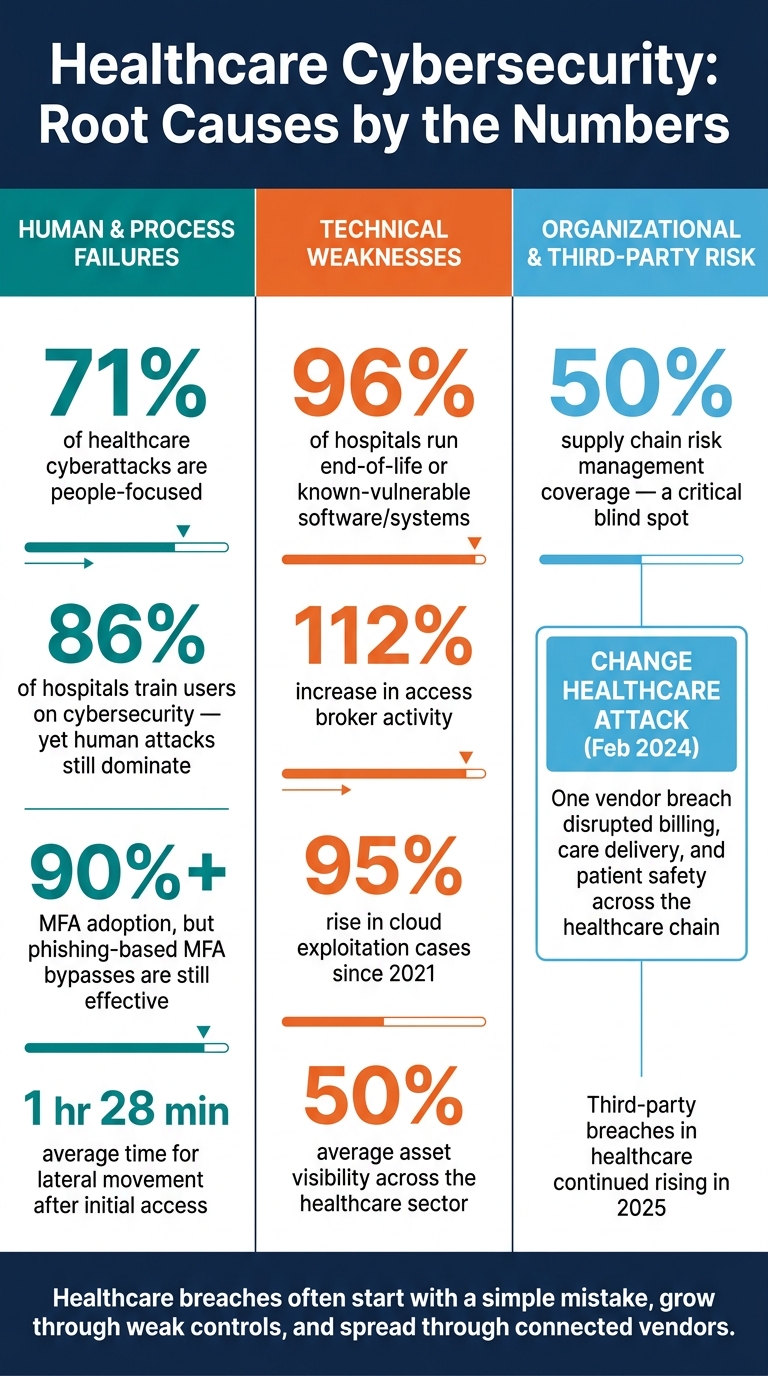
Healthcare Cybersecurity: Key Statistics & Root Causes at a Glance
Summit Conversations - Healthcare Cyber Security Threats
sbb-itb-535baee
Human and Process Failures as Leading Root Causes
Attacks aimed at people make up 71% of healthcare cyberattacks, which points straight to behavior, process, and governance breakdowns.[1] In practice, these problems show up first in identity, access, and user-behavior controls. Attackers often get in by fooling staff into approving a fake multi-factor authentication prompt or by using stolen credentials bought through access brokers.[1]
Employee Error, Negligence, and Insider Misuse
Most of the weak spots are ordinary day-to-day issues: poor handling of PHI, misconfigured cloud systems, weak credential habits, and accounts that stay active after someone leaves or moves into a new role. Those human and process failures give attackers the openings they need. The same patterns keep showing up: phishing, access failures, employee mistakes, weak training transfer, and credential misuse.
The hard part is how fast things move after that first mistake. Once an attacker gets a foothold through human error, lateral movement to another system takes an average of just 1 hour and 28 minutes.[1] That gives security teams almost no breathing room for detection and response.
Weak Security Processes and Uneven Enforcement
A policy can look solid on paper and still fall apart in daily use. In healthcare, constant onboarding and offboarding put account lifecycle management under steady strain. Accounts that should be disabled often remain active, and temporary access that should expire often does not.
Change management is another soft spot. In busy clinical settings, patches are delayed and configurations drift when teams are under time pressure. These failures are easy to miss because they build quietly, one small gap at a time, until an attacker finds a way in.
Training and Culture Gaps in Care Settings
86% of surveyed hospitals report that their users are trained on cybersecurity duties, yet people-focused attacks still make up most incidents.[1] That gap says a lot. Annual compliance modules and checkbox acknowledgments do not hold up well in the middle of a fast, distracting clinical shift, and social engineering tactics change faster than many training programs do.
MFA shows the problem clearly. Adoption has passed 90% in surveyed hospitals.[1] That's progress. But attackers have shifted too, using social engineering built to get around MFA.[1] And the day-to-day habits needed to use MFA well often lag behind the tool itself. Security expectations are not reinforced the same way during busy clinical workflows, which leaves staff exposed even when the control exists.
These same process gaps often stack on top of technical weaknesses that attackers go after next. The next root causes are technical: vulnerabilities, credential abuse, and misconfiguration.
Technical Weaknesses That Attackers Repeatedly Exploit
Human mistakes may open the door. But broken or missing technical controls are what let attackers get inside and move around.
In healthcare breach investigations, the same three weak spots keep showing up: unsupported and unpatched systems, weak identity controls, and misconfigured infrastructure.
Known Vulnerabilities and Legacy Clinical Systems
Legacy systems are still one of the biggest weak points in healthcare. 96% of hospitals report EOL software or known-vulnerable systems, including medical devices, and patching is hard when clinical uptime can't slip. [1]
That creates a rough tradeoff. Hospitals need systems available at all times, but attackers don't wait for a safe maintenance window.
Quarterly scanning does not equal remediation. [1]
That line gets to the heart of the issue. Finding security gaps is only the first step. Closing them is the harder part, and vulnerability management in healthcare still needs urgent work. Those gaps get even riskier when weak credentials and poor cloud controls are part of the mix.
Credential Abuse and Weak Identity Controls
MFA helps, but it doesn't solve everything. Stolen credentials and phishing-based MFA bypasses still play a major role in unauthorized access, and access broker activity has increased 112%. [1] In many cases, these paths lead straight to PHI databases, EHR platforms, and administrative consoles.
The problem is simple: if attackers have valid credentials, they can log in without using a standard exploit. That means weak identity controls can turn a human mistake into direct access to clinical and administrative systems. And once identity controls break down, misconfigured cloud and connected systems give attackers more room to move.
Misconfigurations Across Cloud and Connected Systems
Cloud use has grown fast in healthcare, but secure configuration hasn't kept pace. Cloud exploitation cases have risen 95% since 2021. [1] At the center of the problem is visibility.
Asset visibility averages just 50% across the sector, which makes it harder to secure what is actually connected. [3] You can't protect systems you can't fully see. And once attackers get a foothold, they can move laterally in about 1 hour and 28 minutes. [1]
These weak points are hardest to fix in complex care settings, where teams deal with limited visibility, tight budgets, and a long list of third-party dependencies.
Healthcare-Specific Organizational and Third-Party Risk Drivers
In healthcare, technical gaps stick around because care settings are hard to manage and vendors are woven into daily operations [2]. Fixing issues isn't always a simple patch-and-move-on job. Staffing gaps, weak asset visibility, and uneven vendor oversight all make the problem worse.
Complex Environments, Medical Devices, and Limited Visibility
Healthcare organizations are juggling EHRs, legacy clinical systems, connected medical devices, and clinical applications. That's a lot of moving parts, and not all of them are easy to track.
In the 2025 Healthcare Cybersecurity Benchmarking Study, supply chain risk management and asset management both reached only 50% coverage [3]. That kind of partial coverage creates blind spots. And when teams can't fully see what they own or what their vendors touch, patching slows down, monitoring gets spotty, and incident containment takes longer. In healthcare, those gaps aren't just IT problems. Medical device weaknesses can directly affect care delivery and patient safety [3].
Staffing, Budget, and Compliance-Driven Decision-Making
Staffing and budget limits can turn known weaknesses into repeat incidents [3]. Teams may know where the problems are, but they don't always have the people, time, or money to fix them fast enough.
"The sector is continuing to take a reactive, rather than proactive, approach to reducing risk." - Jill Hughes, Associate Editor, TechTarget [3]
That reactive pattern shows up in how security choices get made. In many cases, decisions are shaped by the push to lower cybersecurity insurance premiums [3]. Frameworks like NIST CSF 2.0 and the Healthcare and Public Health Cybersecurity Performance Goals are gaining traction, but maturity still varies a lot from one organization to another. As a result, known vulnerabilities can remain in place even when the playbook for dealing with them already exists [2].
Third-Party and Supply Chain Governance Gaps
These same pressures are often easiest to spot in vendor governance. Vendors, business associates, and supply chain partners are deeply tied to healthcare operations, so one outage or breach can ripple across care delivery, finance, and patient safety [2]. It's a domino effect, and healthcare has a lot of dominoes.
Third-party breaches in healthcare kept rising in 2025 [3]. The February 2024 Change Healthcare cyberattack showed how connected these relationships have become and how far the fallout can spread [2].
"The low coverage for Supply Chain Risk Management is especially concerning, as the number of third-party breaches in the healthcare industry has continued to increase year over year." - 2025 Healthcare Cybersecurity Benchmarking Study [3]
What the Research Suggests for Reducing Root Causes
Map Incidents to Repeatable Root Cause Categories
The recurring patterns in these incidents suggest a clear next move: use the same system to classify every incident.
Benchmarking shows that healthcare tends to be better at reacting to incidents than stopping the conditions behind them in the first place. [3] That matters, because if every review uses a different lens, patterns stay buried.
A simple way to make those patterns easier to spot over time is to organize incident reviews around three steady categories:
- human and process failures
- technical weaknesses
- organizational and third-party drivers
Tying those categories to the NIST CSF 2.0 "Govern" and "Identify" functions gives leaders a more structured way to monitor progress and track gaps that still sit at only 50% coverage. [3]
Use Scalable Risk Operations to Close Known Gaps Faster
Once those patterns are mapped, the next step is straightforward: fix known issues faster.
The problem, of course, is capacity. Many teams already know what needs attention. They just don't have enough time or staff to move through the work fast enough.
That's where centralized workflows and automation, paired with human review, can help. They make it easier to triage vendor risk at scale and address recurring gaps without adding headcount. For organizations handling a large number of vendor relationships, that kind of scale can be the difference between a gap that stays on a spreadsheet and one that actually gets closed.
Platforms like Censinet RiskOps™ are built for this exact healthcare challenge.
Conclusion: Common Causes Are Well Known but Still Under-Addressed
The causes aren't a mystery. The problem is follow-through.
For CISOs, CIOs, and compliance leaders, root cause analysis is more than a review exercise. It's a way to set priorities, so limited resources go toward the issues most likely to cut disruption, protect PHI, and protect patient safety.
FAQs
Why is healthcare so vulnerable to phishing?
Healthcare is a prime target for phishing because it runs on tightly connected systems. On top of that, staff members and third-party vendors often have broad access to sensitive patient data.
That combination gives attackers an opening. They use social engineering to pose as trusted partners and trick people into handing over login details. And with phishing attempts doubling since 2020, a single compromised account can do a lot of damage. It can give cybercriminals a way into critical systems and, from there, let an attack move through the care delivery ecosystem.
Which weakness should hospitals fix first?
Hospitals should start with the gaps that create the biggest threat to day-to-day operations, patient safety, and revenue, especially supply chain and asset management.
A simple way to set priorities is to rank each issue by how often it happens, what it costs, and how much it affects clinical care.
Censinet RiskOps™ can help organizations assess risk, simplify third-party and enterprise risk management, and track remediation through closure.
How can vendor risk affect patient care?
Vendor risk doesn’t just create IT headaches. It can hit patient care.
When attackers use a vendor connection to get into a healthcare system, the damage can spread fast. Ransomware can shut down electronic health records, diagnostic tools, and medical devices that clinicians rely on every day.
Once that happens, staff may have to switch to manual workarounds. And that’s where problems stack up:
- Medication errors become more likely
- Urgent surgeries can be delayed
- Patient monitoring may be affected
In severe cases, the impact goes beyond disruption and puts patient safety at risk.
