
Healthcare organizations face growing healthcare supply chain security challenges across U.S. and European regulations. Key challenges include conflicting rules like HIPAA and FDA in the U.S. versus GDPR and NIS2 in Europe, leading to security gaps and compliance failures. Vendors often lack awareness of these complexities, and rushed procurement during supply shortages worsens vulnerabilities. The result? Data breaches, regulatory penalties, and risks to patient safety.
Key Takeaways:
Managing these risks requires real-time monitoring, integrated compliance tools, and a shift from manual processes to automated systems to ensure patient safety and regulatory adherence.
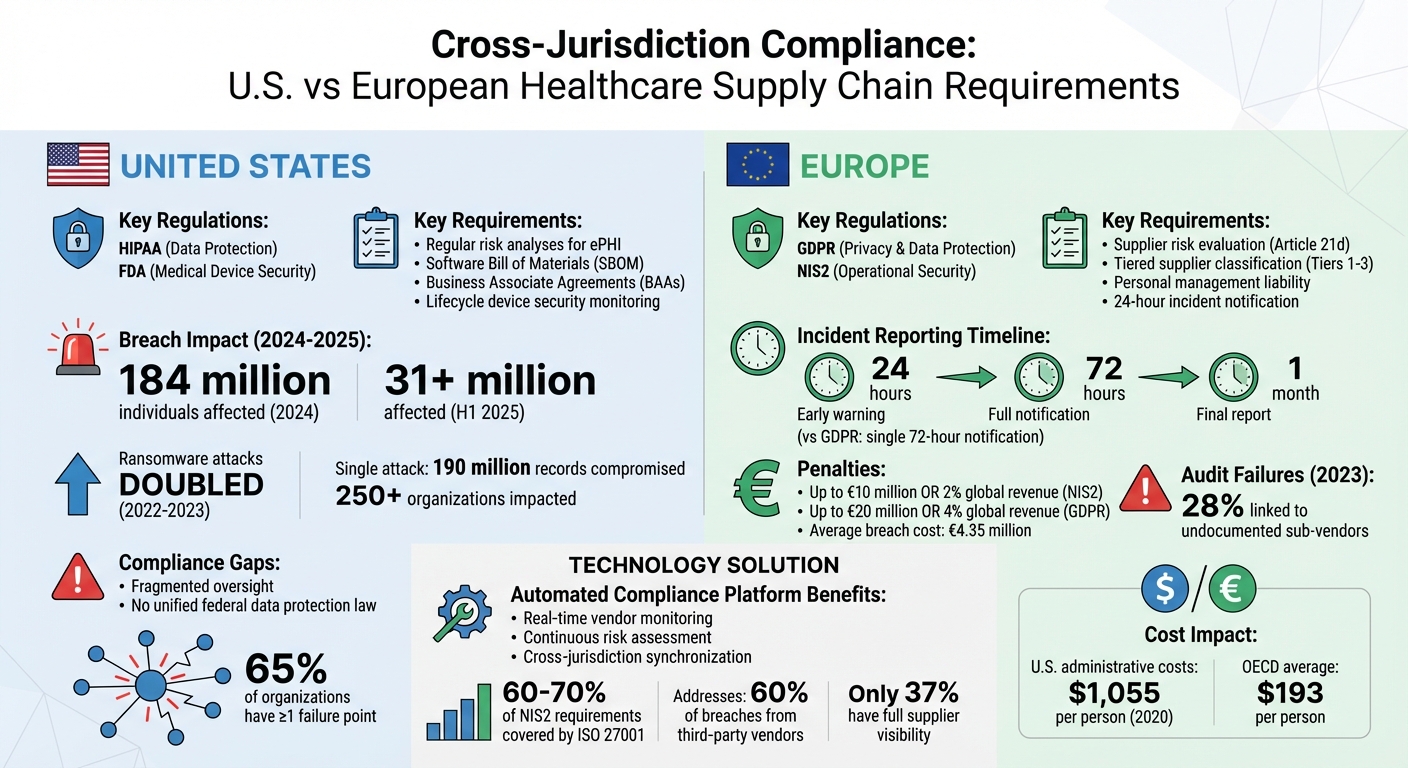
U.S. vs European Healthcare Supply Chain Compliance Requirements Comparison
1. U.S. Regulatory Requirements (FDA, HIPAA)
Regulatory Scope
In the U.S., healthcare organizations must navigate two key regulatory frameworks to manage supply chain risks: HIPAA for data protection and the FDA for medical device security. The HIPAA Security Rule (45 CFR § 164.308) mandates that organizations and their business associates conduct regular risk analyses to identify vulnerabilities in electronic protected health information (ePHI) and implement formal risk management plans. Meanwhile, under Section 524B of the FD&C Act, the FDA requires medical device manufacturers to secure devices throughout their lifecycle. This includes providing a Software Bill of Materials (SBOM) to help identify and address vulnerabilities.
The stakes are high. In 2024, healthcare data breaches impacted a record 184 million individuals. During just the first half of 2025, over 31 million people were affected by healthcare-related breaches [3]. One ransomware attack in 2024 alone compromised the data of 190 million individuals through a major U.S. claims processor [5]. These incidents highlight the urgency of compliance. As the Husch Blackwell Healthcare Privacy and Security Work Group notes, healthcare organizations cannot "outsource accountability" when it comes to protecting patient data and meeting HIPAA requirements [3].
These frameworks establish the foundation for targeted risk management practices.
Risk Mitigation Strategies
Effective risk mitigation requires more than just signing Business Associate Agreements (BAAs). While BAAs are critical for ensuring third-party compliance with HIPAA and FDA regulations, they are not enough on their own. The FDA also demands that manufacturers actively monitor, identify, and address cybersecurity vulnerabilities throughout a device's lifecycle to maintain security.
Manual processes are no longer adequate in the face of increasing threats. Cybercriminals are targeting business associates more aggressively, and regulatory scrutiny is intensifying. Between 2022 and 2023, ransomware attacks on the U.S. healthcare sector more than doubled, impacting over 250 organizations [5]. To stay ahead, healthcare organizations should integrate third-party vendors into their internal incident response plans. Contracts should include provisions for audit rights and clear documentation requirements to ensure alignment with evolving regulatory expectations [4].
Technology Integration
Digital platforms have become indispensable for managing these challenges. They streamline compliance efforts and bolster risk management practices by enabling continuous monitoring and real-time visibility across vendor ecosystems. These tools make it easier to assess vendor security risks and posture, verify HIPAA training, and evaluate incident response protocols - tasks that traditional manual methods struggle to handle efficiently [3]. AI-powered tools can also pinpoint supply chain vulnerabilities, which is critical given that 65% of organizations report at least one failure point [5].
One example is Censinet RiskOps™, which automates due diligence and strengthens medical device supply chain resilience through data-driven insights. These platforms also support the implementation of proposed HIPAA Security Rule updates, such as proactive security testing and multifactor authentication (MFA) across vendor networks [3]. For essential products like insulin, technology enables risk-based inventory management, ensuring higher safety stocks while automating replenishment for less critical supplies [5].
This approach, focused on U.S. regulatory requirements, contrasts with European frameworks, which will be covered in the next section.
sbb-itb-535baee
2. European Regulatory Requirements (GDPR, NIS2)
Regulatory Scope
Europe takes a dual approach to securing supply chains, focusing on both privacy and operational security. The GDPR safeguards personal data and privacy rights, while NIS2 prioritizes the resilience and security of critical network and information systems. Under NIS2, healthcare organizations, classified as Essential Entities, face strict regulations, including third-party vendor risk management and personal accountability for cybersecurity lapses. Article 21(d) specifically requires organizations to evaluate supplier risks beyond standard GDPR agreements, addressing vulnerabilities unique to each provider and their cybersecurity measures.
One major shift with NIS2 is the introduction of personal liability for management bodies, moving beyond GDPR's focus on organizational accountability. Non-compliance can result in fines of up to €10 million (about $10.8 million) or 2% of global annual turnover, whichever is higher [6][8].
Incident reporting under NIS2 is also more demanding compared to GDPR. Organizations must issue an early warning within 24 hours, a full notification within 72 hours, and a detailed final report within one month. By contrast, GDPR requires only a single 72-hour notification for personal data breaches. In 2023, 28% of EU supply chain audit failures were linked to undocumented sub-vendors [7], highlighting the importance of thorough supplier oversight. These stringent requirements call for proactive and well-structured mitigation strategies.
Risk Mitigation Strategies
To manage risks effectively, organizations should classify suppliers into tiers based on their access to data and the criticality of their services:
Supplier contracts need to align with NIS2 by including clauses like 24-hour incident notification, audit rights, and requirements for subcontractors to meet the same security standards. The 2023 MOVEit Transfer vulnerability, which impacted 2,600 organizations, underscores the importance of these measures. As Igor Petreski, Compliance Systems Architect at Clarysec LLC, puts it:
"The old way of managing suppliers, a handshake and a loosely worded contract, is officially dead. NIS2 makes it painfully clear that an organization's cybersecurity posture is only as strong as its weakest link"
.
To demonstrate compliance, organizations should maintain a version-controlled repository of supplier inventories, risk assessments, and meeting records. This shift from annual audits to continuous oversight reflects the evolving regulatory landscape. Existing ISO 27001 certification can cover around 60–70% of NIS2 supply chain requirements, but additional measures are often necessary. Digital tools are increasingly vital to meet these demands.
Technology Integration
Platforms like Censinet RiskOps™ help organizations manage compliance by offering real-time supplier inventories, automated risk scoring, and monitoring of transitive dependencies (i.e., suppliers of suppliers). This is crucial, given that 60% of data breaches stem from third-party vendors, yet only 37% of organizations have full visibility into their suppliers' cybersecurity practices [10].
Automated third-party risk management tools go beyond traditional assessments by providing continuous monitoring through security ratings and threat intelligence feeds. The EU's Digital Omnibus initiative simplifies compliance by consolidating reporting for NIS2, GDPR, and DORA into a single portal. Healthcare organizations should also incorporate findings from EU-level coordinated risk assessments (Article 22) into their internal frameworks.
Technology plays a key role in GDPR and NIS2 compliance through features like encrypted communications, secure API integrations, and zero-trust network access (ZTNA) for vendors. With the average cost of a third-party data breach reaching €4.35 million (around $4.7 million) [10], investing in advanced technological solutions is critical for safeguarding patient data and ensuring operational security.
3. Technology-Based Compliance Solutions (e.g., Censinet RiskOps™)
Risk Mitigation Strategies
When it comes to managing compliance across different jurisdictions, manual processes simply can't keep up. Tower Health experienced this firsthand, relying entirely on spreadsheets and manual workflows to handle third-party risk management (TPRM). The result? Endless frustrations and a limited capacity to complete risk assessments each year [11]. This kind of inefficiency is a major red flag, especially for healthcare organizations that need to verify suppliers under multiple regulatory frameworks at the same time.
Enter Censinet RiskOps™, a platform designed to tackle these challenges head-on. By using continuous monitoring and primary-source verification, it ensures supplier data is accurate and up-to-date. The system provides real-time alerts for sanctions changes or unsafe practices, helping organizations stay ahead of compliance issues. During the COVID-19 pandemic, healthcare providers with tech-enabled supply chain governance avoided costly fines and disruptions. Meanwhile, those stuck with manual tracking faced serious exposure to risks [12]. The key difference? Automated tools caught problems early, preventing them from escalating into regulatory violations or patient safety concerns. This proactive approach sets the stage for a more unified risk management strategy, as explored in the next section.
Technology Integration
Building on its risk mitigation capabilities, Censinet RiskOps™ employs advanced technologies to streamline compliance efforts across various domains. Instead of juggling fragmented manual processes, the platform brings enterprise and third-party risk management under one roof through automated workflows tailored specifically for healthcare. These workflows address critical areas like patient data, PHI, clinical applications, and medical devices. Features such as credential verification, audit readiness tracking, and monitoring of transitive dependencies (e.g., suppliers of suppliers) make collaborative risk management more efficient.
For organizations operating across both U.S. and European jurisdictions, scalability is a must - and this platform delivers. It synchronizes different regulatory timelines, tackling the cross-jurisdictional compliance hurdles mentioned earlier. Additionally, it integrates with technologies like blockchain and RFID to ensure product authenticity, meeting standards such as DSCSA and ISO 13485 [2][12]. By automating these processes, healthcare organizations can maintain consistent security and compliance without piling on extra administrative work.
Healthcare Supply Chain Risk Management Webinar
Advantages and Disadvantages
Regulatory frameworks and automated solutions each come with their own set of trade-offs, influencing how supply chain risks are managed across borders.
U.S. frameworks, such as FDA regulations and HIPAA, provide quicker approval pathways like the 510(k) process. However, they are fragmented, with HIPAA addressing privacy only within specific sectors. The absence of a unified federal data protection law complicates international data transfers, often requiring temporary fixes like the EU-U.S. Data Privacy Framework. In contrast, European frameworks take a more rights-focused approach, offering a different balance of benefits and challenges.
European regulations, including GDPR and NIS2, focus heavily on individual privacy and supply chain transparency. These regulations introduce stricter protections, such as the MDR's Unique Device Identification requirements, which enhance traceability. GDPR violations can result in steep penalties of up to €20,000,000 or 4% of global annual revenue [13]. However, these protections come with trade-offs, including more stringent evidence requirements and longer approval timelines. As Francis Collins, former Director of the National Institutes of Health, explained:
"The GDPR [is] a serious impediment to research... progress on some important projects [has] slowed to a crawl"
.
To address these regulatory differences, technology solutions like Censinet RiskOps™ play a critical role. These platforms automate compliance processes, reducing the administrative workload and helping organizations manage risks across different jurisdictions. For example, Tower Health experienced significant limitations in its assessment capacity when relying on manual processes [11]. Automated platforms not only improve scalability and efficiency but also save time and money. This is particularly relevant in the U.S., where administrative costs in healthcare reached $1,055 per person in 2020, compared to an OECD average of $193 [14].
Conclusion
Managing cross-jurisdiction supply chain risks goes far beyond simply checking off regulatory requirements. The real issue is clear: healthcare organizations are grappling with fragmented compliance standards that lead to duplicated efforts, higher costs, and dangerous gaps in coverage [15]. Without a unified global framework, a vendor could comply with HIPAA while violating GDPR, putting the entire supply chain at risk.
These challenges highlight why fragmented oversight requires fresh approaches. With 65% of organizations relying on a single failure point in their supply chain and ransomware attacks doubling between 2022 and 2023, the risks are enormous [5]. The deeply interconnected nature of healthcare supply chains, combined with limited transparency, means that a breach at one vendor can ripple into widespread public health crises. As Verisys aptly puts it:
"Compliance in healthcare supply chain management... sits at the center of patient safety, workforce protection, regulatory oversight, and organizational trust"
.
To address these risks, healthcare organizations must rethink their approach. Compliance shouldn't just be seen as a cost - it should be leveraged as a strategic advantage. This involves adopting unified risk management frameworks like NIST or ISO 27001, which act as a shared language across different jurisdictions. Additionally, automated platforms that offer real-time insights into vendor security are crucial, especially as third-party incidents continue to rise. Tools like Censinet RiskOps™ help organizations scale their assessments, reduce administrative overhead, and maintain continuous monitoring of international partners.
FAQs
How do we align HIPAA/FDA and GDPR/NIS2 for the same vendor?
Organizations aiming to align HIPAA/FDA and GDPR/NIS2 requirements for the same vendor should focus on implementing strong risk management strategies. This includes conducting regular risk assessments, using data encryption, enforcing strict access controls, and establishing clear breach notification policies. Tools like Censinet RiskOps™ can simplify compliance by automating oversight and monitoring, helping ensure that the vendor meets the standards of both frameworks effectively.
What vendor contract terms matter most for cross-border compliance?
Key vendor contract terms for cross-border compliance should include well-defined cybersecurity provisions. These typically cover areas like data encryption standards, breach notification protocols, and vendor security disclosures. These measures help protect sensitive information and ensure accountability.
It’s also crucial to include clauses that address compliance with regulations such as HIPAA and GDPR. These legal frameworks often span multiple jurisdictions, so aligning vendor agreements with their requirements is essential to meet both legal and security obligations.
How can we get real-time visibility into sub-vendors and supply chain risk?
Real-time visibility into sub-vendors and supply chain risks is achievable with platforms designed to keep a constant eye on vendor activities. These tools can automate compliance checks and send instant alerts if vulnerabilities or breaches are detected. For example, solutions from Censinet simplify this entire process, enabling healthcare organizations to stay ahead of risks related to supply chains, patient data, and essential systems.
