
My rule for turnover readiness: name a backup, share the records, and test the handoff before you sign off. In healthcare, a staff departure should not leave anyone guessing how to contain an incident or protect patient care.
The 2022 HIMSS healthcare cybersecurity survey found that 61.01% of respondents cited insufficient cybersecurity staff as a barrier to their programs.[5] I focus on four steps to keep work moving:
- Assign owners and backups for incident response, risk assessments, access reviews, and recovery - with clear decision authority.
- Keep shared records of procedures, evidence locations, risk decisions, contacts, and unfinished work.
- Control staff transitions: revoke departing staff’s access promptly, preserve records, and give successors approved access.
- Test coverage: have backups perform tasks without the usual owner, track gaps, and check progress after 30 days.
<u>A name on a coverage sheet is not enough.</u> I treat a handoff as complete only when the backup can do the work, find the records, and make or escalate decisions that affect care.
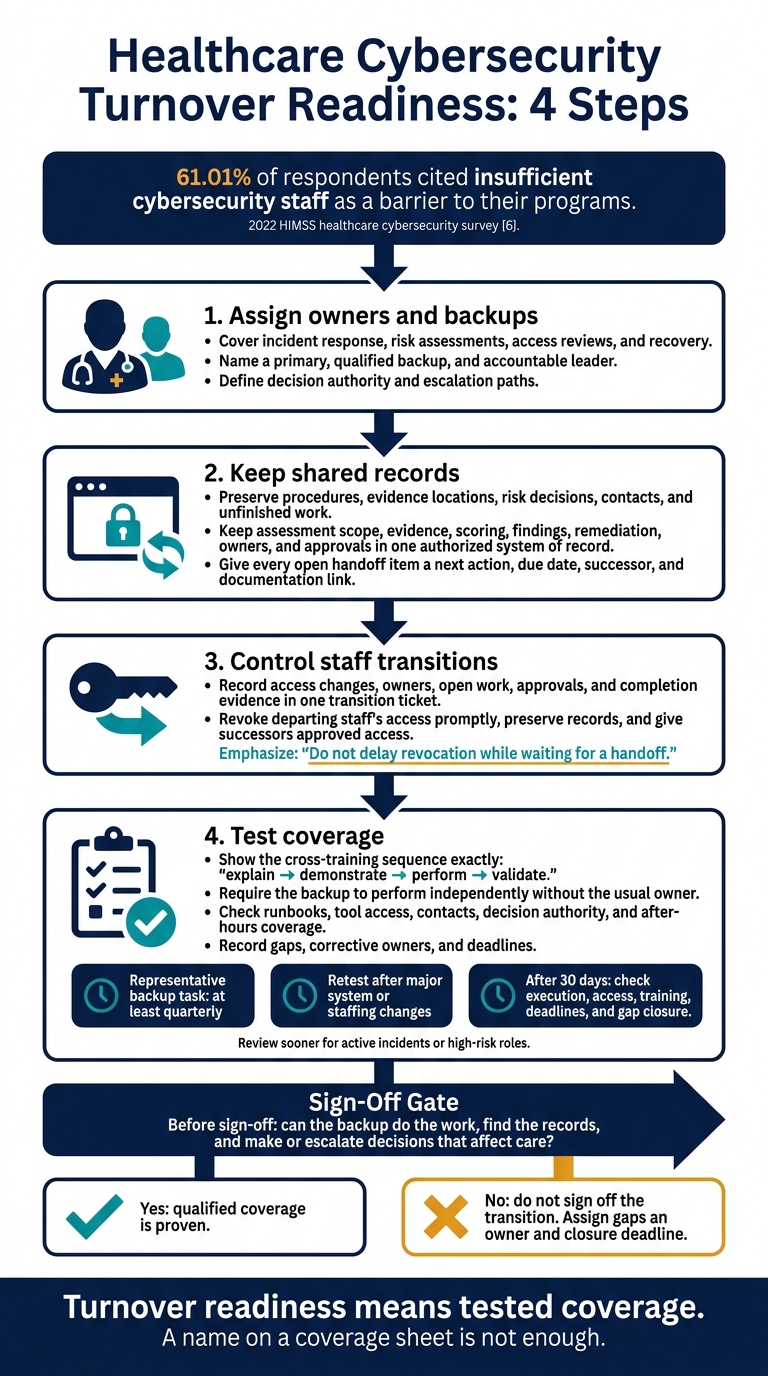
Healthcare Cybersecurity Turnover Readiness: 4 Steps
Keep Incident Response Ready When Staff Leave
Once backup coverage is mapped, document incident response in shared runbooks so staff departures don’t stall containment or recovery.
Link each incident type to affected systems, business owners, recovery priorities, and risk-acceptance decisions. Carry those links through preparation, detection and analysis, containment, eradication, recovery, and lessons learned. This keeps response aligned with risk management and HIPAA incident-response duties while protecting clinical continuity and preserving risk decisions during turnover.[6][7]
Then turn those links into clear activation rules and contact details.
Write Runbooks With Clear Authority and Contacts
Create separate procedures for ransomware, compromised credentials, phishing, suspected exposure of electronic protected health information (ePHI), medical-device or clinical-system disruption, and third-party incidents.
Define objective activation thresholds: privileged-account misuse, a phishing message that obtained credentials, evidence that ePHI was accessed or exfiltrated, loss of availability of a life-supporting device or critical clinical application, or a vendor notification involving your data or environment. For ransomware, activate on suspicion - not confirmation.[11]
Each procedure should name the incident commander and an alternate, assign response tasks, and spell out approval limits and escalation triggers. A departure shouldn’t leave responders guessing who can make decisions. Keep role-based escalation contacts for clinical operations, legal, privacy, communications, infrastructure, medical-device engineering, and executive leadership. Include after-hours numbers and an offline copy.
Tell responders exactly where to find evidence and how to collect it. Include timestamp requirements, chain-of-custody handling, and an approved evidence repository. To preserve evidence, require approval before rebooting, wiping, altering, or restoring systems to service.
Set clear recovery gates: attacker access contained, backups validated, services restored in priority order, security testing completed, clinical safety confirmed, reinfection monitoring established, and remaining risk accepted by authorized leadership.
Include a notification matrix that records the trigger, decision owner, deadline, approval route, and required record. Legal and privacy teams should determine breach-reporting duties. Individual HIPAA breach notices are due without unreasonable delay and no later than 60 calendar days after discovery.[9]
Compare Ownership Models and Test Backups
| Ownership model | Ownership | Turnover exposure | Onboarding effort | Incident-response reliability |
|---|---|---|---|---|
| Single-owner | One specialist performs or coordinates most response activities | High; knowledge and authority leave with the owner | Low, but undocumented knowledge adds to the handoff burden | Low when the owner is unavailable |
| Primary-and-backup | A named primary leads; a trained alternate can take over | Moderate to low when the backup can act without the primary | Moderate; the backup needs access, training, and practice | High when backup coverage is tested and authority is clear |
| Shared-team | A defined team divides tasks among trained members | Low for individual turnover; unclear accountability can delay response | High; roles, workflows, permissions, and coordination must be established | High with explicit responsibilities and a designated incident commander |
Keep one accountable incident commander for each incident. Run a tabletop exercise in which the usual incident lead is explicitly unavailable. Measure time to acknowledgment, time to assign authority, time to obtain required access, completeness of evidence records, accuracy of notifications, and the ability to maintain safe clinical operations. Give each gap an owner and a due date.
Before an incident, define an external-escalation plan with preapproved incident-response, forensic, legal, privacy, communications, cloud, medical-device, and recovery providers. Specify who can approve engagement, retainer terms, emergency contact methods, and permitted access to systems and evidence.[8][10]
Apply the same ownership discipline to risk-assessment records and decisions.
sbb-itb-535baee
Preserve Risk-Assessment Knowledge During Turnover
Hypothetical scenario: An analyst resigns during a remote-monitoring vendor assessment, leaving a draft low rating without supporting evidence and an unresolved PHI-retention question. The backup assessor can escalate these gaps before procurement renews the contract. The shared record shows what is pending, who owns each issue, and when the next decision is due.
Third-party risk assessments can fail just like incident response: evidence, reasoning, and approvals sit in separate places. Incomplete assessments can delay renewal or mitigation and leave clinical systems exposed.
Keep Assessment Records and Risk Decisions Together
Keep scope, evidence, scoring, findings, remediation, owners, and approvals in one authorized system of record. Within that system, separate supplied evidence from reviewer analysis and leadership decisions.
Require standard steps for scoping, evidence requests and validation, scoring, exceptions, escalation, approval, remediation, and closure. Each step needs a decision owner, reviewer, output, and due date.
For every risk decision, record the reasoning, supporting evidence, authorized approver, controls or contract terms, and review date. When staff changes, review time-bound exceptions and check that their controls still work. Do not renew exceptions silently.
A successor should be able to see what was verified, what remains unresolved, who must decide, and what happens next - without contacting the former analyst. Each decision also needs a named owner.
Use Shared Workflows With Named Approvers
Assign technical review to cybersecurity, PHI review to privacy, obligation review to legal or compliance, contract enforcement to procurement, and care-impact review to clinical operations. The business owner handles follow-through in day-to-day work. An executive risk owner approves residual risk beyond delegated authority. Name the person accountable for each approval.
AI can draft summaries and corrective-action plans, but reviewers must validate evidence, scoring, exceptions, and final approval.[12] Label AI output as draft, keep source-document links and dates, and record the reviewer’s identity and changes. Require human approval for risk acceptance and final disposition.
Standardize Staff Transitions and Cross-Training
Apply the same shared-record discipline to every staffing change.
Update Access and Hand Off Open Work
Treat onboarding, role changes, leave, and departures as continuity events for incident response, risk records, and access control. Use one transition ticket shared by HR, IT, security, privacy, clinical leaders, and the manager.
The ticket should record the effective date and time, role and systems involved, primary and backup owners, required training, access changes, open work, records to preserve, approval authority, and completion evidence.
For new staff, verify identity, grant least-privilege access, and enable multifactor authentication where technically feasible. Provide security and privacy training and reporting instructions, then confirm that the employee knows the incident-escalation process. For role changes and leave, reassess access and assign temporary owners for recurring duties. Remove obsolete permissions during transfers, and review or suspend access during extended leave.
Revoke identity-provider, email, VPN, cloud, electronic health record, privileged, vendor, physical, and remote-access permissions.[1][2] Disable tokens and service-account associations. Retrieve devices, badges, keys, and authentication hardware, and confirm completion in the ticket. Do not delay revocation while waiting for a handoff.
Require a handoff record that covers open work, pending approvals, recurring deadlines, contacts, and exceptions. Each item needs a next action, due date, successor, and documentation link.
When possible, the departing or transitioning employee should walk through the record with the successor and manager. But the handoff must not depend on that employee’s availability. The manager must confirm ownership of active incidents, overdue fixes, expiring certificates, and regulatory responses.
Map Responsibilities and Practice Backup Coverage
Use the transition workflow to build a named backup map.
Start with the responsibility matrix below. Assign actual people to each role and record the date coverage was validated in MM/DD/YYYY format. Editing the record does not count as validation. Listing a backup only as “IT” or “security” is insufficient; name a person or role and define the authority they may exercise.
| Function | Primary owner | Backup owner | Executive sponsor | Documentation location | Last validation date |
|---|---|---|---|---|---|
| Incident response and incident command | Security operations lead | Infrastructure or security engineer | Chief Information Security Officer or CIO | Incident-response platform and approved runbook library | MM/DD/YYYY |
| Third-party risk | Vendor-risk manager | Procurement or compliance analyst | Chief Risk Officer or CIO | Vendor-risk system and assessment repository | MM/DD/YYYY |
| Vulnerability remediation | Vulnerability-management lead | Infrastructure engineering lead | CIO or chief technology officer | Vulnerability platform and remediation tracker | MM/DD/YYYY |
| Access reviews | Identity and access management lead | HR/IT service-management lead | CIO or compliance executive | Identity-governance system and access-review records | MM/DD/YYYY |
| Privacy coordination | Privacy officer | Deputy privacy officer or compliance counsel | Chief compliance officer | Privacy incident repository and response plan | MM/DD/YYYY |
| Recovery and restoration | Disaster-recovery or infrastructure lead | Application-recovery lead | COO, CIO, or emergency-preparedness executive | Business-continuity plan and recovery runbooks | MM/DD/YYYY |
Cross-train in four steps: explain, demonstrate, perform, validate. Have each backup complete one representative task at least quarterly, using supervised or time-limited access rather than standing privileges.
Verify runbooks, tool access, contacts, decision authority, and after-hours coverage. Retest after major system or staffing changes. Include downtime procedures and backup communications, consistent with AHA preparedness guidance.[13] Record the task, result, gaps, corrective owner, and deadline.
Conclusion: Put Turnover Readiness Into Practice
When people leave, the program survives only if others can carry on the work.
Turnover readiness means tested coverage: a qualified backup can find the record, make the decision, and protect patient care without relying on memory.
Use this checklist to verify coverage before closing a handoff.
Turnover-Readiness Checklist
| Control group | Verify before sign-off |
|---|---|
| Ownership | Incident response, risk assessment, and access/offboarding each have a named primary owner, a qualified backup, an accountable leader, defined decision authority, and a maximum acceptable coverage gap. |
| Documentation | Current runbooks and contacts link to tracked risks, assessments, treatment decisions, accepted exceptions, supporting evidence, and pending deadlines. Store completion evidence in shared, access-controlled records. |
| Access and workforce controls | Staff-lifecycle procedures are complete, privileged access is reviewed, and departing credentials are promptly revoked. Backups have authorized individual access, and training and handoffs are accepted. |
| Testing | Backups show they can execute independently. Record access failures, decision delays, and unresolved dependencies. Assign each gap an owner, a closure deadline, and an evidence link. |
If any item fails, do not sign off the transition.
Knowledge-Transfer Plan
Use the same records, owners, and tests to track every transition through completion.
Before the transition: Identify critical roles and single points of failure. Confirm procedures, dependencies, deadlines, contacts, decision criteria, exceptions, and evidence locations. Verify primary and backup owners and an accountable leader. Then review open incidents, assessments, risks, and vendor actions with the successor.
Before sign-off: Validate access and require the backup to perform independently. Record the effective date, materials handed off, execution results, acceptance, and any unresolved gaps with closure dates.
After 30 days: Check execution, access, training, missed deadlines, and gap closure. Review sooner for active incidents or high-risk roles. After an abrupt departure, rebuild the handoff from shared records, assign interim owners, and keep gaps open until qualified coverage is proven.
FAQs
How can a small cybersecurity team provide reliable backup coverage?
Build a virtual Computer Security Incident Response Team (CSIRT) with staff from your existing IT, clinical, legal, and compliance departments. Assign and train backup decision-makers who can step in when primary members are unavailable [1].
Document incident-response runbooks, and keep contact rosters and RACI charts up to date so everyone knows their responsibilities [2][3]. Hold regular cross-functional tabletop exercises to test roles, escalation paths, and recovery sequences. These exercises help the team stay ready as personnel change [3][1].
Which turnover risks should we address first?
Start with safety and incident response risks: knowledge and ownership lost when staff leave or change roles; gaps in response scope, authority, checklists covering detection through recovery, and workflows for incident severity and PHI breaches; and outdated or untestable playbooks and runbooks that no longer match current systems or vendors.
Then prioritize gaps in risk assessments and unclear ownership of evidence and controls. During staffing shortages, these issues could leave audits and coverage of high-risk vendors without support. [1][2][3][4]
How can we measure whether knowledge transfer is working?
Test whether teams can handle critical work without the original expert. During incident-response exercises, track the time to declare an incident, complete technical triage, begin containment, and activate safety protocols. Also track corrective action completion.
Document after-action reports with follow-up tasks within 30 days, and check that incident documentation is complete. Use quiz and simulation results, along with acknowledgments, to verify training and understanding. For audit readiness, record what was taught, when, and by whom [1] [2].
