
If multilingual AI is wrong, patient care can go wrong fast. In healthcare, AI tools for translation, portals, notes, and triage should be treated as a patient safety, privacy, and civil rights issue - not just a language access tool.
I’d sum up the article this way: if a health system wants to use multilingual AI safely, it needs to limit AI-only use to low-risk tasks, require human review for high-stakes patient content, protect PHI under HIPAA, and track errors by language and dialect. That matters because 25.6 million people in the U.S. have limited English proficiency, and studies cited here show 49.1% of adverse events involving LEP patients caused physical harm, while 52% were tied to communication failures.
Here’s the plain-English version of what the article says you should do:
- Treat language quality as a safety control
- Use risk tiers based on clinical impact, language difficulty, and harm if the message is wrong
- Do not send machine-translated high-risk content directly to patients without qualified human review
- Use certified medical interpreters for consent, diagnosis, emergency, and other high-risk discussions
- Sign BAAs when AI tools handle PHI
- Log and review AI use by language, workflow, and model version
- Test by language and dialect, not just one average score
- Track outcomes like readmissions, medication use, near misses, and clinician edits
- Pause use fast if a translation error causes serious patient harm
A simple way to think about it: AI can help with appointment reminders and basic portal help, but for discharge instructions, medication guidance, consent forms, and triage, people still need to lead. That is the core message.
The rest of the article lays out the rules, governance steps, validation checks, and monitoring metrics needed to make that happen.
Ethics and AI in Healthcare: A Hard Look Inside - with Dr. Colleen Lyons [FULL INTERVIEW]
sbb-itb-535baee
Ethical Principles and U.S. Rules for Multilingual Healthcare AI
Those risks turn into direct ethical and legal duties once multilingual AI enters healthcare.
Applying WHO and NIST Guidance to Language-Related AI Risks
For discharge instructions, patient portals, and triage chatbots, WHO’s six AI ethics principles fit multilingual care almost point for point: protecting autonomy; promoting well-being, safety, and the public interest; ensuring transparency, explainability, and intelligibility; fostering responsibility and accountability; ensuring inclusiveness and equity; and promoting AI that is responsive and sustainable.[5][6][1]
For patients with LEP, that means a few plain things. Autonomy depends on accurate informed consent and clear notice when AI is part of the process. Beneficence and nonmaleficence mean health systems need to track mistranslation errors and adverse events. Justice and inclusiveness mean testing the main languages and dialects used in the service area. Transparency and accountability mean documenting where the tool is used, what its limits are, and who owns it. Privacy means HIPAA-grade safeguards.[5][7][8][9][14]
The NIST AI Risk Management Framework adds a more hands-on layer. Its valid and reliable and fairness areas support subgroup checks by language and dialect, minimum accuracy thresholds for each language, and written limits for languages the tool does not support.[3] Its accountability and transparency requirements also support version-controlled models, audit trails showing when AI translation was used, and clear escalation paths when staff spot mistakes.[3]
Key U.S. Compliance Issues: HIPAA, Civil Rights, and Documentation
In the U.S., these duties become enforceable rules around access and privacy.
Three frameworks shape multilingual AI use in healthcare: HIPAA, Section 1557, and HHS LEP guidance. Taken together, they require language access that is accurate, timely, and free, while also protecting privacy and informed decision-making.[7][8][9]
Under HIPAA, any AI tool that receives, creates, maintains, or transmits PHI is treated as a business associate. That means a Business Associate Agreement is required unless the data have been properly de-identified.[14][15][16] If PHI is sent to a cloud translation tool without a BAA, that is a HIPAA violation when the text contains PHI.[4][14]
Section 1557 adds another guardrail. Covered entities cannot use AI in ways that leave LEP patients with worse communication than English-speaking patients.[8][9] HHS OCR’s 2024 Language Access Plan states:
machine translation should not reach patients without qualified human review.[12][13]
For high-stakes communications, that line matters a lot. Consent forms, treatment plans, discharge instructions, and notices of rights should be reviewed by a qualified human translator before the patient sees machine-translated content.[8][9]
| Communication Type | AI Use Permitted? | Human Review Required? |
|---|---|---|
| Consent forms, treatment plans | Only as draft support | Yes, before delivery |
| Discharge instructions, medication guidance | Only as draft support | Yes, before delivery |
| Appointment reminders, parking info | Often, if sufficiently accurate for the purpose | No, but monitor for errors |
| Emergency triage: temporary only; review immediately afterward | Temporary use only, with a warning | Yes, as soon as practicable |
Documentation is what turns policy into proof. Clinicians should record the patient’s preferred language, the type of language help used, and, for high-stakes communications, the reviewer’s name and credentials.[7][9][10] At the organization level, there should be an inventory of every AI tool that processes PHI, including supported languages, risk tier, vendor details, and BAA status, along with access logs for AI-assisted communication.[3][9]
Governance and Risk Management Across the AI Lifecycle
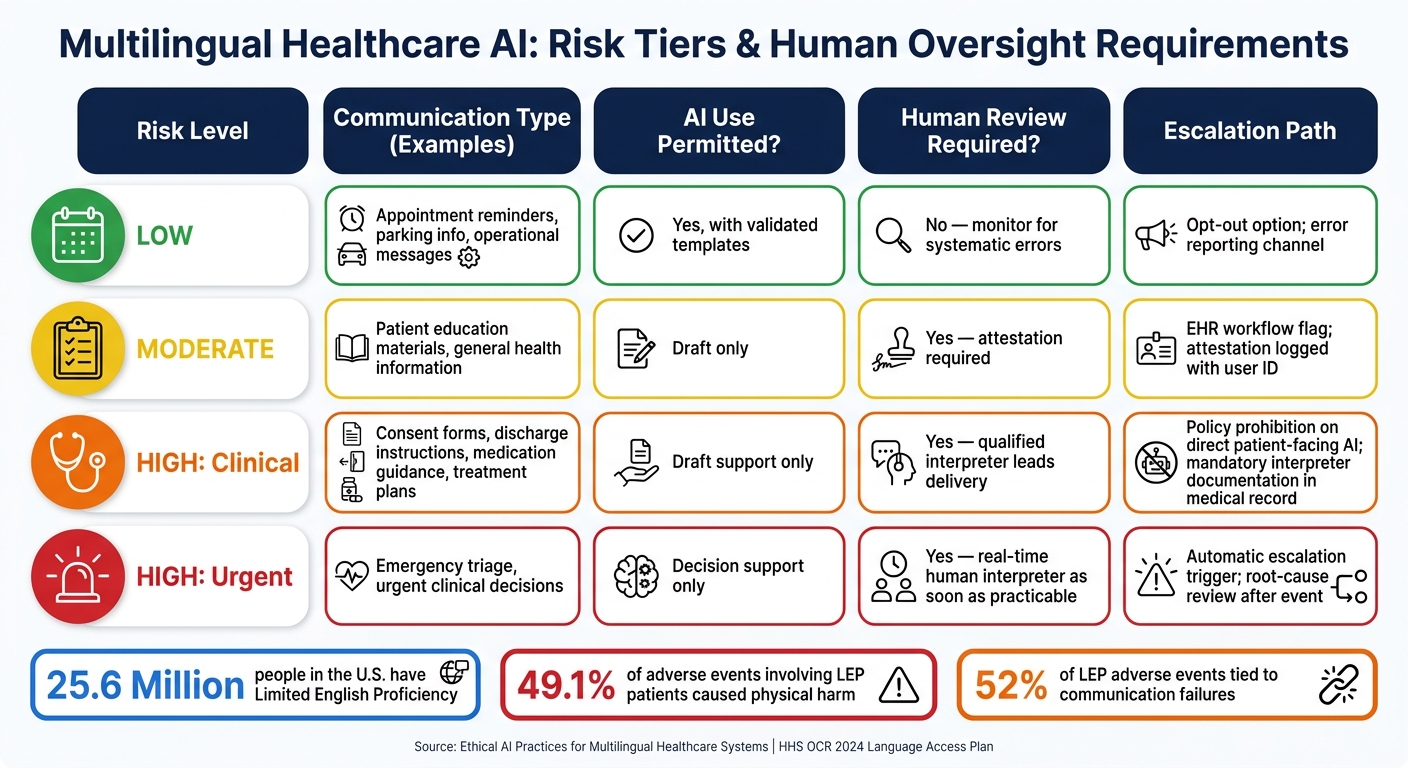
Multilingual Healthcare AI: Risk Tiers & Human Oversight Requirements
Once language-access rules are set, governance puts names next to the work. It assigns owners, sets thresholds, and spells out what happens when something goes off track. That matters because rules on paper don't do much unless people know who decides, who reviews, and who steps in.
Risk Tiering by Clinical Use, Language Complexity, and Patient Harm
Not every multilingual AI interaction brings the same level of risk. A practical tiering model looks at three things: how clinically critical the communication is, how hard the language and context are, and how much harm could happen if the message is wrong. Low-resource languages start with more baseline risk. From there, the next move is simple: match controls to the tier.
| Communication Type | Risk Level | Permitted Use | Human Review | Escalation Path |
|---|---|---|---|---|
| Low-risk operational communication | Low | Yes, with validated templates | No, but monitor for systematic errors | Opt-out option; error reporting channel |
| Moderate-risk patient education | Moderate | Draft only | Yes - attestation required | EHR workflow flag; attestation logged with user ID |
| High-risk clinical communication | High | Draft support only | Yes - qualified interpreter leads delivery | Policy prohibition on direct patient-facing AI use; mandatory interpreter documentation in medical record |
| High-risk urgent communication | High | Decision support only | Yes - real-time human interpreter as soon as practicable | Automatic escalation trigger; root-cause review after event |
That last point is easy to miss: internal controls alone won't save you. A vendor can change model behavior fast, and translation quality can shift overnight.
Third-Party AI Oversight, Cybersecurity, and Enterprise Risk Coordination
Most multilingual AI tools used in healthcare come from outside vendors. So the due diligence process is where a lot of risk gets caught - or slips through.
Standard security questionnaires help, but they don't go far enough here. CISOs and compliance leaders should ask direct questions about training data across languages and dialects, known failure modes for medical terms in low-resource languages, and how the tool shows AI-generated content to clinicians. On the security side, the big issues are whether prompts and outputs that include PHI are stored, whether that data is used to retrain models, and how fast the vendor must notify the organization after an incident.[17][18][19]
Model updates need close review too. If a vendor updates a translation model without notice, errors can show up in workflows that had already been validated. Contracts should spell out notification timelines, versioning documents, and rollback procedures.
When there are many vendors, this gets messy fast. A centralized system helps keep it under control. Censinet RiskOps™ can support this by centralizing third-party and enterprise risk assessments, maintaining risk registers, automating workflows, and providing dashboards for AI risk visualization. For multilingual AI, organizations can tag systems in the inventory as "multilingual", attach language-specific validation evidence, and send them through cross-functional review with language services and clinical safety teams.[17][20]
These controls only hold up if each team knows its decision rights.
Governance Roles and Decision Rights for Multilingual AI
A governance committee without clear decision rights often slows work down without adding much oversight. The aim is to decide up front who owns each part of the process, so approvals happen at the right level and escalations land with the right people.[17][20][21]
| Role | Key Responsibilities |
|---|---|
| AI Governance Committee | Approves use cases by risk tier; sets validation requirements; reviews aggregated incident data; updates policy |
| Clinical Leadership | Determines clinical appropriateness; owns decisions about where AI can and cannot substitute for clinical judgment |
| Language Services | Co-owns translation quality standards; designs comprehension testing; validates multilingual outputs pre-deployment |
| Compliance & Legal | Ensures alignment with HIPAA, Title VI, and OCR language access guidance; reviews documentation requirements |
| IT / Information Security | Manages vendor connections, PHI access controls, audit logging, and model update notifications |
| Risk Management | Maintains AI inventory; assigns and reviews risk tiers; coordinates enterprise risk reporting |
| Patient Advocates | Provides input on comprehension, cultural appropriateness, and patient experience across language groups |
The inventory should be updated whenever a model changes, a language is added, or a workflow shifts. It should also be reviewed quarterly to catch shadow AI.[17][20]
Ethical Design, Validation, and Deployment Controls
Once a multilingual tool gets the green light in principle, the hard part starts: making sure it stays safe in day-to-day use. That comes down to three things - good data, clear pass/fail standards before launch, and human review when the stakes are high.
Data Governance for Multilingual Models and Translations
Multilingual AI quality starts with the training data. Organizations need to document exactly where text and audio come from, whether that’s EHR notes, patient portals, or recorded interpreter sessions. They also need to confirm that model training is allowed under HIPAA, internal policy, IRB protocols, and any patient consent or authorization that applies.
De-identification has to be checked for every language in scope, not just English. That matters even more in low-resource languages, where routine de-identification may still leave someone identifiable. Put simply: bad source data leads to bad patient guidance.
Training and test sets should be tagged by language, dialect, and clinical setting. Performance should then be tracked at that same level. Overall accuracy doesn’t tell you enough. You need to know how the model performs by language and by dialect. Mexican Spanish and Puerto Rican Spanish are not interchangeable. And discharge instruction language is not the same as intake form language.
Representativeness targets can help keep smaller language groups from getting pushed aside. That means setting minimum sample thresholds by language, dialect, and clinical domain. Organizations should also track mistranslation rates by language, severity category, and patient literacy level. A model card should document known gaps in plain language so clinical and compliance teams can actually use it.
Validation Standards Before and After Deployment
Risk tiering should decide the test bar before launch and the monitoring bar after launch. Before launch, any multilingual AI tool used in a patient-facing workflow should be tested against a gold standard: professionally translated, medically validated content reviewed by certified medical interpreters and bilingual clinicians.
AI outputs should be checked with automated metrics and masked human review, and errors should be sorted by clinical risk. For clinically critical content - such as medication dosing, urgent warning signs, and procedure risks - the standard should be zero critical errors across the priority languages in scope [22][11].
| Approach | Accuracy Expectations | Privacy Implications | Equity Impact | Recommended Controls |
|---|---|---|---|---|
| AI-only translation | Lowest assurance; acceptable only for low-risk, non-clinical content with local validation [22][11] | Requires careful PHI handling and patient disclosure | Highest risk of uneven performance across languages and dialects [27][28] | Limit to low-risk use, require disclaimers, monitor outcomes |
| AI plus human review | Higher assurance than AI alone; appropriate for moderate-risk content when verified [22][2][11] | Still requires PHI safeguards, logging, and access controls | Better equity than AI-only when reviewers are bilingual or trained [2] | Teach-back, bilingual QA, documentation of review steps |
| Certified medical interpreters | Highest clinical confidence for high-stakes communication [22][23][25][26] | Standard interpreter confidentiality protections apply | Best supported for equity and safety in complex encounters [25][26] | Use for consent, diagnosis, end-of-life, emergencies, and sensitive conversations [22][23][11] |
After deployment, the job isn’t over. Automated logging of AI-generated patient-facing content - by language and workflow, use case, model version, and clinical area - creates the audit trail needed to manage healthcare operational risks and catch drift early. Sampling-based quality audits, where interpreters review a subset of outputs each week or month, can spot problems that automated metrics miss.
If a clinically significant translation error is confirmed, it should be handled like a medication error. That means severity grading, root cause analysis, and documented corrective action.
Human Oversight and Patient Communication Controls
In the highest-risk encounters, the answer is not better AI. It’s certified human interpretation. For high-stakes encounters, a certified medical interpreter - on site or through remote video - is the required standard of care. If no interpreter is available in an emergency, AI can serve as a temporary bridge, but escalation to a human interpreter must happen as soon as practicable [22][23][11].
For content that does move through AI-assisted workflows, teach-back is non-negotiable. After AI-assisted discharge instructions or medication directions are given, clinicians should ask patients to explain in their own words how they will take their medications, spot warning signs, or get ready for a procedure. If the patient’s explanation shows confusion, the clinician should clarify the message and, if needed, revise the AI-generated content.
Prompts should tell models to write at a 6th- to 8th-grade reading level for most patient-facing content, avoid extra medical jargon, and explain key terms in plain language while keeping dose numbers and conditional statements exact [11][24].
Measuring Equity Impact and Next Steps for Healthcare Leaders
Metrics That Show Whether Multilingual AI Is Helping or Causing Harm
Once multilingual AI goes live, the focus moves from approval to results. And broad averages don't tell the full story.
If multilingual AI lifts average comprehension scores but makes the gap larger between English-speaking and Spanish-speaking patients, then it's doing damage, not help. That's why the metrics that matter must be stratified by preferred language, race/ethnicity, age, disability status, insurance type, and care setting. Those metrics should also follow the same owners and review cadence set in governance.
The main outcome measures to watch are 30-day readmission rates, ED revisit rates, and medication adherence for patients who received AI-assisted translated instructions versus those who did not. On the safety side, track near misses and incident reports tied to language or communication errors. Those issues still drive a major share of harm for patients with LEP.
Control metrics show whether the tool is being used safely day to day. One of the clearest early warning signs is the clinician override rate. If staff are often editing or throwing out AI-generated content in one language, that's a sign the output may be unsafe or unreliable for that group. Patient trust scores, gathered through post-visit surveys for non-English speakers, add the patient side of the story.
| Metric | Type | Data Source | Review Cadence | Accountable Owner |
|---|---|---|---|---|
| 30-day readmission rate by preferred language | Outcome | EHR | Quarterly | Chief Medical Officer |
| Medication adherence by language group | Outcome | EHR / pharmacy data | Quarterly | Chief Nursing Officer |
| Patient comprehension rate (teach-back) | Process / Equity | EHR documentation, surveys | Monthly | Patient Experience / Quality |
| Near misses linked to communication errors | Safety | Incident reporting system | Monthly | Patient Safety Committee |
| Clinician override / edit rate by language | Control | AI tool logs | Monthly | Clinical Operations |
| Patient trust scores (non-English speakers) | Equity | Post-visit surveys | Quarterly | Health Equity Officer |
| High-risk communications with documented human review | Control | EHR / audit logs | Monthly | Chief Medical Officer |
| Third-party AI tools with completed risk assessments | Control | Risk management platform | Quarterly | Enterprise Risk / InfoSec |
Set trigger thresholds before go-live, not after something goes wrong.
For example, if comprehension scores for non-English-preferred patients stay lower than scores for English-preferred patients after deployment, that should trigger action. You may need human interpreter review or a limit that keeps the tool in draft-only mode for that language. If an AI communication issue leads to a sentinel event, the response should be immediate: pause use and run a root-cause analysis, just as you would for a serious medication error.
Conclusion: The Minimum Standard for Ethical Multilingual Healthcare AI
These metrics show whether multilingual AI is improving care or making gaps worse. This isn't just a workflow issue. Multilingual AI touches patient safety, equity, privacy, and cybersecurity, so governance has to cover all four.
The Joint Commission now treats language access as a patient safety requirement in hospitals. New National Performance Goals that take effect in January 2026 require hospitals to stratify outcomes by preferred language and provide community materials in the languages most used by patients [29]. So language access is no longer just a best practice. It's a formal accountability requirement.
For any U.S. healthcare organization using multilingual AI, the minimum operating model needs four controls:
- Risk-tiered use cases with stronger human oversight for high-stakes communication
- Language- and subgroup-specific validation, not just aggregate accuracy
- Continuous monitoring with clear escalation paths when thresholds are crossed
- HIPAA-compliant data handling, with AI tools built into cybersecurity and incident-response plans
Third-party vendor risk management for multilingual AI tools requires the same level of scrutiny as any other vendor that handles PHI. That means completed risk assessments, signed BAAs, and security reviews before deployment, not after. Censinet RiskOps™ gives healthcare organizations one place to manage vendor risk assessments, track remediation, and keep sight of clinical applications and AI tools that touch patient data. A central view of risk helps keep multilingual AI inside the enterprise risk program.
Human clinicians, certified interpreters, and informed consent processes remain the standard of care for high-risk encounters. AI can support care. People still carry the responsibility.
FAQs
When is AI translation safe to use in healthcare?
AI translation is safe in healthcare only when it sits inside a human-in-the-loop workflow. That setup works especially well when teams need steady wording across repetitive documents.
For high-stakes materials like consent forms, discharge instructions, and medication labels, qualified human medical linguists need to review every translation. They check for accuracy, compliance, cultural nuance, and final validation.
Which patient communications require human review?
In multilingual healthcare settings, human review is a must for high-risk communications. It helps protect patient safety, keep information accurate, and meet regulatory requirements. That applies to AI-generated translations of informed consent forms, discharge instructions, and medication labels.
Physicians should also review clinical AI outputs that affect diagnosis or treatment. The same goes for AI-generated clinical insights in electronic health records and high-severity alerts.
How should hospitals monitor multilingual AI errors?
Hospitals need continuous, real-time monitoring for both clinical performance and language access. That means tracking baseline translation accuracy, form completion rates, translation error rates, disparate impact ratios, and consent completion rates across languages.
A central platform such as Censinet RiskOps can help bring those findings into one place, keep audit trails, and route urgent issues to the right teams. Hospitals should also document human oversight, including translator verification and clinician overrides. On top of that, they should run regular bias audits, drift monitoring, and quarterly post-market reviews.
