
If your medical device is a cyber device, an SBOM alone is not enough. I’d treat FDA supply chain security as a 4-part system: know every component, control software through the product life cycle, hold suppliers to written security terms, and use a shared system when the device portfolio gets large.
Here’s the short version:
- SBOMs help me list software parts, versions, suppliers, and support dates.
- IEC 81001-5-1 + FDA QMS help me turn that list into design, test, update, and maintenance records.
- Third-party vendor risk programs help me set patch, disclosure, and support rules in contracts.
- Platforms like Censinet RiskOps™ help me track all of that across many devices and vendors.
A few facts stand out:
- FDA expects a machine-readable SBOM for cyber devices in premarket submissions.
- One case study cited in the article found 10 extra components and 1 CVE after expanding SBOM scope.
- Another example reported a 90% cut in SBOM CVE review time with automation plus expert triage.
- GAO reported an average of 6.2 vulnerabilities per medical device in hospitals as of January 2022.
What I take from this is simple: visibility starts the job, but process and supplier control finish it. If I had to pick a path, I’d do this:
- Build SBOM coverage first
- Tie it to risk files, threat models, and design records
- Add supplier contracts and patch/disclosure SLAs
- Use a platform only if I’m dealing with many vendors, shared components, or a big device fleet
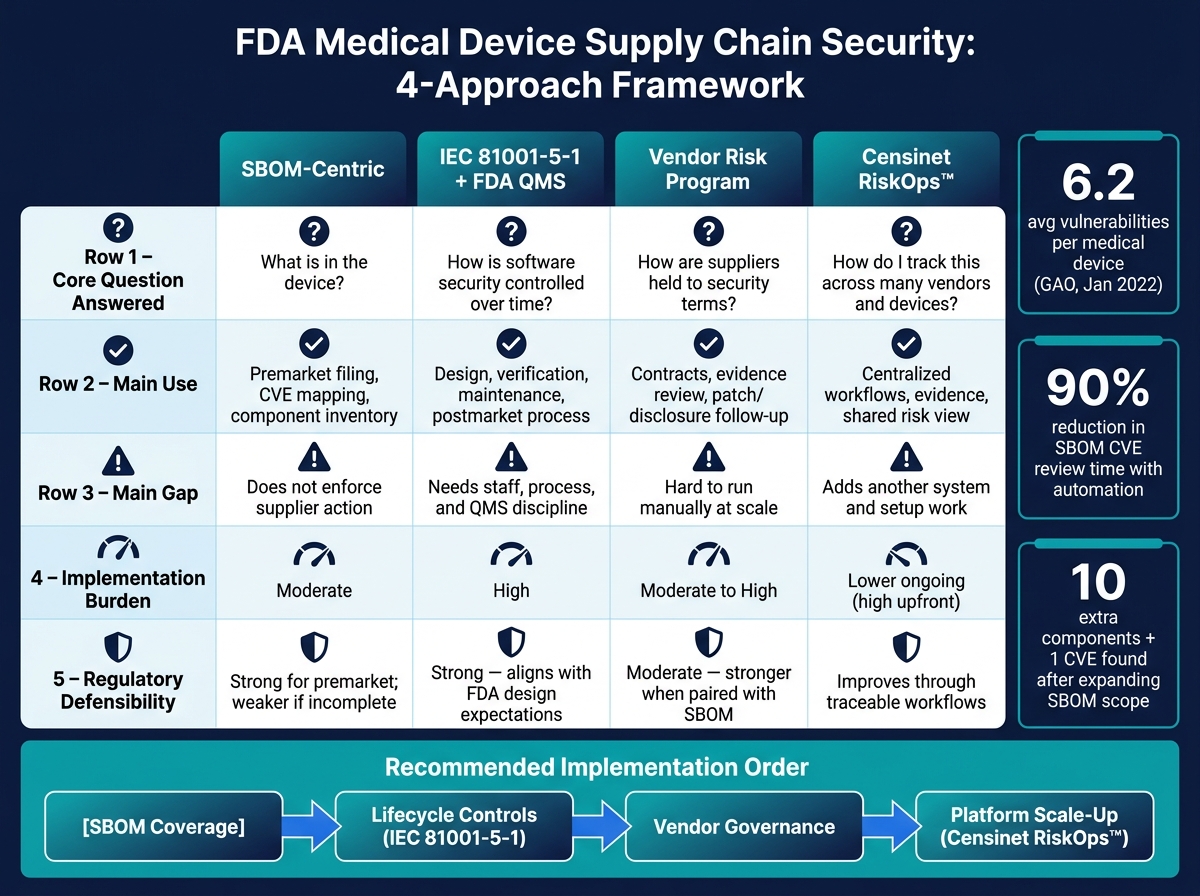
FDA Medical Device Supply Chain Security: 4-Approach Comparison
FDA SBOM Requirements Explained: What Medical Device Makers Get Wrong
sbb-itb-535baee
Quick Comparison
| Approach | What it answers | Main use | Main gap |
|---|---|---|---|
| SBOM-centric | What is in the device? | Premarket filing, CVE mapping, component inventory | Does not enforce supplier action |
| IEC 81001-5-1 + FDA QMS | How is software security controlled over time? | Design, verification, maintenance, postmarket process | Needs staff, process, and QMS discipline |
| Vendor risk program | How are suppliers held to security terms? | Contracts, evidence review, patch/disclosure follow-up | Hard to run by hand at scale |
| Censinet RiskOps™ | How do I track this across many vendors and devices? | Centralized workflows, evidence, shared risk view | Adds another system and setup work |
Bottom line: I wouldn’t treat these as competing choices. I’d use them in order - SBOM, lifecycle controls, vendor governance, then platform scale-up if needed.
1. SBOM-Centric Transparency and Monitoring
An SBOM is a software ingredient list. It identifies third-party libraries, open-source packages, dependencies, versions, licenses, and suppliers. It shows what is inside a device, but it does not prove that the device is safe.
That’s the key point. An inventory by itself doesn’t do much. It starts to matter when teams use it to guide design, monitoring, and response.
FDA Documentation Alignment
Under Section 524B(b)(3) of the Federal Food, Drug, and Cosmetic Act, manufacturers of cyber devices must include an SBOM in premarket submissions, covering commercial, open-source, and off-the-shelf components.[5][14][16] FDA guidance also expects SBOMs to follow NTIA's Framing Software Component Transparency elements and include the support level and end-of-support date for each component.[12][14][15]
To make that filing more useful, connect SBOM entries to the DHF, ISO 14971 risk assessments, and threat models. That link gives reviewers a clean trail from a component to its risk record and design controls. In practice, the SBOM becomes ongoing evidence instead of a one-time submission.
The hard part comes next: coverage. If the SBOM misses pieces of the stack, those gaps can still turn into risk later.
Third-Party Component Visibility
Incomplete inventories create blind spots in later risk reviews. A strong SBOM covers both direct and transitive dependencies. That extra depth matters because hidden layers often carry the exposure.
One medical-device case study found that expanding SBOM scope to embedded systems and network gear exposed 10 additional components and one manually identified CVE.[19][17] Research on automated SBOM generation tools, including Syft applied to an FDA-approved Tidepool Loop kit, also found gaps like missing component relationships, unknown versions, and unspecified supplier names.[21]
In plain terms, an SBOM can look complete on the surface and still miss parts that matter. Closing those gaps takes deliberate process design, not just tooling.
Postmarket Vulnerability Response
After release, the SBOM becomes the baseline for monitoring. Manufacturers are expected to continuously cross-reference SBOM components against databases like the NVD and CISA KEV, document each disposition, and notify healthcare customers when safety or effectiveness is affected.[10][11][13]
That disposition record usually needs to show whether a component is:
- not affected
- mitigated
- patch planned
- patched
This is where speed starts to count. A global medical device manufacturer working with Medcrypt cut SBOM CVE review time by 90% using automated analysis plus expert triage.[22]
Still, monitoring alone isn’t enough. It has to connect to supplier disclosure and change control, or teams end up chasing issues without a clear path to action.
Supplier Governance and Evidence
Regulators and frameworks like IMDRF expect SBOM practices to sit inside a manufacturer's QMS and supplier management processes, with audit trails showing updates after component changes, contract language requiring upstream suppliers to disclose vulnerabilities, and defined SLAs for security notifications.[20][23]
Manufacturers should also keep evidence that shows how the process works day to day, including:
- process descriptions
- internal audit records
- third-party attestations showing SBOM generation is automated, repeatable, and tied to risk decisions
In NTIA's Healthcare SBOM Proof of Concept, all three HDOs ingested SPDX SBOMs into their SIEMs, making component data searchable across device fleets.[18] That gives a practical picture of what mature supplier governance should enable: not just a list in a file, but component data that teams can search, track, and act on across many devices.
2. Lifecycle-Integrated Health Software Security (IEC 81001-5-1 + FDA QMS)
Once SBOMs show what's inside a product, IEC 81001-5-1 turns that view into day-to-day lifecycle controls.
SBOMs show component exposure. IEC 81001-5-1 sets the controls around that exposure. The standard covers security-related work from early design through maintenance, configuration management, and issue resolution, so it's a process framework, not a one-time checklist.[9] When you pair it with an FDA-compliant QMS, cybersecurity becomes part of design and maintenance from start to finish.
FDA Documentation Alignment
FDA recognizes IEC 81001-5-1 as a consensus standard and expects its security activities to tie straight into design controls, risk management, and submission content.[4][24] Threat modeling outputs become design inputs. Secure coding standards and penetration test reports help support design verification. Signed firmware update procedures belong in the device master record. Put together, that creates a lifecycle cybersecurity file that stores evidence by release.[26][7]
That setup only works if component data stays current through procurement and build.
Third-Party Component Visibility
IEC 81001-5-1 calls for procurement and configuration management processes for software components, including review of security documentation and security-related risk management.[26][27] GAO reported an average of 6.2 vulnerabilities per medical device in hospitals as of January 2022.[30] That's not a small warning sign. Passive inventory management becomes a risk fast.
Treat component approval as a release gate, not a paperwork exercise. Track each dependency against its support status and known CVEs so risk assessment and update planning start before end-of-support hits.
Postmarket Vulnerability Response
FDA's postmarket guidance says manufacturers need software lifecycle processes that monitor third-party components for new vulnerabilities across the device's total product lifecycle.[32][33] IEC 81001-5-1 puts that into practice with defined QMS steps for vulnerability intake, triage, remediation, and user communication.[24][28]
A practical workflow looks like this:
- CVE intake
- SBOM-based impact analysis
- Safety assessment
- Patch validation
- Field communication
At each step, name third-party components directly so vendor dependencies move through the process without confusion. The QMS should also spell out when a fix counts as a routine update and when it becomes a change that triggers regulatory reporting, in line with FDA expectations for postmarket management.[25][13]
Supplier Governance and Evidence
IEC 81001-5-1 puts procurement squarely on the manufacturer's side of the table.[27] FDA guidance says the same thing in plain terms: vendor support status and end-of-support dates need active management, not a one-time note in a file.[5][29]
Quality agreements with component suppliers should require:
- Timely vulnerability notifications
- Defined patch timelines
- SBOM sharing for each release
That way, upstream security data flows into the device risk process.[29][8] Keep lifecycle evidence organized by phase and map it to FDA guidance so audits move faster.
Those supplier obligations set up formal third-party vendor risk management.
3. Third-Party Vendor Cybersecurity Risk Management Programs
A formal third-party vendor cybersecurity risk management program turns supplier requirements into repeatable controls, audit evidence, and response workflows. Unlike lifecycle controls, this approach centers on supplier accountability, contract enforcement, and ongoing performance review.
FDA Documentation Alignment
FDA premarket expectations say manufacturers need to document third-party components in an SBOM, assess those components for cybersecurity risk, and include plans to update or replace them when vendor support ends. That means vendor management needs to live inside the QMS. A spreadsheet alone won’t cut it. Keep a vendor register tied to the SBOM, risk file, and contract terms.[3][8][31]
You should also extend 21 CFR 820.30 design controls to supplier selection, cybersecurity review, and mitigation verification. Put simply, security needs to be treated as part of the QMS, not as a separate side process.[4][31]
Once those supplier duties are defined, the next job is making sure vendors still meet them after the product is released.
Postmarket Vulnerability Response
Section 524B of the FD&C Act requires manufacturers to submit a plan to monitor, identify, and address postmarket cybersecurity vulnerabilities across the device lifecycle. In day-to-day terms, that means watching vendor advisories, researcher disclosures, and CERT alerts, then triaging findings based on clinical impact, not just CVSS.[1][25][35]
Two metrics help here:
- Patch adoption rate
- Third-party incident frequency
Both show whether your response process is working in the field.[34][25]
Supplier Governance and Evidence
Vendors need written cybersecurity obligations, and their compliance needs to be recorded in the QMS. If a supplier ships patches late or gives incomplete disclosures, use 21 CFR 820.100 CAPA to address the issue. That way, root-cause analysis drives system-level fixes instead of one-off cleanups. Traceable QMS records that connect device risk, supplier controls, and vendor performance also help during FDA audits.[31][5]
As vendor counts grow and evidence starts piling up, this gets hard to manage by hand. Manual tracking often becomes the choke point, especially when teams need one shared workflow for assessments, evidence, and follow-up.
4. Platform-Enabled Healthcare Vendor Risk Management (Censinet RiskOps™)
When SBOMs, patch deadlines, and evidence requests start stacking up, a platform can bring some order to the mess. Censinet RiskOps™ pulls vendor risk work into one place for FDA-regulated device programs. It helps most when the same third-party libraries, firmware, cloud services, and suppliers show up across many devices.
RiskOps™ doesn’t replace SBOMs, risk files, or supplier controls. It makes them easier to use across a large device portfolio. That’s the key difference. A process framework tells you what to do. The platform helps teams manage those controls across many vendors and devices without losing the thread.
FDA Documentation Alignment
The main upside isn’t new documentation. It’s getting required evidence assembled and pulled up faster when teams need it.
RiskOps™ keeps risk assessment workflows, evidence repositories, and policy mappings current and traceable. HDOs can see which vendors have submitted:
- SBOMs
- SDLC documentation
- Vulnerability management procedures
- Incident response plans
Those same records can support FDA review and internal QMS controls. So instead of hunting through email threads, shared drives, and old spreadsheets, teams can work from one source of record.
Third-Party Component Visibility
Benchmarking data shows healthcare supply chain security challenges remain significant, as third-party control maturity is still weak, with more than half of reporting manufacturers scoring 0 in the supply chain category.[36] That’s a problem, especially when one reused component can ripple across a whole product line.
RiskOps™ supports SBOM ingestion and structured vendor attestations. That gives HDOs a clearer view of which open-source libraries, firmware providers, cloud services, and integration partners sit inside a device portfolio. Dashboards can show concentration risk - for example, several devices relying on the same wireless stack - and connect each component to a risk score and remediation status.
That kind of view matters when teams need to answer a simple but high-stakes question: Where else are we exposed?
Postmarket Vulnerability Response
FDA expects a structured postmarket cybersecurity process that monitors, identifies, and addresses vulnerabilities within a reasonable time.[34][2][1] RiskOps™ supports that work by notifying affected vendors when a new CVE or exploit appears, tracking their responses, and storing those communications in one audit trail.
That response can include:
- Patch availability
- Compensating controls
- Configuration changes
If a critical library turns out to be vulnerable across several devices, the platform can use ingested SBOM data to find the affected vendors, send targeted questionnaires, and pull remediation timelines into one view. When vulnerability intelligence feeds and ticketing systems are connected, technical teams and compliance staff can work from the same risk picture instead of chasing different versions of the story.
Supplier Governance and Evidence
RiskOps™ also supports benchmarking supplier controls. That helps organizations set consistent, FDA-aligned control requirements and request specific documentation from vendors, such as penetration test reports, SOC 2 certificates, and evidence of secure update processes.
The platform can flag evidence that is missing or out of date. It can also generate risk scores based on both whether the documentation exists and how strong that documentation is. The result is a single record of supplier evidence, gaps, and remediation status.
The harder call is less about whether the platform helps and more about where it delivers enough return to justify one more system dependency.
Strengths, Tradeoffs, and Limitations of Each Approach
Each approach deals with a different slice of third-party component risk, and none of them is enough on its own. They answer four different decision questions:
- What is in the device?
- How is it controlled across the lifecycle?
- How are suppliers held to their commitments?
- How is all of that managed across a large portfolio?
That sequence matters. Start with visibility. Then move into lifecycle control, supplier enforcement, and portfolio-scale execution.
SBOM-centric programs show what is inside a device. That’s useful, but it doesn’t tell you whether the device stays secure over time. An inventory by itself proves very little. SBOMs don’t enforce patch SLAs, incident notification terms, or secure development practices. And if the SBOM is incomplete or out of date, it can create a false sense of security. That can hurt regulatory defensibility if an audit later finds gaps.[5][12]
Lifecycle-integrated standards such as IEC 81001-5-1, when built into an FDA-aligned QMS, bring the strongest design-control rigor in this group. Security becomes part of design, release, and maintenance instead of something added at the end. The downside is the work involved. This path needs skilled staff, QMS infrastructure, and steady process discipline. And like SBOMs, it focuses on internal process. It does not, by itself, place security duties on outside suppliers.[24][28]
Vendor risk management programs deal with that supplier accountability gap head-on. They help teams set terms, gather proof, and push vendors to meet security expectations. The catch is scale. Manual reviews take time, and they often miss device-specific needs. It’s also hard to keep a clean view of which vendors touch which devices unless there’s a clear structure behind the program.
Censinet RiskOps™ focuses on the day-to-day execution side of third-party risk management in healthcare-specific settings. It matters most when an organization is dealing with a large mix of devices and vendors, especially when suppliers overlap and components show up in more than one place. It does not replace the other three approaches. It helps teams run them across a portfolio without the process falling apart. The main issue is simple: does your portfolio size justify adding another system layer?
The matrix below puts the main differences side by side.
| SBOM-Centric | IEC 81001-5-1 + FDA QMS | Vendor Risk Programs | Censinet RiskOps™ | |
|---|---|---|---|---|
| Key Benefits | Component-level transparency; supports postmarket vulnerability mapping[12][8] | Strong design-control rigor; lifecycle discipline; aligns with FDA premarket and postmarket guidance[26][2] | Supplier accountability; contractual SLAs; structured evidence collection and escalation | Third-party and enterprise risk assessments; cybersecurity benchmarking; shared risk workflows; centralized risk view |
| Key Limitations | Does not enforce supplier controls; quality varies; becomes static without active maintenance[5][12] | Resource-intensive; does not govern external suppliers; requires QMS mapping for FDA alignment[24][28] | Manual and hard to scale; often misses device-specific requirements; limited portfolio-level visibility | Upfront integration effort required; most useful when vendor and device volume justifies it |
| Ideal Use Cases | Premarket submissions; postmarket CVE tracking; identifying vulnerable components across product lines | New device development; design-control documentation; organizations building or maturing a QMS | Supplier onboarding; contract negotiation; evidence collection for audits and reviews | Large HDO vendor-device portfolios |
| Implementation Burden | Moderate - requires tooling, configuration management, and ongoing updates[24] | High - requires skilled staff, QMS infrastructure, and sustained process discipline[24] | Moderate to high - manual programs do not scale without structure and dedicated resources | Lower ongoing burden once configured; upfront integration effort required |
| Regulatory Defensibility | Strong for FDA premarket submissions; weaker if SBOMs are incomplete or not maintained[5][8] | Strong - demonstrates cybersecurity as a design input consistent with FDA expectations[2][6] | Moderate - strengthens defensibility when paired with SBOM and lifecycle evidence | Improves defensibility through consistent evidence and traceable workflows |
Conclusion and Recommended Path Forward
No single approach covers FDA-compliant third-party component risk. SBOMs, lifecycle controls, and vendor governance need to work together.
That points to one practical path: an integrated model. Use SBOMs for visibility, apply IEC 81001-5-1 inside an FDA-aligned QMS for lifecycle control, and put a structured vendor risk program in place for supplier accountability.
The challenge shows up when you try to do this across a large device portfolio. What works for one product or one supplier can start to fall apart at scale. At that point, execution needs a system.
Censinet RiskOps™ helps coordinate those three controls across large vendor networks. It centralizes assessments, links vendor risk to device inventories, and keeps auditable workflows in place for FDA review and patient safety investigations.
A practical way to move forward is simple:
- Start with SBOMs for premarket readiness
- Add IEC 81001-5-1 for lifecycle control
- Build vendor risk governance for supplier accountability
- Use Censinet RiskOps™ to manage all three at scale
FAQs
Is an SBOM enough for FDA compliance?
No. A Software Bill of Materials (SBOM) by itself is not enough for FDA compliance.
For cyber devices under Section 524B, the FDA requires a machine-readable SBOM. But that's just one piece of a broader cybersecurity program.
Manufacturers also need to show ongoing risk management across the device lifecycle. That includes postmarket vulnerability monitoring, threat modeling, secure design controls, and documented patching or compensating controls.
When do I need IEC 81001-5-1 and a QMS?
You need an FDA QMSR-compliant Quality Management System (QMS) by February 2, 2026 to manage cybersecurity processes. That means cybersecurity can't live in a separate binder or sit off to the side as a few loose procedures. It needs to be built into your QMS itself, including supplier controls and design inputs.
IEC 81001-5-1 should sit alongside your QMS as a core standard for health software and medical device security. In practice, it helps support development, verification, and risk management for cyber devices.
When should I use Censinet RiskOps™?
Use Censinet RiskOps™ when your organization needs to manage third-party and medical device supply chain risks for FDA compliance and operational resilience.
It supports the full device lifecycle, from vendor onboarding and premarket SBOM management to postmarket vulnerability monitoring, incident response, centralized assessments, workflow automation, remediation tracking, and vendor collaboration.
