
My rule for healthcare AI: automate low-risk administrative tasks, not unchecked care instructions. Before using a tool, I’d ask whether a language error could change a patient’s treatment, consent, or decision to seek urgent care.
This review compares four workflows:
- Translation and interpretation: Use validated automation for routine text; require qualified language support for high-stakes communication.
- Multilingual intake bots: Collect symptoms within clinician-set rules, with a confirmed human handoff when urgency or meaning is unclear.
- Patient messages: Review medication changes, discharge steps, and warning signs before sending. Use teach-back to check understanding.
- Documentation support: Verify drafts against the source before they enter the chart. In one 2024 pilot, 18% of 356 AI-generated notes had omissions, and 11.5% had invented details.
Across all four, I’d check performance by language, limit access to protected health information, and name someone who can stop unsafe use. <u>Fluent wording is not proof of safe communication.</u> The decision should rest on patient understanding, error risk, qualified review, and a clear path to human help.
Are machine translations safe to use for patient discharge instructions?
sbb-itb-535baee
1. AI Translation and Interpretation
Use AI only in clearly defined, low-risk workflows. Translation handles text; interpretation handles live speech. Each can fail in different ways. A tool that works for routine text may be unsuitable for consent, triage, or treatment discussions. The controls below separate low-risk language support from patient-facing communication that needs human oversight.
Clinical Safety and Patient Understanding
Start by asking whether a language error could change care. Set permissions based on clinical risk, allowing unreviewed AI only for low-risk administrative communication. Keep treatment instructions under clinician-controlled rules. Require human review before delivering patient-facing output that a patient may act on directly. [5]
Language Equity and Patient Respect
Ask patients which language and dialect they prefer and whether the wording feels clear and respectful. Stop automation if the dialect doesn't match, the wording is inappropriate for the patient's background, or the patient asks for human help. Don't expect the patient to adjust to the tool.
Provide qualified human interpretation for consent, urgent assessment, and treatment discussions where errors could affect care.
Human Oversight and Escalation
Give staff a clear handoff process: pause the tool, contact a qualified interpreter, and resolve any disputed clinical meaning before proceeding. Log the exchange and name someone responsible for follow-up. Audit who approved output or actions that could affect care, and whether AI or a human initiated them. [5]
Once the escalation process is set, limit how much of the conversation the tool can store or reuse.
PHI Protection and Accountability
Set retention limits for stored text and recorded speech, and protect session records containing inputs and outputs. For live conversations, restrict the tool's actions and monitor attempts to act outside those limits.
Vendor agreements must cover the model provider, subcontractors, limits on using PHI for retraining, change notices, and liability for AI output - not just a standard BAA. [5]
2. Multilingual Intake Bots
When language access becomes part of intake automation, the risk shifts from translation mistakes to routing mistakes.
Clinical Safety and Patient Understanding
Let the bot collect symptoms - not make triage decisions. Route answers through physician-set protocols with fixed limits to prevent language-driven misrouting. If an output could change care without physician review, stop automation and escalate to staff or emergency guidance. [5]
Once those safety limits are in place, test each supported language separately.
Language Equity and Patient Respect
Test symptom collection and urgency routing separately in every supported language. Track performance by language - not just overall accuracy - and maintain equal standards at handoff. [5]
Human Oversight and Escalation
A referral message is not a completed handoff. Assign a named owner to unresolved sessions involving unclear symptoms, dialect mismatches, or unclear urgency. Require staff to acknowledge escalations, and use live controls to stop out-of-scope input. Treat symptom logs as input only. [5]
PHI Protection and Accountability
Keep bot-generated intake data pending until staff approve any EHR entry that could affect care. Log the original input, what the bot received, the routing decision, language-related errors, and who accessed or changed the record. Assign a named owner to investigate language access failures and disparities between languages. [5]
3. Patient Messages and Translated Instructions
Clinical Safety and Patient Understanding
Once a message reaches a patient, the risk shifts from incorrect routing to incorrect action. Classify messages by the actions they could prompt. Appointment times and parking directions can use automated translations validated for that site and language, as long as the original English stays available. Medication changes, preparation steps, discharge guidance, and warning signs need qualified review before delivery. That review must check doses, units, timing, and negation.[6][4][8]
Language Equity and Patient Respect
Ask patients for their preferred spoken and written language. Offer language assistance at no cost, accounting for dialect, literacy, disability needs, and sensitive topics.[1][2] Before labeling a patient “noncompliant,” verify both the translation and the patient’s understanding.
Human Oversight and Escalation
Use teach-back after high-risk instructions. Fluent text can still be clinically wrong, so ask patients to explain in their own words what they will do.[7][9] If their response is incomplete, clarify the instructions through a qualified interpreter or a clinician who speaks the patient’s language. Then repeat teach-back. For urgent symptoms, follow the emergency pathway - do not wait for translation.
PHI Protection and Accountability
Use only PHI-approved translation services, with a business associate agreement when required. Apply limits on retention, deletion, and model training.
To trace language-related harm, link the source text, translation, reviewer, tool or model version, delivery channel, and corrections. A clinically significant translation error requires prompt correction with the patient, incident review, root-cause analysis, and reassessment of automation. Apply these same controls when translated text enters the record.
4. Multilingual Documentation Support
Clinical Safety and Patient Understanding
Language errors in a chart can affect later orders, coding, and follow-up. Transcription may mishear accents or miss shifts between languages. Summarization may remove uncertainty or present a patient’s words as a clinician’s finding. In a 2024 pilot of 356 AI-generated notes from 31 physicians, 64 (18%) had omissions and 41 (11.5%) had hallucinations.[13] Check every draft against the source audio, transcript, or interpreter record before signing or releasing it.
Language Equity and Patient Respect
Keep patient quotations, symptom descriptions tied to the patient’s background, and expressions of uncertainty intact. Don’t turn them into firmer clinical claims. Test documentation separately for each language, dialect, and accent. Measure changes in clinical meaning and incorrect speaker attribution - not just word-error rates - so strong English results don’t mask weaker results in other languages.
Human Oversight and Escalation
A note that cannot be trusted should not enter the record. If the source language cannot be verified, require support from a qualified interpreter or translator before sign-off.[1] Escalate low-confidence output, poor audio, uncommon dialects or languages, conflicting accounts, and unclear speaker attribution. Also escalate any content involving allergies, medications, consent, capacity, self-harm, abuse, emergencies, or end-of-life care. Don’t let unverified text trigger orders, medication reconciliation, coding, referrals, or patient messaging.[10][11][12]
PHI Protection and Accountability
Review the entire process: capture, transcription, translation, summarization, and release to the EHR. The note’s accuracy affects future clinicians and the actions they take, including orders, reconciliation, referrals, and patient messaging. Confirm where each artifact is processed, who can access it, and how the vendor reports breaches, model changes, and declining performance. Assign responsibility for material record corrections, track near misses and correction rates by language, and suspend or limit use when safety thresholds are exceeded.[10][11][12]
Language Access: Risks and Controls
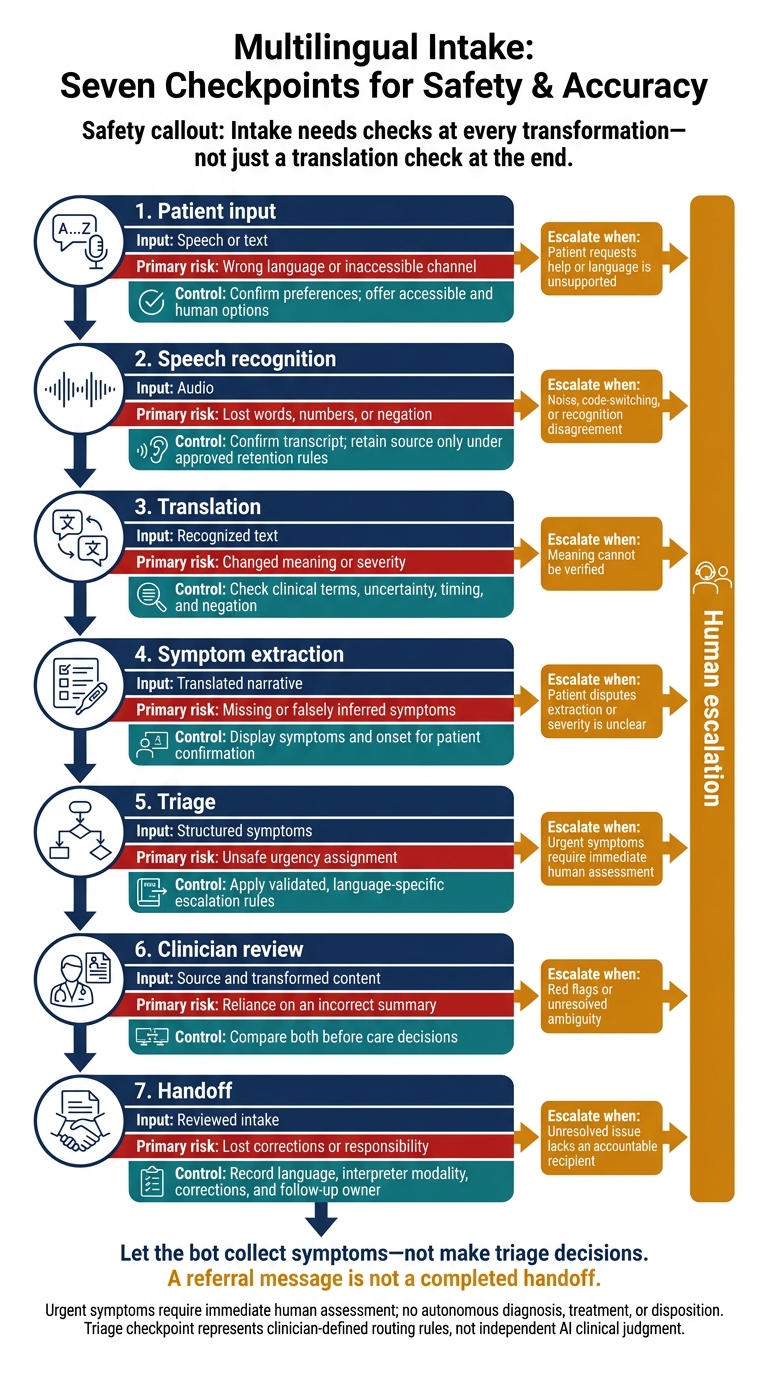
Multilingual AI Intake: 7 Safety Checkpoints
The tables below turn the workflow review into checks to complete before deployment.
Clinical Errors and Patient Understanding
Check translation quality and patient understanding separately. An accurate translation does not, by itself, confirm that a patient understands what to do.
| Workflow | Failure mode | Potential harm | Verification control | Comprehension check |
|---|---|---|---|---|
| AI translation and interpretation | Reversed negation; changed medication terms, dosage, or timing | Wrong medication use or care decision | Qualified review and clinician sign-off | Patient explains the decision or instruction in their own words |
| Multilingual intake bots | Omitted symptoms; understated severity; lost uncertainty | Delayed or incorrect triage | Compare the original input with extracted symptoms and timing | Patient confirms symptoms and onset |
| Patient messages and translated instructions | Missing warnings; changed dose, schedule, or stop conditions | Immediate unsafe action or inaction | Qualified translation review and clinician approval before release | Medication-specific teach-back |
| Multilingual documentation support | Patient uncertainty recorded as a definite finding | Incorrect information shapes later care | Clinician checks against source content | Confirm disputed patient statements with qualified language support |
Language Coverage and Performance Gaps
Test dialects, accents, code-switching, literacy, speech impairments, figurative illness descriptions, and accessibility needs. A supported-language label is not validation. Speaking two languages does not qualify someone to serve as an interpreter.
| Workflow | Underserved language scenario to test | Validation evidence | Patient-respect control | Disparity metric |
|---|---|---|---|---|
| AI translation and interpretation | Regional dialect or mixed-language speech | Review whether meaning is preserved for each language and translation direction | Let patients decline AI and request an interpreter | Clinically significant errors and interpreter wait time by language |
| Multilingual intake bots | Accented speech, speech impairment, or figurative symptoms | End-to-end tests from input through triage | Accessible input, telephone support, and a human alternative | Missed urgent symptoms and abandonment by subgroup |
| Patient messages and translated instructions | Limited literacy, visual impairment, or limited digital access | Patient comprehension testing in the intended channel | Plain language, accessible formats, and channel choice | Teach-back success and clarification time |
| Multilingual documentation support | Code-switching or culturally specific symptom descriptions | Qualified review of meaning and speaker attribution | Preserve the patient’s wording and allow corrections | Material correction rate by language and dialect |
Accuracy checks alone are not enough. Teams also need clear rules for when human review is required.
Human Review and Escalation
Require interpreter support and clinician review for consent, diagnosis disclosure, complex discharge or treatment instructions, major medication changes, emergencies, end-of-life care, behavioral health, and safeguarding. Use confidence scores only as a secondary signal.
| Workflow | Required reviewer | Escalation trigger | Fallback path | Release restriction |
|---|---|---|---|---|
| AI translation and interpretation | Qualified interpreter for speech; qualified translator for text; clinician for care decisions | High-risk content, unsupported language, ambiguity, or patient request | Immediate in-person, video, or telephone interpreter access | Do not release high-stakes communication without review |
| Multilingual intake bots | Clinician, with qualified interpreter support | Urgent symptoms, recognition disagreement, or uncertain severity | Immediate human assessment for urgency; interpreter-supported intake otherwise | No autonomous diagnosis, treatment, or disposition |
| Patient messages and translated instructions | Qualified language reviewer and responsible clinician; pharmacist when appropriate | Medication changes, complex instructions, or conflicting meaning | Direct clinician contact with a qualified interpreter | Hold care instructions until required approval |
| Multilingual documentation support | Responsible clinician; qualified language support where needed | Source meaning cannot be verified, or ambiguity could affect care | Resolve against the source with interpreter support | No record entry before clinician verification |
Intake needs checks at every transformation - not just a translation check at the end. Use these checkpoints as acceptance criteria, and test language-specific escalation rules before deployment.
| Stage | Patient or system input | Primary risk | Control | Escalation condition |
|---|---|---|---|---|
| Patient input | Speech or text | Wrong language or inaccessible channel | Confirm preferences; offer accessible and human options | Patient requests help or language is unsupported |
| Speech recognition | Audio | Lost words, numbers, or negation | Confirm transcript; retain source only under approved retention rules | Noise, code-switching, or recognition disagreement |
| Translation | Recognized text | Changed meaning or severity | Check clinical terms, uncertainty, timing, and negation | Meaning cannot be verified |
| Symptom extraction | Translated narrative | Missing or falsely inferred symptoms | Display symptoms and onset for patient confirmation | Patient disputes extraction or severity is unclear |
| Triage | Structured symptoms | Unsafe urgency assignment | Apply validated, language-specific escalation rules | Urgent symptoms require immediate human assessment |
| Clinician review | Source and transformed content | Reliance on an incorrect summary | Compare both before care decisions | Red flags or unresolved ambiguity |
| Handoff | Reviewed intake | Lost corrections or responsibility | Record language, interpreter modality, corrections, and follow-up owner | Unresolved issue lacks an accountable recipient |
PHI Protection and Accountability
Apply the same checks to PHI access, retention, and accountability.
Put use limits in writing. Allow validated, low-risk administrative assistance. Restrict automation that affects care to approved review pathways, and require human support for high-risk or unresolved communication.
Define incident reporting and patient-notification procedures. Revalidate after material changes to the model, prompt, interface, terminology, or integration. Censinet RiskOps™ can support third-party and enterprise risk reviews for PHI, vendor, and clinical application controls; it does not validate translation quality.
| Workflow | PHI exposure | Downstream error impact | Required controls | Accountable owner | Audit evidence |
|---|---|---|---|---|---|
| AI translation and interpretation | Conversations, recordings, transcripts | Miscommunication during care | Minimum-necessary collection; encryption; vendor and subcontractor access limits; retention rules | Clinical service owner, supported by privacy and security | Access logs, deletion checks, language-review records |
| Multilingual intake bots | Symptoms, identifiers, medication and insurance details | Incorrect routing or delayed assessment | Role-based access; secondary-use restrictions; appropriate contracts; incident reporting | Intake clinical owner and third-party risk lead | Escalations, overrides, triage errors, vendor assessments |
| Patient messages and translated instructions | Diagnoses, prescriptions, care plans | Immediate patient action or inaction | Approved channels; reviewer attribution; version tracking; correction and notification process | Sending clinical service | Approved source/output pairs, release times, comprehension findings |
| Multilingual documentation support | Full notes, audio, clinical history | Lasting record errors reused in later care | Provenance; approval history; amendment process; contractual training restrictions | Responsible clinician and health information management | Amendments, reviewer identity, version history, downstream correction records |
Benefits and Limits by Workflow
Efficiency and clinical safety need separate scorecards. Faster turnaround, more completed forms, broader reach, and less clerical work show convenience - not accurate communication or safe care decisions.
The table brings together the benefit-versus-harm comparisons from the earlier workflow review. It asks where time savings end and clinical risk begins.
| Workflow | Benefits | Limits | Conditions for appropriate use |
|---|---|---|---|
| AI translation and interpretation | Fast drafts, 24/7 availability, and routine written communication. | Fluent wording can hide lost meaning; speech recognition adds errors. | Use locally evaluated, low-risk content. Require human review for any patient-facing text or speech the patient may act on directly.[8][1] |
| Translation evidence | A 2025 medical translation evaluation found high sentence-level accuracy. | Instruction-level errors remained. | Review the full patient message - not isolated lines.[4] |
| Multilingual intake bots | Consistent questions and earlier collection of intake details. | Missed symptoms can distort urgency; high completion rates can hide abandoned intake. | Use intake only to collect symptoms, with triage routed through clinician-defined escalation rules. Measure missed urgent cases and disagreement with clinician review - not completion alone. |
| Patient messages and translated instructions | Broader reach and faster drafting in patients’ preferred languages. | Delivery does not prove understanding; incorrect instructions can lead to unsafe action. | Separate administrative reminders from clinical instructions, and require review for clinical instructions. Check understanding of medication and numerical instructions. |
| Multilingual documentation support | Faster note drafting and less clerical work. | Missing or invented details can remain in the record and influence later care. | Require clinician verification before entry. Preserve the source text when feasible, and include review and amendment time when measuring efficiency. |
The next question is whether measured accuracy reflects the full set of instructions patients receive.
Weak validation can wipe out apparent savings. Track correction time, clarification, and downstream errors alongside time saved. Producing more material that needs extensive repair may shift work rather than reduce it. Even acceptable accuracy may not save time once review and correction are counted.
Privacy exposure, extra copies, review burden, and third-party risk also affect whether a workflow should be approved. Include those costs in approval decisions, and name who has the authority to stop the workflow if it fails. Human review is not enough when the reviewer lacks the language skills, time, authority, or source context to catch errors.[14]
Conclusion: When to Permit, Restrict, or Require Human Support
Use the matrix below to turn your workflow review into a deployment decision.
Permit validated administrative text, such as appointment details. Restrict intake, messaging, and documentation to verified workflows. Require qualified interpretation and clinician review for high-stakes care.
Validation must match both the task and the language. An audit trail records what happened - it does not prove accuracy.
| Workflow | Primary failure mode | Potential harm | Required human role | Minimum validation evidence | Escalation trigger | Deployment status |
|---|---|---|---|---|---|---|
| AI translation and interpretation | Distorted meaning or lost clinical detail | Misdiagnosis; improper treatment | Qualified interpreter or translator, with clinician review | Back-translation and task-specific accuracy logs | High-stakes clinical encounter or meaning drift | Require Human Support |
| Multilingual intake bots | Misread or manipulated patient input | Incorrect urgency assessment; delayed care | Clinician-led review of structured data | Preapproved change-control rules and language-specific intake testing | Red-flag symptoms or out-of-scope input | Restrict |
| Patient messages and translated instructions | Incorrect generated instructions | Patient safety event; medication error | Clinician-approved rules layer and required human review | Generated-text audit trail and task-specific language testing | Clinical instructions requiring direct action, language bias, or output drift | Restrict |
| Multilingual documentation support | Missing or misattributed patient context | Record errors affecting later care | Named clinician signer | Clinical testing against the source record | Discrepancy in clinical summary or missing provenance | Restrict |
For connected tools, enforce authorized action limits at runtime. Keep records of inputs, outputs, and triggered safeguards so investigators can reconstruct a failure. Review business associate agreements for model-update rights, limits on retraining with PHI, and liability for AI outputs.
Before release, confirm meaning, keep a full audit trail, and limit PHI access. Assign one owner to stop unsafe use, correct affected records, notify the care team, and restart use only after revalidation.
FAQs
How can we validate AI for less common dialects?
Overall accuracy can hide gaps between patient groups. Ask vendors to report performance by language and dialect separately. They aren’t interchangeable.
Before deployment, test locally with datasets that reflect the patients you serve. Use gold-standard content that has been professionally translated and medically reviewed by bilingual clinicians or certified interpreters.
After deployment, keep monitoring performance through sampling-based quality audits and comprehension checks to ensure the system works equally well across all patient groups.
What safety thresholds should trigger an AI shutdown?
Set shutdown thresholds before go-live. Shut down or suspend AI when communication-related sentinel events, unsafe behavior, model drift, or bias incidents occur. If comprehension scores stay lower for non-English-preferred patients than for English-preferred patients, pause the tool or limit it to draft-only mode.
Define who has emergency stop authority so they can pause tools immediately after any safety incident, vendor breach, or FDA safety communication.
How can we measure savings after human review?
Track documentation time saved, reductions in EHR time per shift, and increases in patient visits per week [1].
Monitor clinician override and edit rates by language to check that time savings last without putting patients at risk. High override rates may point to unreliable or unsafe AI content for specific groups [2]. Censinet RiskOps™ supports this work by centralizing audit trails, documenting overrides, and tracking performance metrics to protect patient safety and compliance [2][3][4].
