
AI is already shaping claims, coding, prior auth, denials, and payment reviews. The problem is that many health systems still don’t know where it is, who owns it, or how to prove what it did.
Here’s the short version:
- More than 90% of healthcare groups lack an automated AI inventory
- 59% put AI into use without a documented approval process
- Only 12% of U.S. hospitals have a formal AI governance framework
- Weak logging, managing third-party AI risk, and weak ownership can lead to denied claims, HIPAA risk, and audit trouble
- The fix is simple to state: inventory every AI tool, tier risk, require approval, log each decision, and watch model performance over time
If I boil the article down to one point, it’s this: AI risk in revenue cycle is not just a tech issue. It is a control issue.
That gap usually shows up in three places:
- No clear owner
- No clear view into vendor model changes
- No clear audit trail
And that matters because revenue-cycle AI does not sit in the background. It can shape whether a claim is flagged, whether a code changes, or whether a prior auth gets pushed off course. When that happens, the effect can hit cash flow, patient access, legal review, and PHI handling at the same time.
A few facts make the point fast:
- In Lokken v. UnitedHealth, about 90% of AI-generated denials were reversed on appeal
- HIPAA penalties can range from $141 to $2.1 million per violation
- Many teams still cannot reconstruct why an AI-supported decision happened after the fact
So the article’s message is clear: if your team cannot list each AI tool, name its owner, review vendor updates, and produce logs for disputed decisions, your governance is behind your AI use.
What should you do first?
- Build an AI inventory
- Mark high-risk revenue-cycle use cases
- Put a review committee in place
- Require re-review after vendor changes or retraining
- Keep decision logs, version records, and override history
- Track denial patterns, appeal reversals, coding corrections, and PHI-access issues
That is the core of the article in plain English. The rest explains where teams fall short and what controls to put in place.
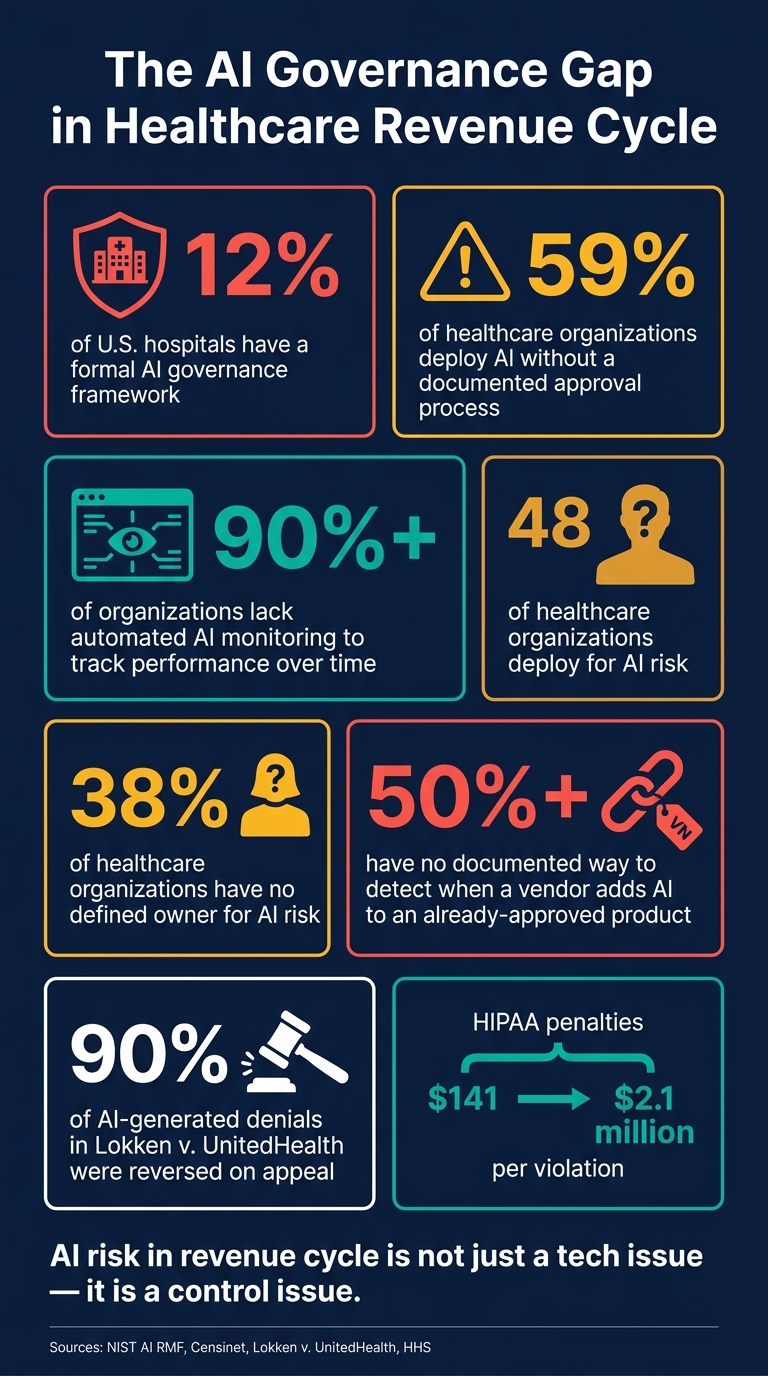
AI Governance Gap in Healthcare Revenue Cycle: Key Stats
AI Oversight for the Modern Revenue Cycle
sbb-itb-535baee
Where Governance Breaks Down in Revenue-Cycle AI
Governance problems in revenue-cycle AI rarely start with a big, obvious failure. They usually begin in small ways: a vendor update that slips through, a coding suggestion no one double-checks, or model drift that builds over time. Then denial rates climb, an audit lands, or regulators start asking for records. By then, the mess is already in motion.
In revenue cycle work, these breakdowns tend to show up in prior authorization, coding, claims editing, denials, and payment integrity. Most of the time, the weak spots fall into three areas: ownership, vendor visibility, and monitoring.
Unclear Ownership and Weak Human Review
If no one clearly owns an AI tool, mistakes sit longer than they should. 38% of healthcare organizations either have no defined owner for AI risk or split that responsibility across several groups without a clear path for escalation [4]. On the ground, that creates a familiar problem: an AI-assisted claim gets flagged, or a coding suggestion turns out to be wrong, and the team first has to figure out who owns the issue before anyone can fix it.
Human review can fail in a quieter way. A lot of organizations say they have a human-in-the-loop process, but that review step can drift into a box-checking exercise. When coders and reviewers are pushed on output, speed tends to win. Review is still there on paper, but it stops working like a control.
That risk showed up clearly in Lokken v. UnitedHealth, where about 90% of AI-generated denials were reversed on appeal [2].
Weak Vendor Oversight and Limited Visibility Into Model Changes
Vendor tools don’t stay frozen after procurement. They change, and sometimes they change in ways the buyer never formally reviews. More than 50% of healthcare organizations have no documented way to detect when a vendor adds AI to an existing product that was already approved [4].
That matters more than it may seem. A claims editing platform that cleared review 18 months ago may now run on a different model than the one your team first signed off on. If that change never made it into the AI inventory - or into an updated Business Associate Agreement - you’ve got a gap.
This is what unapproved AI functionality looks like in day-to-day operations. The compliance problem is plain: PHI is now moving through an AI layer that no one formally approved.
"Approval gates designed for the original product don't cover what the product becomes after a vendor updates it with AI." - Patrick Spencer, Kiteworks [4]
The risk gets worse when subcontractors sit behind the vendor. If your vendor’s AI depends on another company’s model or data pipeline, your line of sight shrinks fast. Your exposure, though, does not.
Poor Monitoring, Auditability, and PHI Controls
Approval at launch is only the starting point. After that, the system still needs to be watched. Yet 90% of organizations lack automated monitoring to track AI performance over time [1]. So a prior authorization model can drift for months before anyone spots the pattern.
Audit gaps turn a performance issue into a legal one. Many legacy claims platforms keep the result, but not the reasoning behind it: what the model weighed, what it skipped, and why it denied the claim [2]. When a payer dispute or regulator asks for answers, the organization may not be able to rebuild the decision trail. That’s a serious problem, especially since AI documentation - including training data specifications and validation reports - is now discoverable in federal court [2].
PHI controls create another pressure point. Bulk PHI exports for training or retraining, without BAA language that covers AI subprocessors, can trigger HIPAA exposure. Penalties can range from $141 to $2.1 million per violation [3].
All of this points in the same direction: formal inventory, approval gates, and continuous monitoring. More ad hoc review won’t solve the issue. What’s needed is a defined AI control framework.
A Control Framework for Safe AI Use in Revenue-Cycle Operations
This section turns that gap into controls. The goal isn't a simple checklist. It's a control framework.
Right now, only 12% of U.S. hospitals have a formal AI governance framework in place [1][5]. That leaves most organizations using AI in revenue-cycle work without the same guardrails they'd expect for any other high-risk financial process. The NIST AI Risk Management Framework fits this work well: Govern, Map, Measure, and Manage. Used the right way, those functions turn a loose AI footprint into a governed operating model.
Build an AI Inventory and Assign a Risk Tier to Every Use Case
You can't govern what you haven't documented.
For each tool, record the vendor, the type of AI, the workflow it touches, whether PHI is involved, what data it uses, the financial and operational effect, and whether the tool is live, in pilot, or still planned. Then assign a risk tier.
High-risk status should apply to AI that affects prior authorization, coding, claims editing, denials, or payment integrity. That's where bad output can hit cash flow, compliance, and patient impact all at once. The inventory then becomes the base for approvals, reviews, and monitoring.
Require Approval Gates Before Any AI Tool Goes Into Production
59% of healthcare organizations deploy AI tools without a documented committee approval process [1][5]. That's the opening where unreviewed features slip into live workflows.
Require committee sign-off before production. That review should come from a multidisciplinary group with medical policy, compliance, legal, privacy, and IT at the table. The team should review:
- privacy and security impact
- vendor-risk assessment
- validation against historical claims
- a documented human review process
That last point matters more than it might seem. Human review can't be there just for show. If clinicians or coders feel pressure not to override the model, then the override option is just theater, not a control [2].
Any vendor update, retraining event, or new AI feature should go back through that same review path. No shortcuts.
Set Up Audit Logs, Evidence Files, and Monitoring Dashboards
Going live is the start, not the finish. Monitoring needs to continue after launch.
For every AI-assisted decision, log the data used, the model version, the output, and the override trail. Those records make the decision path reconstructable for internal audit and legal defense [2]. If someone asks, "Why did this claim get flagged?" or "Who overrode this result?" you need an answer backed by records, not guesswork.
Use the table below as the operating template:
| NIST Function | Deliverable | Purpose | Primary Owner | Review Frequency |
|---|---|---|---|---|
| Map | AI Inventory & Risk Tiering | Identifies all AI assets, PHI exposure, and financial and operational impact | IT / Compliance | Quarterly or upon new tool procurement |
| Govern | Multidisciplinary Approval Committee | Ensures cross-functional alignment and legal/compliance sign-off | Legal / Compliance | Per deployment or vendor update |
| Manage | Structured Decision Logs & Evidence Files | Captures per-decision reasoning and override trails for audit defense | Revenue Cycle / IT | Monthly or per high-risk case escalation |
| Measure | Performance & Drift Monitoring Dashboard | Tracks denial rates, appeal-overturn rates, coding correction rates, and PHI-access anomalies | Data Science / Operations | Continuous monitoring; monthly review |
At a minimum, track denial rate, appeal-overturn rate, coding correction rate, false positives, drift alerts, PHI-access anomalies, and escalation volume.
Vendor-Risk Questions and How to Run AI Governance Day to Day
Vendor oversight is often the control that slips through the cracks in revenue-cycle AI programs. Once you have an inventory and approval gates in place, this becomes the day-to-day control that keeps the program honest.
Questions Procurement and Risk Teams Should Ask Every AI Vendor
Before any tool touches high-risk revenue-cycle workflows, get written answers. Not a slide deck. Not a polished demo. Written responses you can review later.
Use the table below to split diligence work across teams.
| Stakeholder | Key Questions to Ask |
|---|---|
| Procurement | What third-party models or subcontractors does this tool depend on? Can we export per-decision logs for audit or legal review? |
| Compliance / Legal | Does the tool meet applicable transparency and liability requirements? How do the contract terms address data-use restrictions? |
| Privacy / Security | Is PHI used to train the model? Where is data stored and processed? Does the vendor provide a software bill of materials, or component list? |
| Revenue Cycle | How does the tool handle model drift in coding accuracy? How are overrides logged, reviewed, and exportable for audit? |
Two controls need extra scrutiny.
First, ask for the vendor's change-control plan (PCCP). This shows how model updates are checked before release. If a vendor can't provide one, then every retraining event is basically an unreviewed change.
Second, make human overrides nonpunitive. If staff get penalized for going against the model, human-in-the-loop review stops being a safeguard and starts looking like theater [2].
Contract Controls That Reduce Compliance and Financial Risk
Vendor answers help, but they don't mean much if the contract doesn't lock them in.
A BAA by itself is not enough. Most standard BAAs were written before AI became part of revenue-cycle tools. They should now spell out whether PHI is used for model training, what subprocessor duties apply, and what counts as an AI-specific failure, including incorrect outputs, data poisoning, or unauthorized model changes [1][4].
Beyond the BAA, contracts should require advance notice before any model update, retraining event, or new AI feature is pushed into your environment. Before, not after. They should also give your team audit rights, including access to training-data specifications and validation records. Courts can require disclosure of training data and validation records [2]. Liability should also be assigned in plain terms when AI-driven output leads to a dispute or a regulatory review.
A Practical Model for Continuous AI Oversight
After contract language, the next thing that matters is steady review.
Every high-risk AI use case in your inventory should have a named executive owner. One person. One seat at the table. That owner should be accountable for performance, drift, and incident response. Without that, findings tend to float around with nowhere to land.
The governance committee should also do more than approve tools. It should serve as a recurring review forum for performance and drift. Track defensibility metrics along with stability metrics. For example:
- How often are AI-generated denials overturned on appeal?
- How often are human overrides happening?
- Is the override rate shifting over time?
AI incidents should feed into your current privacy and cybersecurity response processes. If a model is producing systematically incorrect coding outputs, that's not just an IT ticket. It's a compliance event.
Censinet RiskOps™ can centralize assessments, remediation, and approvals in one AI risk dashboard [4]. Human review should stay in place at every critical decision point.
"Healthcare has built the governance scaffolding for AI, but the operational muscle - inventory, asset management, detection methods, and clear accountability - is not keeping pace with adoption." - Ed Gaudet, CEO, Censinet [4]
Conclusion: Close the Governance Gap Before AI Becomes a Revenue-Cycle Liability
AI in the revenue cycle isn't going anywhere. But when it's left unchecked, the risks pile up fast: incorrect denials, HIPAA exposure, audit and regulatory trouble, and model drift. Right now, only 12% of U.S. hospitals have a formal AI governance framework in place [2]. That leaves most organizations working without the controls they need.
The issue isn't the technology itself. The issue is governance. High appeal-overturn rates make that plain. Controls, review, and vendor oversight simply haven't kept up. What closes that gap is a governed operating model.
Without structured decision logs, version-controlled training data, and validation records, you can't defend a denial.
So the response has to be operational, not theoretical. Start with an AI inventory, set risk tiers, put approval gates in place, tighten vendor controls, maintain decision logs, and monitor systems on a continuous basis. That's how you close the gap that still leaves 59% of healthcare organizations deploying AI tools without a documented approval gate [1].
FAQs
What counts as high-risk AI in revenue cycle?
In the healthcare revenue cycle, high-risk AI means any AI that could cause major financial, operational, or compliance problems.
What makes it high risk? It usually comes down to a few things: the sensitivity of the data it handles, how much it can do on its own, how critical the workflow is, and how much it can affect revenue or regulatory status.
A couple of clear examples are claims and coding tools. If those systems make the wrong call, they can create upcoding issues or trigger False Claims Act risk. Prior authorization tools also fall into this group because they can lead to unfair denials or compliance problems.
Put simply, AI that works on its own, handles PHI, or directly touches financial transactions needs the strictest governance.
Who should own AI governance in a health system?
AI governance in a health system should use dual accountability.
That means a clinical leader owns patient safety outcomes, while a technical leader owns system performance, data security, and infrastructure. It’s a simple split, but an important one: one side focuses on patient care, the other makes sure the system works as intended and stays secure.
Each AI tool should also have a named owner. That person is responsible for procurement, validation, monitoring, and incident response.
On top of that, a multidisciplinary committee should provide oversight. And not just in name only. The committee needs formal authority to approve, modify, or decommission tools when needed.
What should an AI decision log include?
An AI decision log should create a clear, auditable record of each revenue cycle decision. It needs to show the policy basis, the clinical or administrative data reviewed, and the reasoning used to reach the outcome.
For claims and authorization decisions, it should also record the criteria matched, the documentation reviewed, the approval or denial rationale, feature attribution, any factors ignored, and any clinical override path.
