
AI risk alerts help hospitals spot device threats earlier, sort the most urgent issues first, and cut some of the noise that comes with fixed rules. In this article, I show that the best systems do more than flag odd traffic. They learn normal device behavior, score risk by patient impact, and feed alerts into IT, clinical engineering, compliance, and FDA-related review.
Here’s the short version:
- AI alerts watch for unusual behavior across infusion pumps, monitors, imaging systems, implantables, and insulin devices.
- Anomaly detection leads most IoMT research, with many studies reporting about 98% to 99.9% accuracy. But I’d focus less on accuracy alone and more on false positives, recall, and alert speed.
- Device type shapes the alert design. Implantables often use a gateway or cloud model. Hospital equipment can use edge or central monitoring.
- Low false positive rates matter a lot. Even a small false alarm rate can swamp teams in large hospitals.
- Rules from FDA and hospital governance now matter as much as model scores. That includes SBOMs, postmarket monitoring, change control, logging, validation, and rollback plans.
- The main weak spots are clear: old hardware, model drift, data silos, and too much dependence on lab or simulated datasets.
If you need one takeaway, it’s this: AI-powered medical device alerts work best when they connect device data, alert triage, and governance in one process you can act on.
I break the article down around model performance, device-specific use cases, and the controls hospitals need to keep alerts useful and review-ready.
Medical Devices in the Age of AI and Cybersecurity: Regulatory Insights | Compliance & Risks
sbb-itb-535baee
What Recent Studies Show About AI Detection in IoMT
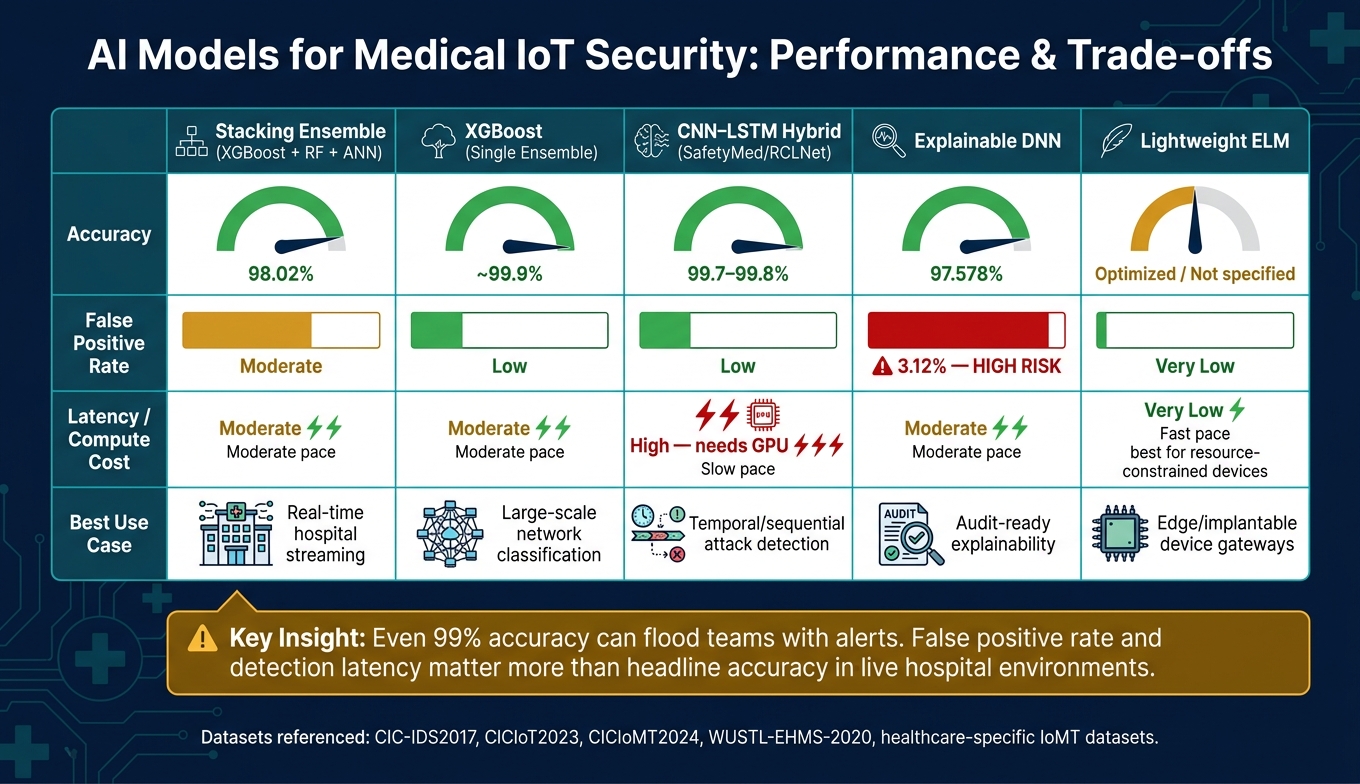
AI Models for Medical IoT Security: Performance & Trade-offs Compared
Recent IoMT intrusion-detection research leans hard toward anomaly detection and multi-class classification. That makes sense. Hospital traffic is messy, mixed, and full of edge cases, so simple rule-based filters often miss the bigger picture. At this point, the main debate isn’t whether AI can spot attacks. It’s which model types do the best job of turning noisy hospital traffic into usable alerts.
AI Models Used to Detect Cyber Threats in Medical IoT
Researchers usually compare four main groups: classic machine learning, tree-based ensembles, deep learning, and stacked hybrid models. And they usually test them against multi-class attack scenarios, not just a plain attack-versus-no-attack setup. Common attack classes include DoS/DDoS, scanning, MITM, injection, botnet, and credential-stuffing attacks.[3][4][6][7][8][9]
Across these studies, ensembles and hybrid deep-learning systems often come out on top. Reported accuracy is often close to 98% to 99.9% on benchmark datasets and healthcare-focused datasets.[5][6][7][9] On paper, that looks strong.
But hospitals don’t run on paper. For medical device alerts, the bigger issue is whether a model catches bad activity without burying clinicians and security teams under noise. A high score sounds good, but alert quality still comes down to two plain questions: How many attacks does the model miss? And how many false alarms does it create?
How to Read the Evidence Behind Alert Quality
Hospitals should read these studies through an alert operations lens, not just an accuracy lens.
A few metrics matter more than the headline number:
- Recall shows how many attacks get missed.
- Precision shows how many alerts are false alarms.
- F1-score balances recall and precision.
- ROC-AUC shows how well the model separates attack traffic from normal traffic.
In day-to-day operations, false positive rate (FPR) is often the metric that hits hardest. Some tuned LSTM-based systems report an FPR as low as 0.0001%.[4] On the other hand, an explainable deep neural network tested on the WUSTL-EHMS-2020 dataset reported 97.578% accuracy with a 3.12% FPR.[11]
That gap matters. In a busy hospital network, even a low single-digit FPR can snowball into alert fatigue fast. A few extra bad alerts here and there may not sound like much, but at scale, they can wear staff down.
Speed matters too. Lightweight models can handle events in about 9 to 25 milliseconds, while higher-scoring ensembles and deep learning models may need more time to run.[6][8] So there’s a trade-off: some models are faster and easier to deploy, while others push higher detection scores but ask for more compute.
IDS Study Comparison Table
The table below compares widely cited IoMT IDS approaches across accuracy, false positives, and compute demand.
| Study Type / Model Family | Dataset Environment | Attack Classes Tested | Key Performance | Latency / Compute Cost |
|---|---|---|---|---|
| Stacking Ensemble (XGBoost meta + RF + ANN) | Healthcare-specific medical IoMT dataset | DoS, spoofing, injection, scanning | 98.02% accuracy; classified 97 of 100 events correctly in real-time tests[6] | Moderate; validated in real-time streaming |
| XGBoost (single ensemble) | CIC-IDS2017, CICIoT2023 | DDoS, botnet, brute-force, scanning | About 99.9% accuracy and 99.9% ROC-AUC on CIC-IDS2017; >98% accuracy on CICIoT2023[7] | Moderate; higher than lightweight models |
| CNN–LSTM Hybrid (SafetyMed / RCLNet) | Healthcare-specific IoMT datasets | MITM, injection, spoofing, temporal anomalies | About 99.7% to 99.8% accuracy[5][9] | Higher; benefits from GPU or edge accelerator |
| Explainable DNN | WUSTL-EHMS-2020 (IoMT) | Multi-class IoMT attacks | 97.578% accuracy; 3.12% FPR[11] | Moderate |
| Lightweight ELM | CICIoMT2024 | DDoS | Optimized for low compute cost[10] | Very low; suited for resource-constrained devices |
Even so, live hospital use is a different ballgame. Without in-hospital validation, device-level thresholds, and clear alert triage rules, even 99% accuracy can still flood teams with noise. In practice, governance and device-level monitoring usually decide whether these systems help staff or just add one more blinking dashboard. Real-world implementations, such as UNC Health's medical device risk management partnership, demonstrate how automation can bridge the gap between detection and clinical operations.
How AI Supports Alerts for Specific Medical Devices
General IoMT research sets the stage, but the real test starts when AI is tied to a specific device, whether that device sits on a hospital network or inside a patient’s chest. The device type changes almost everything: what data you can use, where the model can run, and what kind of alert matters in practice. So in many cases, device type matters more than model type when you design alerts.
Implantable Devices and Gateway-Based Monitoring
Implantable devices such as pacemakers and insertable cardiac monitors (ICMs) can’t run heavy models on the device itself. Battery life and compute limits get in the way. So the AI usually runs somewhere else, like an external gateway, a home monitoring hub, or a cloud platform that receives wireless telemetry from the implant and checks it remotely.[20][18]
That setup has produced strong results. One AI analyzer reclassified 76.0% of false-positive ICM episodes while keeping >98% sensitivity for clinically relevant arrhythmias. It also did this without misclassifying any asystole, bradycardia, or ventricular tachycardia as normal.[14] In a multi-manufacturer review, a cloud-based AI algorithm for ICMs reached 98.3% sensitivity in AI-equipped devices, compared with 94.3% in non-AI models, while specificity reached 75.6%.[16]
Security alerting for implantable devices has its own angle. Research comparing supervised learning models, including multilayer perceptrons (MLPs), k-nearest neighbors, and Naïve Bayes, found that MLPs offer the best tradeoff between false positives and false negatives on hardware with tight limits.[18][13] The goal stays simple: catch every critical event, cut down noise, and keep inference fast enough for near-real-time gateway processing.
Implantables depend on outside monitoring. Hospital equipment, on the other hand, can often support inference closer to the device.
Hospital Equipment: Pumps, Monitors, and Imaging Systems
Networked hospital devices bring a different set of problems. Infusion pumps, bedside monitors, and imaging systems create rich, continuous network traffic, which gives AI models plenty to learn from across each device class and its operating cycle.[12][15][17]
On edge gateways, lightweight deep learning models such as MobileNet autoencoders, micro-TCNs, and compressed LSTMs have shown sub-second latency anomaly detection across device types like vital-sign monitors, infusion pumps, and RFID asset trackers.[21] That speed matters. If an alert comes too late, staff may miss the chance to step in.
An unsupervised spatial-temporal variational autoencoder (VAE) tested on simulated healthcare IoT data reached 95% accuracy, 95% precision, 75% recall, and 98% specificity.[17] Put plainly, it kept false alarms low while still catching most anomalies. A deep autoencoder-based pipeline also cut false alarm rates by about 30% compared with model-centric approaches, moving the F1-score from 0.85 to 0.92.[22]
In practice, these models flag patterns like repeated high-dose pump commands and unauthorized imaging-system configuration changes. That can help stop missed doses, downtime, or unsafe reconfiguration before they turn into bigger problems.[12][15][17]
Device-Specific AI Alert Models Table
| Device Category | Input Data Sources | Deployment Location | Primary Alert Type |
|---|---|---|---|
| Implantable cardiac devices (ICMs, pacemakers) | ECG telemetry, arrhythmia event logs, communication metadata | External gateway or cloud monitoring platform | Clinically meaningful arrhythmia confirmation; false-positive suppression of non-actionable episodes[14][16] |
| Infusion pumps | Network traffic metadata, command sequences, pump rate logs | Edge gateway or nursing station server | Abnormal dosing commands, unauthorized configuration changes[12][15] |
| Bedside vital-sign monitors | Session timing, packet flow statistics, sensor readings | Edge gateway or centralized monitoring platform | Anomalous session timing and device behavior[12][15][17] |
| Imaging systems (CT, MRI) | API call sequences, protocol usage, operational state logs | Centralized monitoring platform | Unauthorized configuration changes, atypical command sequences[12][15][17] |
| Insulin delivery systems | Signal frequency/power, bolus injection levels, time differentials | External monitoring node or gateway | Deviations from normal delivery patterns[23] |
These device-level alerts matter most when they feed into a clear triage and remediation workflow.
Regulatory and Governance Requirements for AI-Driven Alerts
AI alerts only help in day-to-day use when governance, validation, and regulatory controls are part of the setup. Strong detection alone isn't enough. You also need the guardrails that keep alerts trusted, changes controlled, and records ready for review.
FDA Guidance, Lifecycle Controls, and Model Updates

The FDA's June 27, 2025 cybersecurity guidance calls for secure design, logging, access control, and threat modeling across the full device lifecycle, including AI alert pipelines.[1][27] For AI alerts, that translates to secure data pipelines, controlled training, and validated deployment. If those lifecycle controls are missing, even a high-performing model can drift, fire too many alerts, or miss risk.
Under Section 524B, cyber devices must include an SBOM and a postmarket vulnerability plan. If a premarket submission leaves out that documentation, it can lead to an RTA submission rejection.[19][27][28][29]
For AI models, the Predetermined Change Control Plan (PCCP) gives manufacturers a path to make certain algorithm changes after launch without new clearance. But there’s a catch: change types, data management practices, and update procedures must be defined in advance and kept under control. Hospitals should ask for documented model-change scope, validation evidence, drift detection, and rollback steps for every AI update.
A review of FDA safety communications from 2013 to 2025 found 18 cybersecurity-related alerts tied to medical devices, with 94% of reported vulnerabilities rated high risk, including remote code execution and device malfunction.[24] In one well-known case, the FDA told hospitals to stop using a vulnerable infusion pump and move to other devices. It was the first time the agency recommended discontinuation based only on a cybersecurity issue.[25][26] That set a clear marker: regulators will step in when detection and lifecycle controls fall short.
Those rules only go so far on paper. The hard part is putting alerts into hospital workflows where people can act on them.
Hospital Risk Workflows and Continuous Oversight
At the hospital level, AI alerts need clear routing, escalation paths, and ownership. SOC, clinical engineering, and compliance teams should work from shared playbooks, with escalation based on device type, clinical impact, and PHI exposure. That gives HIPAA review the context it needs without wasting time.
Continuous oversight also means regular review, not just one-time setup. Monthly or quarterly risk committee discussions, alert trend analysis, and alignment with enterprise risk dashboards help teams spot drift, repeat issues, and gaps in coverage. Censinet RiskOps™ can centralize vendor risk assessments, model governance reviews, validation records, and device-linked change logs.
The table below turns those expectations into concrete capabilities leaders should check.
Regulatory Expectations Mapped to Alert Capabilities Table
| Regulatory / Governance Expectation | Required Alert System Capability | Internal Owner | Typical Vendor Evidence |
|---|---|---|---|
| Cybersecurity by design | Continuous network and device monitoring; device-aware anomaly detection | IT Security / Biomedical Engineering | Secure Product Development Framework documentation; premarket submission records |
| SBOM and vulnerability management | Asset inventory integration; CVE-linked alert triggers | IT Security / Clinical Engineering | SBOM files; vulnerability disclosure and patch history |
| Predetermined Change Control Plan (PCCP) | Model versioning, rollback controls, documented retraining criteria | IT Security / Vendor Management | PCCP documentation; validation reports for each model update |
| Postmarket cybersecurity monitoring | 24/7 alert coverage; health status indicators for models and data feeds | IT Security / SOC | SLA documentation; uptime and coverage reports |
| HIPAA incident documentation requirements | Structured incident records with context, containment actions, and post-incident review | Compliance / Privacy | Incident log templates; audit trail exports |
| Internal AI governance | Role-based dashboard access; explainability documentation for alert logic | IT Security / Compliance | Model transparency reports; governance committee review records |
| Enterprise risk alignment | Risk dashboard integration; benchmarking against peer organizations | CISO / CIO | Risk platform integration specs; benchmarking methodology documentation |
Implementation Challenges, Future Research, and Key Takeaways
Where Deployments Still Fall Short
Strong benchmark scores don't always turn into useful alerts inside live hospital networks.
A lot of IoMT devices still run on older hardware with limited CPU and memory. That makes on-device AI inference hard to use in practice. So detection often gets pushed to gateways or cloud platforms instead. The tradeoff is pretty clear: you may lose visibility into device-level signals like firmware changes or local log anomalies.
False positives are another big problem. In some healthcare IDS deployments, roughly 15% of flagged intrusions can be false positives,[33] and that can swamp analysts and slow down response to actual threats. Models also drift over time. As device fleets, firmware, and clinical workflows change, models trained on older traffic lose accuracy unless teams retrain them.[34]
Interoperability gaps add another layer of friction. Device identifiers often don't line up across CMMS databases, SIEM tools, and clinical systems. So an alert tied to an IP address may not map cleanly to a specific pump in a specific ICU room. Until asset inventory and security tools share a common data model, teams will keep struggling to connect alerts to clinical context fast enough for triage.
What Future Studies Need to Prove
The evidence base is still thin outside simulated or single-site testbeds. Most published evaluations still depend on synthetic, simulated, or non-hospital traffic, which means cross-site validation is scarce.[30] Studies that compare model performance across academic medical centers, community hospitals, and rural facilities are also limited. Without that kind of testing, healthcare leaders can't judge how a model is likely to perform in their own setting.
Reporting also needs work. Too many papers focus on offline accuracy metrics like F1 score and leave out day-to-day measures that matter more in the field, such as:
- detection latency
- alert volume per analyst
- time to mitigation
Future research should also test adversarial resilience in a more systematic way, since crafted network flows can cause some ML-based IDS models to label malicious activity as benign.[31][32] And there's still limited evidence on human-in-the-loop oversight, including whether analyst feedback helps models improve over time.
Conclusion: What Healthcare Leaders Should Take from the Evidence
The big takeaway is simple: AI helps only when teams turn alerts into action.
That means using high-quality, representative data, tying outputs into SOC and clinical engineering workflows, and applying clear governance linked to measurable outcomes. Regulatory expectations are also climbing. Lifecycle controls, SBOM management, and change control for AI-enabled software are now baseline requirements.[27][36][37][35][2] Censinet RiskOps™ can connect alert data to enterprise risk and audit workflows.
FAQs
How is AI better than rule-based device alerts?
AI-driven alerts are more proactive, context-aware, and real-time than rule-based methods. Instead of relying on static, periodic checks, AI keeps watching device telemetry and network logs, learning what normal looks like and flagging unusual activity as it happens.
It can also cut alert fatigue by ranking notifications based on clinical relevance and asset criticality. That way, security teams can spend their time on the risks that matter most.
What makes false positives such a big problem in hospitals?
False positives are a big problem in hospitals. They create a flood of alert noise, which makes it harder for clinical and security teams to spot actual threats.
That constant stream of alerts leads to alert fatigue. Teams spend too much time checking alerts by hand, only to find that many of them aren’t real issues. The result? Slower response to genuine incidents, more disruption to clinical workflows, lower device availability, and added risk to patient safety.
What should hospitals validate before deploying AI alerts?
Before rolling out AI alerts, hospitals need to check the basics on both cybersecurity and clinical safety. That means looking at network segmentation, authentication and authorization, encryption, incident response that lines up with NIST or HIPAA, and safe behavior on the clinical network. In plain terms, the system has to work without creating problems for bandwidth, latency, or interoperability with EHR, RIS, and PACS.
They should also verify data quality, model governance, and human oversight. That includes validating data feeds, requiring review of high-impact flags, and asking for an SBOM, a vulnerability disclosure policy, and clear escalation paths.
