
If you work with AI in healthcare, this is the short version: HSCC is not a regulator, but its AI guidance is shaping how many health systems and vendors handle governance, security review, procurement, and vendor oversight in 2026.
I’d boil the article down to this:
- The HSCC AI Task Group launched in October 2024
- It now includes 115 healthcare organizations
- The broader HSCC Cybersecurity Working Group includes 480+ organizations
- Its work centers on five workstreams
- Its vendor risk guide uses a 7-phase lifecycle
- The biggest shift is simple: AI risk is no longer just a security team issue
What matters most is not the group’s structure. It’s what healthcare teams are now expected to do:
- classify AI tools before purchase
- keep a live AI inventory
- review third-party AI risk beyond normal security questionnaires
- track risks like data poisoning, model inversion, and performance drift
- set up a cross-functional review group with clinical, compliance, IT, and business input
- keep records that show decisions, approvals, and retirement steps
Here’s the core takeaway in plain English: HSCC is turning AI risk into a repeatable process. The focus is moving from general AI talk to documented controls, contract terms, monitoring, and end-of-life planning.
Quick comparison
| Area | What HSCC is pushing teams to do |
|---|---|
| Governance | Form an AI review committee and assign ownership |
| Procurement | Classify tools early and add AI terms to contracts |
| Vendor risk | Ask about subcontractors, open-source code, and training limits |
| Security | Review AI-specific threats, not just standard cyber checks |
| Monitoring | Track model behavior, data quality, and drift over time |
| Decommissioning | Retire models and delete data in a documented way |
In my view, the article’s main point is clear: the HSCC AI Task Group is helping set the working playbook for healthcare AI policy, even without writing rules.
AI in Healthcare: Hidden Cybersecurity Risks
sbb-itb-535baee
Who the HSCC AI Task Group is and how it organizes healthcare AI risk
The HSCC AI Task Group sits inside the HSCC Cybersecurity Working Group and focuses on one thing: spotting and reducing cyber risks tied to artificial intelligence and machine learning in healthcare. It now includes 115 healthcare organizations [4]. The broader HSCC Cybersecurity Working Group includes more than 480 organizations across health delivery, life sciences, insurance, health IT, and government agencies [2]. Leadership includes Greg Garcia, along with task group co-leads Ed Gaudet and Samantha Jacques [1][2]. Their priorities are grouped into five workstreams.
That setup matters. AI drift, manipulation, or silent failure doesn't just create a tech problem. It can hit patient care, daily operations, and privacy at the same time. The task group looks at those risks as connected, not separate.
HSCC's role in sector policy
HSCC is not a regulator. It doesn't issue binding rules or certify products. What it does is bring together providers, vendors, and governance leaders to turn new AI risk into practical guidance, especially where older models don't go far enough [1][2][3].
Its guidance is meant to line up with established frameworks such as the NIST AI Risk Management Framework and the joint HSCC-HHS Health Industry Cybersecurity Practices (HICP) [1][2].
The five workstreams behind the 2026 agenda
The task group's 2026 agenda centers on five workstreams:
| Workstream | Primary Risk Objective | Accountable Stakeholders | Practical Output |
|---|---|---|---|
| Education and Enablement | Improve sector-wide awareness and terminology alignment | Clinical, operational, and technical staff | AI Cyber Glossary; training checklists [1][2] |
| Cyber Operations | Detect and contain AI-specific threats like adversarial attacks and data leakage | CISOs, SOC analysts, incident response teams | Incident response protocols and forensics guides [2][3] |
| Governance | Establish clear accountability and strategic alignment for AI use cases | CIOs, boards, compliance committees | AI use case justification framework; RACI matrices [2][3] |
| Secure by Design | Ensure AI integrity through rigorous validation and threat modeling | Developers, clinical engineers, vendors | AI-specific threat modeling; test and validation documentation [3] |
| Third-Party AI Risk & Supply Chain Transparency | Manage hidden dependencies and opaque layered supply chains | Procurement, risk managers, legal | Third-Party AI Risk Guide; sample contract clauses [1][2] |
In plain English, these workstreams split a big, messy problem into parts people can act on. One stream helps teams speak the same language. Another deals with attacks and incident response. Others focus on oversight, system testing, and vendor risk. Those streams feed directly into the publications and governance guidance discussed next.
The HSCC publications shaping AI governance, cybersecurity, and procurement
The HSCC AI Task Group has turned its priorities into documents teams can use in practice. Three publications sit at the center of that work, and each handles a different part of the challenge. If you know what each one covers - and what it doesn’t - you can figure out where to begin without wasting time.
HIC-AIM and the basis for healthcare AI cybersecurity
The first HSCC publications set the baseline. The newer guides build on that baseline and turn it into day-to-day requirements.
Health Industry Cybersecurity - Artificial Intelligence and Machine Learning (HIC-AIM) set the sector baseline for AI/ML cybersecurity in clinical and enterprise healthcare settings. It established the starting point for AI/ML cybersecurity risk across the sector. Read this one first if you want the context behind the newer implementation guides.
The AI Cybersecurity Governance Framework Implementation Guide
The AI Cybersecurity Governance Framework Implementation Guide turns HIC-AIM into internal controls for lifecycle governance, secure data handling, model protection, and AI-specific incident response.
That matters because AI failures do not always look like a normal security event. A model can drift, degrade, or shift after a vendor update and never trip the usual breach alarms. The guide deals with that risk through continuous monitoring protocols, inventory management, role clarity with RACI matrices, and template materials that help teams put the guidance to work.
That same internal-control approach also reaches vendors, where visibility and contract terms become part of AI security.
The Third-Party AI Risk and Supply Chain Transparency Guide
Released on April 16, 2026, the Health Industry Third-Party AI Risk and Supply Chain Transparency Guide focuses on vendor due diligence, layered supply chains, and secure decommissioning [1][2].
The guide tackles a big gap: limited visibility into subcontractors, open-source components, and offshore development. It lays out a seven-phase lifecycle that starts with Phase 0 classification and runs through secure decommissioning [2][3]. Phase 0 classifies each AI solution by safety impact tier before procurement starts [2].
It also adds AI-specific BAA provisions for data ownership, training restrictions, and model end-of-life support. The appendices include templates for RACI, contract language, and vendor assessment [2].
Taken together, these documents give organizations a shared reference point for policy, procurement, and security review.
The three most useful publications are below.
| Publication | Release Date | Primary Focus |
|---|---|---|
| HIC-AIM | Pre-2026 | Baseline AI/ML cybersecurity framing for clinical and enterprise settings |
| AI Cybersecurity Governance Framework Implementation Guide | 2026 | Internal controls: lifecycle governance, model protection, and incident response |
| Third-Party AI Risk & Supply Chain Transparency Guide | April 16, 2026 | Vendor due diligence, supply chain visibility, and 7-phase lifecycle management |
These publications align with the NIST AI Risk Management Framework and HSCC-HHS HICP [1][2].
What HSCC guidance changes in organizational AI risk expectations
These HSCC publications push healthcare organizations to treat AI risk in a much broader way. AI risk is no longer just an IT issue. It now sits across governance, procurement, vendor review, and patient safety.
As Greg Garcia, Executive Director of the HSCC Cybersecurity Working Group, put it:
"Inconsistent AI terminology across healthcare organizations creates measurable risk in procurement, vendor contracts, and patient safety oversight." [2]
That change shows up most clearly in governance, inventory management, and documentation.
Governance structures and lifecycle oversight
In day-to-day terms, HSCC places clear ownership on governance. Organizations are expected to set up a cross-functional AI Cyber Governance Committee that includes clinical, operational, compliance, and technical stakeholders. That group should oversee AI across the full lifecycle, from use-case approval to decommissioning.
HSCC also makes room for scale. Smaller health systems can work from baseline controls, while larger systems are expected to apply deeper validation and more detailed risk stratification [2].
AI-specific controls, inventories, and evidence of implementation
A static vendor list doesn't cut it anymore. Organizations need a live AI asset inventory that tracks data flows and embedded AI across the environment [1][2].
Risk reviews also need to go beyond standard security checks. HSCC calls for assessments that address threats many old review processes miss, including:
- data poisoning
- training data leakage
- model inversion
- performance drift
Human oversight matters too. Thresholds for review and escalation paths should be set ahead of time, not figured out in the middle of an incident.
Those expectations translate into specific controls and clear audit evidence.
| HSCC Policy Expectation | Organizational Control | Evidence of Implementation |
|---|---|---|
| Cross-functional oversight | AI Cyber Governance Committee with clinical, operational, compliance, and technical representation | Committee charters, meeting minutes, RACI matrix approvals |
| Lifecycle accountability | Stage-gated AI risk management process from use-case approval through decommissioning | Impact tiering reports, stage-gate approval logs |
| Supply chain transparency | Mandatory disclosure of subcontractors and open-source components | SBOMs, updated vendor inventories, data-flow diagrams |
| AI-specific risk assessment and monitoring | Assessments for data poisoning, model inversion, and performance drift; defined human oversight thresholds | Automatically answer vendor questionnaires, monitoring logs, performance drift reports |
Documentation now does more than satisfy compliance teams. It acts as working proof that controls exist, decisions were reviewed, and risks were addressed. Regulators and auditors still matter, of course. But internal governance groups also need this material to make sound calls.
The next section turns those expectations into a working implementation sequence.
Applying HSCC priorities in practice with a working risk model
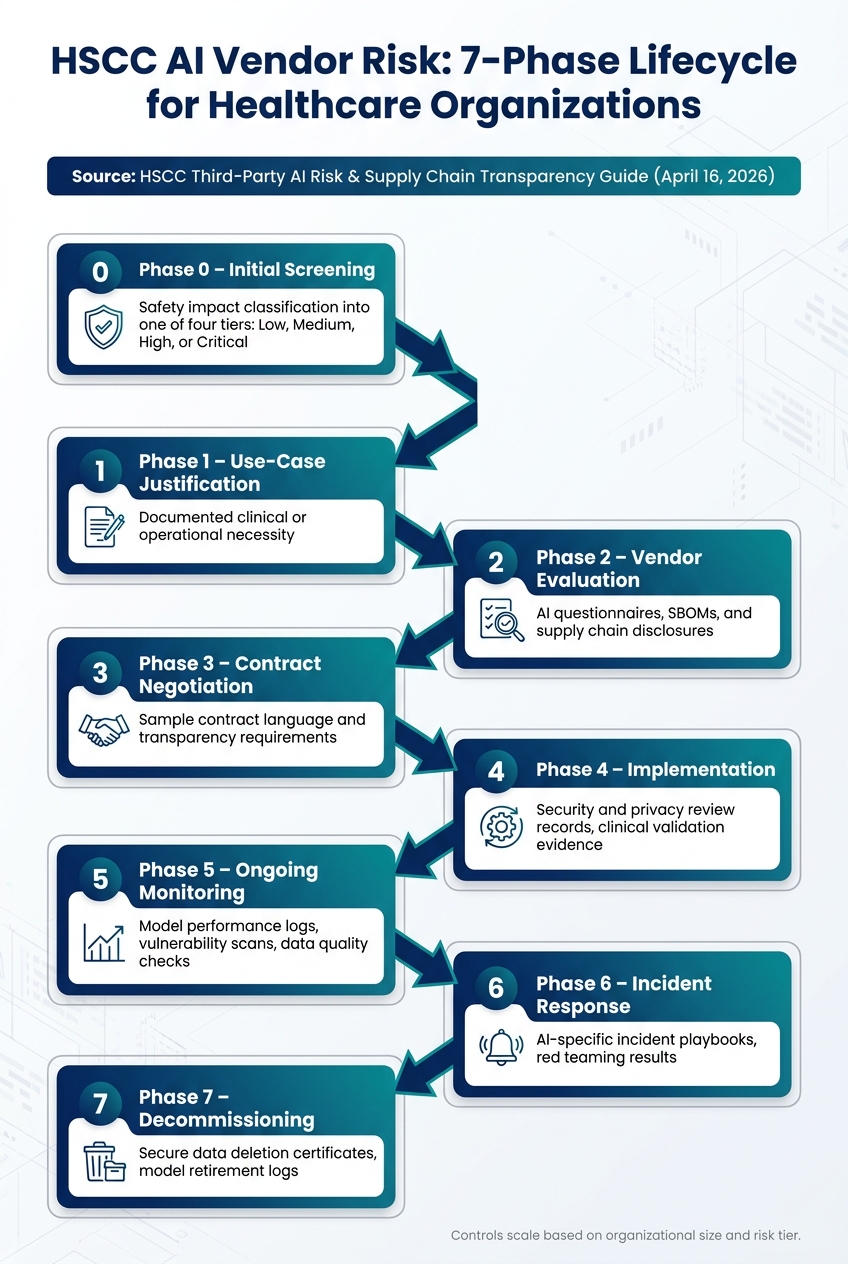
HSCC AI Vendor Risk: 7-Phase Lifecycle for Healthcare Organizations
After you define the HSCC outputs, the next move is to put them to work across intake, review, monitoring, and retirement.
A step-by-step implementation sequence for HDOs and vendors
HSCC turns its guidance into a seven-phase operating model [2]. It begins with Phase 0 initial screening. Before any AI tool moves ahead, classify it by safety impact into one of four tiers: low, medium, high, or critical. That one decision sets the level of due diligence that follows [2].
From there, the process moves through use-case justification, vendor evaluation, contract negotiation, implementation, ongoing monitoring, incident response, and secure decommissioning [2]. Each phase produces a specific output. The table below shows what your teams should gather at each step.
| Phase | Activity | Key Documentation/Evidence |
|---|---|---|
| Phase 0 | Initial screening | Safety impact classification (low, medium, high, or critical) |
| Phase 1 | Use-case justification | Documented clinical or operational necessity |
| Phase 2 | Vendor evaluation | AI questionnaires, SBOMs, and supply chain disclosures |
| Phase 3 | Contract negotiation | Sample contract language, transparency requirements |
| Phase 4 | Implementation | Security and privacy review records, clinical validation evidence |
| Phase 5 | Ongoing monitoring | Model performance logs, vulnerability scans, data quality checks |
| Phase 6 | Incident response | AI-specific incident playbooks, red teaming results |
| Phase 7 | Decommissioning | Secure data deletion certificates, model retirement logs |
HSCC scales controls based on organizational size and risk tier.
That sounds simple on paper. In practice, the tough part is keeping the whole workflow auditable when multiple teams, handoffs, and approvals are involved. If intake sits in one system, security review in another, and approvals in email, things get messy fast.
Where Censinet RiskOps fits into HSCC-aligned governance
Once the lifecycle is set, teams need one place to collect evidence and route approvals. Censinet RiskOps™ is built for that job. It brings AI-related policies, assessments, evidence, findings, tasks, and approvals into one auditable environment for GRC stakeholders. Its workflows line up with the HSCC lifecycle, from intake and tiering through monitoring and decommissioning.
Censinet AI™ automates routing and summaries while keeping people in charge of decisions. It centralizes findings, tasks, and approvals for AI governance. An AI risk dashboard gives leadership a real-time view across AI-related policies, risks, and tasks, without taking human judgment out of the loop.
Conclusion: The HSCC outputs most worth tracking now
HSCC guidance is voluntary, but its influence on healthcare AI expectations in 2026 is already clear. The governance and third-party risk publications are the ones teams can use right away. They offer a seven-phase lifecycle, controls scaled by risk and organization size, and ready-to-use templates such as sample contract language, vendor assessment questionnaires, and RACI matrices. The main focus should be lifecycle governance, continuous monitoring, and current evidence. Those are the HSCC outputs with the strongest effect on healthcare AI governance in 2026.
FAQs
Why does HSCC matter if it is not a regulator?
HSCC matters because it plays a central role in the public-private partnership that advises the government on major threats facing the healthcare sector.
It doesn't have regulatory power. Still, it helps the industry shape voluntary, healthcare-specific best practices, frameworks, and guidance. That matters because healthcare groups often need practical direction long before any formal rule shows up.
Just as important, HSCC takes complex risks and turns them into tools organizations can actually use. In plain terms, it helps healthcare providers, payers, and partners line up with emerging safety, security, and compliance expectations before those expectations become formal mandates.
How should healthcare teams start aligning with HSCC AI guidance?
Start with the AI Cyber Glossary so clinical, operations, and compliance teams speak the same language. That matters more than it may seem. If people use the same term in different ways, governance gets messy fast.
Next, compare your current third-party and supply chain risk practices against the Health Industry Third-Party AI Risk and Supply Chain Transparency Guide. This gives you a clear way to spot gaps in how vendors, models, data sources, and downstream risks are reviewed.
Then group AI solutions with a tiered assessment framework based on safety impact. Not every tool needs the same level of review. A low-risk workflow assistant shouldn't go through the exact same process as a tool that may affect clinical decisions or patient safety.
It also helps to plug AI governance into committees you already have, such as quality, safety, or compliance committees, instead of building a whole new structure from scratch. Keep board oversight in place, and make sure board members get education on AI so they can ask sharper questions and make sound decisions.
What AI risks need review beyond standard security checks?
Beyond standard security checks, healthcare organizations need to look at risks that are specific to AI and the way machine learning systems act in practice. That means reviewing how models are trained, where the data came from, whether bias may shape outputs, how transparent the system is, how well teams can explain its decisions, and what level of human oversight is in place.
They also need to check for adversarial threats, including prompt injection, data poisoning, model inversion, and model theft. On top of that, it’s smart to examine supply chain dependencies, such as open-source components, third-party APIs, and cloud service providers.
