
If I had to boil this guide down to one point, it’s this: HSCC gives a healthcare CISO a plain way to decide what to fix first, why it matters to patient care, and how to show that to leadership.
Here’s the short version:
- HSCC uses the NIST CSF to organize work across Identify, Protect, Detect, Respond, and Recover
- It follows 7 steps: scope, orient, assess current state, assess risk, set target state, rank gaps, and act
- It helps me look at vendors, connected devices, cloud services, and legacy systems in the same program
- It ties cyber work to patient safety, service downtime, contract terms, and board reporting
- It works well with related HSCC resources for supply chain, medical devices, legacy tech, third-party concentration, and AI risk
A few facts stand out. The article notes that only 44% of healthcare organizations align with NIST CSF expectations, while NIST CSF is still the most-used framework in U.S. hospitals. That gap is exactly why this guide matters: many teams know the model, but they still need a clear way to turn assessment results into funded action.
What I like most is that the guide does not treat cyber risk as just an IT issue. It pushes me to connect each gap to things leaders care about: patient harm, care disruption, vendor failure, recovery time, and financial exposure. That makes the program easier to explain, track, and defend.
Cybersecurity in Modern Healthcare: Safeguarding Digital Health
Quick comparison
| Area | What HSCC helps me do | What I should focus on |
|---|---|---|
| Framework structure | Use the 5 NIST CSF functions | Map cyber work to hospital care delivery |
| Assessment process | Follow 7 steps from scope to action plan | Rank gaps by patient impact first |
| Asset review | Assess vendors, devices, cloud, and legacy tech | Treat each asset type differently |
| Governance | Assign ownership across security, clinical, legal, and procurement teams | Use RACI and clear metrics |
| Board reporting | Show risk in care, downtime, and dollar terms | Report trends, not just point-in-time data |
| Companion resources | Extend work into supply chain, device, legacy, and AI risk | Use the right HSCC resource for each problem |
So if I were explaining the article in one sentence, I’d say this: HSCC turns cyber review from a loose checklist into a risk program that leadership can act on and patients can depend on.
How the HSCC Implementation Guide Is Structured
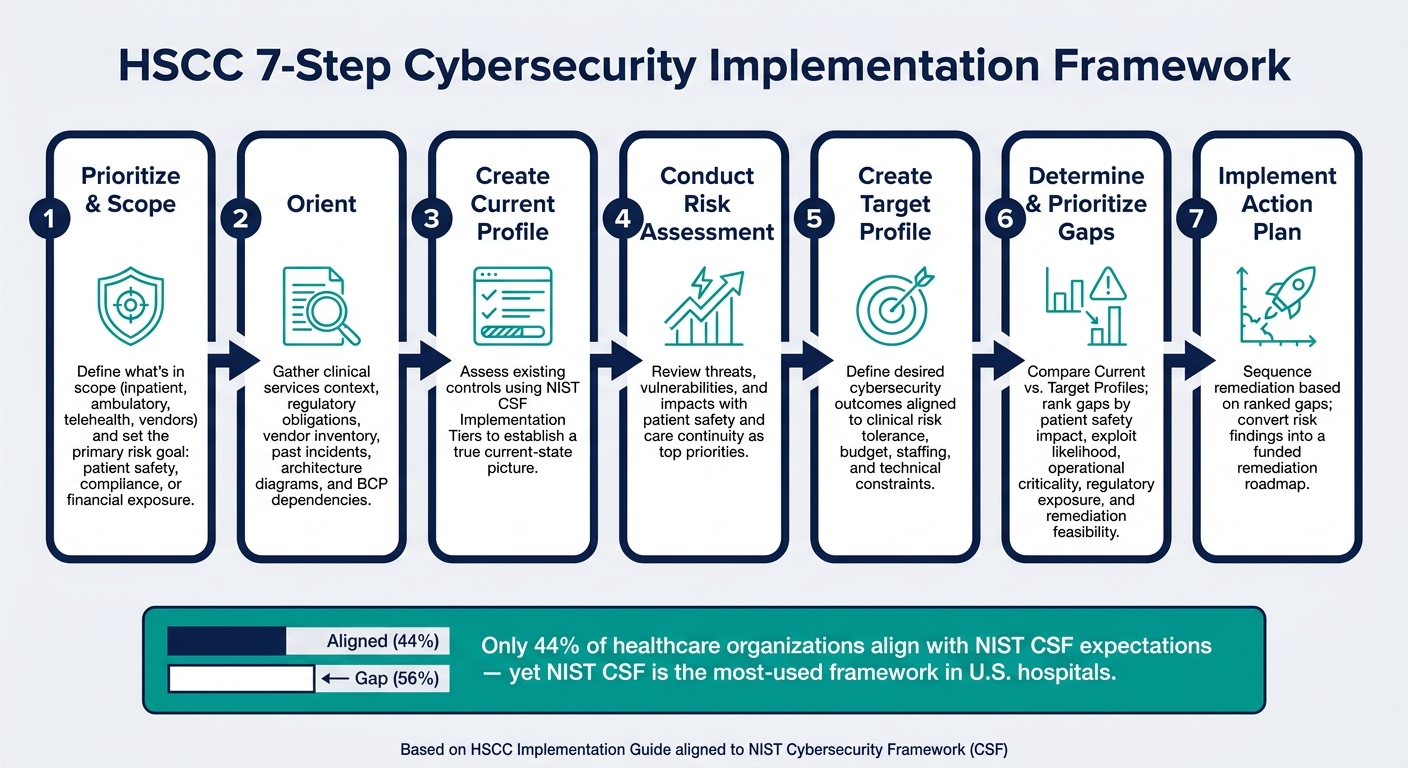
HSCC 7-Step Cybersecurity Implementation Framework for Healthcare CISOs
The HSCC Implementation Guide lays out healthcare cyber risk using the NIST CSF and a seven-step implementation process. That setup fits neatly into security and governance work most hospitals already do. HHS hospital resiliency data show that NIST CSF is the most common cybersecurity framework in U.S. hospitals - by nearly double compared with other frameworks [3].
Put simply: this structure helps teams move from inventory to action.
The 5 Cyber Functions and What They Mean in a Hospital Setting
Each of the five functions points to a different kind of security work. In a hospital, none of them sit off to the side. They all connect straight to clinical operations.
| CSF Function | Hospital application |
|---|---|
| Identify | Inventory EHRs, imaging systems, lab platforms, network-connected medical devices, identity and access infrastructure, cloud services, vendors, and third-party services. Map which systems are critical to patient care and what breaks if they go down. |
| Protect | Apply access controls, MFA, patching, network segmentation, secure remote access, backup protection, and hardening to clinical and legacy systems. Lock down privileged accounts that touch EHR and medication administration workflows. |
| Detect | Monitor for ransomware indicators, unusual account behavior, and anomalous traffic from connected devices - especially agentless devices. |
| Respond | Execute incident playbooks that include clinical operations, not just IT. Coordinate across security, clinical leadership, legal, and privacy teams with clear communication protocols. |
| Recover | Restore safe clinical operations, not just servers. That means paper downtime procedures, order reconciliation, medication verification, and staged service restoration in a clinically safe sequence. |
Recovery is not done when systems power back on. It ends when clinicians can resume care safely.
Once those functions are clear, the next piece is execution. That’s where the implementation steps come in.
The 7 Implementation Steps from Scoping to Action Plan
The guide follows a NIST-style seven-step implementation process [4]. What makes it useful is simple: each step pushes the CISO to make a clear decision. So this is more than a technical checklist. It works as a governance tool too.
- Prioritize and scope: Decide what’s in scope - such as inpatient facilities, ambulatory clinics, telehealth platforms, key third-party vendors - and define the main risk goal: patient safety, compliance, or financial exposure.
- Orient: Gather the context behind the assessment. That includes critical clinical services, regulatory obligations, major vendors, known high-risk systems, past incidents, architecture diagrams, asset inventories, and business continuity dependencies.
- Create a Current Profile: Assess current controls and maturity using NIST CSF Implementation Tiers. The result is a current-state picture of where the organization stands, not where it hopes to be.
- Conduct a risk assessment: Review threats, vulnerabilities, and possible impacts across in-scope systems and workflows. In healthcare, that means putting patient safety and care continuity ahead of technical severity.
- Create a Target Profile: Define the cybersecurity outcomes the organization wants to reach. The target should line up with clinical risk tolerance, budget, staffing, and technical constraints.
- Determine and prioritize gaps: Compare the Current and Target Profiles to spot the gaps, then rank them by patient safety impact, likelihood of exploitation, operational criticality, regulatory exposure, and remediation feasibility.
- Implement the action plan: Sequence remediation based on those ranked gaps. This is the point where the CISO turns risk findings into a funded remediation roadmap.
Next, apply the guide to vendors, devices, and legacy systems that shape daily risk.
How to Apply HSCC to Real Healthcare Risk Decisions
Once the current profile is in place, the next step is to use it on actual assets, workflows, and third-party dependencies.
Map Assets and Dependencies Before Scoring Risk
Before you score risk, map the assets and dependencies that keep care delivery running. The goal is simple: find the points where one failure can interrupt care, and understand how fast that interruption could affect patients.
The HIC-SCRiM toolkit was built for this type of work. Use its risk assessment templates to link supplier relationships to clinical workflows. Then use standardized contract language to set clear data exchange boundaries and spell out incident notification duties [1].
Apply HSCC Risk Assessment Steps to Vendors, Devices, and Legacy Systems
Use the asset map to split risk into vendor, device, cloud, and legacy categories. Don’t ask every asset the same questions. A connected device creates a different kind of risk than a cloud platform or an aging on-premise system.
| Asset Category | Main Risk | Priority Control | Operational Impact |
|---|---|---|---|
| Third-Party Vendors | Supply chain integrity and data access | Contract terms and incident reporting | Business continuity |
| Connected Devices | Patient safety and clinical workflow | Response and recovery testing | Patient safety |
| Cloud Services | Data availability and integrity | Access, backup, and supply chain controls | Data integrity |
| Legacy Systems | Unsupported software and vulnerabilities | Compensating controls | Downtime tolerance |
Use response and recovery testing to show how a supplier incident can spread across the environment [1].
Turn Findings into a Prioritized Remediation Roadmap
Once the gaps are clear, turn them into a ranked remediation plan. Rank gaps by patient-safety impact first, then assign owners and deadlines [5].
Start with the highest-risk items:
- A critical system like life support AI calls for real-time monitoring and fail-safes.
- High-tier systems such as EHR and imaging call for segmentation and strict access controls.
- Medium-tier systems such as revenue cycle platforms can focus on data encryption and vendor audits.
- Low-tier general administrative systems may only need baseline patching and standard MFA [5].
Each ranked item becomes a budget, ownership, and timeline decision for the CISO and clinical leaders. Turn assessment gaps into supplier contract terms, including incident notification and supply chain transparency. When legacy systems can’t be replaced fast, use compensating controls [1][5]. That tiering connects remediation to patient risk, not just technical severity.
Those priorities then feed governance, ownership, and board reporting.
sbb-itb-535baee
How to Build Governance and Board Reporting Around HSCC
A remediation roadmap falls apart fast if no one owns the work. Governance is what turns a ranked gap list into action that someone has to approve, track, and finish. It sets who can allow exceptions, who assigns fixes, and who makes sure risk doesn’t just sit in a spreadsheet.
Define Roles Across the Board, CISO, Clinical Leaders, and Vendor Management
The HSCC framework uses a RACI matrix to set clear ownership across procurement, clinical engineering, legal, and IT [5]. That matters because each group makes different calls, and those calls should tie back to clear outcomes you can measure.
| Role | HSCC-Aligned Responsibility | Key Decision | Sample Metric |
|---|---|---|---|
| Board / Executive Leadership | Enterprise risk oversight and patient-safety impact. | Approve risk appetite and high-risk vendor exceptions. | Estimated financial exposure ($) from third-party downtime. |
| CISO / Security Team | Assess risk and track remediation. | Prioritize remediation roadmap. | Current-vs-target profile gaps. |
| Clinical Leadership | Validate clinical impact. | Clinical safety validation. | Potential service downtime and patient safety impact. |
| Procurement / Vendor Management | Embed risk into sourcing and contracts. | Select vendors by risk tier. | % of vendors with signed security exhibits. |
| Legal / Compliance | Enforce contract and regulatory terms. | Enforce cybersecurity contract terms. | Audit readiness score; contractual non-compliance incidents. |
| Biomedical Engineering | Manage device security and lifecycle. | Lifecycle management of connected devices. | Device patching and isolation status; vulnerability count. |
Use HSCC contract templates to turn risk findings into vendor clauses. That gives legal and procurement something concrete to work with, and it makes compliance easier to audit [1].
Once ownership is clear, the next step is simple: report risk in a way leaders can use.
Build Dashboards That Show Risk in Business and Patient Care Terms
Board members and clinical executives don’t need a screen full of vulnerability data. They need to see what the risk means for patient care, operations, and money. A good way to do that is to build the dashboard around the five NIST CSF functions, then translate each one into business and care impact.
Track items like:
- Current-vs-target gaps
- Third-party concentration
- Supplier recovery test results
- Device patching and isolation status
- Time to restore critical systems
- Downtime exposure in dollars [1]
Then add remediation trend lines so the board can see if the program is moving in the right direction over time. That trend view matters. A single snapshot can look fine, while the bigger pattern tells a very different story.
Keep every board conversation tied to patient safety and operational resilience. That framing helps leaders stay focused on decisions that matter, instead of getting lost in technical detail.
That same reporting model can then support repeat assessments and workflow automation.
How to Put HSCC into Practice with Censinet and Related HSCC Resources
Use Censinet RiskOps to Scale HSCC-Aligned Assessments
Censinet RiskOps gives teams a way to standardize HSCC-aligned supply chain assessments, contract language, and reporting across vendors, devices, and third-party services. It automates HSCC-aligned supply chain assessments and contract workflows mapped to NIST CSF, including risk assessment templates and contractual language for supplier agreements [1][2].
Censinet AI can speed questionnaire intake, evidence summaries, and report generation while keeping human review in place. That matters in healthcare. AI can move the work along, but people still need to make the call so clinical context stays at the center.
This kind of standardization ties back to the asset mapping, gap analysis, and dashboard reporting discussed earlier. Instead of letting assessment results sit in a folder, teams can turn them into remediation priorities and board-ready risk decisions.
Once assessments are standardized, the next move is to apply HSCC guidance to devices, legacy systems, and AI.
Pair the Implementation Guide with HICP, JSP, HIC-SCRiM, HIC-MaLTS, SMART, and AI Governance Guidance
HSCC works best as a stack. The implementation guide sets the process, and the companion resources fill in the domain-specific gaps for vendor risk, medical device security, legacy technology, systemic third-party dependencies, and AI transparency.
HSCC's April 2026 Health Industry Third-Party AI Risk and Supply Chain Transparency Guide is a 109-page resource focused on visibility gaps in AI supply chains, including subcontractors and open-source components embedded in EHRs and remote monitoring devices [6].
The table below shows what each companion resource is for and where it fits in a CISO's workflow.
| HSCC Resource | Purpose | CISO Workflow Fit |
|---|---|---|
| HICP | Threat-driven cybersecurity practices for organizations of all sizes | Baseline control implementation and threat mitigation |
| JSP | Security for medical technology and health IT products | Medical device procurement and lifecycle security |
| HIC-SCRiM | Supply chain risk management toolkit aligned to NIST CSF | Vendor onboarding, risk assessment, and contractual governance |
| HIC-MaLTS | Governance and management of legacy technology security | Legacy system risk treatment and decommissioning |
| SMART | Systemic third-party risk mapping and response | Mapping dependencies and managing large-scale vendor outages |
| AI Governance | Managing third-party AI and AI-related supply chain risks | AI tool discovery, transparency, and model integrity verification |
Taken together, these resources help teams turn assessments into prioritized controls, contract terms, and board-ready risk decisions.
Conclusion: Moving from HSCC Guidance to a Defensible Risk Program
The HSCC implementation guide gives healthcare teams a repeatable way to turn NIST CSF alignment into day-to-day assessment of clinical, operational, and supply chain risk.
In practice, that means turning findings into decisions leadership can actually use. In a clinical setting, patient safety has to guide every technology and service decision.
The payoff is a board-ready risk program that connects supplier assessments, asset inventory, contract terms, and response testing to patient care and operational resilience. When that process runs the same way each time - mapping vendors, devices, and legacy systems, then reporting risk to leadership in plain business terms - executives can see what needs to change and why a given investment matters [1][2].
That same model also reaches beyond core assessments into supplier and AI risk. HIC-SCRiM and HSCC's third-party AI supply chain guide extend this approach to supplier risk and AI oversight [1][6].
At that point, the framework becomes more than guidance. The aim isn't a perfect checklist score. It's a program the board, regulators, and patients can trust.
FAQs
How do I start HSCC if our asset inventory is incomplete?
Start by pulling data from your internal systems so you can get a clear picture of your suppliers and the tools tied to them. That usually means looking across accounts payable, procurement, finance, legal, IT, your CMDB, and ERP platforms.
Think of this as the starting point. You can't protect what you don't know you have.
Once that inventory is in place, assign clear ownership so it stays up to date. Then use it to sort vendors and systems by risk, so your team can focus attention where it matters most.
What should we prioritize first under HSCC with a limited budget?
With a limited budget, put your time and money where they matter most: the suppliers that have the biggest effect on your mission and patient safety.
Start by building a complete supplier inventory. Then map each supplier to the assets they touch, such as EHRs, imaging systems, connected medical devices, and revenue cycle services.
From there, group suppliers into tiers based on:
- PHI access
- Network connectivity
- Operational impact
Once you’ve done that, apply your toughest assessments to the highest-tier vendors. That way, you’re not spreading scarce resources too thin across every supplier in the same way.
How often should we reassess our HSCC current and target profiles?
Use a risk-based approach. Review strategic or critical suppliers as often as your operations need, and at least once a year. Lower-risk suppliers can be reviewed less often, such as every two to three years.
In practice, match review timing to vendor tiers. Critical vendors may need continuous monitoring, while low-risk vendors can often be reviewed at contract renewal or when the scope changes. It also makes sense to reassess after material changes, like an acquisition, a scope change, or an infrastructure shift.
