
One weak identity link can affect many healthcare systems at once. In healthcare, identity federation makes sign-in easier, but it also puts a lot of trust in the IdP, tokens, role mappings, and vendor access. That matters because about 80% of healthcare breaches involve compromised credentials, 88% of attacks on basic web apps involved stolen credentials, and the average healthcare breach cost hit $10.93 million in 2023.
If I had to boil the article down, I’d put it this way:
- The biggest risk is central trust. If the IdP fails, gets misconfigured, or is taken over, access can spread across EHRs, PACS, telehealth, revenue cycle, and other cloud apps.
- Tokens and sessions can keep bad access alive. Stolen tokens, replay attacks, long sessions, and bad redirect URI settings can let attackers move without another password prompt.
- Access often stays too long or goes too far. Delayed offboarding, shared logins, bad claim mapping, and vendor over-permission create ghost accounts and weak audit trails.
- The fix is not less federation. It’s tighter control: phishing-resistant MFA, short token lifetimes, step-up authentication for high-risk actions, tighter role mapping, automated deprovisioning, and linked logging across the IdP and apps.
- governance matters as much as setup, requiring robust third-party risk management. HIPAA-aligned reviews, vendor checks, named owners, and metrics like MFA coverage and time to revoke access help keep federated access from drifting out of control.
Quick comparison
| Risk area | Common problem | What I’d do first |
|---|---|---|
| IdP trust | Compromise, outage, weak admin controls | Lock down admin access, require MFA, test failover |
| Tokens and sessions | Replay, token theft, long sessions | Use short-lived tokens, rotate refresh tokens, tighten session timeouts |
| Access lifecycle | Slow offboarding, shared accounts, vendor sprawl | Automate deprovisioning, remove shared use where possible, review vendor access |
In short, the article shows that identity federation helps care teams move faster, but in healthcare, identity resilience is tied to patient safety, PHI protection, and uptime.
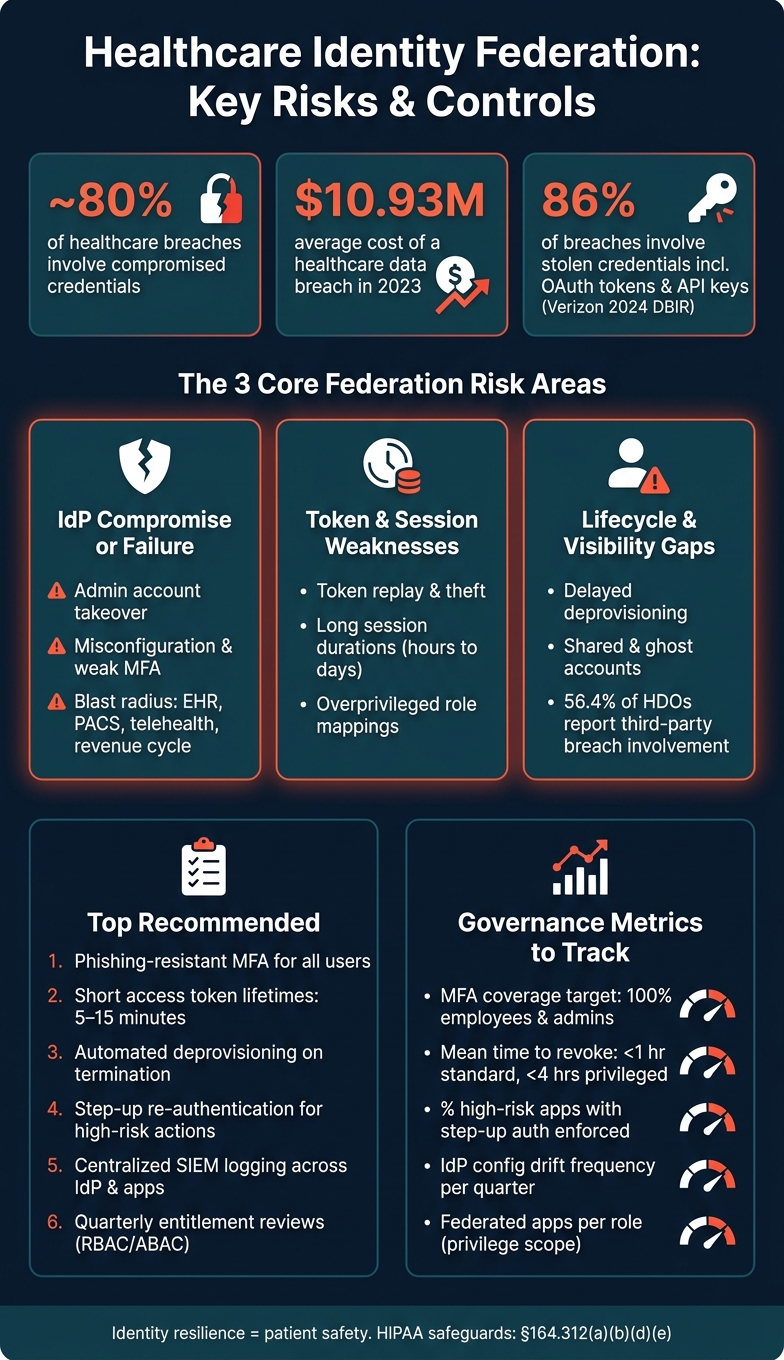
Healthcare Identity Federation: Key Risks, Stats & Controls
Key security risks of identity federation in healthcare
Identity federation puts authentication and access control in one place: the IdP. That setup can make access easier to manage, but it also creates a hard truth. If the IdP is compromised or set up the wrong way, the blast radius can be huge.
In healthcare, that can hit multiple systems at once, from EHRs and PACS to telehealth platforms, revenue cycle tools, and care collaboration suites. The biggest risks tend to show up in three places:
- failure or compromise at the IdP
- weak token and session controls
- gaps in identity lifecycle management, third-party access, and logging
Those problems usually start at the center, move into tokens and sessions, and then spread through weak offboarding, shared access, and poor visibility.
Centralized trust and identity provider failure
The IdP is a prime target. If it is compromised, misconfigured, poorly segmented, or weakly managed, every connected system can feel the impact at the same time.
That includes admin account takeover, weak federation settings, weak MFA rules, and poor change control. In plain terms, an attacker may be able to issue valid tokens for clinicians or service accounts and move from system to system without ever seeing another password prompt.
The Change Healthcare incident followed a similar pattern, with compromised credentials and missing MFA disrupting revenue cycle operations and care delivery across the country.[1] In a healthcare setting, a compromised IdP can lead to a large HIPAA breach and OCR enforcement.
Token, session, and access mapping weaknesses
Even when the IdP itself isn't breached, token handling can still create major exposure. Federated tokens can be stolen or replayed, which gives access without a password.
Some of the highest-risk issues in federated setups include token replay attacks, stolen refresh tokens, unsafe redirect URIs, and sessions that last far too long. Verizon's 2024 Data Breach Investigations Report attributes 86% of breaches to stolen credentials, including OAuth/OpenID Connect tokens and API keys.[2]
Long session duration makes this worse. In a busy hospital, clinicians may stay signed in across shifts. So if a session is compromised, that access can stay alive for hours or even days.
Access mapping can also go wrong in quiet but dangerous ways. Misconfigured claims and over-privileged role mappings often happen because access was built around convenience instead of job duties. A nurse might end up with physician-level access. A contractor might inherit clinical group permissions. A vendor support account might be mapped to an application admin role. If one of those accounts is compromised, an attacker can move fast across systems and data areas.
Lifecycle gaps, third-party exposure, and limited visibility
Strong login controls don't help much when access isn't removed on time or scoped the right way. Delayed deprovisioning is common in U.S. healthcare. Departing clinicians, rotating residents, and contractors may keep access for days or weeks because HR and IT workflows are separate or still done by hand.
With federation, one active identity can still open the door to many cloud systems at once. Shared accounts, such as radiology, kiosk, or scribe logins, make it much harder to tell who did what. They also make HIPAA audit trail requirements harder to meet.
Third-party access adds another layer of risk. A study of healthcare delivery organizations found that 56.4% reported a breach involving a third party accessing their network in the prior 12 months, and in 54.3% of those cases, excessive privileged access by the third party was identified as a contributing factor.[3] When vendors connect through federation, they push the trust boundary beyond the health system's own IT environment.
That matters because a vendor's MFA rules, logging, and incident response may be weaker, yet their federated identities are still trusted to reach core systems.
| Risk | Common Causes | Impact on PHI, Patient Safety, and Operations |
|---|---|---|
| IdP compromise or failure | Admin account takeover, misconfiguration, weak segmentation, poor change control | Broad unauthorized access across EHR, revenue cycle, and clinical tools; care disruption; large-scale HIPAA breach |
| Token and session weaknesses | Token replay, stolen refresh tokens, unsafe redirect URIs, excessive session duration, overprivileged role mappings | Undetected PHI exfiltration, persistent unauthorized access, over-privileged clinician or vendor actions |
| Lifecycle and third-party gaps | Delayed deprovisioning, shared accounts, contractor turnover, vendor over-privilege, siloed logs | Ghost accounts, untracked access, insider misuse, third-party breach cascades, audit trail failures |
Visibility is the thread that ties all three risk areas together. Without correlated logs across the IdP, cloud platform, and application layer, suspicious sign-in behavior and unusual data access can stay hidden. Downstream governance depends on getting those identity and access signals right.
sbb-itb-535baee
How to reduce identity federation risk
Each risk points to a clear control path: lock down the IdP, limit token and session exposure, and automate access cleanup. The next three controls line up with those weak spots.
Harden the identity provider and strengthen authentication
The IdP is the main trust anchor. That means it needs the tightest controls. Disable legacy authentication, enforce TLS 1.2 or higher, restrict redirect URIs, require strong SAML signing, and reject unsigned responses.[8][10]
IdP admin access needs its own guardrails too. Use separate admin accounts, limit them with just-in-time PAM, log every change, and keep the management plane behind a VPN or zero-trust gateway.
Downtime is a patient care issue, not just an IT issue. Use redundant IdPs with automated failover and tested recovery drills so clinicians can still reach EHR and PACS if the primary system goes down.
Authentication also needs to match the level of risk. Require phishing-resistant MFA for users. Add stricter device health checks for remote users, vendors, and admins. For high-risk actions, such as controlled substance prescribing or bulk PHI exports, require step-up re-authentication.
Once the trust anchor is locked down, the next step is cutting exposure in tokens, sessions, and standing access.
Tighten token security, sessions, and least-privilege access
Short-lived tokens shrink the window for replay and theft. Use access tokens that last 5 to 15 minutes, rotate refresh tokens, validate audience, issuer, and expiration fields, reject replayed assertions, and store browser tokens in HTTP-only secure cookies.[7][4][5][8]
Session settings should fit clinical work instead of getting in the way. Set idle and absolute timeouts to match how care teams work. For high-risk actions, require step-up re-authentication even if the user already has an active session.
Access control matters just as much. Use tightly scoped RBAC and ABAC roles, run quarterly entitlement reviews, and standardize claim schemas so privilege creep doesn't slowly pile up in the background.
Strengthen identity lifecycle management and continuous monitoring
Connect HR, medical staff credentialing, and vendor systems directly to the IdP.
This is where automation does a lot of heavy lifting. When HR records a termination, contract end, or leave of absence, the system should automatically disable the IdP account, revoke group memberships, and remove application roles without waiting on a manual ticket. For vendors and contractors, tie IdP accounts to contract records with clear start and end dates, and require a sponsoring manager to approve access. Run nightly or weekly reconciliation to catch ghost accounts early.[6][9]
Monitoring has to cover employees, contractors, and vendors the same way. Centralized logging across the IdP, cloud platforms, and the application layer is the base. From there, identity monitoring should connect those logs and flag anomalies like impossible travel, access from new high-risk countries, and unusual PHI access spikes, including activity from vendor-connected accounts.
A zero trust model adds another layer by checking identity, device health, network context, and behavior through the full session, not just at login. If risk signals climb, policies can trigger step-up authentication, session quarantine, or temporary access limits on their own.
The table below maps each major federation risk to specific controls and its HIPAA safeguard category.
| Risk | Recommended Controls | HIPAA Safeguard |
|---|---|---|
| IdP failure or compromise | Redundant IdP architecture; tested failover procedures; PAM for admin accounts; configuration change logging; emergency access policies | Administrative/Technical |
| Token theft and misuse | Short access token lifetimes (5–15 min); signed and encrypted tokens; strict audience/issuer/expiration validation; replay protection; secure token storage | Technical |
| Weak session controls | Idle and absolute session timeouts matched to clinical workflows; step-up re-authentication for high-risk actions; workstation locking integration | Technical |
| Over-privileged access | RBAC/ABAC with tightly scoped roles; standardized claim schemas; quarterly entitlement reviews; approval workflows for access elevation | Administrative/Technical |
| Lifecycle gaps | HR/medical staff system integration with IdP; automated deprovisioning on termination; contract-tied vendor accounts; regular account reconciliation | Administrative/Technical |
| Third-party exposure | Vendor identity risk assessments; federated access scoped to minimum required permissions; ongoing monitoring of vendor-connected accounts | Administrative/Technical |
| Limited visibility | Centralized SIEM logging across IdP and applications; identity monitoring and anomaly detection; zero trust continuous validation | Technical |
Governance and third-party risk management for federated access
Point controls matter. But governance is what keeps those controls applied the same way across teams, apps, and vendors.
Without a repeatable program, federated access decisions start to drift. One vendor gets approved with weak review, another gets held to a higher bar, and no one has a clear record of who owns what. Over time, those gaps add up. The aim here is simple: take the federation controls you already have and turn them into a structured, auditable program.
Align federation controls with HIPAA and internal access governance
Once the technical setup is in place, governance keeps it from becoming a patchwork.
Every federated connection should tie back to HIPAA’s technical safeguard requirements. For federated identity, the four most relevant safeguards are:
- Access control (§164.312(a)): Enforce role-based and attribute-based access across federated apps that handle ePHI.
- Audit controls (§164.312(b)): Require IdPs and federated apps to log and aggregate identity and access events with defined retention periods.
- Person or entity authentication (§164.312(d)): Require strong authentication for all interactive access to ePHI through federated SSO.
- Transmission security (§164.312(e)): Mandate encrypted, signed token exchange and secure transport across federation endpoints.
One practical way to put this into day-to-day use is with a HIPAA control matrix for federated access. Think of it as a living record that links each requirement to a set configuration baseline, names the owner, and marks gaps that still need to be fixed.
That should sit alongside a formal intake process for every new federated connection. At a minimum, that process should include a risk assessment, architectural review, privacy impact assessment, and BAA review when PHI is involved. No new federated connection should move forward until it clears review.
Assess vendor and supply chain identity risk on an ongoing basis
Federated access stretches your trust boundary to every vendor connected to it. That’s the tradeoff.
If a vendor has a weak MFA setup or a poorly configured SAML endpoint, that weakness can become your problem fast, especially when clinical systems are involved. Their security posture doesn’t stay on their side of the fence.
Due diligence for federated vendors should cover MFA coverage, session management, logging and monitoring, incident response readiness, and configuration and change management. It should also spell out breach notification timelines and roles in the BAA.
Manual review can work for a handful of vendors. It falls apart once the list grows. Use the same assessment approach across vendors in the federation, track gap remediation, and tie review cycles to contract renewals so higher risk leads to action, not just notes in a spreadsheet.
Annual reassessments are the minimum. High-risk vendors, such as EHR platforms, telehealth providers, imaging systems, and e-prescribing tools, need more frequent review.
Track the metrics that matter to clinical and executive leaders
Governance without measurement is just policy sitting on paper.
The five metrics that matter most are:
- MFA coverage for federated users
- Mean time to revoke access after termination
- Number of federated apps per role
- Percentage of high-risk apps enforcing step-up authentication
- Frequency of configuration drift in IdP and app-side federation settings per quarter
MFA enrollment targets should hit 100% for employees, contractors, and admin accounts, and above 95% for partners and external users [12][11]. Mean time to revoke access should stay under 1 hour for standard accounts, under 4 hours for privileged accounts, and under 24 hours for all downstream applications [12][13].
These metrics line up directly with the controls covered earlier: IdP hardening, lifecycle speed, privilege scope, and third-party oversight. Put them into a short quarterly dashboard with trend lines and plain thresholds that trigger action when performance slips.
Each metric also needs a named owner. If no one owns the number, the gap tends to sit there. The table below shows governance ownership across the roles keeping the program in motion.
| Role | Primary Responsibilities |
|---|---|
| CISO | Owns federation security strategy; approves standards and risk appetite; chairs governance committee; decides go/no-go for high-risk connections |
| CIO | Aligns federation with IT and cloud strategy; oversees IdP integration with clinical and business systems; sponsors identity program funding |
| Identity Architects | Design IdP and federation architecture; define token policies, MFA frameworks, and reference configurations; lead technical reviews of new connections |
| Compliance | Maps federation controls to HIPAA; validates audit logging and documentation; ensures BAAs reflect identity-related obligations |
| Clinical Leadership | Represents clinical workflow and patient safety needs; validates that access models support care delivery; participates in approvals for clinically impactful apps |
Conclusion: Cut federation risk without slowing care delivery
Identity federation does a lot of good. It cuts login friction, puts policy checks in one place, and helps clinicians move through cloud-based systems with less drag. But there’s a tradeoff: when trust sits in one hub, a single mistake or breach can ripple across many systems at once. That could mean a compromised IdP, a bad role mapping, an inactive vendor account that still works, or a token that lives too long. The answer isn’t less access. It’s tighter control.
That starts with treating the IdP like critical infrastructure. Use phishing-resistant MFA for privileged users. Keep token lifetimes short. Automate provisioning and deprovisioning so access doesn’t linger after roles change. Pull identity logs into one place and watch them on a continuous basis.
Those controls don’t stick on their own. Governance has to keep them in place and make sure federated access lines up with HIPAA, internal policy, and vendor risk reviews.
When the IdP goes down, this isn’t just a security issue. It can slow care, disrupt medication workflows, and affect diagnosis. Platforms like Censinet RiskOps™ can help healthcare organizations track identity-related vendor risk and keep federated trust relationships aligned as conditions change. In healthcare, identity resilience is patient safety.
FAQs
Why is identity federation risky in healthcare?
Identity federation can concentrate risk because the Identity Provider (IdP) sits at the center of the whole setup. That makes it a critical focal point and, in many cases, a single point of failure. If attackers get hold of its private keys, they can forge assertions, impersonate users, and move across connected systems.
There’s another weak spot too: credential theft and phishing. Those attacks can work even more easily when teams still rely on older MFA methods like SMS codes. On top of that, fragmented oversight and uneven vendor access controls can make suspicious activity easy to miss and slow down permission revocation when something goes wrong.
What if the IdP is compromised?
If an Identity Provider (IdP) gets compromised, attackers may be able to impersonate users across connected systems. The biggest danger shows up when they get access to the IdP’s private keys. At that point, they can generate fake assertions that look valid to connected apps.
That said, a breach at the IdP does not automatically mean every application is compromised. Each relying party checks assertions on its own, so the damage depends on whether those checks are done correctly.
To cut risk, use signed assertions with short validity windows. Pair that with continuous monitoring, and run negative testing to make sure signature verification fails when it should. In plain terms, don’t just check that valid signatures pass - check that bad ones get rejected too.
How can healthcare organizations reduce federation risk?
Healthcare organizations can cut federation risk by standardizing integrations with SAML and OpenID Connect and routing control through a single identity provider.
They should also use phishing-resistant MFA, enforce least-privilege access with role-based access control, adopt zero-trust frameworks, monitor access logs on a continuous basis, and run periodic access certifications.
If that sounds like a lot, that’s because it is. Identity sprawl can get messy fast, especially in healthcare, where users, apps, vendors, and patient data all intersect. A platform like Censinet RiskOps™ can help streamline risk assessments, vendor compliance, and visibility into identity-related threats.
