
Malware in hospitals can change patient care within minutes. When records, imaging, lab, pharmacy, or staff communication systems go down, care teams lose alerts, data, and normal checks. That can lead to canceled visits, delayed treatment, ambulance diversion, and more risk at the bedside.
Here’s the short version:
- WannaCry (May 12, 2017) hit parts of the NHS after missed patching and old systems left hospitals open to attack.
- U.S. ransomware cases such as UHS and Scripps showed that long outages can disrupt care for days or weeks.
- Düsseldorf University Hospital (September 2020) showed how hard it is to prove that a cyber event directly caused a death, even when care was delayed.
A few numbers stand out:
- Reported ransomware attacks are tied to a 17%–25% drop in patient volume in the first week
- WannaCry led to 6,912 canceled appointments in one NHS count, with estimates of more than 19,000
- A study found about a 6% drop in daily admissions at directly infected hospitals
- Healthcare ransomware outages last about 35 days on average
- 70% of healthcare organizations reported more transfers or diversions after an attack
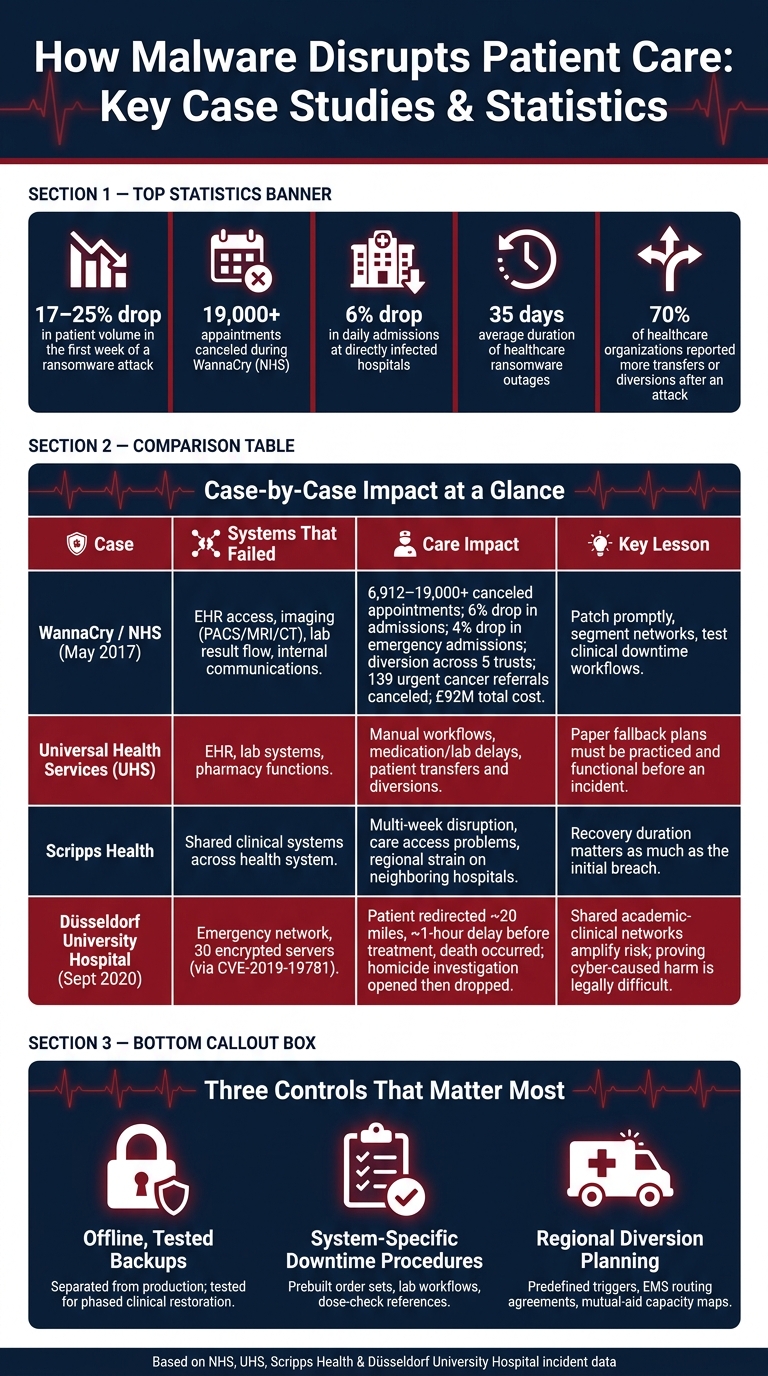
Hospital Malware Attacks: Case Study Comparison & Key Statistics
Cyberattacks on Hospitals Are Attacks on Communities: Why Ransomware Is a Patient Safety Crisis
sbb-itb-535baee
Quick Comparison
| Case | What failed | Care impact | Main lesson |
|---|---|---|---|
| WannaCry / NHS | EHR access, imaging, lab result flow, internal communication | Canceled appointments, lower admissions, ambulance diversion, delayed referrals | Patch on time, separate networks, test downtime care |
| UHS | Core clinical systems, lab, pharmacy, records | Manual work, delays, transfers, diversion | Paper fallback plans must work in practice |
| Scripps Health | Shared clinical systems across the health system | Multi-week disruption, care access problems, strain on nearby hospitals | Recovery time matters as much as the first hit |
| Düsseldorf | Emergency network and server access | Patient redirection, postponed care, legal review of harm | Shared networks can affect emergency care, and proof of harm is hard |
If I had to boil the article down to one point, it’s this: malware is not just an IT problem once patient care depends on the systems that fail. The cases point to the same needs again and again: fast patching, network separation, offline backups, and rehearsed downtime plans for clinical teams.
Case Study 1: WannaCry and NHS Service Disruption in May 2017
WannaCry is a blunt reminder that one missed patch can turn into a patient-safety problem fast. On May 12, 2017, the ransomware used the unpatched EternalBlue flaw in SMBv1 and hit parts of the U.K. National Health Service. Microsoft had released a patch in March 2017, but many NHS systems still hadn't installed it. At the same time, legacy operating systems like Windows XP were still running in hospitals, GP practices, and clinical devices, which made the attack surface much larger. A later NHS CIO lessons-learned review found that 80 of 236 trusts were affected. Of those, 34 were locked out of devices entirely, while 46 others took precautionary steps such as shutting down email and parts of their networks [6][7].
Outages Across Records, Imaging, and Communications
The damage didn't stay in one corner of the system. It moved into core clinical work.
Staff lost access to electronic patient records, scheduling tools, and internal communications. Radiology took a heavy hit. MRI and CT workflows broke down because imaging systems and PACS servers were either encrypted or disconnected on purpose to stop the spread. At tertiary centers, imaging could not be transferred to specialist sites. Oncology teams also lost access to ChemoCare systems, which meant they couldn't send chemotherapy orders to outside providers. Lab result flows failed too when primary care IT providers cut network access, stopping automated blood result transfers to GP practices. Once records, imaging, and communications went down at the same time, clinicians lost data they needed to make timely calls. To contain the outbreak, organizations isolated networks, took devices offline, and declared major incidents [6][7][8].
That forced clinicians back to paper and phone-based workflows. Care didn't stop, but it slowed down in all the places you'd expect.
Effects on Appointments, Admissions, and Emergency Care
Those system failures quickly showed up in patient care.
NHS England recorded 6,912 canceled appointments between May 12 and May 18 and estimated the total was more than 19,000. A retrospective study published in npj Digital Medicine found that directly infected hospitals saw about a 6% decrease in total admissions per day. That included a 4% drop in emergency admissions and a 9% drop in elective admissions. At least 139 urgent cancer referrals were canceled. For patients, this meant delayed treatment, missed referrals, and slower emergency throughput.
Emergency services were affected too. Five acute trusts diverted ambulances from May 13 to May 16. The Department of Health and Social Care put the total cost at £92 million: £20 million in lost output and £72 million in recovery and IT support [2][5][7][11][12].
Lessons on Patching, Legacy Systems, and Downtime Care
WannaCry exposed three controls that matter when care depends on IT: patching, network separation, and downtime planning.
The first lesson is simple: patch fast. The NAO found that NHS Digital had sent alerts about the SMBv1 flaw before the attack, but patch deployment was uneven, and many organizations did not have a clear inventory of what needed updating. You can't fix what you can't see.
The second lesson is network design. Flat networks let the malware move sideways from administrative systems into clinical systems. Better segmentation, along with isolating unsupported devices, could have limited that spread. That's not just an IT issue. It's the difference between a small outage and a hospital-wide event.
The third lesson is downtime care. Roughly 1,220 diagnostic devices were infected, which showed that radiology and oncology need tested fallback procedures of their own, not just broad IT continuity plans. When core systems fail, teams still need a way to move images, handle orders, and keep lab services running.
Put plainly:
- Timely patching cuts risk.
- Network segmentation limits lateral spread.
- Tested downtime workflows help radiology, oncology, and lab services keep working when systems fail.
NHS England reported no confirmed patient harm or data theft directly tied to the attack [1][3][4][6][7][9]. Later U.S. hospital ransomware incidents followed much the same pattern, and many of them took even longer to recover.
Case Study 2: U.S. Hospital Ransomware and Clinical Care Disruption
Ransomware incidents in U.S. hospitals show how fast a large health system can lose access to core clinical tools and disrupt care. WannaCry showed the price of poor patching. These U.S. cases show something else: when clinical systems go down, patient care can slow, stall, or shift in risky ways.
Universal Health Services: System Outages and Manual Workflows
When Universal Health Services was hit by ransomware, key systems went offline, and hospitals across the network had to fall back on manual workflows. Electronic health records, lab systems, and pharmacy functions were among the affected systems. That led to delays in medication decisions, lab processing, and transfer planning.
In many cases, patient transfer or diversion followed. That put more pressure on emergency departments and slowed treatment for people who needed care fast.
Scripps Health: A Multi-Week Outage and Regional Care Strain

A similar pattern showed up at Scripps Health, but the outage lasted longer. Scripps Health faced a prolonged ransomware disruption that affected care access, appointments, transfers, and regional continuity for weeks.
That length matters. A short outage is bad enough. A multi-week outage can spread strain across an entire region, especially when hospitals depend on shared systems and coordinated patient flow.
What U.S. Incidents Reveal About Delays, Mortality, and Recovery Planning
Taken together, these incidents show that outage length matters just as much as the first breach. A system may survive the initial hit, but the longer recovery drags on, the more care delivery starts to bend under pressure.
The broader pattern is hard to ignore. Healthcare ransomware outages last an average of 35 days [13]. That's long enough to disrupt:
- Admissions
- Diagnostics
- Medication management
- Emergency care
The patient-safety effects are just as stark. 70% of healthcare organizations reported more transfers or diversions after an attack [13], and disruptions to time-sensitive care are linked to higher mortality [13].
The financial pressure is climbing too. Average ransom payments went from $282,675 in 2021 to $352,541 in 2023, and 67% of healthcare organizations now pay to restore services [13].
That shifts downtime planning out of the IT corner. It's a patient-safety issue. Healthcare leaders need to test downtime procedures for EHR, lab, and pharmacy systems before an incident happens, not after.
Case Study 3: Düsseldorf University Hospital and the Causality Question
The Düsseldorf case shifts the focus from downtime to causality: when does a cyber disruption turn into a patient-safety event? Unlike the earlier U.S. cases, this one puts a harder issue front and center: proof of harm.
Emergency Service Disruption and Patient Redirection
In September 2020, a ransomware attack aimed at Heinrich Heine University encrypted 30 servers at the affiliated University Hospital Düsseldorf. The attack forced the hospital to leave the emergency network and postpone scheduled care [14].
This is where the patient-safety effect became visible. A patient in critical condition was redirected about 20 miles to Wuppertal, which added roughly an hour before she received treatment. She died shortly after arrival [14].
When police contacted the attackers and explained that they had struck a hospital, not a university, the attackers withdrew the extortion attempt and provided a digital decryption key. But that did not fix the problem on the spot. Restoring 30 encrypted servers took time, and the disruption to care had already happened [14][15].
Why Linking a Cyber Incident to Patient Harm Is Difficult
The harder part was not showing that care was disrupted. It was showing that the delay changed the outcome.
German prosecutors opened a negligent homicide investigation, but later dropped the case after a medical report found that the patient's condition was so severe that the one-hour delay likely did not change the outcome [14].
That result points to a bigger problem in healthcare cybersecurity: tying a cyber incident directly to a death is very hard. Investigators must show that the patient would have survived "but for" the delay. In acute emergency medicine, that is a very high bar [14].
There is also a recordkeeping problem. Ransomware can disrupt the systems used to document care, and paper records made during downtime are often less precise than electronic logs. Putting the IT timeline next to the clinical timeline can take time, and even then, the picture may stay unclear [14].
As Jason G. Weiss noted, attackers often do not grasp the clinical consequences of the systems they disrupt [14].
The case also highlights the risk of shared infrastructure between academic and clinical networks. The attack used a known Citrix vulnerability, CVE-2019-19781, which had been patched eight months earlier [15]. When academic and hospital networks are closely linked, one attack can disrupt emergency care across the whole facility.
The lesson is blunt: if a hospital cannot accept emergency patients, the damage can reach well beyond its own walls.
Cross-Case Lessons for Healthcare Risk Management and Conclusion
Recurring Clinical Failure Modes Across Malware Incidents
Across WannaCry, UHS, Scripps, and Düsseldorf, the same breakdowns show up again and again: lost EHR access, imaging and lab delays, communication failures, canceled procedures, and patient diversion. When that happens, nearby hospitals take the hit right away, often with almost no warning. That pattern makes one thing clear: a small set of controls carries most of the weight.
WannaCry by itself led to roughly 13,500 canceled outpatient visits and at least 139 urgent cancer referrals, and admissions dropped by about 6% at affected hospitals. [10][5][7] And that number may not tell the whole story. Routine data systems don't do a good job of tracking delays, near-misses, or knock-on effects, so the full patient safety toll was likely undercounted.
Practical Controls for U.S. Healthcare Organizations
Whether a cyberattack turns into a patient safety crisis often comes down to preparation. In these cases, three controls stand out.
Offline, tested backups are non-negotiable. Scripps showed how a long recovery window can push a health system into weeks of high-acuity diversion. [16] Backups need to be separated from production systems and tested for phased clinical restoration, so teams can bring back the most important services first.
Downtime procedures need to be system-specific and rehearsed. A generic paper plan won't carry a hospital very far. Clinicians need prebuilt order sets, lab workflows, dose-check references, and critical-result signoff paths so care can keep moving when electronic decision support disappears.
Regional diversion planning has to be shared across facilities. If one hospital shuts its ED or starts diverting high-acuity patients, neighboring hospitals feel it at once. That means predefined diversion triggers, routing agreements with local EMS, and mutual-aid capacity maps should already be in place before an incident starts.
Medical device and OT risk also need direct attention. Networked imaging systems, infusion pumps, and monitoring equipment often run on older platforms and may not be patched as often. Teams need a current inventory of those devices and a clear view of how each one affects care delivery, so contingency plans aren't built on guesswork. Censinet RiskOps™ can centralize device and third-party risk data to support inventory, benchmarking, and remediation. That's the patient-safety case for cyber readiness.
Conclusion: Key Points for Leaders Responsible for Care Continuity
Taken together, these cases point to the same operational fact: malware incidents don't stay in IT. They spill into the ED, the imaging suite, the pharmacy, and every other part of clinical care. That's why cyber resilience has to be treated as a care continuity issue, not just a technical one.
The main takeaways are simple. Malware can delay or change care in ways that matter clinically, even when aggregate mortality data doesn't show a clear signal. Harm is often indirect and hard to measure, but it's still harm. Real resilience depends on both technical controls - patching, segmentation, immutable backups - and day-to-day readiness: downtime procedures clinicians have actually practiced, diversion plans neighboring facilities have already agreed on, and a clear picture of which vendors and devices care depends on. Preparedness shapes the clinical impact.
FAQs
How does malware create immediate patient safety risks?
Malware can put patient safety at risk right away. When it disrupts core healthcare operations, hospitals and clinics often have to move from automated systems back to manual work.
If ransomware encrypts EHRs or diagnostic tools, care teams can lose access to key patient information. That can slow treatment, cancel surgeries, and force ambulance diversions.
The problem doesn't stop there. Malware can also hit network-connected medical devices, including infusion pumps and ventilators. If those devices malfunction - or if someone makes unauthorized changes - the risk to patients goes up fast.
During downtime, staff may face a higher chance of medication errors and may miss signs of clinical deterioration.
Why is it so hard to prove a cyberattack caused patient harm?
Because many patient harm outcomes can also stem from clinical complexity or plain old delays, cyber effects are often indirect and show up later.
During a malware incident, EHRs or medical devices can fail. When that happens, staff often switch to manual workarounds, and that can increase the chance of mistakes. But tying a single adverse event to a single malicious act isn’t simple. It takes precise, trustworthy timelines pulled from logs and audit trails, and those records may be volatile, overwritten, or tampered with.
What should hospitals prioritize to reduce care disruption?
Hospitals should put clinical continuity first. That means building and testing downtime procedures for core systems like electronic health records, labs, and pharmacies before an incident happens.
Resources should also go first to vendors that have a direct effect on patient care. At the same time, hospitals need strong offline backups to speed up recovery, and staff should be trained on manual workflows through tabletop exercises.
