
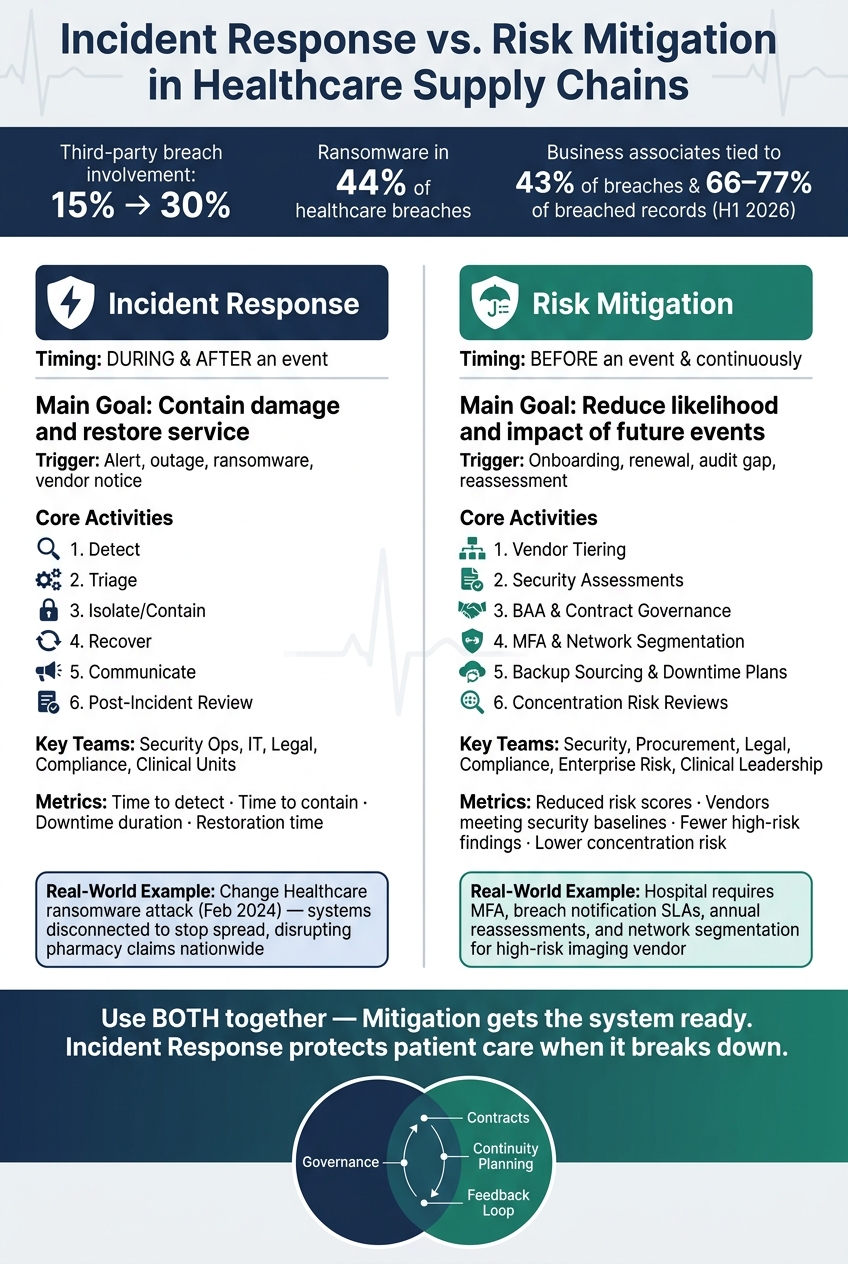
If a healthcare vendor goes down, you need two things: stop the damage now and lower the chance it happens again. That’s the whole split between incident response and risk mitigation.
I’d sum it up like this:
- Incident response is what I do during and after a cyber event or outage
- Risk mitigation is what I do before that event to cut exposure
- Both matter because third-party risk in healthcare is high:
- third-party involvement in breaches went from 15% to 30%
- ransomware showed up in 44% of healthcare breaches reviewed
- in the first half of 2026, business associates were tied to 43% of healthcare breaches and 66% to 77% of breached records
If you work in healthcare, this distinction matters fast. A supplier issue can hit claims, labs, imaging, pharmacy, devices, shipments, and patient care. So I can’t treat prevention and response as the same job.
Here’s the simple breakdown:
-
Risk mitigation focuses on:
- vendor tiering
- security reviews
- BAA and contract terms
- MFA, segmentation, and access limits
- backup sourcing and downtime plans
- concentration risk checks
-
Incident response focuses on:
- detection
- triage
- isolation
- recovery
- internal and vendor communications
- post-incident review
Incident Response vs. Risk Mitigation in Healthcare Supply Chains
Crisis Management in Healthcare | Steve Armstrong-Godwin
sbb-itb-535baee
Quick Comparison
| Area | Incident Response | Risk Mitigation |
|---|---|---|
| Main goal | Limit harm and restore service | Cut the chance and impact of future events |
| When it happens | During and after an event | Before an event and over time |
| Main trigger | Alert, outage, ransomware, vendor notice | Onboarding, renewal, reassessment, audit gap |
| Main work | Detect, contain, recover, report | Assess, tier, contract, segment, plan backups through third-party risk assessments |
| Main measure | Time to detect, contain, and restore | Fewer high-risk gaps and better vendor controls |
| Healthcare example | Imaging vendor hit by ransomware | Hospital sets MFA, SLA terms, and downtime plans for that vendor |
Bottom line: I’d use risk mitigation to get ready and incident response to protect care when a supplier fails. The article below explains where each one fits, who owns the work, and how to connect both in one healthcare supply chain security program.
Incident Response and Risk Mitigation in Healthcare Supply Chains: Clear Definitions
In healthcare supply chains, the main difference comes down to timing and purpose. Risk mitigation lowers exposure before a disruption happens. Incident response limits damage after a threat or breach is found. That gap matters most when a vendor touches a clinical workflow, payment flow, or system integration.
Incident Response: Detect, Contain, Recover
Incident response (IR) is the step-by-step process used after a supplier-related or internal cybersecurity event is detected. NIST SP 800-61 puts it this way:
"Incident response is the process of detecting and analyzing threats and limiting their effect." - NIST SP 800-61 Revision 2
For third-party events, each NIST phase connects directly to a healthcare supply chain task.
| NIST Phase | Supply Chain Application | Key Healthcare Action |
|---|---|---|
| Readiness | Contractual governance | Define breach notification paths and maintain an up-to-date inventory of critical suppliers and business associates |
| Detection | Continuous monitoring | Monitor vendor portals, VPN traffic, and HL7/FHIR interfaces for anomalies |
| Containment | Technical isolation | Suspend VPN access, disable supplier accounts, and block messages from the supplier domain |
| Recovery | Clinical continuity | Activate downtime procedures, including paper charting, while the vendor restores service |
| Post-Incident | Risk re-assessment | Update third-party risk ratings and contract language based on the supplier's response |
The February 2024 ransomware attack on Change Healthcare by the ALPHV/BlackCat group shows what containment looks like in the real world. UnitedHealth Group disconnected Change Healthcare's systems to stop the spread. That move interrupted pharmacy claims processing and provider payments across the U.S. The shutdown was necessary, but it also showed how one critical supplier can ripple through the entire care and payment system.
Risk Mitigation: Reduce Likelihood and Impact Before Disruption Occurs
Risk mitigation covers the work done before a third-party incident to lower the chance and effect of supplier failure. If incident response is reactive, risk mitigation is planned work that happens during vendor onboarding, contract talks, annual reviews, and continuity planning.
In healthcare, that usually comes down to a handful of core practices:
- Vendor tiering sorts suppliers by clinical criticality and PHI exposure, so tighter controls apply to EHR vendors, cloud-based clinical applications, and medical device manufacturers instead of using the same standard for everyone.
- Security assessments check a supplier's safeguards before onboarding and again at renewal.
- Contract governance, including HIPAA Business Associate Agreements (BAAs), sets minimum security terms, breach notification timelines, subcontractor flow-downs, and audit rights.
- Compensating controls like network segmentation, MFA, and restricted API access reduce the blast radius if a supplier account or integration is compromised.
- Downtime planning makes sure clinical staff can switch to manual workflows if a vendor system goes offline.
Governance ties this work together. It needs shared ownership across security, procurement, legal, compliance, and operations, along with clear accountability for vendor approval and risk register upkeep. That is how risk mitigation becomes a repeatable process instead of a one-off exercise, and how supplier decisions stay tied to patient safety and regulatory duties.[1] When these controls work together, recovery gets shorter without assuming every supplier carries the same level of risk.
Incident Response vs. Risk Mitigation: Differences in Scope, Timing, and Ownership
The cleanest way to separate these two disciplines is timing.
Incident response starts after a suspected or confirmed event. Risk mitigation happens before it.
That one difference shapes who owns the work, what teams do, and how success gets measured.
The gap between them shows up most clearly in scope, timing, ownership, and metrics.
| Category | Incident Response | Risk Mitigation |
|---|---|---|
| Primary goal | Contain and recover from an active or suspected cyber event | Reduce the likelihood and impact of future cyber events |
| Timing | During and immediately after an incident | Before an incident and continuously over time |
| Core activities | Detection, triage, containment, eradication, recovery, communications, post-incident review | Vendor due diligence, risk tiering, control validation, contract requirements, segmentation, resilience planning |
| Key teams involved | Security operations, IT, legal, compliance, privacy, supply chain, affected clinical and business units, vendor contacts | Security, third-party risk, procurement, legal, compliance, privacy, supply chain, enterprise risk, clinical leadership |
| Trigger | Alert, outage, suspected compromise, ransomware event, vendor notification, abnormal data exfiltration patterns | New vendor onboarding, periodic reassessment, control gap, audit finding, contract renewal, concentration-risk review |
| Metrics | Time to detect, time to contain, downtime duration, service restoration time, scope of impact, reporting timeliness | Reduced risk scores, more vendors meeting security baselines, fewer high-risk findings, stronger contract terms, lower concentration risk |
| Healthcare supply chain example | A cloud-based imaging vendor is hit by ransomware and the hospital activates downtime and vendor coordination procedures | A hospital requires MFA, network segmentation, breach notification SLAs, and annual reassessments for a high-risk imaging vendor |
How Incident Response Works During a Supplier Cyber Event
When a supplier reports a compromise, or monitoring flags an anomaly, response starts right away. Security operations checks the alert and figures out which clinical workflows and supply chain processes may be exposed. In a hospital, the first priority is life-safety work: medication ordering, imaging, lab results, and surgical supplies.
Then come isolation steps. That can mean disabling a specific VPN tunnel, revoking vendor API tokens, or putting emergency segmentation rules in place. While IT and the vendor work on remediation, supply chain teams move to backup sourcing or local stock. Clinical staff switch to downtime procedures, like paper forms, manual reconciliation, and local charting.
During the event, communication has to stay structured. Clinical leadership, executive teams, and regulators need updates when required. Afterward, the post-incident review feeds lessons back into playbooks and vendor expectations, based on what actually happened instead of what people assumed would happen.
The contrast gets easier to see when you look at the same supply chain event on both sides: before it happens and after it starts.
How Risk Mitigation Works Before a Supplier Cyber Event
Risk mitigation is built into the vendor lifecycle. It does not wait for a crisis.
It starts during onboarding, where third-party risk assessment and inherent risk scoring maps each supplier to its PHI exposure and clinical criticality. A cloud imaging platform does not carry the same risk as a routine supplier, so the control set should reflect that.
From there, recurring reassessments - annual or semiannual for high-risk vendors - check whether the vendor’s security posture has changed. Contracts lock in access controls, MFA, and breach-notification SLAs before production access begins.
concentration risk reviews add one more layer. They look for cases where multiple clinical departments depend on the same cloud provider or software stack. That kind of single point of failure can sit in plain sight until something goes down.
Advantages and Limitations of Each Approach
Neither approach does the job on its own.
Incident response is fast and focused. But it is reactive by nature. It can contain damage and help restore service, yet it cannot erase the exposure that made the incident possible in the first place.
Risk mitigation works over time. It lowers baseline exposure, improves vendor accountability, and supports resilience planning. But it takes steady governance and resources, and it still cannot predict every unknown threat.
In healthcare, third-party incidents happen often enough that both disciplines need to work side by side.
| Approach | Advantages | Limitations | Best-fit use cases |
|---|---|---|---|
| Incident response | Fast action during active events; supports containment, communications, and service restoration; helps limit patient-care disruption | Reactive by nature; cannot prevent the incident that already occurred; effectiveness depends on preparation and coordination | Ransomware at a supplier, third-party outage, unauthorized access, data exposure, urgent operational disruption |
| Risk mitigation | Lowers baseline exposure; improves vendor accountability; strengthens resilience and continuity planning over time | Requires ongoing governance and resources; may not address every unknown threat; benefits may be less visible day to day | Vendor onboarding, contract renewal, recurring assessments, segmentation decisions, backup and downtime planning, concentration-risk reduction |
These differences matter most when governance, contracts, and continuity planning tie both disciplines together.
Building a Connected Program for Healthcare Supply Chain Resilience
The practical link here is feedback. When a supplier incident happens, it shouldn't sit in a report and fade away. It should change how the next incident is prevented and handled.
That means each supplier event should update vendor controls, contracts, and continuity plans. Teams need to document the cause, timeline, decisions, communication gaps, and clinical impact. Then those lessons should flow into vendor requirements, risk registers, incident playbooks, and business continuity plans.[1][3][4] AHA and Health-ISAC guidance also recommends planning for at least 30 days of supplier loss when building continuity plans.[3]
That loop only works when governance, contract terms, and continuity planning move together.
Governance, Contracts, and Clinical Continuity Planning
A cross-functional TPRM committee helps keep that work tied together. It sets risk appetite, reviews critical vendors, and updates controls after incidents. Organizations should also keep an enterprise vendor inventory that maps each supplier to the business processes, data types, and clinical services it supports. From there, vendors can be tiered by criticality, so higher-risk suppliers face tighter controls, closer monitoring, and stronger continuity requirements.[3][4]
Contracts are where governance turns into action. For high-risk vendors, agreements should spell out breach and incident notification rules, including timing and communication channels. They should also require the vendor to take part in incident response by cooperating with investigations, sharing logs and technical details, joining joint incident calls, and supporting root-cause analysis and corrective action planning. When it fits, contracts can also require cyber insurance based on the vendor's risk profile and patient-safety impact.[3][1]
Clinical continuity planning ties it back to patient care. For life-critical and mission-critical suppliers, teams should document manual or offline workflows, line up alternate suppliers, and set stocking plans for pharmacy, lab, or supply chain outages. Those workflows should be tested and updated every year through joint tabletop exercises with suppliers, IT, supply chain, and clinical staff.[3][4][2][5]
Centralized records make all of this easier, both during routine reviews and in the middle of an incident.
Using Censinet RiskOps to Support Both Disciplines
Alignment often falls apart when vendor data is scattered across spreadsheets and email. Censinet RiskOps™ gives healthcare delivery organizations one place to keep a current vendor inventory, apply clinical-criticality tiering, run third-party and enterprise risk assessments, and benchmark cybersecurity posture across the supply chain.
That shared view helps before an incident and during one. If a supplier event hits, response teams can pull the vendor's current risk profile, tiering, and contract details right away instead of digging through old records. Censinet AI™ speeds up the assessment side by helping vendors complete security questionnaires, summarizing vendor evidence and documentation, capturing key integration details and fourth-party risk exposures, and generating risk summary reports. The result is one current record that supports both assessment and response.
Conclusion: Use Incident Response and Risk Mitigation Together
Incident response and risk mitigation need to work side by side. It’s not an either/or choice. Incident response helps contain supplier incidents. Risk mitigation cuts the odds and limits the damage the next time one hits.
The stakes are hard to ignore. In the first half of 2026, business associates were involved in 43% of healthcare breaches and accounted for 66% to 77% of breached records.[8][9] At the same time, healthcare still has the weakest NIST CSF 2.0 coverage in supply chain risk management.[7][6] That gap means prevention alone won’t cut it, and response can’t be treated as an afterthought.
What makes response work in the real world? Readiness. When a supplier crisis starts, preparation shapes how well a healthcare group can react.
A practical next step looks like this:
- Assign clear ownership
- Run a cross-functional tabletop for a vendor cyber event
- Use what you learn to update contracts, playbooks, and continuity plans
Then close the loop. Feed every supplier incident back into HIPAA-compliant vendor risk profiles, contract terms, and continuity plans. Mitigation gets the system ready; incident response helps protect patient care when that system breaks down.
FAQs
Who should own incident response and risk mitigation?
Healthcare organizations need clear ownership across the entire security plan. When an incident hits, IT and security teams usually take care of the hands-on technical work. At the same time, an executive command center should handle big-picture decisions.
For risk mitigation, ownership is often best mapped with a RACI matrix. That gives everyone a clear lane and cuts down on confusion when time is tight.
Procurement, IT security, and clinical teams should work together to build vendor vetting into broader enterprise risk management and shared supply chain accountability.
How do we decide which vendors are most critical?
Use risk-based tiering tied to patient impact.
Classify vendors as low, moderate, or critical based on how much they affect:
- patient care and safety
- operational and business continuity
- system access
- the sensitivity and volume of PHI involved
Give extra attention to vendors that support core clinical services, handle sensitive data, have direct network access, or create a single point of failure.
A simple way to do this is to use a vendor-to-clinical-service map along with standardized scoring. That helps teams sort vendors the same way every time, instead of going by gut feel.
The result is pretty straightforward: critical vendors should face stricter oversight and more frequent assessments.
What should a healthcare vendor downtime plan include?
A healthcare vendor downtime plan should spell out the basics upfront: a business impact analysis, recovery time objectives, and clear shutdown criteria that tell teams when to switch to manual clinical workflows.
It should also cover vendor-related scenarios, define roles and responsibilities, and lay out backup ways to communicate when normal channels fail. Just as important, teams should test the plan often with scenario-based exercises that involve procurement, IT, and clinical staff.
Censinet RiskOps™ can support this work with third-party risk assessments and insights.
