
Interoperable digital identities are transforming healthcare by enabling secure, accurate, and seamless data exchange across systems. These identities help ensure that patient records, prescriptions, and other critical information are accessible to the right individuals at the right time. Here's what you need to know:
- What It Is: A digital identity uniquely identifies entities like patients, providers, devices, or AI tools within healthcare systems.
- Why It Matters: It reduces errors, improves care coordination, and ensures secure access to sensitive health data.
- Key Standards: HL7 FHIR guidelines and CMS frameworks set rules for identity matching, secure APIs, and audit transparency.
- Challenges: Organizations face hurdles like verifying credentials, aligning standards, and integrating systems in complex environments.
- Benefits: Better data accuracy, coordinated care, and simplified patient access to health information.
By July 2026, CMS mandates healthcare networks to adopt interoperable standards, ensuring secure and efficient data sharing. This shift is critical as healthcare data breaches rise and telehealth expands. Advanced tools, like cyber risk management platforms, help secure these systems while minimizing errors.
Let’s dive into how these systems work, their benefits, and the challenges involved.
The Data Chronicles | Health data interoperability and CMS’s new tech initiative
sbb-itb-535baee
Standards and Frameworks for Interoperable Digital Identities
Healthcare Data Breaches and Digital Identity Statistics 2014-2032
To achieve seamless data exchange across healthcare systems, technical standards have become the backbone of interoperable digital identities.
These standards ensure patient information is securely formatted, verified, and exchanged. Two prominent frameworks shaping this landscape are the HL7 FHIR Identity Matching Implementation Guide and the CMS Interoperability and Patient Access Framework.
FHIR and Identity Matching Guidelines
The HL7 FHIR US Identity Matching IG (v2.0.0) outlines precise rules for formatting and transmitting identity data - such as names, addresses, and unique identifiers - allowing systems to compare records consistently [3]. A critical component is the Digital Identifier, a version 4 GUID/UUID as defined by RFC 4122, which provides a unique and permanent identifier for every individual [2][3]. This ensures deterministic matching, moving away from less reliable demographic comparisons.
The guide incorporates Identity Assurance Levels (IALs) from NIST 800-63-3, requiring IAL2 or higher for robust identity verification. This is typically achieved via multi-factor authentication or secure credentials [2][4].
A key feature of the guide is the Patient $match operation, a FHIR-based tool that facilitates patient matching across organizations using trusted identifiers [2][3]. Technologies like SMART on FHIR, which leverages OAuth 2.0 and OpenID Connect, ensure secure app integration with EHR platforms [5]. Additionally, Unified Data Access Profiles (UDAP) enable tiered OAuth for user authentication and JWT-based authentication in business-to-business transactions [2].
These guidelines pave the way for broader regulatory initiatives like the CMS Interoperability and Patient Access Framework.
CMS Interoperability and Patient Access Framework
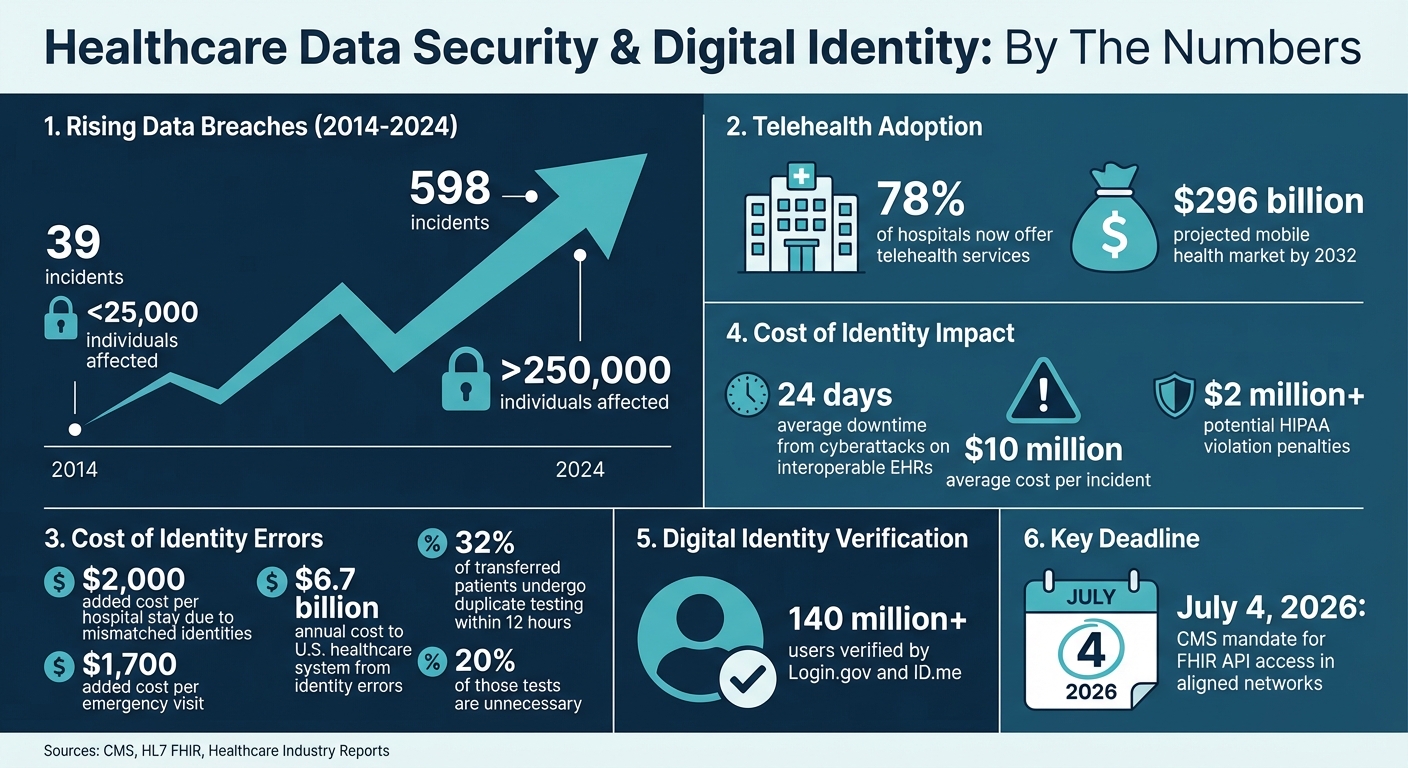
The CMS Interoperability and Patient Access Framework establishes requirements for secure data exchange within healthcare networks through standardized APIs. By July 4, 2026, CMS-aligned networks must provide FHIR API access adhering to US Core FHIR and USCDI v3 standards. This includes mandatory Audit Log Transparency, which tracks and records who accessed patient data, when, and for what purpose. These logs are critical for compliance reviews and forensic investigations, especially as HIPAA violations can result in penalties exceeding $2 million [5][6].
CMS also requires IAL2 credentials, such as mobile Driver's Licenses (mDLs), in line with NIST guidelines [4][6]. These credentials allow direct responses to data queries without the need for additional patient portal registrations [6].
The push toward these standards reflects the growing importance of secure digital identity frameworks. Between 2014 and 2024, healthcare data breaches increased from 39 to 598 incidents, with affected individuals rising from fewer than 25,000 to over 250,000 [5]. As 78% of hospitals now offer telehealth services and the mobile health market is projected to hit $296 billion by 2032 [5], these frameworks are essential for safeguarding patient data while enabling efficient and secure care delivery.
Benefits of Interoperable Digital Identity in Healthcare
Interoperable digital identity systems address major challenges in managing patient data. They improve data accuracy, ensure seamless care coordination, and enhance patient access to personal health information (PHI).
Reducing Data Matching Errors
Traditional methods of matching patients often rely on basic demographic details like names and birthdates, which can lead to errors. By using version 4 GUID/UUIDs, each patient gets a unique and permanent identifier that is never reassigned [2][7].
These digital identifiers significantly improve matching accuracy. For example, in matching algorithms, they carry a match weight of 5, compared to a weight of 3 for a first-and-last name combination. This reduces the likelihood of false positives [7].
To issue a digital identifier, the system requires Identity Assurance Level (IAL) 1.5 or higher, ensuring verification against trusted documents like a passport or driver’s license. For PHI requests, a minimum match input weight of 10 with IAL1.8/AAL2 assurance is mandated [2][7].
Interoperable systems also support manual stewardship, allowing healthcare providers to identify and fix errors like "spurious records", where data from different patients has been mistakenly merged. This manual oversight complements deterministic matching methods, ensuring data integrity across systems. Better matching accuracy directly supports smoother and more coordinated patient care [7].
Improving Continuity of Care
Fragmented medical records can delay or compromise care. Interoperable digital identities make it possible for healthcare providers to access complete and up-to-date patient information instantly. Whether a patient moves between an emergency room, a specialist, or a primary care doctor, every provider can access vital details like allergies, medications, past procedures, and chronic conditions.
This system ensures that all members of a care team have the same accurate and comprehensive health information, no matter where the records originated [8]. In emergencies, paramedics and ER physicians can quickly review a patient's medical history, enabling faster decisions and reducing the chance of errors [8].
For patients with chronic illnesses who see multiple specialists, interoperability eliminates unnecessary tests and avoids conflicting treatment plans. Each provider can view the entire care strategy, reducing risks associated with uncoordinated care [8]. As healthcare becomes more decentralized, initiatives like CMS's push for "Aligned Networks" aim to make patient data accessible across the healthcare ecosystem by 2026 [9].
"For too long, patients in this country have been burdened with a healthcare system that has not kept pace with the disruptive innovations that have transformed nearly every other sector of our economy."
– Dr. Mehmet Oz, CMS Administrator [9]
The benefits extend to everyday experiences. For instance, the "Kill the Clipboard" initiative seeks to replace repetitive paper forms with digital check-ins that work across providers. Patients can authenticate once using their verified digital identity, allowing their information to flow securely and efficiently between systems [9].
Enabling Secure Access to PHI
Interoperable digital identities simplify access to healthcare portals by introducing Single Sign-On (SSO) capabilities. Patients can use one secure credential to log into multiple healthcare systems, reducing the need for multiple usernames and passwords [9].
"For the first time, patients will be able to access their data using modern identity solutions, without needing to set up accounts and remember usernames and passwords for each healthcare website."
– CMS [9]
Security is a top priority. By linking a high-assurance credential (AAL2 or higher) to medical records, healthcare providers can confidently share data with authorized parties, such as insurance companies, knowing the individual’s identity has been verified across systems [2].
High-assurance systems like Login.gov and ID.me have already verified over 140 million users, showing growing acceptance of these secure and user-friendly solutions [11]. Additionally, technologies like role-based access control ensure that users only access data relevant to their professional roles, minimizing potential vulnerabilities [10]. This layered security approach balances expanded data access with robust protections.
Challenges and Requirements for Implementation
Building interoperable digital identity systems in healthcare is no small feat. Organizations face a mix of technical, operational, and regulatory challenges. From managing diverse identity types to ensuring strict verification processes and integrating various technologies, the journey is complex, especially when dealing with hybrid IT environments.
Credential Binding and Verification
Secure digital identities rely heavily on strong credential binding and verification. Healthcare organizations must follow NIST 800-63-3 Digital Identity Guidelines, which are tailored for the healthcare industry [12]. This involves verifying key attributes - such as legal name, address, date of birth, email, and phone number - while also addressing unique challenges, like those faced by pediatric patients or individuals without stable housing [12].
Different Identity Assurance Levels (IALs) dictate the rigor of these processes. For example:
- IAL1.5: Requires two forms of evidence, such as an insurance card and medical record, but doesn’t mandate photo ID [12].
- IAL1.8 with AAL2 Authentication: For consumer-facing requests involving PHI, this level requires photo ID verification and confirmation of a mobile number billed to the individual [7][12].
Mistakes in patient identity come with a high price. For instance, mismatched identities can add nearly $2,000 per hospital stay and $1,700 per emergency visit. These errors also contribute to over a third of denied insurance claims, costing the U.S. healthcare system more than $6.7 billion annually [13]. To minimize such risks, organizations must verify control of communication channels at every assurance level. Notably, Knowledge-Based Verification (KBV) cannot replace photo ID matching for IAL1.6 or higher [12].
"Knowledge-Based Verification (KBV) SHALL NOT be used as a substitute for the in-person or remote unsupervised match of the individual to the government issued photo ID at IAL1.6 or higher." - HL7 International [12]
Once credential verification is in place, the next hurdle is ensuring consistent standards across the healthcare landscape.
Aligning Standards Across Organizations
Consistency in identity verification and authentication practices across healthcare institutions is critical but hard to achieve. Each organization must publicly share its policies online for transparency [12]. However, variations in how these policies are interpreted and applied can disrupt data exchange.
Regulations add another layer of complexity. Healthcare Identity Providers must confirm the legal status of partner organizations via government records and verify that authorized representatives meet the appropriate assurance levels for their credentials [12]. Frameworks like TEFCA require Business Associates to obtain their own credentials, separate from those of Covered Entities [12].
Standardization efforts, such as the use of SMART on FHIR for health IT certification, aim to create a unified foundation [1]. These standards are essential for building trust in interoperable digital identity systems. Still, organizations often struggle to reconcile these requirements with their existing workflows. Unique cases, such as individuals with a single legal name, add further complications. For example, mononymous names must be entered in the "Last Name" field, leaving the "First Name" field blank [7].
Technical Barriers and Solutions
On top of verification and standardization challenges, technical issues further complicate implementation. Healthcare systems must manage a wide range of identities, including patients, providers, workforce members, partners, IoMT devices, and even AI agents [1]. Balancing security and performance while accommodating this diversity requires advanced infrastructure.
Integration is another hurdle. Healthcare organizations must connect various applications - like EHRs, billing systems, and marketing platforms - within hybrid IT environments, all without creating unnecessary administrative burdens [1]. These systems must handle millions of daily transactions and billions of identities, all while enabling real-time data sharing. For example, Availity, a major U.S. health information network, processes millions of transactions daily through centralized identity management [1].
"Interoperability relies on advanced cybersecurity capabilities, a standard called FHIR (Fast Healthcare Interoperability Resources) for data formats and APIs, legal agreements for data sharing, and governance models to manage the data exchange of medical records." - Shasta Turney, Director, Healthcare Solutions Marketing, Ping Identity [1]
Technical frameworks must also address complex relationships, such as linking a remote monitoring device to a specific provider, parent, and dependent child simultaneously [1]. Poor EHR interoperability exacerbates inefficiencies - 32% of transferred patients undergo duplicate testing within 12 hours, and 20% of these tests are unnecessary [13].
Emerging solutions, like no-code and low-code identity orchestration tools, simplify integration by allowing IT teams to connect services through drag-and-drop interfaces, reducing the need for custom coding [1]. Additionally, organizations are adopting Zero Trust security frameworks and centralizing SSO, MFA, and access controls to strengthen breach detection and response capabilities [1]. This is critical, given that cyberattacks on interoperable EHRs result in an average downtime of 24 days and cost hospitals around $10 million per incident [13].
How Risk Management Platforms Secure Digital Identities
Healthcare organizations face a tough challenge: securing interoperable digital identity systems. Risk management platforms step in to address vulnerabilities linked to third-party vendors, clinical applications, and patient data exchanges - areas where traditional methods often fall short. These platforms combine technical safeguards with operational protocols, forming a key part of the broader digital identity ecosystem.
Assessing Third-Party Risks
Third-party vendors are a cornerstone of digital identity systems, but they can also introduce potential security gaps. Censinet RiskOps™ helps healthcare delivery organizations (HDOs) evaluate third-party vendor risk, ensuring they meet federal standards for identity verification. For example, the platform supports compliance with NIST IAL2 identity proofing standards, which are crucial for interoperability networks like TEFCA-connected QHINs [15].
Through automated questionnaires and benchmarking tools, Censinet RiskOps™ identifies risks in vendors' identity verification processes. This ensures that mismatches involving patient personally identifiable information (PII) are minimized, safeguarding data exchanges across health information exchanges (HIEs) [15]. For instance, the platform checks vendor compliance with NIST 800-63-3 requirements, verifying adherence to federal guidelines.
Protecting PHI and Clinical Applications
Digital identity systems don’t just manage access; they protect critical assets like Protected Health Information (PHI) and clinical applications. When these systems fail, the stakes include not only financial losses but also risks to patient safety. Platforms like Censinet RiskOps™ mitigate these risks by enforcing encryption, access controls, and identity verification, all in line with NIST 800-63-3 IAL2 standards [15][16].
In cases where multiple providers exchange data via HIEs, the platform ensures third-party vendors comply with governance frameworks. This includes implementing robust security measures like encryption and consent management. By addressing weak identity proofing in systems such as FHIR-based exchanges, these measures prevent unauthorized access to sensitive patient data [16]. A secure foundation like this also opens the door for automation to further streamline risk management.
Improving Efficiency with Automation
Manual risk assessments can take weeks, slowing down progress in adopting interoperable identity systems. Censinet RiskOps™ uses Censinet AI™ to automate these processes, delivering real-time benchmarking and speeding up evaluations [15]. This automation not only reduces manual labor but also accelerates secure data exchange within healthcare networks.
"Automating risk management and operations across key clinical and business functions, Censinet delivers unmatched visibility, productivity, and automation to target the cyber risks that threaten patient safety and business operations." - Censinet [14]
Censinet AI™ transforms weeks-long assessments into tasks completed in days. It auto-summarizes vendor documentation, generates risk reports instantly, and enables vendors to complete questionnaires in seconds. This streamlined process helps healthcare organizations address risks faster while still allowing for the human oversight needed for critical decisions.
Conclusion
Interoperable digital identity systems are reshaping how patient data is managed and exchanged securely. By aligning key trust frameworks - like NIST 800-53, NIST 800-63, and RFC 3647 - healthcare systems now have unified protocols for recognizing digital identities. This alignment reduces fragmentation across the industry and makes it easier for patients to access their information [17].
In October 2025, the CARIN Alliance, DirectTrust®, and the Kantara Initiative™ introduced the first unified digital identity credential trust framework policy in the U.S. This policy bridges previously separate frameworks, enhancing patient access across TEFCA-connected networks. Ryan Howells highlighted its significance:
"By harmonizing requirements across several trust frameworks, we've created a foundation that can support interoperability not only in healthcare, but in any industry that relies on trusted digital identity exchange. Ultimately, this will reduce fragmentation, lower barriers to patient access, and enable a more seamless digital experience for everyone."
This unified approach also strengthens operational security. Platforms like Censinet RiskOps™ play a critical role by verifying that all entities meet standardized security requirements. This ensures consistent protection for health information exchanges, safeguarding PHI and clinical applications.
Additionally, integrating these standards with initiatives like HL7® FHIR® at Scale Taskforce and TEFCA enhances the digital experience even further. Automated risk assessments, real-time benchmarking, and AI-driven workflows help healthcare organizations overcome the technical and operational hurdles that previously slowed the adoption of interoperable identity systems.
FAQs
How do digital identifiers reduce patient-matching errors?
Digital identifiers play a key role in cutting down patient-matching errors by assigning each individual a unique, verified digital identity. This system boosts accuracy and ensures seamless interoperability across healthcare networks. By simplifying data exchange and maintaining consistent identification, digital identifiers make patient data management more reliable and effective.
What must healthcare organizations do before July 4, 2026?
Healthcare organizations are required to adopt digital identity systems with multi-factor authentication by July 4, 2026. These systems must also comply with HIPAA standards to ensure the secure handling of patient data while meeting regulatory expectations.
How can hospitals implement high-assurance identity without hurting the patient experience?
Hospitals can implement advanced digital identity systems that prioritize both security and ease of use. By incorporating multi-factor authentication (MFA) with biometrics - such as facial recognition or fingerprints - facilities can achieve robust protection without compromising on speed or convenience. Additionally, role-based access control (RBAC) ensures that staff only access information relevant to their roles, enhancing data privacy. Automating onboarding through centralized platforms can further simplify workflows, cutting down on delays. These approaches help maintain strict security protocols while ensuring a smooth experience for patients and staff alike.
