
If you work in healthcare, “ISO 27001:2026” means one thing: use ISO/IEC 27001:2022 plus Amendment 1:2024, and make sure your risk assessment records match the new control set.
I’d boil the whole update down to this:
- The risk assessment process stays the same: identify, analyze, evaluate, and treat risk.
- The control set changed: Annex A moved from 114 controls to 93 controls.
- Your records need work: the Statement of Applicability, control IDs, mappings, and evidence should line up with the 2022 version.
- Healthcare risk scoring should reflect patient care: downtime, PHI exposure, device gaps, cloud use, vendor outages, and clinical impact.
- The 2024 amendment adds climate-related context checks: healthcare groups should note storms, floods, wildfires, power loss, and data center or telecom outages if they affect the ISMS.
Why does this matter? Because the threat level is still high. The article points to 444 reported healthcare cyber incidents, 238 ransomware threats, and 592 HHS OCR filings tied to PHI events affecting 259 million Americans. It also notes that 92% of healthcare organizations faced at least one cyberattack in the prior 12 months.
If I were updating a healthcare ISO 27001 program today, I’d focus on four things first:
- Remap old 2013 controls to 2022 controls
- Recheck asset inventory, especially EHRs, imaging, medical devices, SaaS, APIs, and vendors
- Tie risk scoring to care impact, not just IT impact
- Collect proof that auditors can trace from risk to control to residual-risk decision
Here’s the short version: this is less about a new standard and more about using the current one correctly.
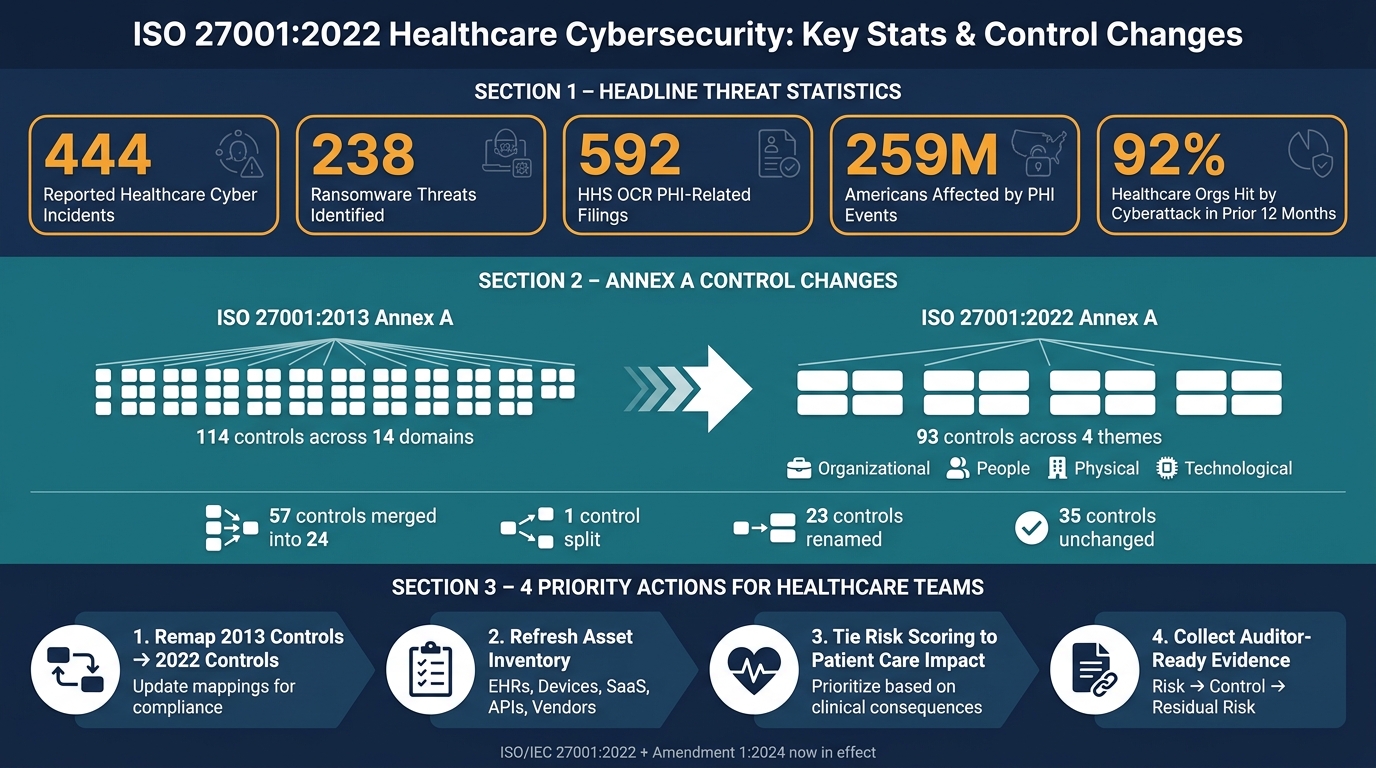
ISO 27001:2022 Healthcare Cybersecurity: Key Stats & Control Changes
ISO 27001 audits for medical device software
sbb-itb-535baee
Key Changes in ISO/IEC 27001:2022 and the 2024 Amendment
These updates don't change how healthcare teams assess risk. What changes is which controls, mappings, and audit evidence the ISMS needs to show.
Annex A Redesign: Fewer Controls, New Structure
ISO/IEC 27001:2022 reshaped Annex A from 114 controls across 14 domains into 93 controls grouped under four themes: organizational, people, physical, and technological.[6][9][10][13] The lower total came from consolidation: 57 controls merged into 24, 1 split, 23 renamed, and 35 stayed the same.[8][9][12][13]
For healthcare teams, this means the old control IDs no longer line up neatly with the new ones. A crosswalk can help for a short time, but it shouldn't be the end state. Teams need to remap the SoA, policies, and treatment plans to the 2022 control IDs.[7][2][11][12] If your SoA still uses 2013 numbering, audit gaps can slip in fast, and your control coverage may not be what you think it is.
Controls That Need Fresh Attention in Healthcare
These controls deserve a closer look because they directly affect how healthcare teams document risk and decide on treatment. In plain English: this is where paperwork, system setup, and day-to-day security work meet.
| Control | ID | Why It Matters in Healthcare |
|---|---|---|
| Threat intelligence | 5.7 | Uses current threat data - ransomware, credential theft, device exploits - to shape risk decisions. |
| Information security for use of cloud services | 5.23 | Requires explicit shared-responsibility reviews for EHR, telehealth, analytics, and backup services. |
| ICT readiness for business continuity | 5.30 | Supports 24/7 availability of EHRs, clinical systems, and telehealth platforms. |
| Configuration management | 8.9 | Addresses cloud and on-premises misconfiguration risk. |
| Information deletion | 8.10 | Covers PHI retention and disposal across internal and vendor systems. |
| Data masking | 8.11 | Reduces PHI exposure in testing, analytics, and vendor data sharing. |
| Data leakage prevention | 8.12 | Controls exfiltration through email, endpoints, and cloud services. |
| Monitoring activities | 8.16 | Improves detection, investigation, and accountability for PHI access. |
| Secure coding | 8.28 | Applies to in-house and outsourced clinical development. |
A few checks matter right away:
- Whether test systems still hold live PHI
- Whether logs record privileged access to PHI repositories
- Whether deletion works the same way across internal platforms and vendor-hosted systems
Those details can sound small on paper, but they often decide whether a control works in practice or just looks fine in a spreadsheet.
The 2024 Climate-Action Amendment in Plain Terms
The control updates above affect day-to-day risk treatment. The 2024 climate amendment is narrower. It mostly changes how organizations think about context and continuity planning.
This amendment adds a context check, not a new set of controls. Clause 4.1 now requires organizations to assess whether climate change affects the ISMS, and Clause 4.2 says interested parties may have climate-related requirements.[3][5]
For healthcare, that means writing down scenarios such as weather events, outages, wildfires, and floods that could disrupt data centers, backups, telecom services, or vendors.
How Healthcare Organizations Should Update Their Risk Assessments
With ISO 27001:2022 and Amendment 1:2024 now in place, healthcare groups should run their risk assessments again against current assets and current threat scenarios. The updated standard is the cue to check the assets and scenarios that shape the assessment.
Refresh Asset Inventory and Threat Scenarios
The most common reason healthcare risk scores drift off course is simple: the asset inventory is incomplete. When that happens, the threat scenarios and controls built on top of it won't line up with actual exposure.
A healthcare-focused inventory should cover EHRs, imaging systems, connected medical devices, telehealth tools, cloud workloads, APIs, and vendor data exchanges. Each one should be tied to the PHI it stores, processes, or transmits. A solid inventory also separates business-critical systems from less critical ones, so the organization can score downtime impact, patient safety impact, and data-loss impact on their own terms. Under-scoped medical devices and imaging systems are a common blind spot.
Once the inventory is in good shape, threat scenarios should match what U.S. healthcare teams deal with every day: ransomware-driven downtime, patient diversion, delayed procedures, PHI exfiltration, and vendor outages that affect care delivery. Likelihood should be scored based on internet exposure, unsupported software, vendor dependency, and integration complexity. Impact should be scored separately for patient safety, operational disruption, privacy exposure, and recovery effort.
That inventory is the base for sound likelihood and impact scoring.
Document Risk Criteria, Residual Risk, and Treatment Plans
Auditors need a traceable chain: asset → threat scenario → score → treatment → control → evidence → residual-risk decision. In healthcare, that chain often breaks when impact criteria are too vague and don't connect to clinical outcomes.
Impact criteria should describe situations that make sense in a care-delivery setting. Instead of high financial impact, use language like clinical documentation unavailable for more than 4 hours or radiology images inaccessible during business hours. That makes the scoring model easier to defend. It also helps risk owners explain why a vulnerability that looks moderate on the technical side can turn into a high enterprise risk in a hospital.
Every treatment plan should name a specific owner, a target completion date, and the evidence that will show the control is working. Each control needs an owner, due date, and evidence requirement. Residual risk should be formally reassessed after implementation. If it still sits above the acceptance threshold, the organization should either add more controls or record written executive acceptance.
Use the Statement of Applicability as the Control Link
The Statement of Applicability connects each material risk to the controls it relies on. For every material risk, the SoA should show which control applies, whether it is fully implemented, partially implemented, or excluded, and why.
If the risk is third-party vendor risk leading to PHI leakage, the SoA should point to controls for supplier security, information transfer, logging, access management, and data masking or deletion. Use the SoA to show why each control was selected, its implementation status, and the evidence behind it.
That mapping sets up the control-by-control review in the next section.
Control Mapping for Core Healthcare Risk Areas
Use the SoA to turn residual-risk decisions into control checks and evidence requests. The simplest way to do that is with a control mapping matrix that ties each risk area to the right controls, a named owner, and the proof you need to review.
| Risk Area | ISO 27001:2022 Control Focus | Healthcare Impact |
|---|---|---|
| Cloud, Suppliers & Shared Responsibility | A.5.19–A.5.23 (supplier relationships, supplier agreements, ICT supply chain management, supplier-service changes, cloud services security) | Unmanaged vendor access, BAA gaps, fourth-party PHI exposure |
| PHI Protection | A.8.10–A.8.12, A.8.15, A.5.34 (information deletion, data masking, data leakage prevention, logging and monitoring) | Unauthorized access, exfiltration, incomplete audit logging |
| Configuration, Secure Dev & Continuity | A.8.9, A.8.13, A.5.29, A.5.30 | Ransomware downtime, clinical disruption, patient safety risk |
Each row below turns the SoA into specific evidence checks.
Start with supplier, PHI, and continuity risks. In practice, these are often the areas that shift the assessment outcome.
Cloud, Suppliers, and Shared-Responsibility Risk
A.5.19–A.5.23 apply to cloud providers and other outside service providers. So this covers your EHR vendor, your SaaS telehealth platform, and your cloud infrastructure provider. A.5.23 calls for a documented shared-responsibility model that assigns each security duty. If that document does not exist, log it as a control gap.
Review every Business Associate Agreement and Master Service Agreement to confirm that each one includes breach notification timelines, encryption standards, and audit rights. Then go a layer deeper. A 287% increase in individuals affected by attacks on third-party business associates between 2022 and 2023 [16] makes it clear that fourth-party exposure matters. In plain English, vendor subcontractors can create risk too.
Ask suppliers to disclose their main hosting providers and any subcontracted services. Then request proof of control coverage for any fourth party that touches PHI or supports clinical operations.
Censinet RiskOps™ can centralize this work by collecting supplier evidence, surfacing gaps in shared-responsibility coverage across PHI-hosting vendors, and tracking remediation across your vendor portfolio.
PHI Protection: Masking, Leakage Prevention, Deletion, and Logging
These controls govern PHI from access to disposal: A.8.10 (information deletion), A.8.11 (data masking), A.8.12 (data leakage prevention), A.8.15 (logging), and A.5.34 (privacy and protection of personal information).
Data masking under A.8.11 matters in research databases, analytics environments, and test systems, where identifiable patient data often lands by default. Secure deletion under A.8.10 lines up with HIPAA disposal expectations and can include cryptographic erasure for storage systems plus verified wipe processes for retired devices.
For exfiltration risk, A.8.12 calls for DLP controls across outbound email, file-sharing services, and data transfers. Give extra attention to telehealth services and home health programs, where PHI moves outside the usual hospital perimeter. A.8.15 should log views, downloads, edits, and printing across EHRs, PACS, lab systems, and patient portals, with retention periods long enough to support investigation and reporting.
The same logic carries over to configuration and recovery controls.
Configuration, Secure Development, and Continuity Readiness
Continuity planning is critical for EHRs, imaging, lab, and medication systems. Misconfigurations are still a common path for ransomware in healthcare. The biggest issues to prioritize are exposed administrative interfaces, default credentials on medical device gateways, and firewall rules that are too permissive.
ISO 27001 controls for configuration management and technical vulnerability management call for documented hardening baselines, regular audits against those baselines, and a change management process that reviews security impact before any configuration update goes live.
Continuity planning is the other top concern. 67% of healthcare organizations were hit by ransomware in 2024, up from 60% in 2023 [14][15]. On top of that, 56% of organizations that suffered these attacks reported poor patient outcomes due to delays in procedures and tests [1]. Those numbers show why downtime is not just an IT issue. It can affect care.
ISO 27001's continuity controls require defined RTOs and RPOs for care-critical systems, including EHRs, imaging, lab information systems, and medication management. They also require tested disaster recovery exercises, incident response playbooks, and verified offline or immutable backups. Add outage, flooding, and power-loss scenarios to disaster recovery testing alongside ransomware exercises.
Common Gaps, Next Steps, and Conclusion
Common Healthcare Assessment Gaps in 2026
Even after the control mapping above, most failures still come back to weak evidence and outdated scope. In healthcare, organizations usually fail ISO 27001 audits because of evidence problems, not because they lack policies.
In 2026, the same trouble spots keep showing up. Asset inventories still leave out medical devices, EHRs, imaging systems, SaaS tools, shadow IT, and legacy apps. Cloud ownership is often split in messy ways, with IT, security, and clinical operations each assuming someone else handles logging, backups, and incident response. Supplier oversight also varies a lot. On top of that, many organizations still map risks to ISO/IEC 27001:2013 control lists, which leaves holes in areas like threat intelligence, cloud services, data leakage prevention, and business continuity that the 2022 standard directly covers.[18]
Auditors want more than broad statements. They expect to see:
- traceable risk registers
- documented reasons for residual risk acceptance
- artifacts that connect controls to specific assets and PHI workflows
Generic risk acceptance entries do not satisfy auditors.[18]
Where Censinet Fits in Healthcare Risk Operations
Large healthcare organizations need a way to handle these gaps across a lot of teams, systems, and vendors. Censinet RiskOps™ supports third-party assessments, risk registers, control mappings, and evidence tracking across PHI, clinical applications, medical devices, and supply chains.
Censinet AI™ helps speed up vendor questionnaire completion and evidence summarization, while still keeping human review in the loop.
Conclusion: Apply the Current Standard Correctly
The update is simple: align assessments to the 2022 control set, apply the 2024 amendment where relevant, and keep evidence current.[4][17]
In practice, that means refreshed asset inventories, updated threat scenarios, documented risk criteria that include patient safety and care disruption, and evidence that auditors can actually follow. It also means treating the Statement of Applicability as a living document instead of a one-time deliverable.
Healthcare organizations that set a steady review cadence, with quarterly or semiannual reassessments tied to actual incident lessons and clinical input, will be in a stronger position for audits and for the disruptions that still shape the threat landscape.[18]
Applying it correctly is what reduces patient risk.
FAQs
Do we need to recertify for ISO 27001:2026?
It depends on your current certification status and which version you're certified against.
ISO 27001 certificates are generally valid for three years. At the end of that period, you need a full recertification audit to keep the certification in place.
The transition from the 2013 edition to the 2022 version ended on October 31, 2025. That means all valid certifications now need to align with the 2022 standard.
To stay certified, organizations also need to complete annual surveillance audits and keep their risk management practices up to date.
How should healthcare teams map 2013 controls to the 2022 Annex A controls?
Healthcare teams should use a crosswalk matrix to map legacy ISO 27001:2013 controls to the 2022 Annex A framework. It’s a practical way to line up existing risk treatment plans with the updated set of 93 controls.
Start by identifying the security objectives each 2013 control was meant to meet. Then map those controls into the 2022 control groups:
- organizational
- people
- physical
- technological
Because the transition period ended on October 31, 2025, the Statement of Applicability should show these mappings to support current certification compliance.
What audit evidence should we update first for a healthcare risk assessment?
Start with the documentation that proves day-to-day compliance and control performance: the risk register, Statement of Applicability, and ISMS policies.
Then check that the rest of your evidence is up to date. That includes audit trails, access logs, encryption documentation, recent penetration test results, incident records, and proof of corrective actions, especially for clinical and patient data.
