
Healthcare organizations must protect electronic protected health information (ePHI) and meet HIPAA compliance standards. But how do you measure the effectiveness of your safeguards? By tracking specific Key Performance Indicators (KPIs), you can evaluate performance, identify risks, and improve responses. Here’s a quick breakdown of the most important metrics:
- Access Logs & Audit Controls: Monitor user access, failed login attempts, and changes to ePHI.
- Incident Response Metrics: Track how quickly breaches are detected (MTTD) and resolved (MTTR).
- System Uptime: Ensure continuous access to ePHI by maintaining high system availability.
- Employee Training: Measure training completion rates and adherence to security policies.
- Vendor Compliance: Track Business Associate Agreement (BAA) completion and vendor risk assessments.
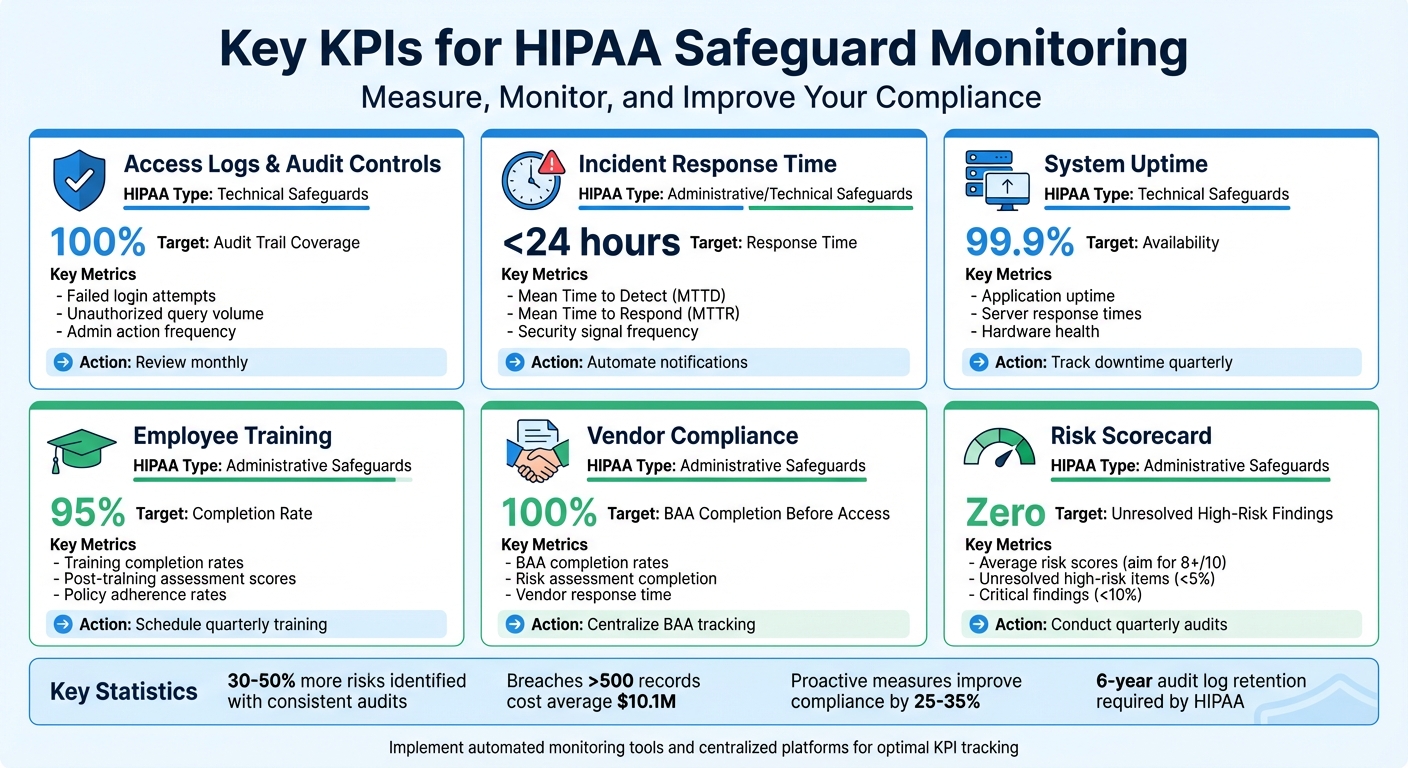
6 Essential HIPAA Safeguard KPIs: Metrics, Benchmarks, and Implementation Guide
The 9 HIPAA Administrative Safeguard Standards EXPLAINED
sbb-itb-535baee
Core KPIs for HIPAA Safeguard Monitoring
Tracking key performance indicators (KPIs) turns HIPAA compliance into a measurable process that strengthens security, improves incident response, and ensures system reliability. Here's a closer look at the critical metrics organizations need to monitor.
Access Logs and Audit Controls
User access logs are the backbone of HIPAA audit controls. Every interaction with electronic protected health information (ePHI) - from user logins and data queries to access control updates and administrative actions - must be tracked to comply with the HIPAA Security Rule.
"The Security Rule's provision on Audit Controls states that covered entities and business associates must 'implement hardware, software, and/or procedural mechanisms that record and examine activity in information systems that contain or use electronic protected health information.'" - Datadog [1]
Monitoring failed login attempts and unauthorized queries can act as an early warning system. A spike in "access denied" logs might indicate attempts to access ePHI without proper authorization. Similarly, tracking changes to records can reveal unauthorized attempts to modify or delete patient data, a critical aspect of HIPAA's Integrity Controls [1].
It's not enough to simply collect logs - HIPAA requires audit logs to be retained for six years to support investigations by internal teams or the Department of Health and Human Services (HHS) [1]. Consolidating logs from various systems, including electronic health record (EHR) platforms and cloud providers, many of which require robust third-party risk management, into a centralized platform can simplify investigations and improve response times.
Incident Response and Breach Detection Metrics
When it comes to security incidents, speed matters. Two essential metrics capture this: mean time to detect (MTTD) and mean time to respond (MTTR). MTTD measures how quickly a potential breach is identified, while MTTR tracks the time it takes to contain and resolve the issue.
Automated detection tools can analyze log streams in real-time to flag potential threats [1]. Tracking the frequency of these alerts helps identify emerging enterprise risks early. Additionally, monitoring the types of sensitive data - like patient identifiers, Social Security numbers, or payment information - detected and scrubbed by automated tools provides insight into the effectiveness of data loss prevention measures [1].
System Uptime and Infrastructure Performance
Under HIPAA, availability isn't just a technical goal - it's a requirement. Metrics like system uptime, server response times, and application availability ensure that authorized users can access ePHI whenever needed. Downtime not only disrupts patient care but may also breach the Security Rule's availability standards.
Keeping an eye on server uptime, application performance, and hardware health is essential to maintaining continuous access to ePHI. Poor performance could indicate deeper issues, such as failing hardware, capacity shortages, or misconfigurations, all of which could lead to data inaccessibility or loss [1].
| KPI Category | Specific Metrics to Track | HIPAA Safeguard Alignment |
|---|---|---|
| Access & Audit | Failed login attempts, unauthorized query volume, admin action frequency | Technical Safeguards (Audit Controls) |
| Incident Response | Security signal frequency, time to remediate breaches, sensitive data leak alerts | Administrative Safeguards (Incident Procedures) |
| System Performance | Application uptime, server response times, hardware health | Technical Safeguards (Availability) |
Identifying Risk and Safeguard Gaps
Spotting weaknesses in HIPAA safeguards demands a structured approach, combining risk scoring and frequent security evaluations. Instead of waiting for a breach to expose vulnerabilities, organizations rely on proactive monitoring to pinpoint gaps before they lead to compliance issues. Here's how tools like risk scorecards and breach metrics help uncover these weaknesses.
Risk Scorecard Ratings and Security Audits
Risk scorecards assign numerical ratings to potential threats based on factors like likelihood, impact, and the strength of current safeguards. For instance, if a vendor's PHI (Protected Health Information) handling scores 7/10 due to outdated encryption, immediate action is required to address the issue [8][9]. Conducting regular audits - quarterly for internal reviews and annually for external ones - ensures compliance with HIPAA standards. Additionally, performing audits after major system updates helps catch vulnerabilities early. A 2025 study revealed that consistent audits identified 30–50% more risks at earlier stages [4].
To measure safeguard effectiveness, compare scorecard metrics against industry benchmarks. Key indicators include:
- Average risk scores (scores below 8/10 may indicate gaps).
- Percentage of unresolved high-risk items (aim for less than 5%).
- Trends over time.
For example, if an organization’s scorecard averages 6.5 while peers average 8.2, it signals weaknesses in administrative safeguards [6]. Beyond scoring, tracking actual PHI breaches provides further validation of safeguard performance.
PHI Breach Incidents and Audit Findings
Monitoring PHI breaches offers direct insights into safeguard performance. Track critical metrics like incident frequency (goal: zero breaches per quarter), breach size, and containment time (ideally under 72 hours, as per HIPAA guidelines) [5]. Common issues include unauthorized ePHI disclosures via email (40% of breaches) and lost unencrypted devices (25%). These patterns often highlight encryption and access control gaps. In 2025, data showed that breaches involving over 500 records could cost an average of $10.1 million, emphasizing the steep financial risks [5].
Audit findings also provide valuable data. Key performance indicators include:
- The percentage of critical findings (target: under 10% of total issues).
- Resolution rates (over 95% resolved within 30 days).
- Recurrence rates (keep below 5%) [4].
Mapping vulnerabilities from audit findings to scorecard categories allows organizations to track trends over time using unified dashboards. When combined scores fall below thresholds, proactive measures can improve compliance by 25–35% [6].
To streamline these efforts, healthcare organizations can use platforms like Censinet RiskOps™, which consolidates risk assessments, audit findings, and breach data into a single, user-friendly dashboard. This centralized approach simplifies HIPAA safeguard monitoring and helps ensure compliance.
Employee Training and Vendor Risk Management KPIs
HIPAA's administrative safeguards require healthcare organizations to implement strong workforce training programs and oversee vendor compliance. These measures are essential for maintaining compliance, yet many organizations face challenges in gauging their effectiveness. Using the right KPIs helps ensure both staff compliance and vendor accountability. Below, we break down how to measure performance through specific training and risk management metrics.
Employee Training Completion and Policy Adherence
Employee training is a cornerstone of HIPAA compliance, and tracking its effectiveness is critical. To assess training success, aim for at least 95% completion rates and high scores on post-training assessments. These metrics help pinpoint areas where knowledge gaps may exist within departments [7].
Another important metric is policy adherence rates, which track how consistently employees follow established security procedures. This includes monitoring incidents like unauthorized access attempts or improper handling of PHI. For example, organizations can review the number of policy violations reported each quarter to identify trends [2]. However, when monitoring employee behavior, it’s essential to avoid invasive tools that capture screen content or keystrokes, as these can inadvertently expose PHI. Instead, focus on compliance-friendly measures like tracking training completions, documenting policy acknowledgments, and evaluating the responsiveness of incident reporting processes [2].
Third-Party Risk Assessment Completion Rates
In addition to internal metrics, tracking external vendor compliance is equally important. Vendors who handle electronic protected health information (ePHI) must be classified as business associates and held accountable through business associate agreements (BAAs). These agreements outline crucial details, such as encryption standards, breach protocols, subcontractor responsibilities, and permitted data uses [6].
Key KPIs for vendor oversight include BAA completion rates - the percentage of vendors with signed agreements before gaining access to sensitive data. Another critical metric is BAA review frequency, which ensures that agreement terms are updated as vendor relationships evolve [6].
Organizations should also monitor vendor risk assessment completion rates to confirm that third-party evaluations are conducted on schedule. This involves tracking how quickly vendors respond to security questionnaires and address identified vulnerabilities. Platforms like Censinet RiskOps™ can simplify the process by centralizing vendor assessments, BAA tracking, and even fourth-party risk identification into a single dashboard. This approach not only reduces administrative workload but also strengthens oversight of security threats in vendor relationships, helping to safeguard patient data effectively.
How to Implement and Monitor KPIs
Start by conducting a baseline risk analysis to identify the most critical metrics. Assign compliance officers to oversee KPI tracking and integrate these metrics into workflows using automated tools. This approach minimizes errors and ensures consistent oversight. By building on earlier discussions of KPI selection, this method lays the groundwork for efficient and effective monitoring.
Once the baseline is established, set clear benchmarks aligned with HIPAA's three safeguard categories: administrative, physical, and technical. For instance, you might begin by monitoring access logs, then establish regular review cycles - quarterly audits are a common choice for many organizations. These reviews help ensure KPI performance aligns with benchmarks and allow for quick responses to new threats. Following these steps ensures that the KPIs discussed earlier lead to measurable improvements in HIPAA safeguard compliance.
An essential part of implementation is leveraging integrated platforms to streamline data management. Tools like Censinet RiskOps™ can centralize vendor assessments, BAA tracking, and risk scorecards, offering a unified view that eliminates data silos and eases the workload for compliance teams. Pair this with automated tools for intrusion detection and log analysis to catch anomalies in real-time, while monthly access reviews help confirm that user permissions remain appropriate.
When resources are limited or threats evolve, prioritize KPIs that have the greatest impact. For example, focus on breach detection metrics and vendor BAA completion rates first, then expand to other areas as resources allow. These steps ensure continuous monitoring and support the proactive risk identification strategies discussed earlier.
KPI Implementation Table
| KPI | HIPAA Safeguard Type | Target Benchmark | Tracking Tools | Implementation Steps |
|---|---|---|---|---|
| Access Logs Coverage | Technical | 100% audit trail | SIEM, Censinet RiskOps™ | Deploy automated logging; review monthly |
| Incident Response Time | Physical/Technical | Less than 24 hours | Monitoring dashboards, SIEM alerts | Automate notifications; conduct post-incident reviews |
| System Uptime | Technical | 99.9% availability | Infrastructure monitoring tools | Set SLAs; track downtime events quarterly |
| Training Completion Rate | Administrative | 95% employee completion | Compliance platforms, Censinet RiskOps™ | Schedule quarterly training; monitor completion |
| BAA Completion Rate | Administrative | 100% before vendor access | Censinet RiskOps™ | Centralize BAA tracking; review vendor agreements |
| Risk Scorecard Ratings | Administrative | Zero unresolved high-risk findings | Censinet RiskOps™, audit tools | Conduct quarterly security audits; prioritize remediation |
Conclusion
Keeping an eye on HIPAA safeguard KPIs transforms compliance from a reactive checklist into an active defense strategy. By tracking metrics like access logs, incident response times, system uptime, training completion rates, and vendor risk management assessments, healthcare organizations gain critical insights. This visibility helps spot vulnerabilities early, preventing them from escalating into breaches. It also ensures compliance with HIPAA's administrative, physical, and technical safeguard requirements while promoting a mindset of continuous improvement.
With these metrics in place, advanced tools now make proactive detection and resolution more achievable. Automated monitoring systems enhance real-time KPI tracking, catching potential issues faster. For example, daily access log reviews can flag unauthorized actions immediately, while anomaly detection tools identify irregularities that manual reviews might miss. Organizations using these automated solutions have reported over 99% system uptime and a noticeable reduction in breach incidents by addressing risks before they grow. [3][4][8]
Censinet RiskOps™ takes this a step further by integrating vendor BAA management, risk assessments, and security audits into one platform. Its comprehensive compliance dashboard simplifies data consolidation and provides instant insight into compliance status. By breaking down data silos, this unified system gives compliance teams a centralized view of risks across their organization. This streamlined approach makes it easier to measure performance against HIPAA standards and respond to new threats quickly and effectively.
In the long run, consistent KPI tracking offers more than just compliance. It builds trust, ensures better use of resources, and strengthens accountability across departments. By making KPI monitoring a regular practice instead of a one-time task, healthcare organizations can safeguard ePHI, adapt to evolving threats, and achieve operational excellence. [9][10]
FAQs
Which HIPAA safeguard KPIs should we prioritize first?
Start by focusing on key metrics such as vendor risk ratings, compliance completion rates, and mean time to risk resolution. These measurements provide valuable insights into third-party security, adherence to regulations, and how quickly risks are addressed. By tracking these, healthcare organizations can better oversee HIPAA safeguards and ensure they remain compliant and secure.
How do we set realistic KPI benchmarks for HIPAA compliance?
To create realistic KPI benchmarks for HIPAA compliance, start by focusing on specific, measurable goals that align with established best practices. Key metrics to track include regular risk assessments, effective access controls, and comprehensive audit logging. Tools like Censinet RiskOps™ can help by providing accurate, real-time tracking of these metrics.
Set benchmarks based on data-driven insights and ensure they align with industry standards. Additionally, adopt a system of continuous monitoring to adjust and refine your benchmarks as your compliance processes evolve and mature.
What’s the best way to centralize audit logs and vendor risk data?
When it comes to managing compliance and risk, leveraging automated, centralized platforms can make all the difference. Tools such as Censinet RiskOps™ simplify the entire process by handling the collection, storage, and analysis of audit logs and risk-related data. These platforms offer features like continuous monitoring, automated evidence collection, and reporting that's ready for audits.
Additionally, they come equipped with real-time dashboards and automated alerts, keeping everything organized and easily accessible. They also help manage Business Associate Agreements (BAAs) while ensuring all data stays compliant with HIPAA regulations.
