
If your medical device connects to the internet, FDA now expects cybersecurity proof before clearance or approval. Since March 29, 2023, covered submissions must include a postmarket cyber plan, lifecycle security process details, and an SBOM.
Here’s the short version: I’d treat cybersecurity as a start-to-finish product duty, not a launch checklist. That means tying design controls, software risk work, testing, patch planning, supplier tracking, and end-of-support planning into one file that FDA can review and hospital buyers can use.
What matters most:
- Covered devices include products with software or firmware that can connect to the internet and can face critical medical device security risks
- Covered submissions include 510(k), PMA, De Novo, HDE, and PDP
- FDA wants evidence, not broad claims:
- threat models
- risk records
- architecture diagrams
- security test results
- patch and disclosure plans
- an SBOM with component details
- Core standards and guidance work together:
- FDA SPDF
- ISO 14971
- AAMI TIR57
- IEC 62304
- IMDRF and HSCC lifecycle guidance
- Hospital impact is direct: weak patching, poor visibility, or gaps in update support can affect patient care, data, and device uptime
- Postmarket work starts before launch: intake, triage, remediation, disclosure, and field communication all need to be planned in advance
A simple way to think about it: safety risk work asks, “What happens if the device fails?” Cyber risk work also asks, “What happens if someone gets in, changes data, blocks service, or hits a third-party component after ship?”
Quick comparison
| Area | Safety risk work | Cyber risk work |
|---|---|---|
| Main focus | Device failure and patient harm | Access abuse, data changes, downtime, software flaws |
| Timing | Heaviest before launch | Continues through updates, monitoring, and retirement |
| Main records | Hazard analysis, validation, controls | SBOM, threat model, test reports, patch and disclosure plan |
| Effect on care | Injury or device malfunction | Patient risk, data risk, network issues, care delays |
In plain terms, I’d sum up the article like this: build security into the device, track every software part, test the controls, plan for fixes after release, and keep the evidence tied together in your quality system. That’s what makes a premarket package easier to defend.
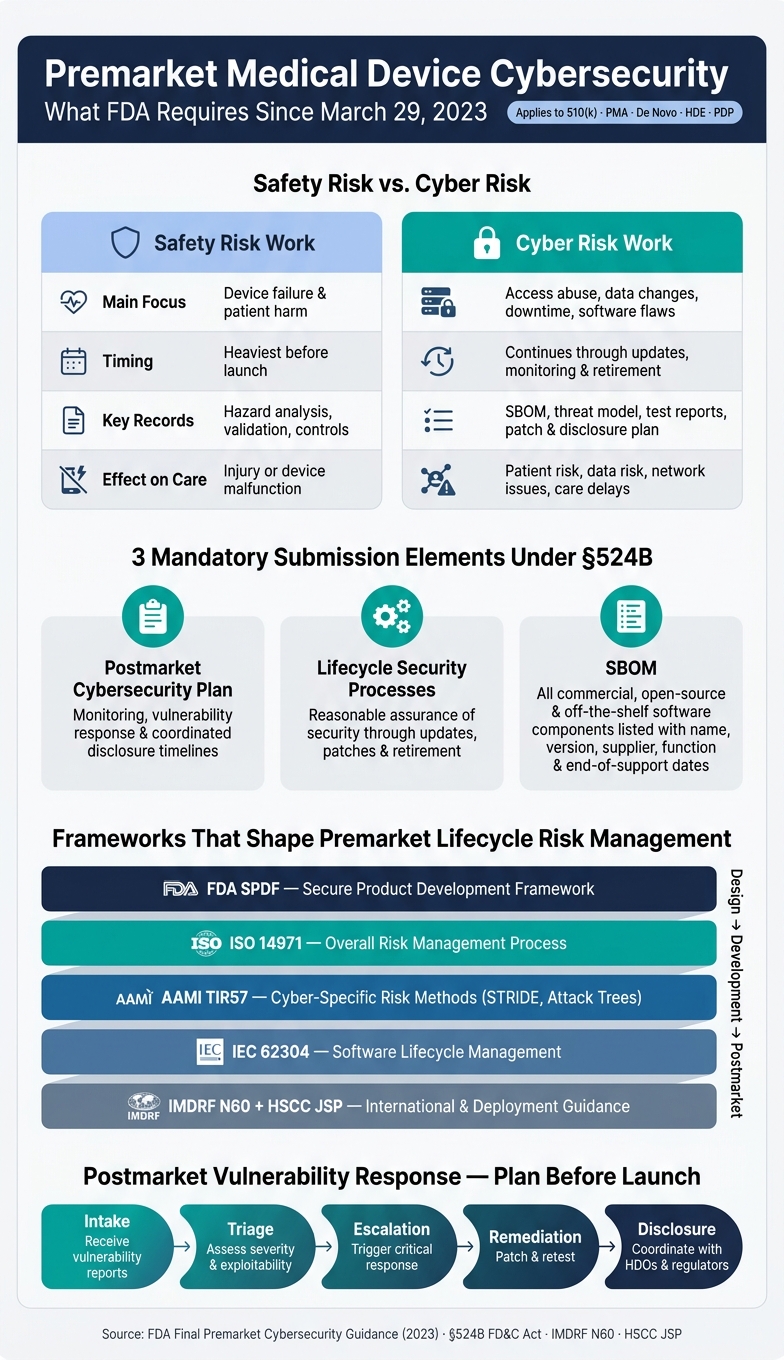
Medical Device Cybersecurity: Safety Risk vs. Cyber Risk at a Glance
What Is Required for an FDA Premarket Cyber Submission? | Ep. 47
sbb-itb-535baee
Core Frameworks That Shape Premarket Lifecycle Risk Management
Manufacturers need more than one framework here. Each one covers a different part of lifecycle governance, documentation, and engineering proof. These aren't just reference documents sitting on a shelf. They're the structure used to show premarket cyber risk control, and they turn FDA's lifecycle expectation into the evidence package reviewed during submission.
FDA Guidance and the Secure Product Development Framework
FDA's 2023 final premarket cybersecurity guidance made the Secure Product Development Framework (SPDF) the main lifecycle model for secure development.[7][9] SPDF is a set of lifecycle processes built into the QMS to reduce vulnerabilities from design through decommissioning.[31][34]
At a practical level, SPDF has three main parts:
- Security risk management to identify assets, threats, and vulnerabilities
- Security architecture to put least privilege, defense in depth, and secure defaults in place
- Testing that includes static analysis, dynamic analysis, penetration testing, fuzzing, and regression testing across development[7][9][13][17][18]
FDA reviews the outputs of SPDF - not just the idea of it. That means risk analysis, architecture records, and testing evidence. Just as important, SPDF applies to hardware, networking, update services, and decommissioning, not only software, because cybersecurity is a system-level property rather than a single feature.[31][33][34]
ISO 14971, AAMI TIR57, and IEC 62304 then give that work a clear documentation structure.
How ISO 14971, AAMI TIR57, and IEC 62304 Work Together
These three standards work like a stack.
ISO 14971:2019 sits at the top. It defines the overall risk management process for medical devices, including hazard identification, risk evaluation, control implementation, and postmarket monitoring across the full device lifecycle.[26][28] It also brings data and system security into scope, which puts cybersecurity inside the same risk governance structure used for safety issues.[26][29]
AAMI TIR57:2016(R2023) connects directly to ISO 14971 for information security risk. It adds cyber-focused methods such as structured threat modeling with STRIDE or attack trees, asset and data flow characterization, exploitability-based risk scoring, and security control justification. All of that is documented within, or closely tied to, the ISO 14971 risk file.[8][10][14] One detail matters a lot here: ISO 14971's usual probability × severity model does not fit cybersecurity neatly, so exploitability is often used instead of probability when estimating cyber risk.[10][27][30]
IEC 62304 covers the software lifecycle: planning, requirements, design, implementation, testing, maintenance, and problem resolution.[12][18] Manufacturers can carry cybersecurity through each phase. That can mean security requirements in the software specification, secure boot and protected communication channels in architecture records, static analysis and code review evidence during implementation, and patch impact analysis in maintenance.[12][18] The result is traceability from threat to control to test evidence to postmarket maintenance.[12][18]
How IMDRF, HSCC, and Related Lifecycle Guidance Add Value
The IMDRF "Principles and Practices for Medical Device Cybersecurity" (N60) sets aligned international expectations for devices built secure by design and secure by default, threat modeling, baseline security controls, and postmarket vulnerability monitoring. For manufacturers, that creates a way to line up U.S. SPDF work with international regulatory expectations at the same time.[19][21][24]
The HSCC Medical Device & Health IT Joint Security Plan (JSP), including JSP 2.0, puts secure-by-design and secure-by-default ideas into day-to-day product work across design, development, deployment, and end-of-life. It also puts direct focus on reducing deployment burden for HDOs.[20][15][22][23] For premarket planning, the JSP helps because it ties security architecture choices to actual HDO deployment settings. It also reinforces that postmarket readiness - including vulnerability response, coordinated disclosure, and communication pathways - has to be built before submission.[1][11][15][16]
Taken together, these frameworks turn lifecycle planning into submission-ready evidence.
What FDA Expects in a Premarket Submission for a Cyber Device
Those lifecycle controls turn into the proof FDA reviews in the submission. FDA treats cybersecurity documentation as part of the submission itself, not as some separate operations add-on. Reviewers want to see how lifecycle risk management links design, testing, and postmarket planning.
Required Cybersecurity Documentation Under §524B
Under FD&C Act §524B, a premarket submission must include three items: a postmarket cybersecurity plan, lifecycle security processes, and an SBOM.
The postmarket cybersecurity plan needs to explain how the manufacturer will monitor, identify, and address vulnerabilities and exploits within set response timelines, including coordinated vulnerability disclosure procedures. Lifecycle security processes must give reasonable assurance that the device and its supporting systems stay secure across the lifecycle, including updates and patches for unacceptable and critical vulnerabilities. The SBOM must list commercial, open-source, and off-the-shelf software components used in the device and supporting systems.[2][4][32][7]
For SBOMs, FDA expects a machine-readable SBOM plus a short human-readable summary. Component entries should include:
That format makes it easier for hospital cybersecurity teams to match SBOMs against vulnerability feeds and track exposure across device fleets.
Building the Evidence Package: Threat Models, Risk Reports, Architecture, and Testing
The required artifacts should map straight to the threat model, architecture, and test plan. In plain English, the package should show a clear line from threat to control to verification to maintenance, using SPDF outputs from across development.
Threat modeling outputs are the starting point. These can include data flow diagrams, trust boundary maps, identified threats with initial risk ratings, and the method used, such as STRIDE or attack trees. A traceability matrix should then connect each major threat to a security requirement, an architecture control, and a verification activity. For example, a man-in-the-middle threat on a remote update channel could trace to a TLS 1.2-or-higher requirement, a signed firmware control, and a penetration test aimed at that interface.[1][4][35]
Security architecture documentation should include high-level system diagrams, data flow diagrams showing where PHI is stored and transmitted, and a defense-in-depth explanation of how authentication, network segmentation, secure boot, and cryptographic protections work together. It should also explain how the device behaves on typical U.S. hospital networks and what configuration options HDO security teams can use.[1][4][35]
Testing evidence pulls the package together. FDA expects results from penetration testing, fuzz testing, static and dynamic analysis, and cryptographic validation, each tied to specific risks and components. Reports should summarize scope, tools, findings, remediation actions, and residual risks, along with the reason those risks were accepted. Evidence of re-testing after remediation helps show that fixes did not introduce new vulnerabilities.[1][4][35]
Cybersecurity Artifacts by Submission Pathway
The same core package applies across pathways; the main difference is depth. For 510(k), De Novo, PMA, HDE, and PDP submissions, include the same core cybersecurity package: SBOM, postmarket cybersecurity plan, security testing, risk documentation, and lifecycle maintenance plan. The level of detail should match device risk, with traceability, architecture, and postmarket readiness linking each part.[11][1][4][35]
How to Build Lifecycle Cyber Risk Controls Before Submission
Premarket evidence only helps if the controls behind it are built into the product from day one. That means design, supply chain, and postmarket support all need to work together.
Design Controls That Support Secure Use in Healthcare Environments
Design controls need to match how care settings actually work. In healthcare, that often means shared workstations, spotty connectivity, segmented legacy networks, and little local IT help. So manufacturers should set a secure-by-design baseline with controls like strong authentication, role-based access, encryption, secure boot, code signing, hardening, logging, and configuration protection.[1][38][42]
Those controls also need to handle the messy parts of the field, not just ideal conditions. Recovery and fail-safe behavior should be built in, not left to chance.[41][43] If network access drops, what happens? If authentication fails, what can the device still do safely? Those answers should be clear in the design. Each control should map to a named threat and be verified before submission.
Those design decisions only hold up if the software and component base is under control.
Managing Supply Chain, Software Updates, and SBOM Governance
Manufacturers should put a formal software supply chain program in place. That program should assign an owner to each dependency and spell out how vulnerabilities will be tracked over time.[39][42]
The SBOM should be maintained across every release, with:
- version pinning
- provenance checks
- validation on field configurations
- anti-rollback protections
Rollback should be allowed only for documented safety-critical failures.[2][39][40][42]
Once the component base is controlled, the next step is deciding how vulnerabilities will be found and handled after release.
Planning Postmarket Monitoring and Coordinated Disclosure Before Launch
Postmarket readiness belongs in the premarket file because it shapes how the device will be supported once it is in the field. Before launch, manufacturers should build workflows for intake, triage, escalation, disclosure, and patching. The plan should state how vulnerability reports come in, who reviews them, what severity levels trigger escalation, and how field communications and patch deployments are coordinated with HDO security teams.[45][6]
Teams should also track a small set of operating metrics, including acknowledgment time, triage time, mitigation time, inventory coverage, patch success rate, and open critical findings.[2][39][40][42]
IMDRF also requires monitoring, disclosure, remediation, incident response, and legacy-device management after launch, because premarket controls on their own are not enough.[21][44]
Making Lifecycle Risk Management Work Across Manufacturers and HDOs
Once the premarket evidence package is built, governance decides whether it remains defensible over time.
Governance, Traceability, and Audit-Ready Decision Making
Premarket cybersecurity only works when ownership, traceability, and evidence control are clearly defined. Manufacturers need a cross-functional governance model that brings regulatory affairs, engineering, product security, quality, clinical safety, and legal into one shared risk management process aligned with ISO 14971 and AAMI TIR57.[36][14][48]
Each group has a clear role. Engineering and product security handle the technical controls. Regulatory and quality handle submission alignment. Clinical safety handles residual-risk acceptance. Legal handles labeling and postmarket commitments.[1][46]
A single risk register helps hold that process together. Each issue should have a unique ID that traces it from design input through monitoring and remediation.[46][47][3] If a new vulnerability appears, the team can trace it right away and show how the risk was assessed, mitigated, and monitored.
Audit-ready decision making comes down to discipline. Evidence needs to stay current, stay mapped to the risk register, and stay available in the QMS.[1][46][6]
That internal traceability matters for another reason too: HDOs need to use that evidence during procurement and deployment.
Supporting Collaboration with Healthcare Risk Operations
Even a thorough premarket program has weak spots if manufacturers and HDOs are not sharing information in a structured way. HDOs need current, device-specific cybersecurity evidence to make procurement decisions, configure deployments safely, and respond to incidents. Put simply, neither side can manage lifecycle risk well on its own.[25][1]
Censinet RiskOps™ supports structured risk assessments, cybersecurity benchmarking, and collaborative risk workflows for HDOs and vendors managing medical devices, supply chain dependencies, and enterprise risk.[49][50]
Conclusion: Key Elements of a Defensible Premarket Lifecycle Program
With ownership and evidence workflows in place, the last piece is keeping the program auditable after launch.
A defensible premarket program does not come from one document or one review. It depends on clear ownership, traceable decisions, and evidence that stays current after submission. When manufacturers can show that continuity, the program supports both compliance and patient safety.[46][36][14][48]
FAQs
Which devices are covered by FDA cybersecurity requirements?
Under Section 524B of the FD&C Act, a product is considered a cyber device if it:
- includes manufacturer-validated, installed, or authorized software
- connects directly or indirectly to the internet or other networks
- has features that could be exploited by cybersecurity threats
The FDA reads connectivity broadly. That includes wired and wireless interfaces, debug ports, and cloud-linked update paths.
So this isn't limited to devices that are always online. Even standalone devices with embedded firmware may fall under this scope if they meet those conditions.
What should an SBOM include in a premarket submission?
The FDA requires a machine-readable SBOM in SPDX or CycloneDX format.
At a minimum, it needs the NTIA core elements:
- Supplier name
- Component name
- Version
- A unique identifier, such as PURL or CPE
- Dependency relationships
- SBOM author
- Generation timestamp
It should also include lifecycle metadata, like support status and end-of-support dates.
Just as important, the SBOM needs to reflect the final production build. That means listing all direct components and all transitive dependencies too, not just the packages you added yourself.
How can manufacturers prepare postmarket cyber plans before launch?
Before launch, manufacturers should build the postmarket cyber plan from the work they already did before release. That includes the threat model, the cybersecurity risk management plan, the SBOM, and the test and traceability evidence. Those items shouldn't sit in separate folders and gather dust. They should live inside the QMS, with clear owners and defined lifecycle phases so everyone knows who handles what, and when.
They should also set up workflows for vulnerability monitoring, triage, patching, remediation, and coordinated vulnerability disclosure. On top of that, updates need to be signed, authenticated, integrity-protected, and version-controlled from the production build.
