
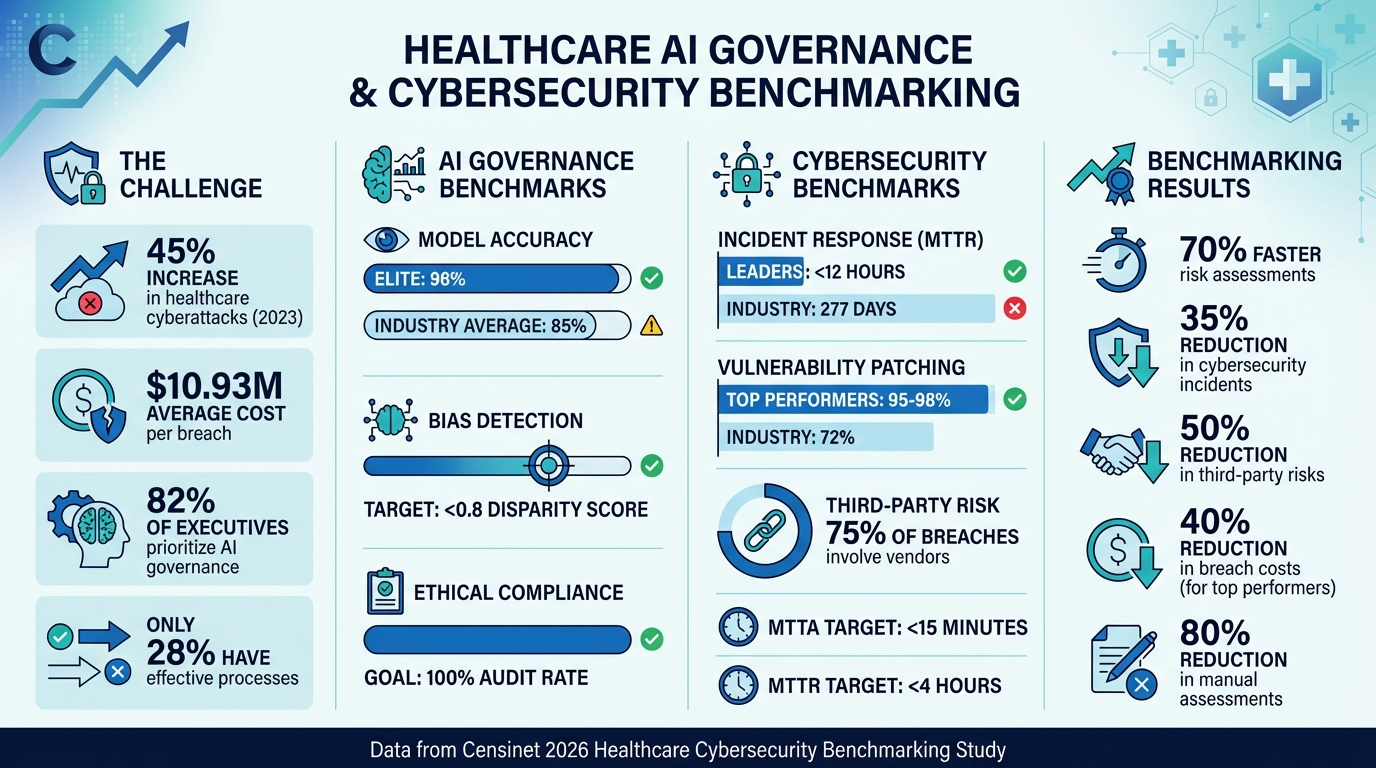
Cyberattacks in healthcare are rising, with a 45% increase in 2023 alone, costing an average of $10.93 million per breach. Despite 82% of healthcare executives prioritizing AI governance, only 28% have effective processes in place. This gap leaves patient data exposed and compliance efforts lagging.
Benchmarking offers a clear path forward. By comparing performance against industry standards, healthcare organizations can identify vulnerabilities, improve response times, and align with regulations like HIPAA and HITECH. For example, leaders like Cleveland Clinic resolve incidents in under 12 hours, significantly reducing breach costs. Tools like Censinet RiskOps™ simplify the process, enabling faster risk assessments and better vendor management.
Key Takeaways:
- AI Metrics: Top-tier AI models achieve 95%+ accuracy and ensure fairness with bias detection tools.
- Cybersecurity Metrics: Industry leaders maintain under 4-hour incident response times and 95%+ vulnerability patching rates.
- Benchmarking Benefits: Organizations using platforms like Censinet report 70% faster risk assessments and a 35% reduction in cybersecurity incidents.
Benchmarking transforms healthcare's approach to AI and cybersecurity, shifting from reactive fixes to proactive safeguards. Start by setting measurable KPIs, using tools to automate data collection, and regularly re-evaluating progress to stay ahead of risks.
Healthcare AI and Cybersecurity Benchmarking: Key Metrics and Performance Standards
The Healthcare Cybersecurity Benchmarking Study Wave 3
sbb-itb-535baee
Key Performance Indicators for AI and Cybersecurity
Tracking the right metrics can set proactive organizations apart from those that simply react to issues. In healthcare, leaders need measurable KPIs that align with established frameworks like the NIST Cybersecurity Framework 2.0, Healthcare and Public Health Cybersecurity Performance Goals (HPH CPGs), and the NIST AI Risk Management Framework (RMF). Matt Christensen, Sr. Director GRC at Intermountain Health, emphasizes this complexity:
"Healthcare is the most complex industry... You can't just take a tool and apply it to healthcare if it wasn't built specifically for healthcare." [6]
Let’s dive into the essential metrics for AI governance and cybersecurity risk management.
AI Governance Metrics
AI model accuracy is a cornerstone for safe deployment. It’s calculated as (True Positives + True Negatives) / (Total Predictions). Top-tier benchmarks aim for over 90% accuracy in imaging and 95%+ in diagnostic applications. According to HIMSS, elite organizations achieve 96% accuracy, compared to the industry average of 85% [13].
Bias detection scores play a crucial role in ensuring fairness in patient care. Disparity metrics, like demographic parity, can be measured using tools such as IBM AI Fairness 360 or Google's What-If Tool. The goal is to minimize outcome variations across race and gender, targeting a difference of less than 0.8 to comply with OCR guidelines on algorithmic discrimination [9]. Additionally, the ethical compliance rate tracks how many AI systems are audited for fairness. Organizations should aim for 100% compliance with HIPAA and FDA guidelines through regular reviews [7][8].
Cybersecurity Risk Indicators
Third-party risk scores are vital since 75% of healthcare breaches involve vendors, highlighting the need for collaborative risk management. These scores are calculated using security questionnaires and continuous monitoring, weighted as 40% security posture, 30% compliance, and 30% incident history, on a 1–10 scale. Vendors are classified as low risk (<4), medium risk (4–7), or high risk (>7).
Incident response times are another critical metric. The goal is to keep Mean Time to Acknowledge (MTTA) under 15 minutes and Mean Time to Resolve (MTTR) under 4 hours. While the 2024 Verizon DBIR reports an average MTTR of 277 days, leaders like Cleveland Clinic resolve incidents in under 12 hours, cutting breach costs by 40% - a significant improvement given the average breach cost of $10.1 million.
Vulnerability patching rates measure how effectively vulnerabilities are addressed within agreed timelines. HHS OCR data shows top organizations achieving 95% compliance, compared to the 72% industry average. Some, like Mayo Clinic, reach 98% through automation [10][11][12].
Using Censinet RiskOps™ for Benchmarking
Healthcare organizations need tools to transform complex risk data into actionable benchmarks. Censinet RiskOps™ simplifies this by aggregating real-time data from over 50,000 vendors and products across its collaborative risk network. This allows organizations to measure their performance against industry standards and peers with ease [6]. By automating the benchmarking process, the platform reduces manual assessments by 80%, enabling teams to dedicate more time to strategic initiatives [1]. These capabilities lay the groundwork for stronger cybersecurity and AI risk management, as detailed in the sections below.
Brian Sterud, CIO at Faith Regional Health, and Terry Grogan, CISO at Tower Health, have praised the platform’s impact. Sterud explains:
"Benchmarking against industry standards helps us advocate for the right resources and ensures we are leading where it matters." [6]
Grogan adds:
"Censinet RiskOps allowed 3 FTEs to go back to their real jobs! Now we do a lot more risk assessments with only 2 FTEs required." [6]
Organizations using the platform have reported impressive outcomes: 70% faster risk assessments, a 50% reduction in third-party risks, and a median cybersecurity score of 72/100 based on data from over 10,000 assessments [4,6]. Tasks that used to take weeks are now completed in under 10 days, with some organizations achieving over 400% productivity gains [14].
Cybersecurity Benchmarking Capabilities
The platform’s anonymous peer benchmarking feature allows organizations to compare their risk scores, questionnaire responses, and validation rates against data from more than 5,000 members [15]. Using standardized frameworks like SIG and NIST, organizations can identify vulnerabilities such as weak vendor controls or outdated patching practices.
Automated scoring and visual dashboards provide a clear view of key metrics, including cyber risk ratings on a 1–100 scale, while issuing continuous alerts for deviations from HIPAA compliance [2,5]. One large U.S. health system leveraged these tools to benchmark over 500 vendors, improving average risk scores from 65 to 85 in just six months by prioritizing remediation for underperforming vendors [16]. Another hospital network used phishing simulation benchmarks to achieve top-quartile resilience.
The Risk Register consolidates all assessment findings, tracking both third-party and enterprise risk remediation efforts. Meanwhile, the Cybersecurity Data Room™ facilitates secure sharing of risk data with 1‑Click Assessments™ [14]. Organizations can create custom benchmarks, monitor their progress over time, and analyze trends to see how their security posture evolves compared to industry peers.
AI Risk Management with Censinet AI
Censinet’s platform extends its benchmarking expertise to AI governance as well. Censinet AI brings precision to AI risk management by automating validation processes that scan documents and AI outputs for compliance [4,6]. With 95% accuracy, the system flags issues like data privacy violations, reducing review times from weeks to hours and generating audit-ready reports. This enables organizations to compare their validation completeness rates with peer institutions.
AI risk dashboards provide real-time insights into metrics such as model accuracy drift, fairness scores, and regulatory compliance status, all benchmarked against industry averages [18,5]. Users can filter data by peer groups - like hospitals versus insurers - and dive into analytics to pinpoint specific areas for improvement. According to Censinet's 2026 Healthcare Cybersecurity Benchmarking Study, 40% of healthcare AI deployments exceed peer risk thresholds, highlighting areas that require governance attention [4,6].
The platform also aligns with the NIST AI Risk Management Framework, helping organizations assess and compare AI risks across various deployments [17,19]. Censinet TPRM AI™ streamlines evidence summarization for vendor AI systems by capturing IT integration data and generating executive-level assessment reports. Advanced routing ensures that key findings reach the appropriate stakeholders, such as AI governance committees, for timely resolution [6].
These benchmarking tools empower organizations to quantify their performance and drive continuous improvements in both cybersecurity and AI governance. By leveraging peer data, healthcare providers can enhance incident response and improve risk scores, ultimately strengthening their overall security and governance frameworks.
How to Implement Benchmarking Frameworks
Turning benchmarking capabilities into actionable strategies means taking data and using it to drive measurable improvements. For healthcare organizations, this involves moving from planning to execution, focusing on tangible results in areas like cybersecurity and AI risk management.
Step-by-Step Benchmarking Process
Start by setting clear goals and choosing benchmarks from trusted industry frameworks. For AI governance, prioritize metrics that can be measured, such as model validation timelines, bias detection rates, and adherence to the NIST AI Risk Management Framework.
Tools like Censinet Connect™ simplify the process of integrating data. With pre-built connectors to systems like electronic health records (EHRs), AI platforms, and security tools, this platform automates data collection and maps it to healthcare-specific metrics. Using standardized US formats, it ensures consistency across benchmarking activities. Organizations can select benchmarks like HIPAA compliance scores or AI fairness thresholds (e.g., a target score above 0.9). Peer-group filtering also allows comparisons with hospitals of similar size, making benchmarks more relevant.
Interactive dashboards in command centers are key to identifying performance gaps. These dashboards highlight areas needing attention, while trend charts track metrics like quarterly cybersecurity maturity scores against national benchmarks. For example, gap analysis tools can compare encryption targets (e.g., 99.9%) against peer performance, helping organizations quickly pinpoint and address weaknesses.
Real-world examples show the impact of benchmarking. Intermountain Healthcare used Censinet RiskOps™ to improve its third-party cyber risk posture, climbing from the 40th to the 85th percentile within six months. By prioritizing 150 high-risk vendors with the help of Connect™ data sharing and gap analysis, they were able to avoid potential breach costs of $5 million. Similarly, Mayo Clinic enhanced its AI governance in 2023, raising its maturity score from 2.8 to 4.2 on a 5-point scale in just nine months. This was achieved through automated model audits and peer comparisons, resulting in 95% compliance with the NIST AI Risk Management Framework.
Once gaps are identified - like slower patch deployment times compared to leading benchmarks - organizations can create prioritized action plans. For instance, a mid-sized US hospital discovered a 15% gap in AI governance when comparing its model validation cycle of 45 days against the industry median of 30 days. Using command center visualizations, they identified the issue and implemented workflow automation, cutting the cycle time to 28 days.
With well-defined benchmarks and focused actions, healthcare organizations can keep improving their risk management practices.
Tracking Continuous Improvement
Automated workflows in Censinet RiskOps™ make benchmarking a part of daily operations. The platform sends alerts if performance falls below benchmarks - like cybersecurity patch compliance dropping under 95% - and automatically assigns tasks to address the issue. Dashboards then monitor progress, showing improvements such as an increase in risk mitigation rates from 75% to 92% over six months.
Healthcare organizations should also schedule bi-annual reviews using Censinet's reporting tools. These reviews help track key performance indicators (KPIs) like the mean time to detect cyber threats, aiming for less than 24 hours. By comparing current performance to updated benchmarks, adjusting frameworks to meet new regulations, and documenting progress - such as a 25% reduction in detection time for audits - organizations can stay aligned with changing standards.
Gartner experts suggest focusing on five to ten core KPIs to keep teams from feeling overwhelmed. Leveraging Censinet AI for predictive gap analysis can also help forecast potential risks. Involving cross-functional teams - including IT, compliance, and clinical departments - during reviews can increase adoption rates by 40%. This collaborative approach ensures that benchmarking insights lead to real, measurable improvements across the organization.
Case Studies: Benchmarking Success in Healthcare
Building on earlier discussions of benchmarking metrics and frameworks, these case studies showcase how structured benchmarking leads to measurable progress in healthcare. According to Censinet's 2026 healthcare benchmarking study, organizations leveraging benchmarking achieved impressive results: a 35% average reduction in cybersecurity incidents and a 28% improvement in AI governance compliance scores. By comparing their performance with over 150 peers, participants identified critical gaps and implemented targeted improvements.[1][15] Let’s explore how HealthNet and AIHealth used benchmarking to drive operational and governance advancements.
Improving Cyber Resilience
HealthNet, a mid-sized U.S. hospital network, adopted a four-step approach using Censinet RiskOps™. They began with a baseline risk assessment and then evaluated their performance on 20 key indicators, such as patch deployment time, against peer organizations. After identifying gaps, they focused on remediation efforts and conducted quarterly re-benchmarking to monitor progress.[2][3]
This strategy led to a 25% reduction in third-party cyber risks and an 18% improvement in operational efficiency, measured by faster threat detection and remediation times. Within six months, their resilience score surpassed the industry median by 15 percentile points, and they achieved 42% faster threat response times.[15][5]
HealthNet placed a priority on managing third-party vendor risks, integrated benchmarking into board-level reporting for sustained leadership support, and automated data feeds into RiskOps™. This automation cut manual data collection by 60%, allowing the team to focus on high-impact initiatives.[1][3] These outcomes highlight how focused benchmarking can reshape cybersecurity strategies in healthcare.
Improving AI Governance
AIHealth, a large academic medical center, utilized the Censinet AI module to benchmark its AI governance practices. They evaluated 15 AI models against standards like the NIST AI Risk Management Framework, compared their governance maturity to over 200 peers, and introduced oversight dashboards for real-time compliance tracking.[2][4]
The results were striking: AIHealth's AI risk oversight scores jumped from 62% to 91%, outperforming the industry median of 74%. Non-compliant AI deployments were reduced by 40%, and the organization achieved top-quartile performance in transparency and bias mitigation metrics, showcasing significant progress in ethical AI auditing.[15][5]
"Benchmarking shifts healthcare from reactive to proactive excellence, as seen in 2026 data where top performers cut risks 2x faster", noted Censinet's Chief Risk Officer, who emphasized the value of peer anonymity in fostering actionable insights.[4][17]
This case study revealed three key takeaways: starting with high-risk AI applications like diagnostic tools, combining quantitative benchmarks (e.g., model accuracy drift) with qualitative peer reviews, and creating cross-functional teams to ensure scalability and regulatory alignment with frameworks like HIPAA.[1][3] Both HealthNet and AIHealth demonstrated that iterative benchmarking cycles, supported by data visualization in RiskOps™, led to an average 30% improvement in performance metrics.[2][15] AIHealth’s success underscores the importance of benchmarking in advancing AI governance and ethical compliance in healthcare.
Conclusion
Throughout our discussion on measurable KPIs and streamlined workflows, it’s clear that a strong benchmarking strategy can reshape your approach to cybersecurity. Benchmarking shifts the focus from reactive problem-solving to proactive performance improvement. By comparing your performance against industry standards, healthcare organizations can pinpoint areas for growth, strengthening both patient data protection and operational resilience.
With ransomware threats and AI-driven vulnerabilities becoming more sophisticated, older methods just can’t keep up. That’s where Censinet RiskOps™ comes in - offering an automated benchmarking system that evaluates your security posture with precision [6].
Experts in the field highlight how benchmarking helps organizations allocate resources more effectively and sharpen leadership priorities. Many who’ve adopted the platform have reported notable operational gains, including reduced assessment workloads and improved efficiency. This means teams can redirect their energy toward strategic goals that truly matter.
Start by reviewing your healthcare cybersecurity benchmarking metrics, setting clear baselines, and scheduling regular benchmarking updates. This methodical, data-driven approach ensures ongoing progress and compliance. In a healthcare landscape filled with challenges, having a tailored solution is essential to safeguarding patient trust, meeting regulatory demands, and driving continuous improvement. The real question isn’t whether to benchmark - it’s how quickly you can start focusing on what truly counts.
FAQs
Which 5–10 KPIs should we benchmark first?
When it comes to evaluating healthcare cybersecurity and AI governance, certain key performance indicators (KPIs) are essential for measuring performance and identifying areas for improvement. Some of the most important metrics include:
- Mean Time to Contain (MTTC): This measures how quickly threats are contained after detection, reflecting the efficiency of your response processes.
- Patching Cadence: Tracks how consistently and promptly systems are updated to address vulnerabilities.
- Compliance Success Rates: Indicates how well your organization meets regulatory and industry standards.
- Multi-Factor Authentication (MFA) Coverage: Shows the extent to which MFA is implemented across systems, a critical step for securing access.
- Incident Response Time: Evaluates how fast your team responds to security incidents.
- Breach Detection and Reporting Time: Measures how quickly breaches are identified and reported, which is crucial for minimizing damage.
- AI Model Metrics: Includes accuracy, precision, recall, and AUC-ROC, which are vital for assessing the performance and reliability of AI systems in healthcare.
- Framework Alignment: Ensures adherence to established guidelines like NIST CSF 2.0 and the HHS Cybersecurity Performance Goals.
These KPIs serve as a solid framework for tracking progress, identifying weaknesses, and guiding strategic improvements in both cybersecurity and AI governance.
How do we pick fair peer benchmarks for our organization?
When choosing fair peer benchmarks in healthcare, it's crucial to focus on organizations that share similarities in size, scope, and operations. This ensures you're comparing apples to apples. Use established tools like the NIST Cybersecurity Framework and reference industry studies to guide your evaluation process. Look at comparable entities, such as hospital systems or healthcare providers operating on a similar scale.
It's also important to factor in your organization's maturity level. This helps ensure that the benchmarks you select are not only relevant but also practical for your current stage of development. At the same time, they should encourage ongoing progress and improvement.
How often should we re-benchmark and report results?
Benchmarking is most effective when carried out on a regular basis. Many healthcare organizations aim to perform assessments at least once a year. This approach helps maintain a steady focus on improvement and ensures performance stays in line with up-to-date standards.
