
One weak link can delay care, block repairs, or put patients at risk. From sole-source parts to supplier cyberattacks, this article shows that medical device supply chain risk is no longer just a purchasing issue.
If I had to boil it down, the article makes three core points:
- The biggest risks are connected. A hidden sub-tier supplier, an unpatched firmware library, or a factory quality failure can all lead to the same result: device downtime and patient harm.
- Some risks need action now, not later. The fastest-moving threats are counterfeit parts, supplier cyber incidents, unpatched software, and poor response coordination.
- Teams that recover faster usually prepare before the event. That means SBOMs, BOM traceability, backup suppliers, stock thresholds, vendor disclosure rules, and clear owner handoffs.
The article covers 10 high-risk failure points:
- Single-source critical components
- Limited third-party vendor risk management and visibility beyond tier one
- Counterfeit or tampered components
- Unpatched software and firmware dependencies
- Weak vendor vulnerability disclosure
- Manufacturing quality and validation failures
- Logistics disruption and inventory shortages
- Geopolitical and regulatory shocks
- Cyberattacks on suppliers and service providers
- Poor incident response coordination across the device lifecycle
A few facts stand out right away:
- 48% of respondents in one OECD finding pointed to shortages of parts, components, or accessories.
- Only 21% of HDOs report high visibility past primary vendors.
- One study found a 3.2-year average gap between device purchase and public vulnerability disclosure.
- About 60% of healthcare organizations have faced a third-party cyber disruption.
Quick Comparison
| Risk | Main harm | First move |
|---|---|---|
| Single-source parts | Production stops | Check affected devices, use backup stock or substitutes |
| Hidden sub-tier suppliers | Slow root-cause work | Map BOM/SBOM exposure |
| Counterfeit or tampered parts | Device failure, wrong readings, therapy risk | Quarantine and trace serials |
| Unpatched software/firmware | Fleet-wide cyber exposure | Identify versions and isolate if needed |
| Weak disclosure | Late response | Validate exposure and apply network controls |
| Manufacturing failures | Defects across lots | Quarantine lots and trace UDIs |
| Logistics shortages | Delays and substitutions | Triage inventory and shift supply |
| Geopolitical/regulatory shocks | Loss of approved supply | Rank affected services and qualify alternates |
| Supplier cyberattacks | Ordering, support, and updates fail | Restrict access and assess bedside impact |
| Poor coordination | Slow, broad containment | Activate shared response roles through a collaborative RiskOps approach |
Bottom line: this article is about where device supply chain security challenges occur most often and what teams should do first when they do.
sbb-itb-535baee
1. Single-Source Critical Components
A single-source critical part creates a plain, hard risk: one disruption can stop production. And switching to another source usually isn’t fast. Testing, validation, and regulatory review can take 6 to 24 months.[4] In medical devices, that delay can turn a supply problem into a patient-care problem fast, because replacement devices and parts move through a slow, tightly controlled process.
This risk isn’t rare. Shortages still show up again and again. The OECD found that 48% of respondents pointed to shortages of components, parts, or accessories.[2] FDA shortage lists also still include key device supplies.[3]
A recent example made that risk very concrete. In September 2024, Hurricane Helene shut down Baxter International's North Cove facility in Marion, North Carolina. That single site produced most U.S. IV fluids.[2] Hospitals had to move to conservation protocols, while manufacturers leaned on emergency imports from Baxter plants in Ireland, the UK, and Canada to help restore supply.[2]
The fallout usually hits four areas: patient safety, operations, detection speed, and lifecycle control.
Patient Safety Impact
When a sole-source component is delayed or compromised, clinicians can end up in a tough spot. They may need to defer treatment, switch to another device, or rely on temporary workarounds. If the part is something like a specially sourced sensor, battery, or firmware-dependent chip, the device may no longer operate within its validated specifications. That can increase the chance of treatment interruption or incorrect therapy delivery.
Operational Continuity Impact
For manufacturers, a sole-source failure can halt production and drive up expedited sourcing costs. For HDOs, the effect shows up as fewer devices available for use and slower repairs. In plain terms, equipment sits idle longer, and that puts more pressure on staff and inventory.
Detection and Containment Speed
Single-source failures are often found late, which makes early response even more important. The first move is to map the problem fast: identify the affected part, the device population, and the safety impact.
From there, teams may need to:
- Pause use or shipment if needed
- Activate alternate inventory or approved substitutes
- Notify internal leadership and clinical stakeholders
- Document the event and any required regulatory action
Use FDA 506J reporting when a disruption may cause a meaningful U.S. shortage.[5]
Lifecycle Control Maturity
Organizations with strong lifecycle controls don’t treat single-source dependency as a one-time sourcing issue. They treat it as a risk that needs attention from design through supply monitoring.
That usually means putting a few guardrails in place early:
- Qualify at least two suppliers for each critical component before design is frozen
- Keep safety stock for long-lead sole-source items
- Pre-qualify alternate suppliers before a disruption happens
- Add "Right to Audit" and mandatory notification clauses to supplier contracts
It also helps to map the full bill of materials (BOM) to find Tier 2 and Tier 3 dependencies. That matters because two suppliers that look separate on paper may still depend on the same sub-tier source. If you don't see that upstream link, the risk stays hidden until something breaks. Censinet RiskOps™ can help HDOs and vendors centralize third-party risk assessments and track supply-chain dependencies across the device lifecycle. This visibility is a core component of how organizations effectively manage third-party risk to ensure operational resilience.
2. Limited Supplier Visibility Beyond Tier One
Even dual sourcing can fall apart when hidden sub-tier dependencies stay out of view. For many teams, visibility stops at tier one. That leaves a blind spot where upstream defects, weak points, and single points of failure can sit unnoticed until they show up in finished devices.
The problem runs deeper than direct vendors. Tier-two, tier-three, and other upstream suppliers often stay hidden, even when they provide critical raw materials, components, software libraries, or services. When that happens, response gets slower, broader, and far more reactive.
Patient Safety Impact
A sub-tier change can slip past quality controls and lead to material drift, calibration errors, or firmware issues that later show up as device malfunction. In practice, that can mean a biocompatibility problem, sensor drift, or critical medical device security risks that leaves a device open to exploitation.
Only 21% of HDOs report having high visibility into their medical device supply chain beyond their primary vendors.[8]
Operational Continuity Impact
Sub-tier failures are often slow to diagnose. Without bill of materials traceability, root-cause analysis can take days or even weeks. That's a long time when devices are already in use.
During that period, manufacturers may need to quarantine large groups of devices. Hospitals, meanwhile, may have to cancel procedures or rely on backup equipment for longer than planned.
Detection and Containment Speed
Once a team traces the issue to a sub-tier source, speed matters. They need a clear sequence of action without wasting time on basic discovery work.
- Detect: Identify whether the incident - device failures, unexpected performance, or a new vulnerability advisory - could link back to a sub-tier component or software dependency.
- Scope: Cross-reference hardware and software bills of materials against affected device models, lot numbers, and clinical sites.
- Escalate: Use defined escalation paths through tier-one vendors to request production records, change logs, and vulnerability data.
- Contain: Quarantine affected devices, apply compensating network controls, or switch to vetted alternatives while root cause analysis continues.
- Remediate: Test fixes, roll them out under monitoring, then update risk assessments and supplier oversight criteria.
Frameworks like NIST SP 800-161 and the Health Industry Cybersecurity Supply Chain Risk Management (HIC-SCRiM) guide give teams a structure for this kind of response.[6][7] Censinet RiskOps™ supports this process by centralizing supplier risk data and enabling collaborative risk management between HDOs and vendors, so teams spend less time figuring out where the issue started and more time containing it.
Lifecycle Control Maturity
The teams that move fastest during sub-tier incidents usually started long before the incident itself. They didn't wait for a failure to begin mapping the chain.
Mature programs often require tier-one vendors to:
- maintain and share lists of their own critical sub-suppliers
- submit machine-readable SBOMs
- report major upstream changes within a set time frame
For safety-critical components, mandatory sub-tier disclosure and change-notification clauses push that accountability deeper into the supply chain. The aim is simple: spot sub-tier risk before it reaches the clinic.
3. Counterfeit or Tampered Components
When supplier visibility is limited, counterfeit or tampered parts can slip past normal controls. They may enter through unauthorized sourcing channels, compromised logistics providers, or nonapproved service work. Shortages and urgent replacement orders make this problem worse.
Patient Safety Impact
The failure modes here are direct and serious. Counterfeit batteries in cardiac implantable electronic devices can drain faster than expected, which can interrupt pacing or defibrillation. Nonapproved flow sensors in infusion pumps can miscalculate dose rates for drugs like insulin or chemotherapy.
Once a bad part gets into circulation, the damage doesn't stay limited to one device.
Operational Continuity Impact
When a counterfeit or tampered component is confirmed, the response usually spreads far beyond a single repair. HDOs may need to pull entire device fleets from service for serial-number checks, shift biomedical engineering staff away from other work, and delay or cancel elective procedures. Emergency replacement parts may also cost more.
Detection and Containment Speed
Detection is often slow because many problems show up only during field failures or through trend analysis. A practical response sequence looks like this:
- Detect and verify anomalies, UDI mismatches, or procurement issues
- Quarantine affected devices and inventory
- Trace provenance with serial numbers, part markings, and firmware checks
- Report, replace, and block further procurement from the implicated source
Censinet RiskOps™ can support this process by centralizing supplier risk data and linking it to device inventories, which helps teams move from detection to containment with less delay. The response starts with provenance, quarantine, and removal from service.
Lifecycle Control Maturity
Mature programs screen parts before purchase and maintain traceability from sourcing through service. The same BOM and supplier traceability used for sub-tier visibility can also help teams spot suspect parts faster.
That includes formal supplier due diligence, approved and authenticated suppliers, traceability through serial numbers and UDIs, and incoming inspection for counterfeit markings, performance anomalies, or tampered firmware. In the field, configuration management and asset inventories should connect devices to parts, suppliers, and firmware versions, and repairs should require OEM or approved-equivalent parts.
For higher-risk components sourced outside franchised distributors, X-ray inspection, decapsulation, and automated optical inspection can help catch internal inconsistencies before a device reaches the clinic. The aim is simple: verify parts before they reach production or patient care.
4. Unpatched Software and Firmware Dependencies
Medical devices run on embedded software and third-party code. The problem is simple: some of that code ships with known flaws, and patching devices already in use is often slow. If a team doesn’t have a clear software inventory, they can’t tell which deployed devices are exposed or fix them fast. At that point, patching stops being just a device issue. It becomes a supply-chain issue too.
A well-known case came in July 2019, when researchers found Urgent/11, a group of 11 critical vulnerabilities in the VxWorks real-time operating system TCP/IP stack. Urgent/11 exposed 11 critical flaws in VxWorks and showed how a single unpatched dependency can hit many deployed devices at the same time. That was the core danger: one shared dependency flaw spread across fleets. Once that kind of dependency is buried across devices, the patient risk depends on where the flaw ends up.
Patient Safety Impact
An unpatched flaw in firmware or embedded software can do far more than expose data. It can interrupt monitoring, delay alerts, or make therapy devices less reliable right when clinicians need them most.
Operational Continuity Impact
Once a device is confirmed as vulnerable, teams often isolate it or limit its network access before any exploit even happens. That may be the right move, but it comes at a cost. Workflows slow down, procedures get delayed, and biomedical teams can end up stuck in containment mode instead of normal support work.
Detection and Containment Speed
Detection starts with one basic question: What is actually inside each device? Without a Software Bill of Materials (SBOM), HDOs often don’t find out about a vulnerable dependency until a CVE becomes public or a vendor sends an advisory. A practical response usually looks like this:
- Identify affected models, firmware, and components from SBOM data.
- Assess clinical criticality and isolate exposed devices.
- Apply compensating controls, then deploy and validate vendor patches.
- Document the incident and update response playbooks.
Censinet RiskOps™ can help centralize third-party risk data and device exposure tracking, helping teams connect vendor advisories with deployed device inventories and move faster from identification to remediation.
Lifecycle Control Maturity
Firmware patching moves slower than IT patching. Updates often need revalidation, scheduled downtime, or direct vendor support. So mature programs don’t sit back and wait for a flaw to show up in the news. They build monitoring into the device lifecycle from the procurement stage onward.
In practice, that means requiring SBOMs during procurement, checking components against the CISA Known Exploited Vulnerabilities (KEV) catalog on a set cadence, defining patch SLAs based on clinical criticality, and keeping compensating controls in place for devices that can’t be updated fast. SBOM-driven programs described in FDA guidance support continuous CVE, KEV, and supplier-advisory monitoring [10]. That steady rhythm replaces ad hoc patching with continuous visibility across the full device lifespan. And when vendors are slow to disclose issues, response slows down at exactly the moment the next risk starts to build.
5. Weak Vendor Vulnerability Disclosure Processes
When a vendor sits on a vulnerability, HDOs lose time they can't get back. That time matters because teams need it to isolate affected devices, put controls in place, and alert clinicians. If the vendor doesn't have a clear way to receive, triage, and share the issue, the details can get delayed, buried, or hit the public before HDOs have a chance to respond. At that point, the risk doesn't stay in one lane. It spills into procurement, service operations, and bedside care. In plain terms, disclosure speed sets the pace for incident response.
This happens more often than it should. One study found a 3.2-year average gap between device purchase and public vulnerability disclosure [19]. Since March 29, 2023, manufacturers of devices covered by Section 524B have been required to include a coordinated vulnerability disclosure plan in premarket submissions [11][9]. Even with that rule in place, many vendors still don't offer a public intake channel, a set acknowledgment timeline, or a mature PSIRT. So HDOs often hear about device flaws from CISA advisories or media reports instead of from the vendor itself [12][15].
Patient Safety Impact
When disclosure is late or missing, clinical teams have no clear signal to act on. A flaw in an infusion pump, ventilator, or implantable device can sit there with no network segmentation, no usage limits, and no extra monitoring simply because no one in the HDO knows the issue exists. And the longer that window stays open, the more likely it is that a cyber event turns into disrupted therapy or incorrect device behavior at the bedside.
Operational Continuity Impact
Weak disclosure also slows risk triage. Without a formal vendor advisory, biomedical and security teams can't sort device risk with confidence, plan maintenance windows, or build response runbooks. Then the worst-case scenario shows up: a serious flaw becomes public with no warning. HDOs may have to react with emergency shutdowns, unplanned device recalls, or broad network restrictions. That can hit scheduling, procedure volume, and elective services all at once.
Detection and Containment Speed
Detection gets much slower when vendors don't provide CVE identifiers, CVSS scores, or exact affected version numbers. Without that data, IT teams are stuck doing manual checks across thousands of assets just to figure out what is exposed.
If vendor disclosure is weak or absent, a practical response sequence looks like this:
- Validate exposure internally, document vendor outreach, and escalate to CISA or Health-ISAC if the vendor does not respond; these groups can help drive broader awareness and formal vulnerability identification [12][14].
- Apply compensating controls by moving affected devices to a restricted VLAN, disabling unnecessary ports, and enforcing strict access control lists.
- Notify clinical staff and, if the vulnerability allows unauthorized setting changes, require manual verification of device parameters before patient use.
- Feed results into vendor risk scoring after closure, using platforms like Censinet RiskOps™ to track disclosure responsiveness over time and link vendor advisory data with deployed device inventories.
Lifecycle Control Maturity
More mature programs include a public intake channel, acknowledgment SLAs, and disclosure aligned with ISO/IEC 29147 and 30111 [16][17]. Procurement contracts should also require vendors to notify the HDO about any vulnerability that affects safety, performance, or security, and to coordinate disclosure timing and content with customers and researchers. These requirements map to NIST SP 800-53 controls PM-15, IR-06, IR-07, and SI-05 [13][18]. They also give HDOs a clearer way to reduce dependence on vendors whose disclosure processes are still underdeveloped. When disclosure is weak, downstream containment often comes down to manual verification and stopgap controls.
6. Manufacturing Quality and Validation Failures
Not every supply chain incident starts with software or sourcing. Some start right on the production line. A device may be well designed and still fail if manufacturing was never validated, drifts out of control, or changes without requalification. That matters because quality escapes and validation failures are not the same risk, and either one can lead to a Class I recall.[20][25]
The 2021 Philips Respironics recall, which affected about 15 million devices, is a clear example of how one validation failure can turn into a remediation effort that lasts for years.[20]
Patient Safety Impact
When manufacturing controls break down, the harm shows up in ways that are painfully direct: inaccurate readings, interrupted therapy, infection risk, or mechanical failure.
A study of a heart failure pacemaker recall using FDA MAUDE data tied battery failures to 1 death, 1 cardiac arrest, 5 syncopal attacks, and 6 heart failure exacerbations before the recall went out.[24] That’s the hard part with production defects. A small shift in a process can spread across thousands of units before anyone spots it.
Operational Continuity Impact
These events don’t stay contained inside the plant. They spill into operations fast.
Organizations may have to quarantine inventory, find backup supply on short notice, delay procedures, stop production lines, rework product, scrap product, and notify customers. In 2023, certain plastic syringes distributed by Cardinal Health were recalled after failing to meet performance specifications. That forced HDOs to move to other suppliers, which put immediate strain on clinical workflows, staff training, and purchasing.
Detection and Containment Speed
When manufacturing quality starts slipping, speed matters. The first line of defense is fast lot traceability and quarantine.
Common warning signs include:
- rising nonconformances
- failed inspections
- repeated complaints
- yield drops
- lot-record mismatches
Response should focus on a few direct actions:
- Identify and quarantine affected lots at once, including inventory held by distributors and HDOs.
- Assess patient exposure by tracing units through UDI records to specific facilities and, when possible, to individual patients.
- Perform root-cause analysis to find out whether the issue came from process settings, equipment drift, supplier components, or gaps in change control.
- Implement corrections and CAPA, then verify the fix before full release resumes. FDA’s CAPA guidance states that corrective actions must be verified or validated to confirm they work and do not create new risks.[23]
- Update Device Master Records, procedures, validation protocols, and training materials, and report to FDA if the event meets MDR thresholds.
Lifecycle Control Maturity
Under 21 CFR 820 and the newer Quality Management System Regulation (QMSR), which aligns U.S. expectations with ISO 13485, manufacturers must validate any process that cannot be fully checked by inspection, revalidate after major changes, and expect the same from critical suppliers.[21][22]
That expectation should show up in procurement contracts too. Those agreements should require validation evidence, ISO 13485 practices, and documented CAPA and complaint handling.
Even when manufacturing has been validated, failures can still happen later if logistics or inventory controls fall apart.
7. Logistics Disruption and Inventory Shortages
A device can be well designed and properly made and still not reach the patient in time. That's the hard truth. Transportation breakdowns, warehouse failures, port congestion, and inventory gaps can block a critical device at the worst possible moment. The FDA notes that medical device shortages can be triggered by natural disasters, transportation delays, public health emergencies, and other supply chain shocks. This is not the same as a sourcing failure. Here, the product exists, but the route to the bedside falls apart.
Patient Safety Impact
The harm to patients usually shows up in three ways: delay, substitution, and less backup capacity.
When devices don't arrive, procedures may be delayed or canceled. Clinicians may have to switch to a device they don't know as well, which adds error risk because the interface or handling is different. For high-dependency devices like ventilators, infusion pumps, and dialysis equipment, even a short supply gap can strip away the backup hospitals count on during demand spikes.
Operational Continuity Impact
Logistics failures hit operations fast, and they hit from more than one angle.
Canceled procedures cut into revenue. Emergency freight and spot buys push per-case costs up right away. Staff lose hours hunting for options instead of caring for patients. In severe cases, HDOs may need to trigger emergency policies, update consent for substitute devices or delayed procedures, and work with regional partners just to keep care moving.
Detection and Containment Speed
Once supply is disrupted, the response can't stop at checking inventory. It has to shift straight into clinical prioritization.
The response sequence should move through these steps without delay:
- Detect and triage: Confirm the disruption and classify its severity - what devices are affected, how critical they are to patient care, and how long the gap is expected to last.
- Map clinical impact and activate response: Identify which procedures, patient populations, and care settings depend on the affected devices. Bring in supply chain, clinical leadership, biomedical engineering, and risk management. Predefined playbooks speed this up.
- Execute mitigation: Validate clinically acceptable substitutes, move inventory from lower-acuity sites, look at alternate suppliers, and adjust procedure schedules.
- Communicate and monitor: Notify clinicians and, where needed, patients - with clear guidance on substitution protocols and care pathway changes. Track inventory levels and logistics status as conditions change.
Platforms like Censinet RiskOps™ support this work by centralizing third-party risk data, incident history, and remediation commitments. That helps HDOs spot which suppliers can offer alternate products or expedited shipments with risk profiles the organization can accept.
Lifecycle Control Maturity
Strong programs prepare for logistics disruption before it starts. High-risk device categories need defined safety stock, alternate logistics routes, and tested disruption playbooks. More mature organizations keep safety stock for life-sustaining devices and consumables, diversify across at least two logistics providers with different regional strengths, and run regular stress tests against disruption scenarios.
They also align logistics risk management with NIST CSF ID.SC (Supply Chain Risk Management) and ISO 22301 business continuity controls. In practice, that means inventory policies, contingency logistics plans, and incident response procedures are formally documented, tested, and updated after every major disruption.
At this level, vendor contracts also include resilience requirements. Escalation triggers are set when days of supply for critical devices drop below defined thresholds, turning an inventory warning into a coordinated clinical response before the shortage reaches the bedside.
8. Geopolitical and Regulatory Shocks
Supply chains don’t break only at the warehouse or factory level. Tariffs, export controls, and rule changes can shut off access to critical devices just as fast. When that happens, devices may become unavailable, cost more, or fall out of compliance. These events should trigger the same incident-response flow used for shortages or cyber events: triage, substitution, escalation, and communication.
The source may be different, but the result is the same. A policy shift overseas or a new rule in Brussels or Washington can block access to a critical device as fast as a factory fire. U.S.-China trade tensions have pushed tariffs on syringes and needles to 50%, and on medical gloves and face masks to 25%.[31] China’s 2025 rare earth export controls apply even when Chinese-origin materials account for as little as 0.1% of a foreign-made item’s value. That creates compliance risk for medical devices that depend on specialized magnets and components.[30][32] On the regulatory side, the EU MDR’s tighter rules for clinical evidence and post-market surveillance have already led manufacturers to discontinue low-volume “orphan” devices, including specialized pediatric implants.[28][29]
Patient Safety Impact
When geopolitical or regulatory shocks remove approved devices from the market, patients can face delayed care because those devices are no longer available or lose market access. EU MDR-driven product discontinuations have already reduced access to specialized devices, which makes it harder for hospitals to carry out some surgeries or advanced interventions when no alternative is on hand.[29] This is not a routine shipping delay. It is a policy-driven loss of approved supply with no immediate substitute.
Operational Continuity Impact
The operational hit adds up fast. Studies of major geopolitical disruptions show delivery periods stretching by 110% to 150%, procurement costs climbing 20% to 45%, and shortages lasting 6 to 9 weeks.[27] Regulatory shocks add another burden. Compliance and quality teams may have to re-source, relabel, or revalidate devices under deadline pressure, which pulls time and money into work that was never in the budget.
Detection and Containment Speed
These shocks often appear late, so the first move is fast mapping, not root-cause analysis. Once a signal appears, the response should move through a clear sequence:
- Triage the event: Identify affected SKUs, manufacturers, and high-priority service lines.
- Activate a cross-functional response: Bring together supply chain, compliance, quality, clinical engineering, and clinical leadership. Rank devices by patient safety impact and by the availability of substitutes.
- Engage suppliers and regulators: Contact manufacturers and distributors to confirm the impact and look for contingency options. If a rule change is driving the disruption, coordinate with regulators and professional societies to understand any transition allowances.
- Qualify preapproved alternate sources: Use alternate suppliers that already meet quality and regulatory requirements.
- Communicate and monitor: Keep clinical teams updated on supply status and any changes to device models or procedure workflows. Track inventory and escalate to leadership when days-of-supply thresholds are breached.
Censinet RiskOps™ supports this work by centralizing supplier risk profiles, regulatory exposure data, and remediation tracking. That helps HDOs move from detection to coordinated action faster when a geopolitical or regulatory event hits.
Lifecycle Control Maturity
Mature programs treat geopolitical and regulatory risk as a standing input to enterprise risk management, not a one-off response. In plain English, they keep a risk register that tracks tariff exposure, export control rules, and regulatory transition timelines by device category. They also run scenario planning against shocks such as sudden tariffs on specific device classes or export bans on rare earth materials, so they know ahead of time which service lines would be hit and how fast.
Strong programs also spread sourcing across suppliers in multiple trade blocs, include force majeure clauses for trade or regulatory disruption in vendor contracts, and set escalation triggers tied to regulatory milestone calendars and sanctions list changes.[26][33] Framework alignment draws on NIST SP 800-161 for supply chain risk management controls, ISO 22301 for business continuity planning, and ISO 28000 for supply chain security, with geopolitical and regulatory triggers built in as formal risk categories.
When supplier shocks and outside rules collide, response depends on clear ownership across the full device lifecycle.
9. Cyberattacks on Suppliers and Service Providers
After geopolitical shocks, the next big risk is cyber disruption inside the supplier network. In many cases, supplier cyberattacks hit ordering, shipping, or remote support first. Then the damage spills into clinical operations. This isn't only an IT issue. When it disrupts manufacturing, ordering, support, or software delivery, it becomes a device supply-chain issue.
A 2026 PLOS One multi-case study found that most supply chain cyberattacks start through third-party connections and grow through third-party access, delayed detection, tightly coupled operations, and pressure on partner relationships.[35] That finding lines up with what hospitals and manufacturers keep running into in practice: when a supplier's systems fail, incident response has to protect device availability, support, and updates at the same time.
On March 11, 2026, Stryker identified a cybersecurity incident that caused global disruption to its Microsoft-based environment. The incident temporarily affected manufacturing capacity and internal electronic ordering and shipping processes. The company worked with Palo Alto Networks' Unit 42 to investigate and contain the incident, with priority placed on restoring critical manufacturing lines. Ordering and shipping processes were still being restored as systems came back online.[36]
Patient Safety Impact
When a supplier's systems go down, the effect on care delivery may be indirect, but it's far from minor. Remote monitoring platforms can lose connectivity. Patch distribution channels can stop working. Cloud-hosted device management portals can go offline. And when that happens, clinicians may have to work without current telemetry or trend data.
That gap can hurt diagnostic accuracy, especially in high-acuity settings like the ICU or the operating room. A bedside team can't wait around for a vendor portal to come back if they need current device data NOW. Supplier cyber risk is shared across manufacturers, HDOs, users, and regulators. This shared responsibility is central to managing threats to patient care through proactive risk management. These attacks matter because they can block remote support, telemetry, and patch delivery, which directly affects device use at the bedside.
Approximately 60% of healthcare organizations have experienced a cyber-disruption caused by a third-party vendor or service provider, and the average economic impact of third-party risk management shows the time to identify and contain a healthcare breach runs around 236 days. That's a long enough window for major operational harm to pile up.
Operational Continuity Impact
The operational hit from a supplier cyberattack spreads fast through tightly coupled systems. Spare parts ordering, firmware update repositories, license activation servers, and cloud-hosted clinical decision support can all go offline at once.
When Surmodics, a medical technology supplier, detected a breach on June 5, 2025, it disrupted critical operations and rendered parts of its IT environment temporarily unavailable.[34] That's not an abstract back-office problem. It can lead straight to delayed procedures, rerouted patients, and canceled surgeries when device availability or maintenance workflows break down.
Detection and Containment Speed
Detection lag is the biggest problem here. Once a breach is confirmed, teams need to move fast before the supplier's systems spread disruption even further. The response sequence should look like this:
- Confirm the breach and map every affected device, integration, and workflow - use trusted threat-intelligence sources to validate scope and identify each local dependency tied to the compromised supplier.
- Contain immediately - disable or restrict vendor remote access, segment affected networks, and pause non-essential data exchanges without interrupting care.
- Assess clinical impact - work with clinical engineering to review safety risks and activate backup workflows for high-acuity devices such as ventilators and infusion pumps.
- Coordinate notifications, then verify integrity before reconnecting - notify internal stakeholders, engage the vendor's incident response team, prepare any required HIPAA breach notifications, and confirm device and data integrity before normal connectivity is turned back on.
Censinet RiskOps™ supports this sequence by centralizing vendor risk profiles, tracking incident response actions across clinical, IT, and supply chain teams, and helping HDOs move from detection to coordinated containment faster when a supplier event hits.
Lifecycle Control Maturity
Mature programs treat supplier cyber risk as a standing input across every phase of the device lifecycle, from contracting through live operation and recovery. At the procurement stage, that means requiring SBOMs from manufacturers, requiring 24- to 72-hour disclosure timelines, and including "right to audit" clauses.
During operations, it means continuous monitoring of third-party connections, anomaly detection on vendor remote access, and tabletop exercises for supplier ransomware scenarios. Framework alignment should follow NIST CSF ID.SC, PR.AC, DE.CM, and RS.CO. Apply them to the medical device supplier ecosystem. Those controls make cross-functional coordination possible when incidents cut across manufacturers, HDOs, and vendors.
10. Poor Incident Response Coordination Across the Device Lifecycle
The last risk makes every other one worse: weak response coordination across the full device lifecycle.
Here’s the problem. Manufacturers, suppliers, service providers, and HDOs all hold different pieces of incident data. If they don’t share playbooks, clear ownership, and handoff paths across procurement, deployment, monitoring, service, and decommissioning, the team can’t pull the facts together fast enough to respond.
That delay matters. A lot.
Patient Safety Impact
When coordination falls apart, devices can remain in active clinical use long after a vulnerability or defect is known.
A supplier might flag a compromised component. But if that alert lands with the wrong team, shows up too late, or arrives in a format no one can use, patients are still at risk. FDA's postmarket cybersecurity guidance says that, for uncontrolled risks, manufacturers should communicate with customers within 30 days of learning about a vulnerability, outlining interim controls and remediation plans.[1]
If that timeline slips because no one owns the notification process, patient safety weakens quietly. And that’s what makes this kind of failure so dangerous. The risk is known, but without a clean handoff path, it can stay active in care.
Operational Continuity Impact
Poor coordination doesn’t just slow response. It often pushes teams into broad, disruptive containment moves.
When no one knows the exact scope, the default choice is often to shut down entire device fleets instead of isolating the units that are actually at risk. That can lead to canceled procedures, emergency rentals, overtime staffing, and broad containment steps that end up causing more harm than the threat itself.
It’s a bit like pulling the fire alarm for the whole building because one room smells like smoke. Sometimes you have to act fast. But if you don’t know where the problem is, the response gets messy and expensive.
Detection and Containment Speed
Speed comes from prep, not luck.
The response flow that works looks like this:
- Detect through monitoring and vendor notices
- Triage by mapping affected devices and sites
- Contain with clinically approved isolation and loaner workflows
- Recover with validated patches
- Feed lessons back into procurement and playbooks
Censinet RiskOps™ can support this flow by centralizing vendor risk profiles, device-level incident records, and remediation workflows. That gives HDOs and their vendor partners a shared view, which can make containment faster and more targeted.
That coordination model is what the next comparison section will test against single-source and multi-source supply patterns.
Lifecycle Control Maturity
High-maturity programs build incident response into every phase of the device lifecycle. They do it with coordination-focused controls such as SBOMs, VEX documents, and formal coordinated vulnerability disclosure commitments from manufacturers. They also run joint tabletop exercises with manufacturers and key suppliers, set up a cross-functional medical device risk committee with a defined RACI across clinical engineering, IT security, supply chain, and compliance, and document decommissioning procedures so vulnerable legacy devices don’t create downstream exposure.
Without those controls, incident response turns into improvisation. And in medical device supply chains, improvisation is not a strategy.
Single-Source vs. Multi-Source Resilience: A Side-by-Side Comparison
A sourcing model has a direct effect on how well a team handles a disruption. If a manufacturer depends on one supplier, a single breakdown can stall production. If it has more than one source, the team has more room to move. That changes how fast production can shift, how inventory can be rerouted, and how care keeps moving. This continuity is often threatened by cyber risks to patient care that can paralyze clinical operations.
Single-source setups are easier to run and usually cost less in day-to-day operations. Multi-source setups cost more to keep in place, but they handle shocks much better. There’s a catch, though: a backup supplier has to be fully qualified and ready to produce. A name in a vendor file won’t save you when a line goes down.
The cost of setting up that backup is far from small. Qualifying a second medical-grade supplier can run $50,000 to $250,000 per component and site. For custom parts like injection-molded housings, secondary tooling can add $20,000 to $150,000. On top of that, splitting volume across suppliers often brings a 5% to 15% unit-cost premium.
Here’s the tradeoff at a glance:
| Dimension | Single-Source | Multi-Source |
|---|---|---|
| Resilience | Low - one failure stops production | High - volume shifts to qualified backup |
| Qualification burden | Lower - one audit and validation cycle | Higher - multiple audits, ongoing monitoring per site |
| Cost Tradeoffs | Lower unit cost; baseline setup | $50,000–$250,000+ in qualification costs; 5%–15% unit price premium |
| Change-Control Complexity | Simple - one spec, one controlled path | Complex - changes must be validated across all suppliers to prevent spec drift |
| Recovery speed | Slow - months to years to re-qualify a new source | Fast - days to weeks if backup supplier is warm and pre-qualified |
There’s an important twist here. One paper found that lower supplier diversification correlated with 16% faster recovery to near-normal operations.[38][37] At first glance, that sounds backward. But the point is simple: adding suppliers helps only when those backup sources are kept active, checked, and ready. If no one is managing them, more structure can just mean more confusion.
That’s why many companies land on a middle path: a primary-and-backup model. One supplier handles about 70% of volume, while a fully qualified backup carries 30%, usually kept active through periodic orders or re-verification.[39][40] It’s a practical setup, but only if manufacturers, vendors, and HDOs are clear on who flips the switch when the backup source needs to go live.
Who Does What: Incident Coordination Roles Across Manufacturers, HDOs, and Vendors
These risks only get under control when each group knows its job before an incident begins. When a supply chain incident hits, unclear ownership is often what turns a bad day into a mess. Manufacturers, HDOs, distributors, and service providers all play a part, but their jobs are not the same. If ownership isn't set ahead of time, work stalls, handoffs fall apart, and patient care can take a hit.
FDA guidance draws a clear line: manufacturers are responsible for finding and addressing risks across the third-party healthcare ecosystem, while HDOs are responsible for securing their networks and clinical settings. Both sides also share responsibility for mitigations that protect patient safety and device performance.[42] On paper, that sounds simple. In practice, it only works if contracts and response playbooks spell out who does what. Predefined escalation paths, backup contacts, and 24/7 contact routes are often the difference between a contained event and a long crisis.
Use the table below as a default handoff model when a device issue moves across procurement, service, and clinical operations.
| Incident Task | Manufacturer (MDM) | Healthcare Delivery Org (HDO) | Distributor | Service Provider |
|---|---|---|---|---|
| Detection | Owns: Monitors threat intel, field complaints, and vulnerability signals | Owns: Monitors network traffic, device behavior, and clinical alarms | Supports: Flags inventory anomalies, shipping mismatches, and counterfeit indicators | Supports: Reports infrastructure outages, managed log alerts, and configuration drift |
| Triage | Owns: Leads technical root cause analysis and assigns CVSS score | Owns: Leads clinical impact assessment and determines patient-safety risk | Supports: Supplies traceability data and supply chain gap analysis | Supports: Provides uptime and maintenance context |
| Containment | Owns: Issues workarounds, temporary mitigations, or recall guidance | Owns: Isolates devices, segments the network, or removes units from clinical use | Supports: Halts shipments and quarantines affected lot numbers | Supports: Isolates affected equipment and revokes access during maintenance |
| Patching / Replacement | Owns: Develops, tests, and validates software or firmware fixes | Owns: Schedules deployment, manages downtime, and verifies compatibility | Supports: Coordinates hardware exchanges and reverse logistics | Supports: Installs updates on-site and performs field modifications |
| Clinical Communication | Supports: Issues technical bulletins, advisories, and safety notices | Owns: Communicates risks to clinicians, biomedical engineering, IT/cybersecurity, and leadership | Supports: Relays manufacturer notices to downstream customers | Supports: Publishes service status updates |
| Regulatory Notification | Owns: Determines whether a correction or removal is needed and manages FDA reporting | Supports: Preserves evidence and documents patient impact | Supports: Provides shipment, lot, and traceability records | Supports: Provides service logs and chain-of-custody evidence |
| Recovery Validation | Owns: Confirms the fix resolves the issue without regression | Owns: Verifies the device is safe in the clinical environment and signs off for patient use | Supports: Confirms affected inventory is removed, replaced, or updated | Supports: Audits infrastructure integrity and closes related service tickets |
Ownership can shift based on the contract, device class, and regulatory regime. But one rule should stay fixed: every task needs a named owner before an incident starts.
FDA 21 CFR Part 806 requires manufacturers to report corrections or removals that reduce a risk to health within 10 working days.[41] That puts pressure on everyone involved. HDOs need to preserve evidence and document patient impact fast so manufacturers can file accurate reports on time.
Censinet RiskOps™ centralizes third-party risk, device dependencies, and remediation status across manufacturers, HDOs, and vendors.
This role map feeds the response-priority matrix that follows.
Risk-to-Response Priority Matrix
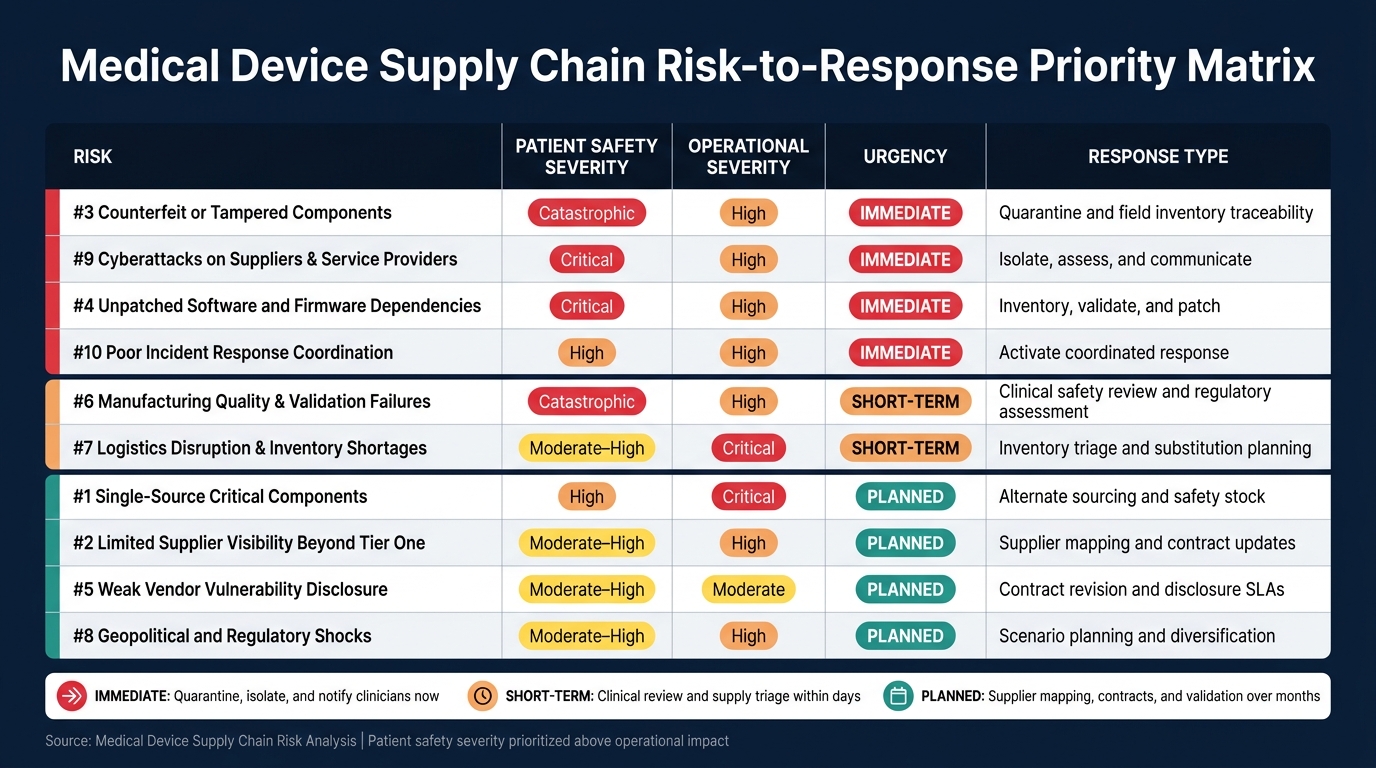
Medical Device Supply Chain Risk Priority Matrix: 10 Threats Ranked by Severity
Once the risks and owners are clear, the next step is simple: decide what gets attention first.
This matrix ranks all 10 risks by severity, with patient safety first, then operational continuity, and then urgency. It turns the earlier impact review into a response order. Urgency comes from two things: how fast you can detect the issue and how easy it is to contain. Risks that are hard to spot, like tampered components or sub-tier failures, move up the list because every hour of delay makes containment harder.
Use this ranking to sequence containment, remediation, and supplier action.
| # | Risk | Patient Safety Severity | Operational Severity | Urgency | Response Type |
|---|---|---|---|---|---|
| 3 | Counterfeit or Tampered Components | Catastrophic | High | Immediate | Quarantine and field inventory traceability |
| 9 | Cyberattacks on Suppliers and Service Providers | Critical | High | Immediate | Isolate, assess, and communicate |
| 4 | Unpatched Software and Firmware Dependencies | Critical | High | Immediate | Inventory, validate, and patch |
| 10 | Poor Incident Response Coordination | High | High | Immediate | Activate coordinated response |
| 6 | Manufacturing Quality & Validation Failures | Catastrophic | High | Short-term | Clinical safety review and regulatory assessment |
| 7 | Logistics Disruption & Inventory Shortages | Moderate–High | Critical | Short-term | Inventory triage and substitution planning |
| 1 | Single-Source Critical Components | High | Critical | Planned | Alternate sourcing and safety stock |
| 2 | Limited Supplier Visibility Beyond Tier One | Moderate–High | High | Planned | Supplier mapping and contract updates |
| 5 | Weak Vendor Vulnerability Disclosure Processes | Moderate–High | Moderate | Planned | Contract revision and disclosure SLAs |
| 8 | Geopolitical and Regulatory Shocks | Moderate–High | High | Planned | Scenario planning and diversification |
The top four risks call for immediate containment because harm can grow before most organizations even see what's happening. If counterfeit parts are confirmed, the first move is quarantine and field inventory traceability, not a long root-cause review. If a supplier gets hit with ransomware, device support or software delivery can stop cold, so affected services should be isolated and clinicians should be notified right away.
Put another way:
- Immediate risks need quarantine, isolation, and clinical communication.
- Planned risks need supplier mapping, validation, and contract controls.
The lower half of the matrix shifts from emergency action to planned control work. That does not mean the stakes are small. Single-source dependencies and limited supplier visibility can create major harm over time. They need supplier mapping, contract updates, and validation work over months.
Use this order to assign owners, set escalation paths, and define remediation timelines. Censinet RiskOps™ supports this work by centralizing third-party risk assessments, tracking remediation status, and keeping risk scores current as conditions change.
Conclusion
Medical device supply chains don’t break at random. They tend to fail in the same places: hidden sub-tier dependencies, untracked software vulnerabilities, single-source components, and response plans that look fine on paper but haven’t been tested. When teams spot these issues late, a routine supply problem can turn into a clinical and operational mess. The answer isn’t scrambling after something goes wrong. It’s steady discipline across the full supply chain.
Resilience starts before a disruption hits. That means mapping past tier one, keeping SBOMs up to date, qualifying alternate sources, and rehearsing response across the full device lifecycle.
When those controls are in place, speed changes everything. Pre-validated recovery playbooks and clear supplier visibility help teams identify affected devices in minutes, not days, which can limit downtime and reduce patient risk.
Supply chain compromises in the health sector increased fourfold in 2021 compared to the prior year.[43] The risk is there. Readiness is what changes the outcome.
Censinet RiskOps™ helps healthcare organizations centralize risk, track remediation, and keep supply-chain visibility current.
FAQs
Which medical device supply chain risks should teams address first?
Teams should start with risks that have a direct impact on patient care and safety. That means putting vendors in order based on criticality and risk exposure, with special attention on those connected to Class II and Class III devices or those that can access patient data and clinical systems.
Handle high-priority threats right away, especially risks that could lead to severe injury or loss of life. Tools like Censinet RiskOps™ can automate risk assessment and vulnerability tracking, which helps teams make decisions based on data instead of guesswork.
How do SBOMs and BOM traceability speed up incident response?
SBOMs and BOM traceability help teams move faster during incident response because they provide a machine-readable, living inventory. That means teams don’t have to dig through old records by hand when time is tight.
When a new vulnerability is disclosed, these records help teams quickly find affected components in deployed devices. From there, they can triage threats using sources like the NVD or CISA’s KEV catalog, based on clinical impact and device criticality.
What should hospitals do first when a supplier disruption affects device availability?
Hospitals should first protect patient safety and keep critical operations running with pre-established manual backups and protocols.
They need to confirm the incident, isolate affected systems or vendor connections, and do it without disrupting life-sustaining devices. At the same time, they should activate vetted backup suppliers. Clear labels and emergency instructions make it easier for staff to reconfigure equipment or run it manually, so patient care can keep moving.
