
If you work in healthcare, the short answer is this: NIST is a strong U.S. starting point, but it is not enough by itself for global AI governance.
I’d boil the article down to five points:
- NIST AI RMF helps me run internal AI risk management across the AI lifecycle.
- EU AI Act creates legal duties for AI used in or sold into the EU, including many healthcare AI tools. This is particularly critical for medical device cyber risk management as software integration deepens.
- ISO/IEC 42001 gives me a certifiable management system for AI governance.
- OECD AI Principles give board-level policy direction.
- WHO guidance applies those ideas to healthcare, with a close focus on patient safety, autonomy, equity, and accountability.
The article also makes one thing clear: healthcare AI use is moving fast. By 2024, 71% of U.S. hospitals reported using predictive AI tools, and 31.5% of 2,174 nonfederal U.S. hospitals said they were using generative AI built into their EHR. At the same time, PHI exposure risk is growing, including in speech-to-text pipelines, logs, and embeddings.
So if I’m building an AI governance program for a hospital, health system, or healthcare vendor, I should not ask, “Which single framework wins?” I should ask:
- Which one helps me run internal controls?
- Which one creates legal duties?
- Which one helps with certification?
- Which one helps with managing third-party AI risk and PHI exposure?
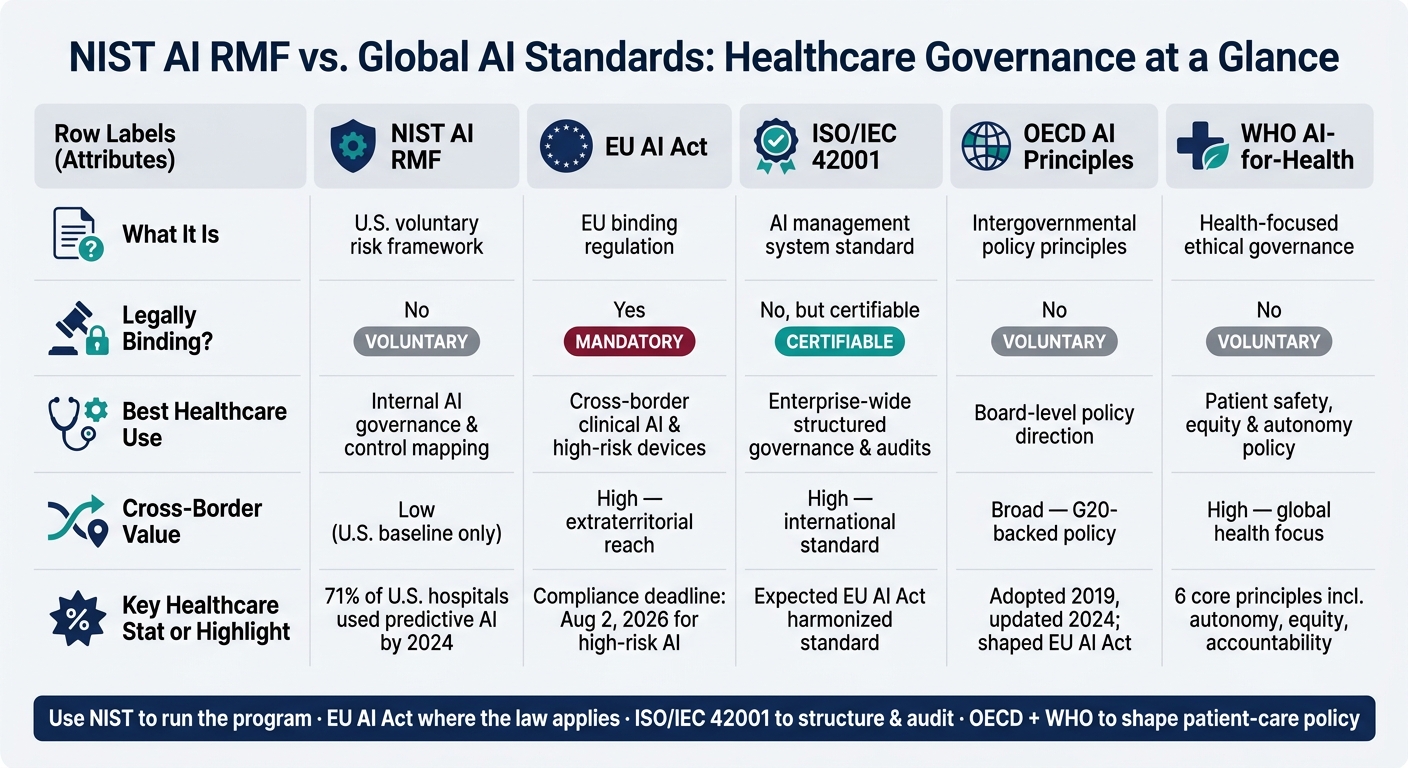
NIST AI RMF vs. Global AI Standards: Healthcare Governance at a Glance
The NIST Artificial Intelligence Risk Management Framework (NIST AI RMF)
sbb-itb-535baee
Quick Comparison
| Framework | What it is | Binding? | Best fit in healthcare |
|---|---|---|---|
| NIST AI RMF | U.S. risk framework | No | Internal AI governance and control mapping |
| EU AI Act | EU law | Yes | Cross-border healthcare AI and high-risk clinical use |
| ISO/IEC 42001 | AI management system standard | No, but certifiable | Formal governance structure across the enterprise |
| OECD AI Principles | Policy principles | No | Board and policy guidance |
| WHO AI for health guidance | Health-focused governance guidance | No | Patient-centered AI policy and review |
My takeaway is simple: use NIST AI RMF assessments to run the program, use the EU AI Act where the law applies, use ISO/IEC 42001 to structure and audit the system, and use OECD plus WHO to shape policy for patient care.
That’s the lens for the rest of the article.
NIST AI RMF: What U.S. Healthcare Organizations Get
The NIST AI Risk Management Framework (AI RMF 1.0) is a voluntary, risk-based framework for managing AI risk across the AI lifecycle.[11][12][13] It is not a compliance regime. Instead, it gives healthcare organizations a clear way to manage AI risk from data collection and model design to deployment, monitoring, and decommissioning.[10][15][16]
That setup fits neatly into the risk workflows many healthcare teams already use. So while NIST works well as a practical U.S. baseline, it does not serve as a complete cross-border standard.
Core structure and healthcare use cases
The framework is built around four functions: Govern, Map, Measure, and Manage.
Govern covers accountability, policies, and oversight.
Map focuses on where AI touches PHI, clinical workflows, and day-to-day operations.
Measure calls for concrete metrics, validation checkpoints, and ongoing monitoring. NIST also calls for model documentation and TEVV before deployment and during monitoring.[16][1][7][8] In healthcare, that means things like documented evaluation results, bias monitoring, and clear triggers for review. If a clinical model starts drifting or an operational tool begins making odd scheduling calls, teams need a set way to catch it.
Manage is where those controls move into daily use. NIST puts weight on incident response playbooks for AI failures, including misdiagnosis or scheduling errors, along with communication plans, remediation steps, and review triggers.[14][16][7]
Strengths and limits in healthcare settings
One of the biggest draws of NIST AI RMF is its flexibility. Healthcare organizations can plug it into programs they already run, such as NIST CSF 2.0, HHS Cybersecurity Performance Goals, and HSCC HICP.[7] Health AI policy groups have also mapped NIST’s trustworthy AI characteristics to practical healthcare controls, including safety testing, bias monitoring, and user training for explainability.[9][17]
But there’s a catch: voluntary alignment does not meet binding legal duties on its own. If a healthcare organization falls under AI-specific rules, NIST alignment by itself will not close that compliance gap.
In day-to-day use, that flexibility still depends on the basics: the right tools, clear workflows, and teams that actually follow them.
Using Censinet to support NIST-aligned AI risk management
Censinet RiskOps™ centralizes NIST-aligned AI risk assessments, cybersecurity benchmarking, and oversight of PHI, clinical applications, medical devices, and supply chains. Censinet AI™ speeds vendor evidence review and routes findings to governance stakeholders for human review, keeping human-in-the-loop oversight for AI governance in place across GRC teams.
That U.S. baseline gets more complicated once AI starts crossing borders.
Global AI Standards and Governance Models: How They Differ From NIST
Once AI crosses borders or needs certification, the NIST AI RMF stops being enough on its own. For U.S. hospitals, vendors, and health systems that serve EU patients, that shifts the compliance floor. Four global frameworks matter most here: the EU AI Act, ISO/IEC 42001, the OECD AI Principles, and WHO's AI-for-health guidance. Each does a different job.
EU AI Act: Binding rules for high-risk healthcare AI
The EU AI Act is a binding regulation, not a voluntary guide. It applies to providers and deployers that place AI systems on the EU market or use AI outputs that affect people in EU member states. That can include U.S. healthcare groups that sell or use AI-enabled clinical tools affecting EU patients.[2][20][34]
A lot of healthcare AI falls into the high-risk bucket. That includes AI built into medical devices covered by the EU's Medical Device Regulation (MDR) or In Vitro Diagnostic Regulation (IVDR), along with tools used for diagnosis, triage, clinical decision support, and patient monitoring.[5][6][20] One peer-reviewed analysis found that about 75% of commercial AI-enabled medical devices were in radiology, and almost all were Class IIa or higher under MDR. Put simply, much of the clinical radiology AI already in use sits inside the high-risk regime.[5][6]
For high-risk systems, the Act requires a continuous risk management system across the full lifecycle, plus data governance, detailed technical documentation, built-in human oversight, logging and traceability, and proof of accuracy, robustness, and cybersecurity.[2][20][26] Deployers - including hospitals and clinics - must assign qualified human oversight, monitor how the system operates, and report serious incidents to authorities.[21][22] Article 15 duties on accuracy, robustness, and cybersecurity apply to Annex III high-risk systems on August 2, 2026, while MDR/IVDR-regulated AI follows on August 2, 2027.[24]
The key shift is simple: the EU AI Act adds legal duties, paperwork, and direct accountability.
The other frameworks are less strict, but each covers a different gap.
ISO/IEC 42001, OECD, and WHO: Management systems, principles, and health guidance
ISO/IEC 42001:2023 is an AI management system standard built on a management-system model.[3][23] It lays out how an organization should govern AI in a systematic way across policy, risk management, roles, documentation, oversight, and continual improvement.[3][18][23] It is also certifiable, which matters for healthcare groups that need to show structured governance to regulators, partners, or patients. In cross-border settings, it is expected to become a harmonized standard under the EU AI Act, which may turn it into a compliance path for high-risk healthcare AI systems.[18]
The OECD AI Principles sit at a much higher level. First adopted in 2019 and updated in 2024, they are a nonbinding intergovernmental standard that sets broad principles around inclusive growth, human-centered values, transparency, robustness, and accountability, with backing from G20 governments.[28][29][32] They set values, not control requirements, and they helped shape the design of the EU AI Act.[31][30][33]
WHO's AI-for-health guidance is the most healthcare-specific of the four. Its 2021 report, Ethics and governance of artificial intelligence for health, lays out six principles: protect autonomy; promote human well-being, safety, and the public interest; ensure transparency, explainability, and intelligibility; foster responsibility and accountability; ensure inclusiveness and equity; and promote AI that is responsive and sustainable.[19][4][25][27] Compared with the OECD principles, WHO takes those ideas and applies them directly to clinical care and public health. It puts more weight on patient autonomy, informed consent, safety, equity, accountability, workforce impact, and continued review of real-world performance.[3]
| Instrument | Type | Binding? | Healthcare Focus |
|---|---|---|---|
| EU AI Act | Regulation | Yes | High-risk clinical AI, MDR/IVDR devices |
| ISO/IEC 42001 | Management system standard | No (certifiable) | Structured governance across AI lifecycle |
| OECD AI Principles | Policy principles | No | Cross-sector trustworthy AI values |
| WHO AI-for-health guidance | Ethical/governance guidance | No | Patient safety, equity, autonomy, accountability |
That mix matters because healthcare groups often need both hard legal controls and room for internal governance. The next step is to compare these tools on legal force, scope, and how well they fit healthcare.
Side-by-Side Comparison: NIST AI RMF vs. Global AI Standards in Healthcare
The comparison comes down to three questions: what is required, where it applies, and what it controls. For healthcare systems and vendors working across borders, the key issue is simple: which framework helps run AI inside the organization, and which one has to be met outside it?
Legal status, scope, and cross-border impact
NIST AI RMF is voluntary and not audit-based. The EU AI Act is mandatory. ISO/IEC 42001 is voluntary, but it can be certified. U.S. healthcare companies that serve EU patients must meet the EU AI Act’s high-risk AI rules by August 2, 2026.[35]
| Framework | Type | Legal Status | Best Use | Cross-Border Value |
|---|---|---|---|---|
| EU AI Act | Law | Mandatory | healthcare vendors and systems serving EU patients | Extraterritorial |
| ISO/IEC 42001 | Standard | Voluntary / Certifiable | Enterprise AI governance | High (international) |
| OECD AI Principles | Policy principles | Voluntary | Governments, industry | Broad policy principles |
| WHO AI-for-health guidance | Ethical guidance | Voluntary | Health systems, policymakers | High (global health focus) |
NIST is the best internal baseline, not a compliance endpoint.
That distinction matters. A framework may work well for internal governance, but that does not mean it satisfies cross-border legal duties or healthcare rules at the same time. In healthcare, that gap can get expensive fast.
Risk lifecycle, cybersecurity controls, and healthcare fit
NIST helps shape internal governance. The EU AI Act creates legal duties. ISO/IEC 42001 supports certifiable processes. One big plus of ISO/IEC 42001 is that it can bring the same process across teams, which makes day-to-day governance less messy.
But NIST has limits. On its own, it does not cover clinical safety, FDA device rules, or ONC transparency rules. The EU AI Act adds mandatory duties that NIST does not, including documentation and human oversight for high-risk medical AI.[35] ISO/IEC 42001 adds a certifiable management system standard for AI governance.[35] And PHI protection still depends on HIPAA-aligned controls.[35]
So NIST works well as an operating model. It just doesn’t answer every compliance need for global healthcare deployments.
Matching each framework to a specific healthcare need
No single framework does it all. The hard part is turning several sets of rules into one process that teams can use again and again without reinventing the wheel.
| Healthcare Need | Most Relevant Framework |
|---|---|
| Internal AI governance structure | NIST AI RMF |
| Cross-border deployment (EU patients or market) | EU AI Act |
| Certifiable governance for enterprise AI | ISO/IEC 42001 |
| Board-level policy guidance | OECD AI Principles / WHO guidance |
| PHI protection and cybersecurity controls | HIPAA |
Governance is still uneven across the field. Many organizations have committees, but only a small share have a formal framework or approval process.[35] That gap is exactly why healthcare organizations need one program that maps internal controls to multiple frameworks. Tools like Censinet Connect™ Copilot can help automate this mapping by using standardized questionnaires and existing documentation to streamline compliance.
Building a Unified AI Governance Program for Healthcare
No single framework does it all. The smart move is to address the promise and peril of AI in healthcare by building one governance program with a shared control set, then add jurisdiction-specific overlays where needed.
A practical alignment model for HDOs and vendors
Treat the comparison as a control map, not a checklist. Map each AI system to NIST controls, give each obligation one clear owner, and use that setup to run governance across both clinical and operational areas.
Start with a full inventory of every AI system. Tag each one by use case and jurisdiction. Then map EU-facing high-risk systems to the required documentation, human oversight, logging, and post-market monitoring.[37][38][5] That same inventory should do double duty: it should support internal governance and jurisdiction-specific obligations at the same time.
ISO/IEC 42001 gives the program a standard structure and an audit path. In plain terms, it helps teams run governance the same way across sites and departments.[3][23]
Once controls and process are in place, add policy guardrails. Use OECD and WHO guidance to define patient-safety, transparency, and fairness metrics.[36] Those metrics can feed straight into the KPIs used in NIST's Measure function and ISO/IEC 42001's improvement cycles.
Use one dashboard to track risk, gaps, and active alerts by service line, vendor, and jurisdiction. When cybersecurity, compliance, and clinical leadership all work from the same view, governance becomes part of day-to-day operations.
Conclusion: Key points for healthcare decision-makers
After the control set is mapped, the next job is simple: assign ownership. Use NIST for internal governance, EU rules for cross-border compliance, ISO/IEC 42001 for structure, and OECD/WHO guidance for patient-centered policy.[1][37][38][3][23][36]
FAQs
How do I know which AI framework applies to my organization?
Choose NIST AI RMF 1.0 if you want voluntary guidance for spotting, mapping, and measuring technical risks like bias, robustness, and clinical safety in day-to-day operations. Choose ISO/IEC 42001 if you need a certifiable management system that supports audit readiness and organization-wide governance.
A lot of healthcare organizations use both. They lean on NIST for specific technical risks and use ISO 42001 for formal, documented governance. Censinet RiskOps™ can help streamline assessment and monitoring workflows.
Is NIST AI RMF enough for healthcare AI compliance?
No. The NIST AI RMF is a voluntary framework that helps organizations manage AI risk, trustworthiness, and safety. But it does not replace legal or regulatory duties like HIPAA, HITECH, or FDA rules for Software as a Medical Device.
In healthcare, teams often use it alongside standards like ISO/IEC 42001. Then they fold both into day-to-day risk management, including accountability, vendor controls, and continuous monitoring.
When should a hospital use ISO/IEC 42001 or the EU AI Act?
Use ISO/IEC 42001 when a hospital needs a formal, certifiable AI management system with documented governance, third-party assurance, and audit readiness. A lot of teams use it alongside the NIST AI RMF: NIST helps with day-to-day risk management, while ISO/IEC 42001 sets the structure for organization-wide governance.
Use the EU AI Act when the hospital falls under its jurisdiction or its AI systems affect EU citizens. This matters most for high-risk uses, such as diagnostic tools, medical devices, and electronic health records.
