
If OCR reviews your HIPAA program today, policies alone will not save you. I’d boil the article down to this: you need proof that your risk analysis is current, your vendors were checked, your incident files are complete, and your fixes were tracked to closure.
Here’s the short version:
- Risk analysis is the first test. OCR keeps citing narrow scope, old assessments, weak scoring, and findings with no owner or due date.
- Vendor review must go past the BAA. A signed agreement shows intent, but OCR also wants records of security checks before access starts and after changes.
- Breach files must tell the whole story. Keep one record with timestamps, containment steps, root cause, four-factor breach review, and notice dates.
- Documentation drives enforcement. OCR may ask for records fast, and missing logs, stale files, or scattered evidence can turn one incident into a larger case.
A few numbers make the risk plain: the average healthcare breach cost reached $7.42 million in 2025, the average time to find and contain a breach was 279 days, and past OCR audit results showed only 14% of covered entities and 17% of business associates met risk-analysis duties.
If I were preparing for OCR, I would start with four things right now:
- Update the enterprise risk analysis across all systems that touch ePHI.
- Assign every open risk item to one person with a due date.
- Review vendor access, logging, and subcontractor exposure.
- Build one audit-ready file for each incident and breach decision.
That’s the core message of the article: OCR is not just asking what your policy says; it is asking what you did, when you did it, and where the record is.
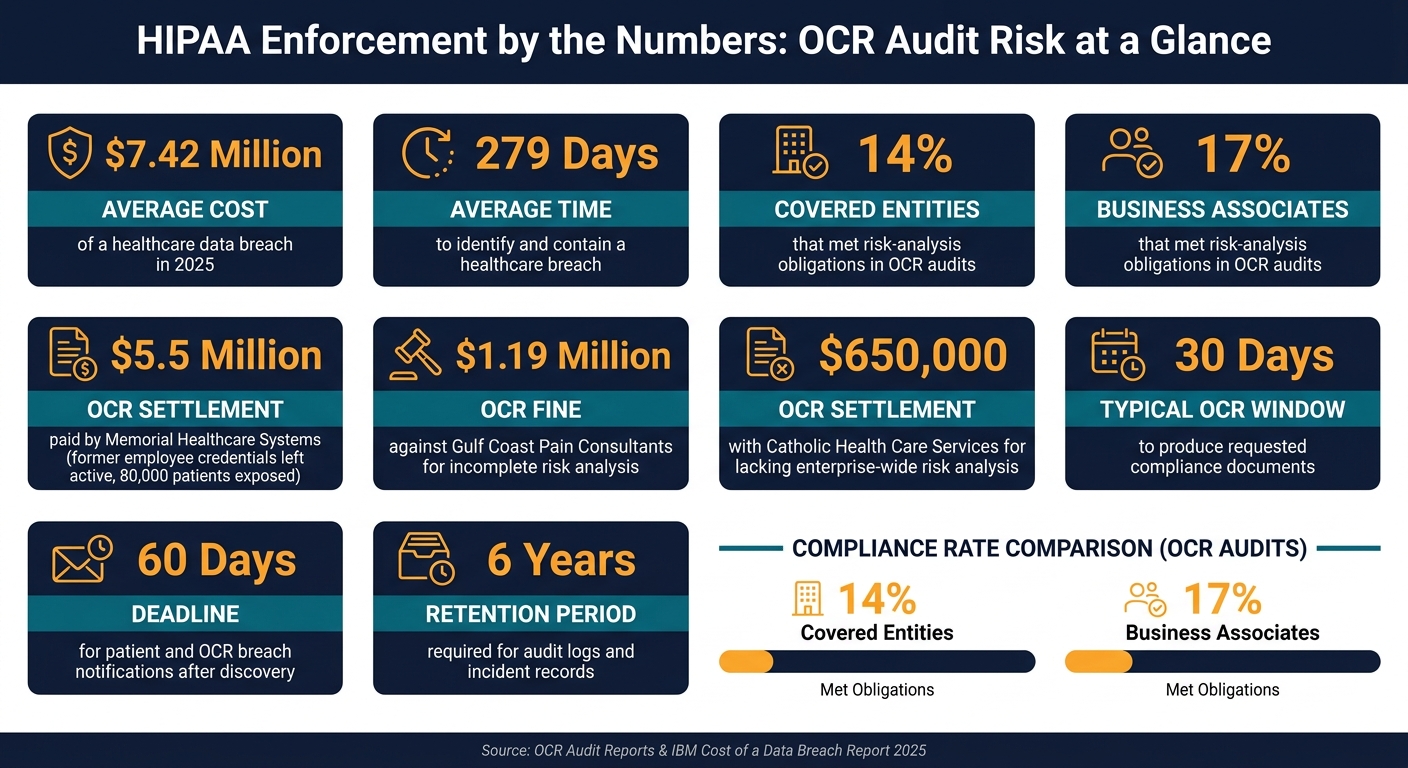
HIPAA Enforcement by the Numbers: OCR Audit Risk at a Glance
Risk Management Under the HIPAA Security Rule
sbb-itb-535baee
The Core OCR Enforcement Problem
OCR findings usually trace back to gaps in how controls are put in place, watched, and documented. OCR checks whether safeguards work across the organization, not just on paper. Once a case opens, the agency wants proof that controls, remediation, and vendor oversight worked in day-to-day practice.
OCR treats repeated process failures as systemic compliance failures.
How OCR Investigations Typically Start
OCR investigations often start with breach notifications involving 500 or more people, patient complaints, or compliance reviews tied to other security incidents. Even smaller reportable incidents can draw attention when they point to larger weaknesses.
What matters most is what happens after that first trigger. When OCR starts a review, it doesn't stay narrowly focused on the original event. It looks at the organization's full compliance record: how risks were found, whether they were fixed, and whether the documentation backs up those claims.
That review usually starts with the risk analysis OCR expects to see first.
What Enforcement Patterns Tell Healthcare Leaders
Risk analysis quality is the most common enforcement trigger. OCR looks closely at whether the assessment covered the whole organization and whether it included vendors with access to electronic protected health information (ePHI). The next gap is risk management follow-through. Finding a weakness means very little if there's no remediation plan, no owner, and no deadline.
Access controls and audit logging come up again and again. OCR often treats routine control failures as worthy of enforcement because they point to weak oversight. Memorial Healthcare Systems paid $5.5 million after former-employee credentials stayed active for a year, exposing ePHI for 80,000 patients [2]. OCR treats that as a control failure.
Vendor oversight is the other half of the story. If a vendor has a breach, it can still become the covered entity's enforcement problem [1]. In plain English, OCR expects organizations to show they checked their vendors' security posture, not just gathered a signed BAA. Vendor failures often point back to gaps in the risk analysis.
That pattern usually starts with the risk analysis itself.
Why Risk Analysis Falls Short of OCR Expectations
OCR now treats weak risk analysis as a main enforcement issue. In plain terms, the same problems keep showing up: narrow scope, shaky methods, and poor records. The first checkpoint is scope. Does the analysis cover every system that touches ePHI?
Scope the Risk Analysis Beyond the EHR
A lot of risk analyses stop at the EHR. OCR expects a much broader view. That means every system and every place where ePHI is created, received, maintained, or transmitted, including cloud apps, backup environments, mobile devices, removable media, and legacy systems [2].
This is where things often go sideways: data flow mapping. If you can't show how ePHI moves through APIs, VPNs, email, messaging apps, shadow IT, and unauthorized cloud services, OCR can treat the assessment as incomplete [2].
Once the scope is set, OCR looks at how you reached the risk score in the first place.
Document Methodology, Scoring, and Remediation Ownership
OCR wants to see a documented method, defined scoring, and risks tied to specific threats and vulnerabilities [2]. It also wants findings assigned to named owners with due dates. Not broad governance language. Actual risk-analysis records that show each finding was assigned and tracked.
OCR fined Gulf Coast Pain Consultants $1,190,000 for an incomplete, organization-wide risk analysis and missing required security measures [3]. If findings sit around with no owner and no target date, that can end up in the enforcement record.
Put simply, stale and unassigned findings are an easy way to fail this review.
Fix the Common Gaps That Trigger OCR Findings
Refresh the risk analysis every year and after mergers, migrations, or major application changes [2].
Another repeat issue is low-risk ratings with no backup. If an unencrypted device is labeled "low risk" and there's no written reason for that rating, OCR auditors see a red flag, not a defensible call [2]. The same goes for controls. Policies alone won't carry much weight. OCR wants evidence that the controls work, not just documents that say they should [2].
| Common Gap | Why OCR Flags It |
|---|---|
| Scope limited to EHR | Leaves cloud, backups, and vendor systems unassessed |
| No data-flow mapping | Can't demonstrate where ePHI travels or who touches it |
| Unsupported low-risk ratings | Auditors treat undocumented ratings as assumptions, not analysis |
| Findings without owners or deadlines | Signals that risk management exists on paper only |
| Stale assessments | Fails to reflect current threat environment or system changes |
That is the risk-analysis baseline OCR will expect before it looks at vendors.
Vendor Oversight and Business Associate Gaps
A signed BAA is the starting point, not the finish line. OCR expects organizations to document vendor risk management before onboarding, during the relationship, and after any material change. The Phase 2 report found that only 17% of business associates met risk-analysis obligations. That’s exactly why a BAA by itself doesn’t cut it. The first thing OCR will look for is simple: did vendor diligence happen before ePHI access began?
What Must Exist Before and After Contract Signature
Before a vendor touches ePHI, documented security due diligence and risk assessments should already be on file. In plain terms, you need proof that the vendor’s controls work in practice, not just on paper.
If a vendor says MFA is required for remote access, there should be evidence that MFA is actually enforced. The same goes for encryption and other required safeguards. Policies matter, but OCR wants to see that the controls are live in the vendor environment.
And once the contract is signed, the review can’t just sit on a shelf. If the vendor goes through a material change, reassess then, not at the next annual review.
How to Manage Ongoing and Fourth-Party Exposure
Ongoing monitoring is where vendor oversight often breaks down. Access reviews should happen quarterly, and vendor credentials should be revoked right away when contracts end or personnel change [2].
For high-risk vendor systems, audit logs should be reviewed at least weekly. Those logs should capture:
- Username
- Timestamp
- IP address
- Action taken
They also need to be kept for six years [2].
Then there’s the next layer: subcontractors behind the vendor. This is where fourth-party exposure tends to hide. Cloud apps, integrations, backups, and subcontractors can create blind spots fast. Map those vendor and subcontractor relationships quarterly so they don’t sit outside OCR’s view [2].
| Vendor Oversight Element | What OCR Expects |
|---|---|
| Due Diligence | Documented review of administrative, physical, and technical safeguards before ePHI access begins [2] |
| Access Reviews | Quarterly validation of vendor privileges; immediate revocation upon termination [2] |
| Audit Logs | Vendor access reviewed weekly for high-risk systems; retained for six years [2] |
| Fourth-Party Visibility | Subcontractor relationships identified and included in quarterly data flow mapping [2] |
| Remediation Tracking | Vendor gaps assigned a risk rating with documented ownership and resolution timelines [2] |
Breach Response, Audit Readiness, and Documentation That Reduces Enforcement Exposure
Once OCR gets past risk analysis and vendor oversight, it usually turns to your incident record next.
When OCR opens an investigation, that record becomes one of the main things you'll need to hand over. If it's incomplete, OCR can't confirm what happened, how your team responded, or why you made the breach determination you did.
Build an Incident Record OCR Can Audit
Each security incident should have one central record with timestamped actions and decisions. That includes containment steps, a documented root cause, and a four-factor breach risk assessment. Your file should clearly document the four breach-risk factors: what PHI was involved, who received it, whether it was actually acquired or viewed, and how much the risk was mitigated [2].
Notification timing needs to be crystal clear too. Patient and OCR notifications must go out within 60 days of breach discovery, and your records should show that the deadline was tracked and met [2]. After every incident or tabletop exercise, document lessons learned and any policy changes [2].
"Lack of access controls and regular log review allows hackers or insiders to cover their tracks." - Robinsue Frohboese, OCR Acting Director [2]
Keep your containment steps, log-review evidence, and breach-risk decision in the same file. That way, the full story is in one place instead of scattered across inboxes, tickets, and shared folders.
Maintain the Documentation Inventory That Matters Most
OCR often gives just 30 days to produce requested documents. That's not much time. The key files need to be ready before an investigation begins.
| Record Category | Essential Evidence to Preserve | Review Frequency |
|---|---|---|
| Incident Response | Triage logs, four-factor risk assessments, notification timestamps, forensic reports, after-action updates | Per incident |
| Risk Management | Annual enterprise-wide risk analysis, prioritized remediation logs, exception approvals | Annual / major change |
| Access & Monitoring | Quarterly access review logs, weekly audit log summaries, automated alert history | Quarterly / weekly |
| Vendor Files | Signed BAAs, completed security questionnaires, risk-tiered assessments | Annual (high-risk vendors) |
| Workforce & Policy | Training attendance with quiz scores, signed policy acknowledgments, sanction records | Annual |
Retain audit logs and incident records for at least six years [2].
Sequence Remediation by Enforcement Exposure
After the records are in place, fix the gaps OCR is most likely to cite first.
Focus first on the issues most likely to draw scrutiny: an incomplete or outdated enterprise-wide risk analysis, remediation items with no owner or due date, missing vendor-contract evidence, and incident records or breach-decision files that aren't complete [1][2]. Catholic Health Care Services of Philadelphia paid a $650,000 settlement after OCR found that it lacked a comprehensive enterprise-wide risk analysis and a formal risk management plan [2].
Once those gaps are closed, move to the next layer of diligence work. That includes annual reassessments for high-risk vendors, automated training logs, and unresolved remediation items that are still open [1][2]. The smartest move is simple: handle the highest-exposure gaps first.
FAQs
What will OCR ask for first?
OCR usually starts with core compliance documents. Business Associate Agreements (BAAs) are often one of the first things they review, along with an enterprise-wide risk analysis that covers every system handling electronic protected health information.
They also often ask for written privacy, security, and breach notification policies, workforce training records, incident and breach logs, and proof of safeguards like encryption and access controls.
How often should we update our risk analysis?
At a minimum, update your risk analysis annually. But this shouldn’t be a one-and-done exercise.
Treat it as a continuous process. If your risk profile changes, your analysis should change too. That includes events like system implementations, cloud migrations, mergers, ownership changes, or security incidents.
Some areas move faster and need a tighter review cycle. For example, access controls and certain risk assessments may need a quarterly review.
Is a signed BAA enough for vendor compliance?
No. A signed BAA is required, but it’s not enough on its own.
OCR and auditors also expect documented, ongoing vendor due diligence. That means an organization-wide HIPAA security risk analysis that includes vendors, regular reassessment and monitoring, and proof that the vendor can protect PHI, not just say they will on paper.
