
Healthcare breaches still cost a lot and take too long to contain: $7.42 million on average and 279 days in 2025. My take is simple: healthcare teams need one shared way to intake, sort, track, and close risk across security, privacy, compliance, vendors, AI, and patient care.
Instead of treating risk like a once-a-year review, I’d frame this article around a single idea: put every risk signal into one workflow, give each item one owner, and tie every decision to business and clinical impact. That means fewer duplicate requests, fewer missed escalations, and less guessing about who needs to act.
Here’s the article in plain English:
- A Risk Operations Center (ROC) is a working model, not just a tool or a new team.
- It brings intake, triage, remediation, escalation, and reporting into one place.
- It uses one shared risk record so cyber, privacy, compliance, vendor, and AI issues do not live in separate tracks.
- It ranks risk by what matters in healthcare: PHI, EHR uptime, medical devices, patient safety, and care disruption.
- It gives each risk one accountable owner, with service levels, evidence rules, and clear closure standards.
- It connects with systems like ITSM, procurement, incident response, IAM, medical-device platforms, and vendor monitoring.
- It uses automation for admin work, but keeps human approval for high-impact calls like risk acceptance, vendor suspension, clinical-use AI decisions, and disclosure actions.
- It should be measured by outcomes such as time to triage, time to remediate, overdue actions, vendor review coverage, and whether incidents lead to corrective risk actions.
A few numbers stand out:
- Healthcare had the highest breach cost for the 14th straight year
- Third-party incidents average $4.91 million
- Slow, split workflows often lead to duplicate effort and delayed action
If I were boiling the full piece down to one sentence, it would be this: a ROC helps healthcare leaders see risk sooner, route it to the right owner, and make documented decisions before small issues turn into patient-care or compliance problems.
The Future of GRC in Healthcare
sbb-itb-535baee
The operating model: intake, triage, and remediation in one place
Risk comes in from all over the place. A vulnerability scan might hit one queue. A vendor questionnaire might go to another. An audit finding may sit in a different system with a different team on point. The ROC brings intake, triage, remediation, and closure into one workflow.
That only works when every signal maps to the same record format.
From risk intake to normalized risk records
Map each intake source to one standard risk record, while still keeping source-level details attached. A vulnerability record still needs CVE data, exploitability details, scan output, and patch evidence. A vendor finding still needs contract obligations and breach-notification confirmation.
At the core, every record should use the same fields:
- risk statement
- source
- discovery date
- affected system or supplier
- business unit
- data involved
- clinical service affected
- control gap
- preliminary likelihood and impact
- owner
- due date
- evidence
- status
Normalization also cuts down on duplicate counting. A ransomware incident, a failed backup control, and an overdue vulnerability may look like separate items on paper. But in practice, they can point to the same risk scenario. Linking them under a shared risk identifier keeps the picture clean and stops teams from chasing one weakness as if it were three separate problems.
NIST CSF 2.0 backs this up by requiring asset vulnerabilities to be identified, validated, and recorded.[3] Once records are normalized, the ROC can tier risk based on clinical and business impact.
Risk tiering based on clinical and business impact
CVSS helps, but it should not make the call by itself. A moderate vulnerability on a medication-dispensing system or an EHR interface may matter far more than a critical issue on an isolated, nonclinical server.
That’s why risk tiering needs a broader view. Teams should weigh PHI exposure, patient-safety impact, clinical-system criticality, care disruption, exploitability, regulatory impact, and supplier dependency together.
HIPAA guidance says the same thing in plain terms: regulated entities should consider the probability and criticality of potential risks to ePHI, not just technical ratings.[4][5]
Each risk tier should tie to a set action, a named owner, and a service-level target. For example, a critical risk may call for immediate containment, executive notification, and a documented treatment plan or temporary compensating control within 24 hours. A high risk may need a remediation plan within five business days and completion within 30 days, based on company policy.
The key point is simple: leadership should set thresholds that fit actual staffing and workload, not copy generic framework language.
Remediation, escalation, and closure
Once a risk is tiered, assign one accountable owner. Security, privacy, legal, procurement, clinical operations, and vendors may all help. But one person needs to drive the work to closure.
If remediation has to wait, document the compensating control, its limits, and a review date. Say a vendor is still working toward a platform upgrade. In the meantime, the healthcare organization might restrict network access, disable unused functions, increase logging, require manual review, or temporarily move a sensitive workflow. Those controls should be checked for effectiveness, not treated as a permanent stand-in.
Escalation should happen when teams miss SLAs, active exploitation starts, impact grows, controls are blocked, ownership remains unclear, clinical dependency changes, or a vendor stops responding. And when that escalation goes up the chain, the package needs to be specific. It should spell out the affected services and data, current score, business and clinical impact, actions already taken, remaining exposure, the decision needed, the accountable owner, and the deadline.
Close a risk only when evidence shows exposure has gone down. That evidence might include:
- a successful vulnerability rescan
- configuration screenshots or exports
- access-review results
- updated policies
- signed contract amendments
- vendor attestations backed by review
- completed control tests
- incident tabletop results
A closed ticket is not the same as a closed risk. These operating rules shape the workflows the ROC technology stack needs to support.
Core capabilities of a healthcare Risk Operations Center
Once risk intake is normalized, the ROC can use that same operating model across enterprise, vendor, compliance, and AI work. It uses one normalized risk record across enterprise risk, cybersecurity, third-party risk, compliance, and AI governance. Because each domain uses the same record structure, risks stay connected across teams instead of getting split into separate systems.
Enterprise and cyber risk tied to incidents and controls
The ROC connects incidents, assets, controls, vulnerabilities, remediation, and executive decisions in one loop. If a clinical application is compromised, for example, that event should create linked records for the incident, affected systems, ePHI exposure, the root vulnerability, the failed control, the corrective action, and the executive risk decision.
Cybersecurity findings should connect to controls and policies, not just sit in technical ticket queues. A vulnerability on a medication-dispensing system should link to the related asset, patient-safety impact, compensating control, remediation owner, and exception approval. HHS guidance backs this up: organizations should review confidentiality, integrity, and availability risks, address security incidents, document outcomes, and periodically check whether safeguards still work.[4][5] After an incident, teams should update risk ratings, create remediation tasks, and log lessons learned. That cycle - incident to control update to executive report - is a core ROC capability, not an extra feature.
Third-party, vendor, and supply chain risk operations
Annual questionnaires create too much lag. A vendor’s risk profile can shift between reviews because of a breach, a new subprocessor, an ownership change, or a broader data-access scope. The ROC closes that gap by treating vendor risk as a continuous operation instead of a once-a-year task.
The ROC keeps a vendor inventory that includes the business owner, service description, data accessed, ePHI exposure, criticality tier, BAA status, contract dates, security requirements, assessment history, monitoring signals, open findings, and offboarding status. Fourth-party visibility matters too. A healthcare provider may rely on a cloud host, software component, or subcontractor that it does not directly contract with, but that still creates material risk.[1][2]
Continuous third-party risk assessments and operations bring onboarding, monitoring, contract data, breach signals, vulnerability intelligence, and offboarding into one workflow, rather than waiting for annual questionnaires.
Continuous monitoring does not mean treating every alert like a five-alarm fire. It means sending major changes, active exploitation, or service disruption to the right owner, with an auditable decision and a defined service level.
Compliance and AI governance in the same operating model
The same shared workflow also cuts duplicate evidence collection and control testing. Compliance work often piles up redundant effort when every audit or obligation runs its own evidence request. The ROC fixes that with a common control library. One control - access review, encryption, incident response, vendor oversight, workforce training, or contingency planning - can map to multiple obligations at the same time. Evidence collected once can support HIPAA, HITECH-related requirements, internal policies, payer or customer contracts, and audit requests, as long as the record keeps the evidence owner, collection date, scope, and review status.[5][8] Control owners get notified when evidence expires or a control changes, so gaps show up before an auditor finds them.
AI governance fits this same model: one inventory, one review path, one audit trail. The ROC keeps an AI inventory covering internally developed tools, purchased applications, embedded vendor features, and employee-deployed services. Each record identifies the accountable owner, intended use, users, data types, model or vendor, deployment environment, clinical relevance, privacy and security review status, validation status, human-approval requirements, monitoring plan, incident process, and retirement date. Higher-risk use cases - clinical decision support, patient-facing communications, and diagnosis assistance - route automatically to privacy, security, legal, clinical safety, compliance, and AI governance stakeholders for review. Censinet RiskOps centralizes AI policies, risks, and tasks, while Censinet AI routes work with human review. NIST's AI Risk Management Framework emphasizes trustworthiness and defined human oversight.[6][7]
The technology foundation for continuous risk operations
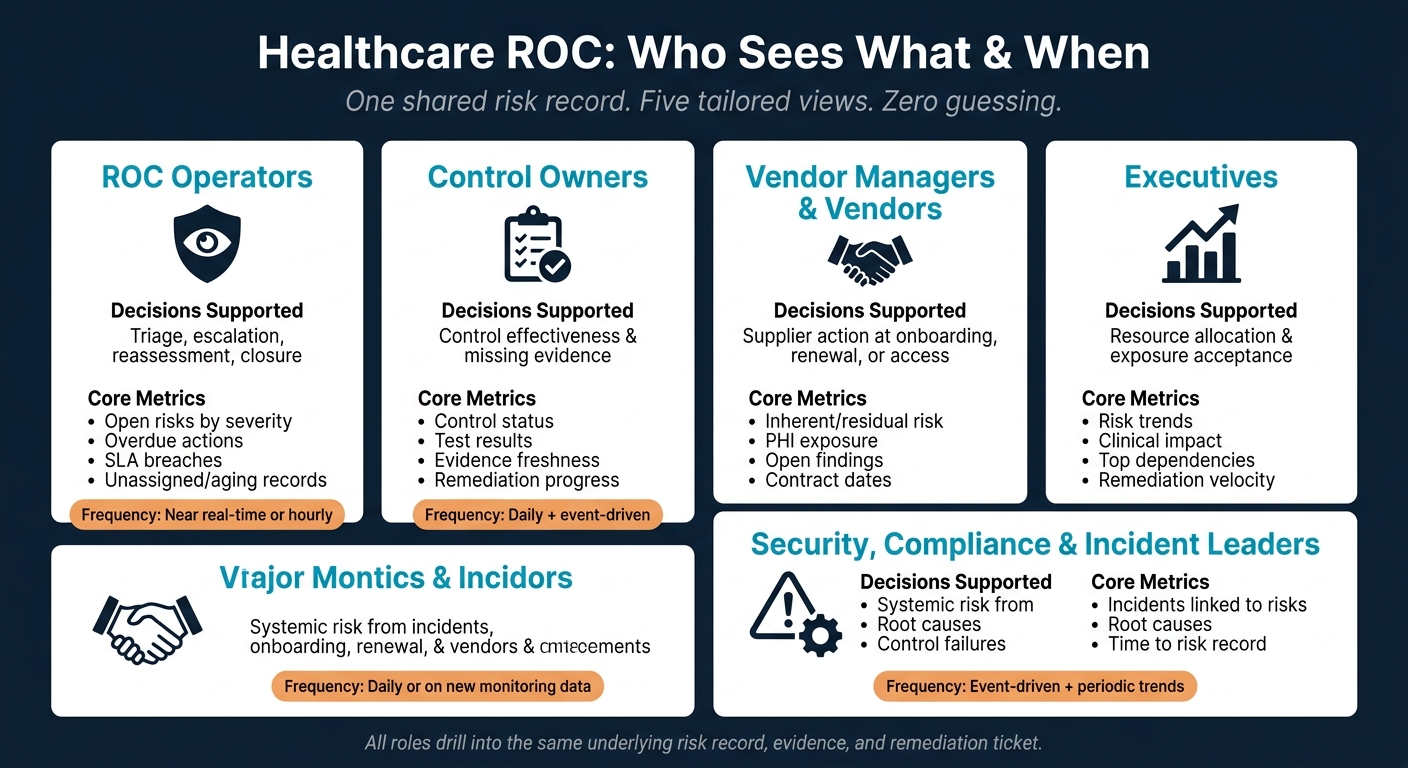
Healthcare Risk Operations Center: Dashboard Views by Role
The technology layer should turn intake, assessment, remediation, and closure into one auditable workflow. That means no manual rekeying, no scattered records, and no guessing about what changed or who changed it. The system should normalize submissions, route work, and keep a single record from start to finish.
The next subsections break down the systems, views, and controls that make that workflow work day to day.
Systems that support intake, monitoring, and workflow orchestration
At the center of this setup is a centralized risk-operations platform. Its job is simple in theory, but hard in practice: treat intake, assessment, remediation, and closure as one connected process instead of a patchwork of separate tools held together by manual effort.
When a submission comes in - whether from employees, security tools, procurement, compliance teams, incident responders, auditors, or vendors - the platform should convert it into a standard risk record. From there, it should remove duplicates, classify the risk, identify the affected clinical service or asset, assign an owner, and send it into the right workflow automatically.
Censinet RiskOps is one healthcare-focused example of this model. Its RiskOps Command Center provides a real-time operations dashboard backed by workflow and analysis features, standards-aligned data collection mapped to NIST CSF, ISO, and HIPAA, automated risk ratings, and corrective-action-plan generation across clinical and business use cases.[10]
This only works at scale if the platform connects to the systems teams already use. In plain terms, integrations do the heavy lifting. The platform should connect with security tools, IAM, medical-device systems, incident-response tools, procurement and contract systems, third-party monitoring, ITSM, and evidence repositories.
Censinet, for example, integrates with ServiceNow so teams can assign, track, manage, and approve assessments without bouncing between two separate systems.[9] The goal is not to copy every field into every tool. It is to sync the fields that matter and keep a record of the source, timestamp, transformation logic, and responsible owner for each material change. That’s what keeps automation auditable instead of opaque. Organizations like Emory Healthcare have already moved toward these streamlined, scalable models.
Once this data is connected, the ROC can present different risk views depending on the user’s role.
Dashboards for operators, control owners, vendors, and executives
Different users need different views of the same underlying risk record. An executive does not need the same screen as a ROC operator, and a vendor manager should not have to dig through incident-response detail just to check supplier status. Each dashboard should fit the decisions that person needs to make.
Every dashboard should also show data freshness clearly: when it was last updated, which systems supplied the data, and whether any metrics are still pending reconciliation.
| Audience | Decisions supported | Core metrics | Update frequency |
|---|---|---|---|
| ROC operators | Triage, escalation, reassessment, or closure | Open risks by severity, overdue actions, SLA breaches, unassigned records, and aging | Near real time or at least hourly |
| Control owners | Control effectiveness and missing evidence | Control status, test results, exceptions, evidence freshness, and remediation progress | Daily, with event-driven updates |
| Vendor managers and vendors | Supplier action before onboarding, renewal, or continued access | Inherent and residual risk, PHI exposure, open findings, certification status, and contract dates | Daily or when new monitoring data arrives |
| Executives | Resource allocation and exposure acceptance | Risk trends, clinical impact, top dependencies, overdue high risks, and remediation velocity | Weekly or monthly, with immediate alerts for critical events |
| Security, compliance, and incident leaders | Systemic risk revealed by incidents and implicated controls or vendors | Incidents linked to risks, root causes, control failures, repeat events, and time from incident to risk record | Event driven, with periodic trend reporting |
A dashboard should do more than show a score. Users should be able to drill from an executive trend straight into the underlying risk record, evidence, control, vendor, incident, and remediation ticket. Otherwise, the dashboard becomes a pretty surface with no path to action.
That’s where automation starts to help. It takes care of repetitive work, while people keep control over the calls that carry weight.
Automation with human oversight
Automation works best on high-volume administrative tasks. That includes summarizing evidence, routing submissions, triggering reassessments, drafting risk summaries, and tracking overdue actions. These are the jobs that can eat up hours if handled by hand.
But automation needs guardrails. It should operate within documented rules, confidence thresholds, source attribution, version history, and exception handling. A human should step in when the system produces low-confidence extractions, conflicting evidence, unusual risk combinations, or recommendations that could affect patient care or continuity of operations.
High-impact decisions should stay under human approval. That includes:
- Risk acceptance
- Exceptions to security or compliance requirements
- Decisions affecting patient safety or clinical availability
- Major vendor onboarding or suspension
- Material contract changes
- Disclosure or notification decisions
- Judgments about AI systems used in clinical or operational processes
Before approval, the reviewer should be able to see the evidence, assumptions, affected services, decision authority, expiration date, and monitoring requirements. NIST's AI Risk Management Framework specifically calls for human-oversight processes to be defined, assessed, and documented.[6]
The ROC should also record who approved each decision, when it was approved, the rationale, compensating controls, and the conditions for reevaluation. That creates a full audit trail instead of a black box.
How to build a Risk Operations Center and measure results
Once the ROC operating model is set, the next step is to put governance rules in place so the work can happen the same way every time.
Set the charter, common risk model, and ownership rules
Before any workflow goes live, the ROC needs a charter that answers four basic questions:
- What risk domains are in scope?
- Which teams are involved?
- Who can accept residual risk?
- Which cases need legal, clinical, or executive escalation?
The scope should cover cyber, enterprise, vendor, compliance, privacy, AI governance, and patient safety risk.
The ROC also needs one normalized record for source, impacted asset or process, data, impact, severity, owner, due date, and closure criteria. That shared taxonomy helps keep the ROC from turning into one more silo.
Ownership rules need to be plain and explicit. The ROC coordinates. Owners decide. Residual risk acceptance stays with the authorized owner.
With scope and ownership in place, start by piloting the workflows that cause the most friction today.
Start with high-value workflows and service levels
Don’t try to pull every GRC process into the ROC at once. That usually creates a mess.
Start with the workflows that already create the most manual effort across cyber, vendor, compliance, AI, and third-party risk:
- Vendor intake
- Supplier incident analysis
- Audit remediation
- Critical vulnerability escalation
- AI use-case review
- Control evidence collection
Each workflow should have a named owner, required evidence, a target response time, an escalation trigger, and a clear definition of "done" - meaning remediation is verified or a formally approved exception is documented.
Set SLAs by risk tier and clinical impact. Cases tied to PHI, patient safety, critical clinical systems, and high-dependency suppliers should move faster. Before publishing SLA targets, line them up with staffing, operating hours, and legal obligations.
Conclusion: what a ROC changes for healthcare leaders
A Risk Operations Center replaces fragmented, manual coordination with one auditable workflow. Prioritization gets more consistent. Security and compliance actions connect to the same records. Teams move faster because the information they need is already linked and current.
Measure the ROC by one simple standard: does it cut delay, duplication, and unresolved risk? Set a baseline before launch, then track a small set of outcome metrics from day one.
| Metric | What it reveals |
|---|---|
| Time from intake to triage | Whether submissions are being acted on promptly |
| Time to remediate critical and high findings | Whether the ROC resolves risk, not just tracks it |
| % of high-risk vendors with current assessments | Supplier coverage and reassessment discipline |
| Overdue remediation by risk tier and owner | Where accountability is breaking down |
| Audit request fulfillment time | Whether reusable evidence is reducing repeated work |
| % of incidents linked to corrective risk actions | Whether response work is producing durable risk reduction |
| % of exceptions with valid owners and expiration dates | Whether risk acceptance is governed, not informal |
Don’t look at speed alone. A short triage time doesn’t mean much if severity keeps getting downgraded or no one is clear on ownership.
Review these metrics monthly with operators and quarterly with executive, legal, compliance, security, and clinical stakeholders. That makes it easier to spot duplicate requests, move escalations faster, and keep accountability clear across every risk domain the ROC touches.
FAQs
How is a ROC different from a GRC platform or team?
A Risk Operations Center (ROC) shifts GRC from a siloed platform team into a coordinated way of working. Instead of separate departments moving on their own through layered escalations, a ROC supports real-time communication and shared ownership of risk across IT, compliance, legal, clinical, and procurement.
By bringing data into one place and using automated orchestration, a ROC replaces fragmented manual workflows with a more unified, proactive response to risk.
Which healthcare risks should go into a ROC first?
Start with the risks that hit patient safety, care delivery, and day-to-day operations the hardest.
From there, build a risk-tiered inventory of vendors and products. Rank each one based on:
- Data access
- System integration
- Regulatory requirements
Put your attention first on the areas that can do the most harm if something goes wrong. That means critical clinical assets and vendors, high-risk vendors that handle PHI or don't have a BAA, new threats tied to AI capabilities, and cross-team risks that affect IT, supply chain, and clinical staff.
How do you start a ROC without disrupting current workflows?
Start with a phased approach. First, audit your current policies, procedures, and technologies to spot bottlenecks and siloed data. Then aim your early work at high-volume tasks with heavy admin work, where automation can take pressure off the team fast.
Bring together a cross-functional team, and keep evidence in one unified platform that fits your existing infrastructure. At the same time, keep human oversight in place for final risk decisions. Review workflows every quarter so you can refine performance and keep up with changing requirements.
