
If you need to stop ransomware on a workstation or server, I’d start with EDR. If you need to see PHI access, identity activity, cloud events, and audit logs in one place, I’d start with SIEM. Most healthcare teams end up needing both.
Healthcare breaches are costly and can affect patient care. In 2023, HHS OCR received 732 large breach reports, affecting about 113,173,613 people. IBM put the average healthcare breach cost at $10.93 million. And ransomware can do more than lock files - it can slow care and put patients at risk.
Here’s the short version:
- SIEM helps me see activity across EHRs, identity systems, cloud apps, VPNs, servers, and networks
- EDR helps me detect and stop threats on workstations and servers
- SIEM is stronger for audit trails, log search, and cross-system investigations
- EDR is stronger for device isolation, process kill, and file quarantine
- SIEM does not stop malware on an endpoint by itself
- EDR does not give me a full view across cloud, identity, and non-endpoint systems
- In healthcare, the choice often comes down to visibility vs. containment
- I also have to factor in legacy systems, medical devices, staffing, HIPAA logging needs, and patient safety
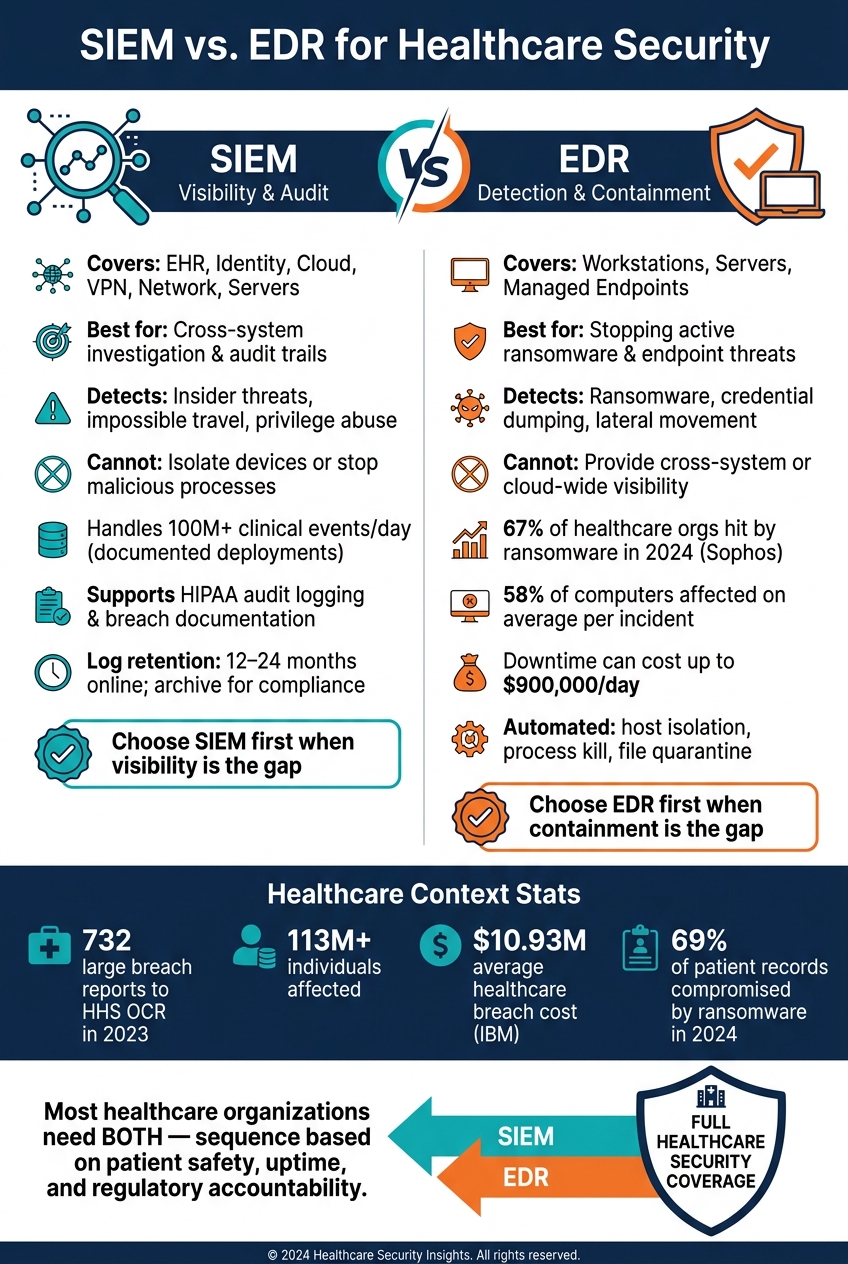
SIEM vs. EDR for Healthcare: Key Differences at a Glance
SIEM, EDR, XDR, SOAR Explained in 7 Minutes
sbb-itb-535baee
Quick Comparison
| What I need | SIEM | EDR |
|---|---|---|
| See activity across many systems | Yes | No |
| Search long-term logs for audits and breach review | Yes | Limited |
| Spot suspicious endpoint behavior in near real time | Limited | Yes |
| Isolate a device during an attack | No | Yes |
| Investigate insider access to EHR data | Yes | Limited |
| Protect devices hit by ransomware | Limited | Yes |
| Cover legacy medical devices without agents | Via logs/network data | Often no |
| Lower analyst effort on day one | No | Often yes |
So if you’re asking, “Which tool should I buy first?” my answer is simple: pick SIEM if your main gap is cross-system visibility and audit logging; pick EDR if your main gap is stopping active threats on endpoints. Then build toward both.
SIEM in Healthcare
SIEM pulls security data from across healthcare systems into one place and links related events together. NIST defines SIEM as an application that "gathers security data from information system components and presents it as actionable information via a single interface."[2] In healthcare, that matters because it helps teams connect identity activity, EHR access, cloud actions, and network events into one incident timeline.
That timeline is where SIEM shines.
A suspicious login in an identity provider, followed by odd EHR access and a large cloud file download, can look harmless when each event sits on its own. SIEM ties those events together, so security teams can trace a compromised account across systems without losing sight of the care workflow around it. In distributed care settings, that cross-system view matters even more, since the root of an incident may be account misuse or abused privileges, not the endpoint itself.
Where SIEM Adds the Most Value
SIEM tends to pay off most in log aggregation, forensic search, and insider threat monitoring. Healthcare teams can dig through weeks, months, or even years of retained logs to piece together what happened before, during, and after a breach. AHIMA guidance recommends keeping EHR audit logs for at least three years because legal cases and regulatory reviews often stretch over long periods.[1]
For insider threat detection, SIEM looks at normal user behavior and flags outliers, such as:
- unusual EHR access volume
- off-hours logins
- large data exports
- logins from unfamiliar locations
The catch is simple: SIEM can see the incident clearly, but it does not stop it.
SIEM Strengths and Limitations for Incident Response
SIEM is good at showing the full story across systems. It can detect and document incidents, but it cannot isolate devices or kill malicious processes. For example, it may show that a compromised account touched multiple servers and downloaded patient records. During an active incident, though, that gap can slow response when every minute counts.
The other big issue is tuning. At hospital scale, SIEM can handle a huge event load - more than 100 million clinical transaction events per day in one documented deployment.[3] But if correlation rules are poorly designed, or if no one keeps refining them, alert fatigue hits fast. Healthcare teams need clear use cases, written runbooks, and analysts who know the difference between normal clinical workflow and suspicious access behavior.
Here’s the tradeoff at a glance:
| Area | Strength | Limitation |
|---|---|---|
| Centralized visibility | Single view across EHR, cloud, network, and identity systems | Requires all key log sources to be integrated |
| Cross-system correlation | Connects identity, VPN, EHR, and server activity into one timeline | Depends on clean, normalized logs |
| Historical forensics | Supports long-term log retention for investigations and audits | Storage and retention costs scale with event volume |
| Insider threat detection | Flags anomalous access, off-hours logins, and data export spikes | Needs behavioral baselines and ongoing tuning to reduce noise |
| Compliance reporting | Supports audit trails and breach response documentation | Report quality depends on log completeness and use-case design |
| Endpoint containment | - | Cannot isolate devices or stop malicious processes |
| Staffing requirements | - | Requires ongoing tuning and trained analysts |
EDR in Healthcare
Where SIEM helps you see the bigger picture, EDR helps you stop the hit at the device itself.
EDR watches endpoints in real time and gives healthcare teams a way to detect, contain, and investigate threats at the device level. It gathers endpoint telemetry on processes, files, network connections, scripts, and privilege escalation across supported servers and workstations. Modern EDR platforms also use behavioral analytics to flag suspicious activity. That matters in healthcare because ransomware and credential-theft tools are often built to slip past old-school antivirus.
Ransomware is still a major risk for healthcare. Sophos found that 67% of organizations were hit in 2024, and 58% of computers were affected on average.[4][6]
Where EDR Adds the Most Value
EDR tends to matter most on busy, high-risk endpoints: clinician workstations, front-desk registration PCs, administrative laptops, file servers, and authentication servers. In plain English, that means the systems staff use every day to get into EHR platforms, imaging systems, and lab apps that handle patient data.
Its biggest strength is fast containment. That becomes a big deal when a workstation or server shows signs of active compromise. If a receptionist PC starts encrypting files, or a nurse station workstation launches an unauthorized remote access tool, EDR can isolate that device from the network, stop the malicious process, and quarantine harmful files. In healthcare, speed is everything. Downtime can cost up to $900,000 per day.[7]
EDR also helps during triage by collecting forensic artifacts right away, so investigators can start with device-level evidence immediately after containment.
EDR Strengths and Limitations in Healthcare Environments
EDR has two main limits in healthcare: agent coverage gaps and care-safety risk.
First, not every clinical asset can run an EDR agent. Many environments still rely on legacy systems, embedded systems, and medical devices that either can't support an agent or won't allow one. For those systems, teams usually lean on compensating controls like:
- Network segmentation
- Allowlisting
- Network-based monitoring
The second issue is patient safety. Isolating an endpoint that supports an active care workflow can create real risk for patients. That's why containment playbooks should be approved in advance by clinical leadership, with clear rules for when isolation makes sense and when another response is safer.
You can see these tradeoffs most clearly when EDR is stacked up against SIEM.
| Area | Strength | Limitation |
|---|---|---|
| Real-time endpoint telemetry | Continuous monitoring of process, file, and network activity on devices | Limited to managed, agent-supported endpoints |
| Behavioral detection | Identifies ransomware, lateral movement, and credential theft without relying on signatures | Requires baselining normal clinical workflows to cut false positives |
| Rapid containment | Can isolate devices, kill processes, and quarantine malicious files during active incidents | Containment actions need pre-approved playbooks; misuse can disrupt care workflows |
| Forensic collection | Captures device-level artifacts for triage and investigation | Evidence scope is limited to the endpoint; no cross-system correlation |
| Coverage on legacy or medical devices and cross-system visibility | - | Many clinical and IoMT devices cannot support agents; does not cover cloud activity, network-wide events, or non-endpoint log sources |
SIEM vs. EDR: A Direct Comparison
Key Differences Side by Side
The table below lays out the healthcare differences that matter most.
| Dimension | SIEM | EDR |
|---|---|---|
| Primary purpose | Centralize and correlate logs across the environment for detection and retention | Monitor endpoint activity in real time to detect and contain active threats at the device level |
| Coverage scope | Broad: network, identity, cloud, EHR, and device logs | Deep on endpoints, narrow in scope; limited on legacy or proprietary medical devices |
| Data collected | Normalized logs and events, retained for longer investigations and audit needs | High-fidelity endpoint telemetry - process trees, file writes, registry changes, command-line arguments - typically retained in shorter investigative windows |
| Detection style | Cross-source pattern detection, such as impossible travel and privilege abuse | Behavioral endpoint detection - flags ransomware, credential dumping, and malicious scripts in near real time |
| Response capability | Alerts and orchestrates; does not contain endpoints directly | Direct containment: isolate devices, stop processes, quarantine files |
| Audit value | High for audit readiness and access reporting | Indirect: demonstrates technical safeguards on workstations and servers, but does not replace organization-wide logging |
| Forensics | Reconstructs cross-system incidents | Shows device-level compromise details |
Here’s the plain-English version: SIEM gives you the big picture, while EDR deals with the machine under attack.
A SIEM helps teams piece together what happened across systems. That matters in healthcare, where activity can stretch across identity tools, cloud apps, EHR platforms, servers, and connected devices. EDR, by contrast, stays close to the endpoint. It watches for suspicious behavior and can step in fast by isolating a device, killing a process, or quarantining a file.
So the main operational question is simple: which tool should lead the response?
SIEM shows the broader incident. EDR stops the endpoint attack. From there, the next issue is deciding which one should come first in a healthcare response plan.
Choosing the Right Tool for Healthcare Incident Response
Once you see the tradeoffs, the choice gets pretty simple: which gap hurts more right now - visibility or containment? Pick based on visibility, containment speed, compliance burden, and staffing. Neither tool wins in every case. The better fit is the one that deals with your most urgent problem first.
When SIEM Is the Better Starting Point
SIEM makes the most sense when your team needs one place to see activity across a lot of systems. It’s a good starting point when investigations rely on centralized logs from EHRs, identity platforms, cloud systems, and device networks. In multi-site or hybrid-cloud setups, centralized log collection often comes first.
SIEM is also a strong fit when compliance reporting is high on the list, especially for HIPAA or HITRUST assessments. It helps support centralized audit logging across PHI systems and identity providers.
There’s also a practical staffing angle here. If your security team already has a SOC, or you work with a strong MSSP, SIEM will usually pay off sooner. Someone needs to tune correlation rules, build use cases, and handle investigations. Without that support, a SIEM deployment can create more noise than signal.
Use SIEM first when the bigger issue is seeing the incident clearly across systems.
When EDR Should Come First
EDR should come first when ransomware is the clearest day-to-day risk. Ransomware accounted for 69% of all patient records compromised in 2024 despite representing only 11% of breach incidents by count.[5][8] That’s a hard number to ignore. It makes a strong case for putting endpoint detection and containment first.
EDR also makes sense when your most important assets sit on clinical workstations, EHR and imaging servers, and domain controllers, and when your security team is small. In healthcare, those systems support care delivery directly. If one gets hit, operations can go sideways fast.
For smaller teams or outsourced SOCs, EDR’s built-in automation can do a lot of the heavy lifting. That includes:
- behavior-based ransomware detection
- automated host isolation
- process termination
- file quarantine
That kind of response can deliver immediate protection without deep log-correlation skills. MDR can also extend EDR for smaller teams.
Use EDR first when stopping the attack at the endpoint matters most.
How Both Tools Fit into a Broader Healthcare Risk Program
Most healthcare delivery organizations end up needing both. A practical path is to start with EDR and MDR for immediate endpoint protection, then add SIEM once logging infrastructure and analyst capacity are in place.
Even with strong SIEM and EDR coverage, some healthcare risks still sit outside what incident response tools can handle. A broader risk program also needs to deal with third-party risk, medical device exposure, and supply-chain exposure. Censinet RiskOps™ can support those broader assessments.
Healthcare Implementation Considerations and Conclusion
Implementation Factors That Affect Outcomes
In healthcare, rollout limits often decide what gets deployed first. Many hospitals still rely on legacy systems or regulated devices that can't support EDR agents. Because of that, coverage usually has to be tiered by asset type.
For devices where agents aren't an option, the fallback is pretty clear: use segmentation, strict firewall rules, and passive monitoring to lower risk. SIEM can then pull in network-level telemetry from those segments, which helps teams keep visibility in places where EDR can't operate.
After coverage is mapped, log quality becomes the next make-or-break issue for SIEM. If timestamps don't line up or key fields are missing, correlation falls apart fast. A practical move is to set a logging standard before onboarding sources. That standard should spell out event types, schemas, data owners, retention windows, and whether each source contains ePHI. Start with the sources that matter most:
- identity providers
- EHR systems
- remote access
- endpoints
- backups
Retention also needs a tiered setup. Keep 12 to 24 months of complete logs online, then archive older data for compliance and legal review.
This is where the tool decision stops being abstract and becomes an day-to-day tradeoff. Escalation paths can't focus only on technical severity. They also need to reflect clinical impact. A runbook that isolates a clinical workstation without coordination might slow or interrupt care. Escalation decisions should be tied to clinical impact levels: no impact, degraded service, or safety risk so security actions are coordinated with clinical leadership before they affect care delivery.
Conclusion: Match the Tool to the Response Objective
The choice comes down to the first question you need answered: Where did this happen across our systems? or How do we stop it right now at the endpoint?
SIEM supports broad visibility, cross-system investigation, and the audit trails that regulators and legal teams expect. EDR supports fast detection and containment at the endpoint level, using behavioral analytics and automated response without requiring deep log-correlation expertise.
Most healthcare organizations end up needing both. The catch is that sequence and scope should match local conditions: patient safety, system uptime, and regulatory accountability.
If the main threat is a fast-moving ransomware attack hitting clinical workstations, EDR should come first. If the urgent need is proving broad monitoring to regulators or investigating suspected PHI access across many systems, SIEM should take priority. Most organizations need both; sequence them based on patient safety, uptime, and regulatory accountability. Used together, they strengthen healthcare resilience.
FAQs
Can SIEM and EDR work together in healthcare?
Yes. SIEM and EDR work well together in healthcare because they bring different pieces of the puzzle into one place. EDR shows what’s happening on endpoints, while SIEM pulls in network, identity, and application logs. Put them together, and security teams get a more unified view of threats and a better shot at spotting complex attack chains in real time.
Censinet RiskOps™ adds third-party and enterprise risk context to that picture. That helps healthcare organizations focus response efforts on the systems that matter most, including critical clinical assets, medical devices, and PHI-handling systems.
Which tool is better for HIPAA audit needs?
For HIPAA audit needs, SIEM is usually the stronger primary control. It pulls logs into one place across the enterprise and turns them into structured, searchable audit records that line up well with HIPAA audit control standards.
EDR still plays an important part. It gives you endpoint forensic logs that can help during investigations. But for continuous log review, long-term retention, and compliance reporting, SIEM is the better fit.
Censinet RiskOps™ can also help support this work by helping teams manage risk assessments and document remediation.
How do hospitals protect devices that cannot run EDR?
Hospitals often have to protect medical and legacy devices that simply can't run EDR. In those cases, agentless monitoring does the job by watching network activity instead of relying on software installed on the device itself.
Passive network sensors let security teams see what's normal for each device, then flag unusual behavior as it happens. They can also spot odd connections and unauthorized configuration changes before those issues spread.
If a device starts acting suspiciously, teams can contain it without shutting down care. Common options include:
- Microsegmentation
- VLANs
- Access restrictions
That way, hospitals can limit risk while keeping core clinical systems running.
