
If you sell into U.S. healthcare, SOC 2 software is not just about passing an audit. It’s about proving that your PHI controls, vendor reviews, and log retention can hold up under buyer checks.
I’d boil this article down to a simple point: the best tool depends on your PHI scope, audit model, and third-party risk load. For most teams, the shortlist is clear: Drata, Vanta, Thoropass, Secureframe, Sprinto, Aptible, and Censinet RiskOps. The main things to check are HIPAA-to-SOC 2 mapping, BAA support, 6-year log retention, access reviews, and cloud/EHR/FHIR integrations.
A few numbers make the stakes clear:
- 55% of healthcare organizations have faced healthcare supply chain security challenges
- The average healthcare breach cost is $9.77 million
- A Type 2 audit often adds $15,000 to $40,000 on top of software cost
- Sprinto starts around $8,000 to $10,000 per year
- Drata cites a drop from 980 hours to 220 hours for audit and evidence work
Here’s the short version of who fits where:
- Drata: best if you want HIPAA + SOC 2 in one program
- Vanta: best if you want lots of integrations and room to grow
- Thoropass: best if you want software plus an audit firm together
- Secureframe: best if you want more hands-on help
- Sprinto: best if price is a big factor
- Aptible: best for infrastructure control automation, not full GRC
- Censinet RiskOps: best if SOC 2 sits inside a larger healthcare risk program
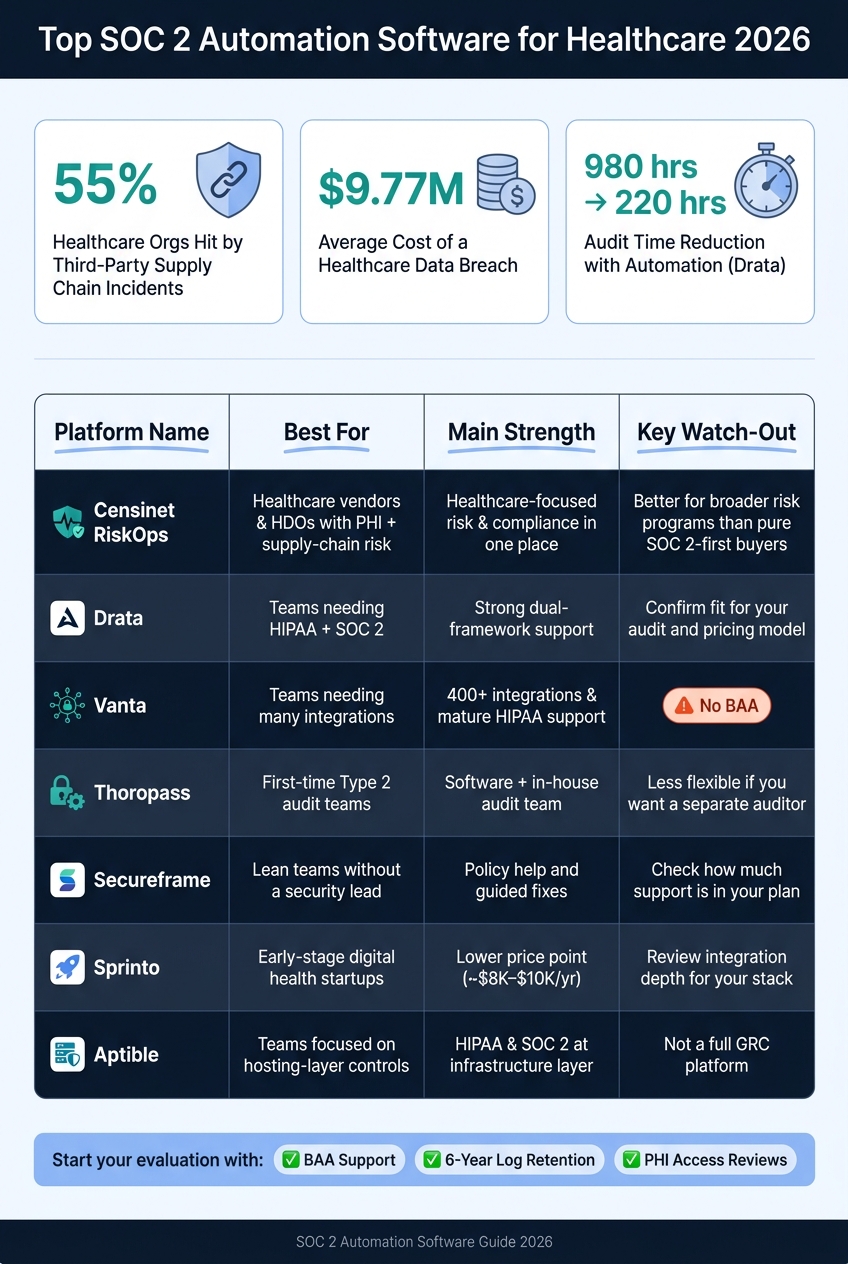
Top SOC 2 Automation Software for Healthcare 2026: Side-by-Side Comparison
Quick Comparison
| Platform | Best Fit | Main Strength | Watch-Out |
|---|---|---|---|
| Censinet RiskOps | Healthcare vendors and HDOs with PHI and supply-chain risk | Healthcare-focused risk and compliance in one place | Better fit for broader risk programs than pure SOC 2-first buyers |
| Drata | Teams needing HIPAA + SOC 2 | Strong dual-framework support | Confirm fit for your audit and pricing model |
| Vanta | Teams needing many integrations | 400+ integrations and mature HIPAA support | No BAA |
| Thoropass | First-time Type 2 teams | Software + in-house audit team | May be less flexible if you want a separate auditor |
| Secureframe | Lean teams without a security lead | Policy help and guided fixes | Check how much support is included in your plan |
| Sprinto | Early-stage digital health startups | Lower price point | Review integration depth for your stack |
| Aptible | Teams focused on hosting-layer controls | HIPAA and SOC 2 controls at the infrastructure layer | Not a full GRC platform |
My take: if you handle PHI, start with BAA terms, retention rules, and PHI access review support before you look at dashboards or templates. That one filter will cut your list fast.
Below, I break down which platform fits which healthcare use case, and what I’d ask before signing a contract.
sbb-itb-535baee
How to Evaluate SOC 2 Automation Software for Healthcare
Healthcare teams need software that can show PHI controls, audit readiness, and third-party risk management. A generic compliance checklist won’t cut it.
Core evaluation criteria used in this roundup
Once you get past the basics, the real issue is simple: which platforms can handle healthcare compliance without adding extra work?
Every platform in this roundup was reviewed against six core criteria: automation depth, continuous control monitoring, integration coverage, multi-framework support, reporting quality, and vendor-risk support.
Those six areas help separate tools that merely collect evidence from tools that actually cut down the compliance load for healthcare teams.
| Platform | Automation Depth | Continuous Monitoring | Integration Coverage | Multi-Framework Support | Healthcare Fit |
|---|---|---|---|---|---|
| Drata | High | Yes | Very broad | Broad | Best for dual HIPAA+SOC 2 |
| Vanta | High | Yes | Very broad | Broad | Best for scale/integrations |
| Thoropass | High | Yes | Broad | Broad | Best for bundled audits |
| Secureframe | High | Yes | Broad | Broad | Best for expert guidance |
| Sprinto | High | Yes | Broad | Broad | Best for budget-conscious teams |
Healthcare-specific requirements that affect the buying decision
Those baseline features matter, but healthcare vendors face tighter demands around PHI, logs, and third parties.
The biggest one is HIPAA-to-SOC 2 mapping. The platform should connect HIPAA technical safeguards to SOC 2 Trust Services Criteria so your team doesn’t end up running two separate compliance programs side by side [2].
Another must-have is six-year audit trail retention. PHI access logs and security-event logs need to stay available for six years.
BAA management and PHI-scoped access reviews matter more in healthcare than in many other sectors. The platform should track Business Associate Agreement status and renewal dates for every third-party vendor that touches PHI. It should also support role-based reviews for everyone with production PHI access [2]. On top of that, EHR, FHIR, and HIPAA-eligible cloud integrations can shape the buying decision in a big way.
Comparison tables for this section
Use these mappings to line up each platform with your healthcare risk profile.
| Vendor Type | Recommended Platform(s) | Key Reason |
|---|---|---|
| Early-stage digital health | Sprinto | Cost-efficiency and inherited infrastructure controls |
| Medical device vendors | Secureframe / Drata | Strong edge security templates and technical guidance |
| Large health-system vendors | Vanta / Drata | Broadest integrations and multi-framework scale |
| Multi-framework programs | Drata / Vanta | Native support for ISO 27001 and HITRUST mapping |
| Vendor-risk intensive | Drata / Vanta | Advanced vendor risk modules and BAA tracking |
Confirm BAA support before handling PHI.
Top SOC 2 Automation Software Picks for 2026
Using those criteria, the biggest difference between these platforms comes down to how they deal with healthcare risk, PHI workflows, and audit prep.
Censinet RiskOps for healthcare-focused SOC 2 and third-party risk management
Censinet RiskOps™ is built for healthcare organizations that need to handle third-party risk, PHI exposure, and evidence collection in a single workflow. For vendors, that means SOC 2 prep can sit inside the same program as risk work instead of living in a separate lane.
The platform supports portfolio-level risk tiering, automated reassessments, and corrective action planning. Censinet AI™ helps teams move faster by completing third-party risk assessment questions, summarizing vendor evidence, and drafting risk summary reports from assessment data. It also includes guided automation with configurable review steps, so risk teams can keep control while the platform takes care of repetitive tasks.
The other tools below focus more directly on SOC 2 automation, each with its own strengths around integrations, audit help, and guided compliance.
Other leading SOC 2 automation platforms in 2026
The top SOC 2 platforms for healthcare vendors vary based on company size, integrations, audit help, and PHI workflow needs.
Drata is the best fit for dual HIPAA + SOC 2 coverage. Its research cites a 78% drop in audit and data-collection time, from about 980 hours to 220 per year [2].
Vanta works best for teams that need broad integrations and room to scale, with continuous evidence collection across 400+ integrations and a mature HIPAA module. One procurement detail matters here: Vanta does not sign Business Associate Agreements (BAAs) by design, because its architecture is meant to avoid processing PHI [2].
Thoropass is a strong match for teams going through their first Type 2 audit. It combines compliance software with an in-house CPA audit team that has healthcare experience.
Secureframe is a good option for teams without a dedicated security lead. Its healthcare-focused policy templates and compliance-expert model cut down the work tied to guided remediation.
Sprinto is the lowest-cost choice for early-stage digital health companies, with startup pricing starting at $8,000–$10,000 per year [2].
Aptible is an infrastructure-layer tool rather than a full GRC platform. It automates infrastructure controls for SOC 2 and HIPAA at the hosting layer, and it works best alongside a separate GRC tool.
Feature comparison table for the top picks
Use the table below to match each platform with your compliance model and the time your team can put into the process.
| Platform | Best for | Healthcare relevance |
|---|---|---|
| Censinet RiskOps | HDOs and vendors managing PHI, devices, and supply-chain risk | Healthcare-exclusive cybersecurity and risk management |
| Drata | Healthcare vendors needing fast audit readiness | Dual HIPAA + SOC 2 coverage |
| Vanta | Teams needing broad integrations and scale | Mature HIPAA module; no BAA |
| Thoropass | Teams wanting bundled audit + software | Healthcare-experienced auditors |
| Secureframe | Teams needing guided remediation without a dedicated security lead | Healthcare policy templates |
| Sprinto | Price-sensitive early-stage digital health startups | SOC 2 + HIPAA automation |
| Aptible | Teams pairing hosting with a GRC tool | Infrastructure-layer HIPAA and SOC 2 controls |
How to Choose the Right SOC 2 Automation Approach for Healthcare
Match the platform to your compliance and risk model
Pick the simplest platform that still fits your PHI footprint and audit scope.
Start with risk scope, not a flashy feature list. A single-product SaaS vendor may just need a fast way to get through SOC 2. But a healthcare vendor that handles PHI, works with subprocessors, or supports EHR/FHIR workflows usually needs HIPAA mapping and third-party risk controls too.
If your main goal is to pass a SOC 2 Type 2 audit fast, a SOC 2-first platform with guided onboarding and ready-made policy templates is a strong place to begin. If you already have a HIPAA program in place, look for a platform that brings HIPAA and SOC 2 controls together - especially Security, Confidentiality, and Availability [2].
Sometimes compliance is tied to a bigger healthcare risk picture. In that case, the platform needs to do more than help with audit prep. Healthcare-specific platforms make sense for vendors managing PHI, clinical apps, devices, and supply-chain risk. That’s where Censinet RiskOps™ fits: a healthcare-exclusive platform that supports third-party and enterprise risk assessments, cybersecurity benchmarking, and automated workflows.
Key buying questions for U.S. healthcare teams
Before you sign a contract, put each platform through a simple stress test.
On PHI and HIPAA alignment:
- Will the vendor sign a Business Associate Agreement (BAA)? [2]
- Does the platform support 6-year retention for PHI access logs and security event records under HIPAA §164.316(b)? [2]
- Can it automate role-based access reviews for personnel with access to production PHI? [2]
On integrations and evidence collection:
- Does the platform integrate with AWS, GCP, or Azure HIPAA-eligible services and automatically verify encryption on PHI-containing systems? [2]
- Can the tool collect evidence directly from EHR or FHIR API environments? [2]
On audit model and total cost:
- Do you want a bundled audit model, where software and the CPA firm come together, like Thoropass, or do you want an independent auditor marketplace?
- What’s the all-in cost? Independent SOC 2 Type 2 audit fees usually add $15,000–$40,000 on top of software costs [2].
- Are there price caps on renewals as your vendor portfolio grows across frameworks like ISO 27001 or HITRUST?
These filters help you narrow the list to the platform that fits your PHI exposure, audit model, and budget.
Conclusion: Choosing SOC 2 Automation Software Based on Healthcare Risk Complexity
Pick the platform that fits your PHI scope, subprocessor footprint, and framework needs.
The right choice comes down to one thing: is your main problem audit readiness, or do you need a broader system for PHI and vendor-risk management in healthcare? If your PHI footprint is larger, look first at automation depth and HIPAA-to-SOC 2 control mapping. If your team runs a broader healthcare risk program, Censinet RiskOps keeps PHI, vendor, and compliance risk in one workflow.
BAA tracking and subprocessor review should be table-stakes. With 55% of organizations hit by third-party supply chain incidents [1], these controls aren't optional.
SOC 2 automation should give you:
- Continuous evidence collection
- HIPAA-mapped controls
- PHI-specific access and retention support
The simplest buying filter is this: start with PHI scope, BAA support, and auditor-tested retention and access review controls.
FAQs
How do I know if I need BAA support?
Under HIPAA, you need a Business Associate Agreement (BAA) for any vendor that handles, processes, or can access PHI.
That means if your SOC 2 automation software, or any other digital platform, connects to systems that contain PHI, the vendor needs to sign a BAA. Before you share any data, make sure you’ve identified every vendor that touches PHI and put those agreements in place.
What should healthcare teams check before buying SOC 2 software?
Before buying SOC 2 software, healthcare teams need to make sure it covers HIPAA-specific safeguards, not just broad security work.
That matters because a tool can help with SOC 2 and still fall short for healthcare use. If protected health information is in the mix, the software should fit the day-to-day compliance needs that come with PHI.
Look for support in a few key areas:
- A Business Associate Agreement (BAA)
- Support for 6-year PHI access-log retention
- Tools for PHI-specific access reviews
- EHR integrations
- Clear mapping between HIPAA controls and the SOC 2 Trust Services Criteria
In plain terms, you want software that does more than check generic security boxes. It should help your team connect HIPAA work to SOC 2 work without gaps.
Can one platform support both HIPAA and SOC 2?
Yes. A single platform can support both HIPAA and SOC 2 because about 60% to 70% of the required controls overlap. That includes things like data encryption, incident response, and access reviews.
Censinet RiskOps™ helps healthcare organizations bring these efforts together in one place. It combines SOC 2 workflows with enterprise and third-party risk management, including BAA obligations and PHI-related risks.
