
Medical device cyber risk does not end at launch. Once devices are in hospitals, the biggest weak spots often come from third-party software, firmware, hardware parts, and vendor support that change long after shipment.
If I had to boil this article down to the main point, it would be this: you need more than one control to deal with postmarket supply chain risk. The four main options each solve a different problem:
- SBOM-driven management helps me find exposed software parts after a new CVE is disclosed
- Manual inventory and ad hoc patching may work at small scale, but often slows response and leaves gaps
- Secure-by-design hardware and manufacturing controls help block bad firmware, tampering, and weak factory settings before devices ship
- HDO third-party risk management programs help me hold vendors to patch, disclosure, and support duties after deployment
A few numbers show why this matters:
- 993 vulnerabilities were found across 966 medical products and devices in one 2023 industry report
- 53% of connected medical devices had at least one known critical vulnerability
- 99% of hospitals had at least one IoMT device with a known exploited vulnerability
- 60% of medical devices were end-of-life with no security patches available
So the short answer is simple:
- If the problem is software traceability, start with SBOMs
- If the problem is device and firmware integrity, start with hardware trust controls
- If the problem is vendor follow-through, start with TPRM
- If you rely on manual tracking alone, expect slower response and more blind spots
No single approach is enough on its own. The best path is to combine software visibility, device-level integrity checks, and vendor oversight so you can spot issues, rank patient risk, and act before a field issue gets worse.
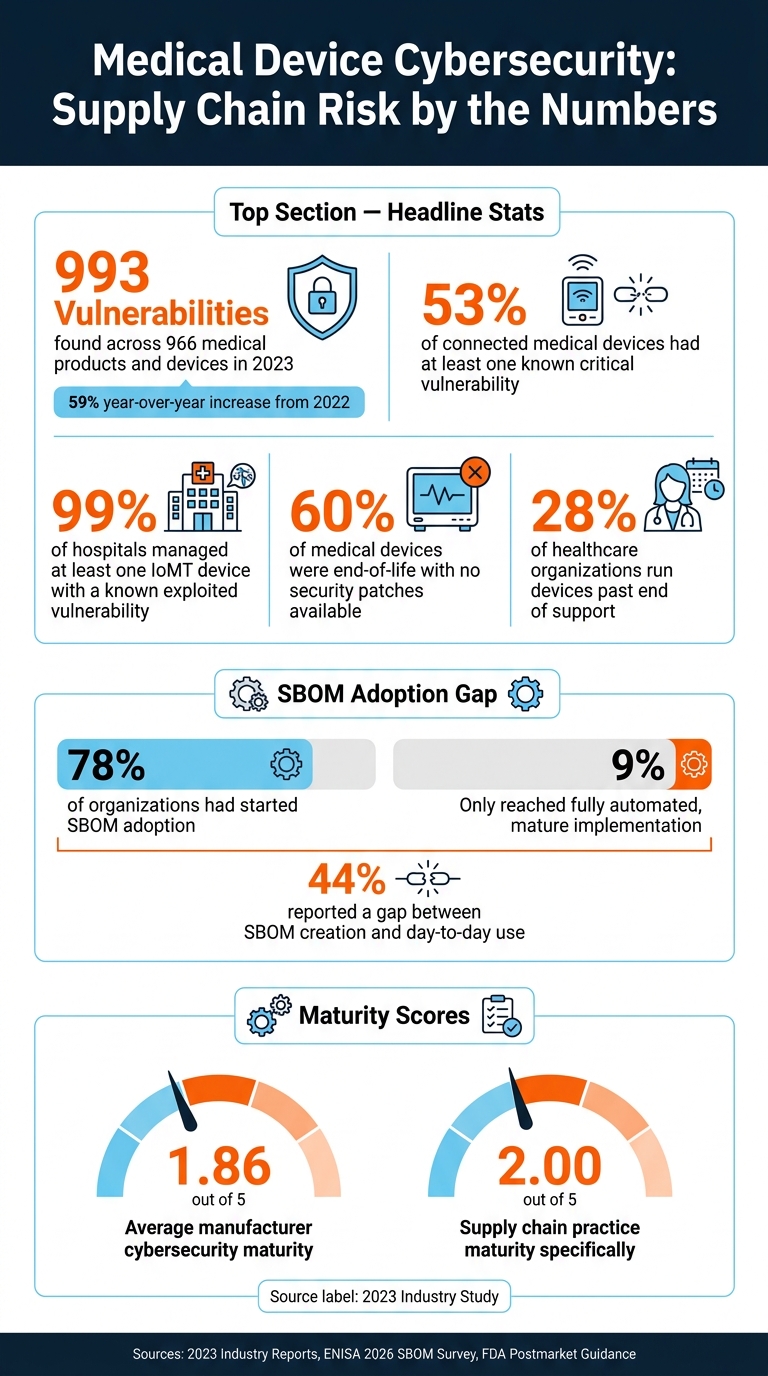
Medical Device Cybersecurity: Key Supply Chain Risk Statistics
Medical Device Security: What Must Be Decided Early
sbb-itb-535baee
Quick Comparison
| Approach | Best Use | Main Upside | Main Limitation |
|---|---|---|---|
| SBOM-Driven Management | Finding exposed software components after a CVE | Strong component traceability and faster search across deployed devices | Depends on current, complete SBOM data |
| Manual Inventory & Ad-Hoc Patching | Small fleets or temporary stopgaps | Low setup cost | Slow, error-prone, and hard to scale |
| Secure-by-Design Hardware | Protecting firmware, boot process, and device integrity | Helps stop bad or altered code from running | Often limited to newer devices and adds upfront cost |
| HDO TPRM Programs | Vendor oversight, patch SLAs, and disclosure duties | Clear accountability and contract-based follow-up | Depends on vendor response and internal staffing |
If you want the plain-English takeaway, it’s this: SBOMs tell you what’s exposed, hardware controls help block tampering, and TPRM tells you who must act when something goes wrong.
1. SBOM-Driven Software Supply Chain Management
A software bill of materials (SBOM) is the inventory of software parts inside a medical device. That includes commercial software, open-source code, and third-party components. Under Section 524B of the Food, Drug, and Cosmetic Act, manufacturers must submit an SBOM for cyber devices. The FDA also expects that SBOM to stay up to date as software changes and new vulnerabilities appear. In practice, it works like a living record that ties straight into postmarket field response.[2][4][6][8][1][9]
Regulatory Alignment
A compliant SBOM program uses machine-readable formats like CycloneDX or SPDX. It also tracks each component’s version, supplier name, CPE/PURL identifiers, and end-of-support dates in version control alongside the design history file. That level of detail matters.
If a manufacturer treats the SBOM like a box to check, it can miss the mark on Section 524B duties tied to continuous monitoring, patch readiness, and transparency.[1][5][7][8][3][6][9][2][4] Used the right way, the SBOM becomes a live search tool. When a new vulnerability drops, teams can look up affected components instead of scrambling through old records.
Postmarket Visibility
When a new CVE is disclosed, a current SBOM helps teams search the deployed fleet and spot affected devices fast. That speed can make a big difference in the field.
Pairing SBOMs with sources like the National Vulnerability Database (NVD) and CISA's Known Exploited Vulnerabilities (KEV) catalog makes triage faster and more exact. Teams can focus on what is exposed and under active attack instead of chasing every alert that pops up. A 2023 industry report found 993 vulnerabilities across 966 medical products and devices, a 59% year-over-year increase from 2022.[5][7][11][13][12]
Patient Safety Impact
Once exposure is confirmed, the next move is clinical prioritization. In devices like an infusion pump or cardiac monitor, a vulnerable component can affect performance and patient harm. That’s where SBOM-driven programs help most.
They let manufacturers quickly verify whether a safety-critical device is affected, rank remediation by clinical impact, and give HDOs clear guidance on compensating controls while a patch is being validated.[1][5][7][8] At scale, none of this works well without automated generation and clean component data.
Scalability for Deployed Devices
Scaling SBOMs across deployed devices takes more than making a file once and filing it away. It calls for automated generation in build pipelines, a searchable repository linked to SKUs and software versions, and tools that map components to vulnerability feeds.
ENISA's 2026 SBOM survey found that 78% of organizations had started SBOM adoption, but only 9% had reached fully automated, mature implementation. Another 44% reported a gap between SBOM creation and day-to-day use.[3][5][6][14][10] That gap slows field remediation.
SBOM quality matters too. Research on medical device SBOM generation found common completeness issues, including missing component relationships, missing versions, and missing supplier names. When those details are absent, remediation gets slower at the exact moment teams need answers fast.[3][5][6][14][10]
2. Manual Software Inventory and Ad-Hoc Patching
Manual inventory and ad hoc patching leave HDOs with a big blind spot: supplier-driven changes in deployed devices. In most cases, teams rely on spreadsheets, device logs, and periodic inventory checks to track operating systems, firmware, and application versions. Patching usually happens after the fact - once a CVE notice, vendor alert, or FDA safety communication shows up - instead of through a defined program.
Regulatory Alignment
Manual work can catch one-off problems, but it falls short for a systematic postmarket program. FDA postmarket cybersecurity guidance calls for accurate, current configuration and software records, structured risk review, and repeatable proof of patch management. Manual records are often scattered and out of date, which makes that kind of oversight hard. They also tend to lack the logs, dashboards, and reports auditors expect.
Standards such as NIST SP 800-53 and AAMI/UL medical device cybersecurity guidance also call for defined asset inventory and patch management workflows. That is tough to keep up with by hand once the number of devices starts to grow.[5][19]
Postmarket Visibility
The main issue with manual inventory is simple: it gives you a snapshot, not an always-current view. A spreadsheet or local list may look fine on day one, but it gets old fast as devices are upgraded, retired, or moved across departments. And without component-level data, teams can't quickly tell which devices are exposed when a new third-party library issue or OS flaw comes to light.
That slows everything down. In manual-only setups, it often takes weeks to connect a new disclosure to the devices it affects. The numbers make that gap hard to ignore:
- 53% of connected medical devices have at least one known critical vulnerability.
- 99% of hospitals manage at least one IoMT device with a known exploited vulnerability.[15][16][20]
Patient Safety Impact
Unpatched flaws on clinical devices are not just a compliance problem. They can put patient safety at risk too. If the inventory is incomplete, clinicians and biomedical staff may not know which devices are exposed. That makes it harder to pull risky equipment out of critical workflows before something goes wrong.
Ad hoc patching brings its own problems. A rushed update can introduce compatibility issues, latency, or interface changes that affect clinical use. FDA guidance stresses the need to weigh cybersecurity risk against possible effects on device safety and performance. That balancing act is much harder when the process is informal and done under pressure.[1][21][22]
Scalability for Deployed Devices
Manual methods start to crack as device fleets get bigger. Every new device type, vendor, or facility adds more coordination work, and staff can’t keep up with the flow of vendor advisories. What happens next is predictable: newer networked systems get more attention, while older or less visible devices slip through the cracks.
Current data points to how serious that gap is:
- 60% of medical devices are end-of-life with no available security patches.
- 28% of healthcare organizations run devices past end of support.[16][17][18]
At that scale, a manual program can’t close the gap without more staff and more budget. When inventory and patching are handled by hand, the next control point moves upstream to supplier qualification, secure boot, and manufacturing integrity.
3. Secure-by-Design Hardware and Manufacturing Controls
When manual inventories break down and patching happens too late, the next line of defense starts upstream. Secure-by-design hardware and manufacturing controls cut medical device security risks before a device ever ships, instead of trying to clean things up after deployment. That matters because a supplier, assembler, or firmware workflow can introduce hidden exposure long before an HDO puts the device into use.
Regulatory Alignment
This approach usually includes locking down or disabling debug and test ports like JTAG and UART before delivery, placing tamper-evident seals on enclosures and communication ports, and cryptographically signing firmware so a device can verify that an update is legitimate before it runs it.[2][25] In plain terms, the goal is simple: stop weak points from leaving the factory in the first place.
Standards such as IEC 81001-5-1 and IEC 62443-4-1 give teams a clear structure for secure development and manufacturing. That matters because supplier quality and factory integrity often decide whether a vulnerability is built in before first use.
Postmarket Visibility
Hardware controls also give HDOs signals they can actually verify across deployed fleets. If each device gets a distinct identity during manufacturing, asset management tools can track what is deployed, where it is, and which firmware version it is running with much better accuracy.
Hardware roots of trust can also provide attestation capabilities - cryptographic proof that a device is running an approved, unmodified software baseline - that security platforms can query at scale.[23][24] That turns hardware trust signals into more than a security feature. They also help with everyday asset control.
Censinet RiskOps™ can pull these hardware-backed signals into broader medical device risk programs, which helps improve fleet visibility and speed up the identification of outdated or suspect configurations.
Patient Safety Impact
For patient safety, the biggest upside is the shift from reactive protection to prevention. Secure boot makes sure only signed, validated firmware loads on a device. That lowers the chance that malicious or corrupted software could interfere with therapy delivery or patient monitoring.
Devices that are built to fail safely add another layer of protection. If integrity checks fail, the device can move into a safe mode instead of continuing in an unsafe state. That is a better option than depending on manual isolation or field configuration changes after an integrity failure.
Scalability for Deployed Devices
Remote attestation lets centralized platforms check the integrity and configuration state of entire fleets at scale.[26] That sounds straightforward, but there is a catch: older or low-power devices often do not support these features.
The result is a split fleet:
- Newer hardware supports automated, large-scale security management
- Legacy devices still depend on manual workarounds
That gap is why secure manufacturing practices matter so much for long-lived fleets. Where device-level controls end, HDO risk programs have to carry the oversight forward into vendor management and service relationships.
4. HDO Third-Party Risk Management Programs
When device-level controls stop at the product boundary, vendor governance keeps oversight in place. HDO third-party risk management (TPRM) adds the governance layer: vendor obligations, verification, and accountability. It spells out what vendors must do, checks whether they’re doing it, and makes clear who answers when requirements are missed. The big issue is simple: do vendor controls stay up to date after deployment?
Regulatory Alignment
Strong TPRM programs tie vendor control requirements to FDA postmarket cybersecurity guidance, the HIPAA Security Rule, and frameworks such as the NIST Cybersecurity Framework and HITRUST. An HDO shouldn’t bring on a device vendor without a risk assessment, a documented security posture, and contract terms that cover breach notification, vulnerability disclosure, and lifecycle patch support.
That work can’t sit still. HDOs need to track rule changes and update questionnaires, playbooks, and contract templates each year, or sooner if guidance shifts. HSCA guidance pushes HDOs to require suppliers to warrant compliance with FDA guidance and security frameworks like NIST, ISO, and CIS directly through procurement contracts.[27] That kind of alignment becomes most important when vulnerabilities are disclosed and field response starts.
Postmarket Visibility
After deployment, TPRM keeps vendor reporting repeatable, structured, and consistent.[28] In practice, that means requiring coordinated vulnerability disclosure, regular reporting on patch availability and end-of-support timelines, and clear notice windows for high-risk vulnerabilities.
HDOs should also require SBOM updates as part of vendor oversight.[28] Once that information starts flowing in a steady way, the next issue is speed: how fast can the HDO act on clinical risk?
Patient Safety Impact
TPRM programs help patient safety when vendors are required to disclose vulnerabilities quickly and provide validated fixes or compensating controls. That gives HDOs time to put safeguards in place before exploitation reaches clinical devices.[30][32]
Those safeguards may include:
- Network segmentation
- Disabling affected services
- Scheduled patching
Risk scoring should also reflect clinical impact, so life-sustaining devices move to the front of the line.
Scalability for Deployed Devices
Scaling TPRM takes risk-based tiering and clear ownership.[29][31] HDOs can group vendors by criticality, such as life-sustaining versus ancillary and connected versus standalone. That lets teams save deep assessments for high-risk categories, where postmarket vulnerability response has the most at stake.
Ownership also needs to be clear across teams. Information security handles control design and risk scoring. Supply chain puts requirements into contracts. Clinical engineering checks operational impact. Compliance watches for alignment with regulatory expectations. Standardized questionnaires and automated workflows cut the load for low-risk vendors, which helps keep the program manageable without giving up consistency.[33]
Tradeoffs by Risk Scenario
No single control handles every postmarket supply chain risk. The best option depends on the issue in front of you: software traceability, firmware trust, manufacturing continuity, or vendor accountability. Put simply, these scenarios show how the controls discussed earlier play out in day-to-day operations.
Scenario 1: A newly disclosed CVE in an open-source component.
SBOMs are the fastest option when the main question is simple: Is this component in any deployed device?
Scenario 2: A firmware flaw in a third-party networking module.
Fixing this takes more time because the problem can spill across company lines. Each affected OEM, supplier, and HDO may need its own validation process and manual verification. In this case, secure boot and signed updates matter most, because they help contain the issue and support remediation when third-party firmware is involved.
Scenario 3: A ransomware outage at a contract manufacturer.
This is a continuity problem, not a device defect. TPRM matters most here because it sets the path for escalation and alternate sourcing when a manufacturer goes down.
Scenario 4: A supplier missing a patch SLA.
At its core, this is an accountability and documentation issue. TPRM is strongest in this situation because it creates the audit trail and the escalation record.
The table below compares the four approaches across detection speed, traceability, remediation, and documentation.
| Risk Scenario | SBOM-Driven Management | Manual Inventory & Ad-Hoc Patching | Secure-by-Design Controls | HDO TPRM Programs |
|---|---|---|---|---|
| CVE in open-source component | Fast for identifying exposed components and versions; strong traceability. | Slow and error-prone; may miss dependencies. | Can reduce exploitability, but does not identify exposure. | Useful for vendor escalation, but not a substitute for component traceability. |
| Firmware flaw in networking module | Helpful if firmware and component identities are documented; may still need manual verification. | Slow at fleet scale and prone to gaps. | Strongest when secure boot and signed updates are already built in. | Helps coordinate supplier and HDO response, but depends on vendor responsiveness. |
| Ransomware at contract manufacturer | Helps identify affected device lines, but does not restore operations. | Weak for continuity because dependencies are often incomplete. | Limited immediate value because the problem is operational continuity. | Strongest for continuity planning, alternate sourcing, and escalation. |
| Supplier missing patch SLA | Helps document support status, end-of-support dates, and risk controls. | Often weakest because it relies on local knowledge and manual follow-up. | Can limit exposure if rollback, secure update, or isolation is built in. | Strong for escalation, contractual enforcement, and evidence collection. |
The next section turns these tradeoffs into direct pros and cons.
Pros and Cons
The examples above show where each control makes sense. Here, the focus shifts to what each one does well and where it tends to fall short in day-to-day use.
SBOM-driven management stands out when time is tight. If you have a current, machine-readable SBOM, you can spot affected devices fast and respond to a CVE with far less guesswork. The downside is pretty plain: if the component data is missing, old, or uneven across vendors, the whole process gets shaky. And even with a strong SBOM, you still need patching and vendor follow-through.
Manual inventory and ad hoc patching may look cheap at first. That makes them tempting, especially for smaller teams. But the cracks show fast. As the device fleet grows, this approach gets slow, messy, and hard to keep up with.
Secure-by-design hardware offers the strongest integrity baseline. Features like secure boot, hardware roots of trust, and signed updates help lock down the device at its core. The catch is cost. It usually requires a bigger upfront spend, and it does little for older devices already in service.
HDO third-party risk management matters when the issue goes beyond finding a problem. In many cases, the harder part is deciding who needs to act, how soon, and what proof is needed. A mature program gives HDOs a steady way to oversee vendors across the portfolio. Still, it relies on regular assessments and vendor participation. Censinet RiskOps™ supports this workflow at scale, helping healthcare organizations automate vendor assessments, track remediation, and manage supply chain risks tied to medical devices.
The table below narrows the comparison to four main decision points: visibility, speed, integrity, and governance.
| Approach | Key Strength | Key Weakness |
|---|---|---|
| SBOM-Driven Management | Fast, granular component visibility for CVE response | Only as good as SBOM data quality; doesn't fix vulnerabilities |
| Manual Inventory & Ad-Hoc Patching | Low initial cost; simple to start | Slow, error-prone, and unsustainable at scale |
| Secure-by-Design Hardware | Reduces attack surface at the device core | High cost, long time-to-value, not viable for legacy devices |
| HDO TPRM Programs | Portfolio-wide vendor oversight and accountability | Resource-intensive; depends on vendor cooperation |
Conclusion
No single method covers postmarket medical device supply chain risk on its own. SBOM automation, hardware trust controls, and third-party risk management in healthcare each deal with a different part of the issue. Each one also leaves gaps that the others can help cover. That’s why treating them like interchangeable options tends to cause problems.
Start with the layer that lines up with your biggest blind spot.
If your fleet is software-heavy, cloud-connected, or depends on frequent updates, SBOM automation should come first. If your team can’t quickly tell which devices are running a vulnerable version of a given component, you don’t have the visibility needed for CVE response. Use machine-readable SBOMs generated in CI/CD and scan them on a continuous basis against current vulnerability feeds.
If your main risk is tied to firmware integrity, long supply chains, or devices used in high-stakes settings like ICUs or surgical suites, hardware trust controls should be prioritized early. These controls need to be built in from the start, not bolted on later. For legacy fleets, that usually means relying on compensating controls.
Where device controls end, vendor oversight begins. For HDOs managing large, mixed fleets across many vendors, centralized third-party risk management is often the best place to start. A 2025 report found KEVs were widespread across healthcare networks and medical devices.[35] Censinet RiskOps™ helps HDOs handle this at scale by automating vendor assessments and managing medical device supply chain risk.
Maturity is still low. A 2023 study rated average manufacturer cybersecurity maturity at 1.86/5, with supply chain practices at 2.00.[34] The practical move is to layer software visibility, hardware integrity, and vendor governance so postmarket supply chain gaps are harder to miss.
FAQs
Which control should we implement first?
Start with a strong governance plan: set clear goals, policies, and processes that stakeholders agree on. That gives teams accountability and ties supply chain security decisions to your broader enterprise risk management framework.
Then focus on vendor relationships first, especially those handling Class II and Class III medical devices or those with access to patient data.
How do SBOMs improve CVE response?
SBOMs help teams respond to CVEs faster because they provide a machine-readable list of software parts, including dependencies and libraries. With that list in hand, organizations can match components against vulnerability databases and see if a newly disclosed CVE affects specific devices.
When SBOMs are built into continuous build pipelines, they make triage faster by helping teams sort issues based on device criticality and clinical impact. That speeds patch planning, coordinated disclosure, and the use of compensating controls.
What should HDOs require from vendors postmarket?
HDOs should treat security requirements as a must-have checkpoint during procurement.
Ask vendors for a machine-readable SBOM in SPDX or CycloneDX format. That SBOM should cover both direct and transitive dependencies, and it should be updated every quarter.
Contracts should also require a formal CVD policy with clear response timelines. On top of that, vendors should provide documented postmarket support plans that spell out:
- vulnerability management
- patch records
- lifetime support
- clinical escalation paths
This keeps the ask simple and concrete from the start, instead of leaving security gaps to sort out later.
