
Healthcare supply chain security challenges are complex because systems are highly interconnected, involving vendors, devices, and systems that process sensitive patient data. This complexity exposes healthcare organizations to cyberattacks, as every connection creates potential vulnerabilities. High-profile incidents like the 2024 Change Healthcare ransomware attack and the 2026 Stryker Corporation breach demonstrate the devastating effects of supply chain weaknesses, including financial losses, operational disruptions, and compromised patient trust.
Key takeaways:
- Third-party vendors are common targets, with breaches often spreading to multiple healthcare organizations.
- IoT devices and outdated systems increase risks, as many are difficult to secure or update.
- Ransomware attacks are evolving, with some aiming to destroy data rather than demand payment.
- Regulatory penalties for breaches, such as HIPAA fines, can reach millions of dollars, adding to the financial burden.
To mitigate these risks, healthcare organizations must:
- Conduct thorough risk assessments of all vendors, including non-technical suppliers.
- Use strong contracts that enforce security standards and breach notifications.
- Leverage automation tools like Censinet RiskOps™ to expedite vendor evaluations and monitor risks continuously.
Proactive supply chain security is critical to protecting patient data and maintaining trust in healthcare systems.
Healthcare Supply Chain Cybersecurity Risks: Key Statistics and Impact
Reducing Third-Party Risk in Healthcare
sbb-itb-535baee
How Supply Chain Weaknesses Create Patient Data Risks
Healthcare supply chains have transformed into intricate digital networks, creating numerous points where patient data could be at risk. Each connection - whether it's a software vendor, logistics partner, or medical device manufacturer - becomes a potential entry point for cybercriminals. These vulnerabilities shed light on the growing risks tied to third-party vendors, the evolution of ransomware, and weaknesses in device security.
Third-Party Vendor Risks
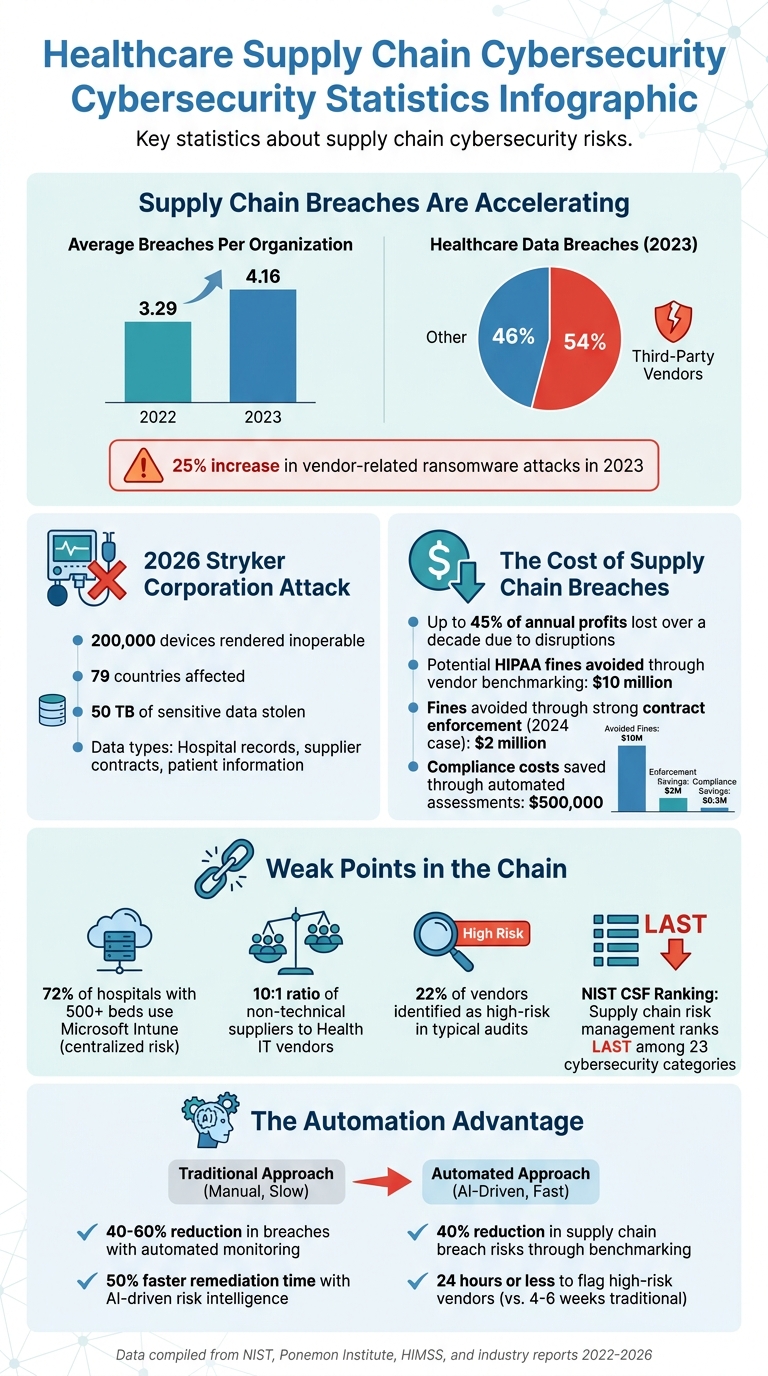
Third-party vendors are often a prime target for attackers. Why? A single breach at a software provider or device manufacturer can ripple through to thousands of healthcare organizations. The widespread reliance on consolidated IT services only amplifies this risk. For instance, over 72% of hospitals with more than 500 beds use Microsoft Intune for unified endpoint management [5]. While tools like Intune streamline operations, they also present a tempting target for attackers.
A stark example of this occurred on March 11, 2026, when the Stryker Corporation suffered a devastating attack. The pro-Iran group Handala exploited Microsoft Intune to send mass factory reset commands, rendering 200,000 devices inoperable across 79 countries. On top of that, they stole 50 terabytes of sensitive data, including hospital records and supplier contracts. The attack disrupted manufacturing and distribution centers, leaving hospitals scrambling to manually order critical surgical tools and implants via phone and spreadsheets [5][6]. Jeff Pollard, Forrester VP and Principal Analyst, summed it up:
The Stryker cyberattack is a live case study in how third-party risk shows up in the real world, not in a management slide deck [5].
Smaller vendors add another layer of risk. With fewer cybersecurity resources, they’re easier targets for attackers. Once inside, cybercriminals can use stolen credentials to infiltrate the networks of larger healthcare organizations. Common strategies include phishing through compromised email systems, exploiting outdated inventory software, and breaching shared cloud storage [9]. Many third-party distributors and logistics providers also fall outside the strict regulatory standards that hospitals and insurers must follow, leaving gaps in the system [9].
Ransomware and Data Breaches Through Supply Chains
Attackers aren’t just stealing data - they’re evolving their tactics to cause maximum disruption. Traditional ransomware, which encrypts data for ransom, is now being replaced by "wiper" attacks. These attacks aim to permanently destroy data and cripple operations. The Stryker attack showcased this shift. Instead of demanding payment, the attackers focused on completely halting operations, making it impossible for hospitals to secure essential supplies like ventilator tubing or orthopedic implants. The HIPAA E-Tool explains:
By targeting the supply chain rather than the hospital itself, groups like Handala can cause significant civilian disruption while maintaining plausible deniability [6].
The numbers back up the growing threat. In 2023, organizations experienced an average of 4.16 supply chain cybersecurity breaches, up from 3.29 in 2022 [8]. Over a decade, these disruptions could cost businesses up to 45% of their annual profits, highlighting the economic impact of third-party risk management [8]. Beyond financial losses, these attacks can have life-or-death consequences, delaying medical deliveries or corrupting critical patient device data [9].
IoT Devices and Outdated Systems as Attack Vectors
Connected medical devices and aging systems pose persistent challenges. The sheer number of IoT devices in healthcare means each one could act as a gateway for attackers. Many of these devices run on outdated software that’s tough - or even impossible - to update, leaving open security gaps.
The Stryker attack also underscored the risks tied to personal devices. When third-party vendors manage employee devices under corporate policies, a breach can spill into personal lives. Jeff Pollard noted that Intune-enrolled phones and laptops were wiped, leading to the loss of personal photos, financial records, and even multifactor authentication apps - extending the damage far beyond the workplace [5].
As healthcare organizations adopt new technologies, they face tough choices about where to allocate resources. While digital advancements promise efficiency, they also bring heightened exposure to cyber threats. Without alignment to frameworks like NIST or HICP, these innovations risk undermining patient data security rather than improving it [7].
Risk Assessment Models for Supply Chain Security
Addressing the critical vulnerabilities in healthcare supply chains requires effective risk assessment models. These models help organizations identify and mitigate weaknesses before they lead to breaches of sensitive patient data. Unfortunately, supply chain risk management ranks at the very bottom in maturity among the 23 categories of the NIST Cybersecurity Framework for healthcare cybersecurity programs [11]. This shortfall leaves organizations highly vulnerable, especially considering that general suppliers often outnumber specialized Health IT vendors by a factor of ten [11].
Common Risk Assessment Frameworks
Healthcare organizations can rely on two key frameworks for supply chain security: NIST SP 800-161r1-upd1 and the NIST Cybersecurity Framework (CSF).
- NIST SP 800-161r1-upd1: Updated in January 2025, this framework focuses specifically on Cybersecurity Supply Chain Risk Management (C-SCRM). It integrates supply chain security into overall enterprise risk management, addressing issues like malicious functionality, counterfeit components, and vulnerabilities stemming from poor manufacturing practices [10].
- NIST CSF: While this framework is the primary tool for benchmarking cybersecurity maturity in healthcare delivery organizations, its supply chain category remains underdeveloped in practice [11]. Both frameworks emphasize the need for better visibility into how technology suppliers develop, integrate, and deploy their products [10]. A thorough risk assessment should also consider factors such as financial stability, subcontractor management, international data offshoring, and operational resilience [11].
This broader focus is particularly relevant given the largest healthcare breach of 2022, which stemmed from a hacking incident at a printing and mailing supplier. That breach impacted 2.7 million individuals across 37 healthcare organizations [11].
Risk Assessment Model Comparison
| Framework | Primary Focus | Key Application for Supply Chain Security |
|---|---|---|
| NIST SP 800-161r1-upd1 | C-SCRM specific guidance | Provides a multilayered approach to identifying risks in products and services, including counterfeit detection and manufacturing evaluations [10] |
| NIST CSF | General cybersecurity benchmarking | Assesses maturity across 23 categories, with supply chain risk as a core area needing improvement [11] |
| HICP | Healthcare-specific practices | Aligns industry standards with NIST to guide resource allocation for reducing cyber risks [7] |
To manage supplier risks effectively, healthcare organizations should use standardized questionnaires to evaluate non-technical suppliers on their access to and protection of PHI/PII [11]. Since non-technical suppliers often have less mature controls, automated risk ratings and summary reports are critical for handling the large number of suppliers in the healthcare sector [11].
These frameworks provide a foundation for advanced tools like Censinet RiskOps™, enabling proactive management of supply chain vulnerabilities.
Managing Supply Chain Risks with Censinet RiskOps™
Censinet RiskOps™ tackles the pressing challenges of healthcare supply chain risk management. This area remains one of the least developed in healthcare cybersecurity, as shown by its ranking at the bottom of all 23 NIST CSF categories for healthcare programs [12]. The issue is compounded by the fact that non-technical suppliers outnumber Health IT vendors by a factor of ten, making risk assessments even more complex [12]. The platform provides a solid foundation for conducting fast and reliable third-party risk assessments.
Faster Third-Party Risk Assessments
Traditional vendor assessments can take anywhere from 4 to 6 weeks, but Censinet RiskOps™ automates this process, reducing the time to flag high-risk vendors to under 24 hours [1][2]. Its recommendation engine eliminates guesswork by automatically selecting the most appropriate questionnaire for each supplier's offerings, ensuring a thorough evaluation from the outset [12].
The platform's collaborative risk network, which includes data on over 50,000 vendors and products, allows for one-click assessments [13][14]. Vendors only need to submit their security information once, making it instantly accessible to multiple healthcare organizations. Tower Health, for example, saw immediate benefits. Terry Grogan, CISO at Tower Health, shared:
"Censinet RiskOps allowed 3 FTEs to go back to their real jobs! Now we do a lot more risk assessments with only 2 FTEs required." [14]
Another large U.S. hospital system used the platform to assess over 200 vendors in just two weeks. This process uncovered vulnerabilities in 15% of their supply chain partners, protecting patient data from third-party data breaches and saving $500,000 in compliance costs [1].
Platform Features for Supply Chain Protection
Beyond speeding up assessments, Censinet RiskOps™ enhances risk mitigation with automated workflows. Its AI-driven risk intelligence evaluates vendor responses, historical breach data, and supply chain connections to prioritize threats like ransomware risks from outdated medical devices. This approach reduces remediation time by 50%, allowing teams to focus on critical vulnerabilities [1].
The platform also includes cybersecurity benchmarking, which compares vendors' security practices to industry standards. Metrics like patch management and PHI encryption are scored, encouraging vendors to improve their security to maintain contracts. Organizations using this feature have reduced supply chain breach risks by 40% [1][3]. Brian Sterud, CIO at Faith Regional Health, explained:
"Benchmarking against industry standards helps us advocate for the right resources and ensures we are leading where it matters." [14]
Automated workflows simplify the creation of Corrective Action Plans, assign tasks to relevant team members, and track progress in real time [12]. These workflows enable seamless collaboration between healthcare organizations and vendors, resolving 80% of supply chain risks without the need for meetings [1][2]. Organizations report a 60% faster risk mitigation process and a 35% reduction in third-party incidents after adopting the platform [1].
A centralized digital inventory serves as a single source of truth for all vendor, product, and service risks. It includes built-in evidence capture for compliance audits [12]. For vendors, Censinet Connect™ streamlines the process further by allowing them to share completed security questionnaires and evidence with healthcare organizations in one click [13][14]. This efficiency not only accelerates assessments but also strengthens patient data protection throughout the supply chain. By benchmarking over 1,000 vendors, healthcare organizations have avoided an estimated $10 million in potential HIPAA fines related to supply chain breaches [1].
Building a Supply Chain Security Strategy
Protecting patient data is a critical priority for healthcare organizations, and a solid supply chain security strategy is key to achieving this. By combining thorough risk assessments, well-structured vendor contracts, and automation, healthcare providers can better safeguard sensitive information. Considering that third-party vendors were involved in 54% of healthcare data breaches in 2023, this layered approach is more important than ever [16].
Starting with Risk Assessments
The first step in securing the supply chain is identifying all vendors that handle patient data. This includes not only major electronic health record providers but also less obvious partners like printing and mailing companies. A 2022 breach involving a non-technical supplier highlighted the need to scrutinize all vendors equally, regardless of their role [11].
A great example comes from Ascension Health. In September 2023, they used an automated platform to audit 1,200 vendors, identifying 22% as high-risk. By updating contracts and enforcing audit rights, they cut assessment time from six weeks to just three days per vendor, achieving a 95% compliance rate [HIMSS Case Study, 2024]. Healthcare organizations should focus on vendors based on their access to protected health information (PHI), the critical nature of their services, and their cybersecurity maturity levels. Those adopting tiered assessments have reported a 30% reduction in risks [1][2]. Once risks are clearly mapped, the next step is to manage them through strong contracts.
Creating Strong Vendor Contracts
Vendor contracts are essential tools for establishing cybersecurity accountability. These agreements should include specific requirements like HIPAA compliance certification, right-to-audit clauses, breach notifications within 24 hours, and strict data encryption standards (e.g., AES-256). Penalties for non-compliance, such as termination fees, can also be included. In one case from 2024, a health system avoided $2 million in fines by enforcing these types of contractual terms after a breach [3].
Contracts should also address service-level agreements, such as 99.9% uptime for secure data transmission, annual penetration testing, and clear escalation protocols for emerging risks. Legal advisors often suggest tiered penalties, like fee reductions for violations, and exit strategies for unresolved risks. According to the Ponemon Institute, organizations with strong contracts see 35% fewer supply chain incidents [4]. For instance, a U.S. hospital network prevented a phishing attack that could have compromised 100,000 PHI records by requiring vendors to implement multi-factor authentication and zero-trust models [4]. These safeguards not only protect data but also set the stage for ongoing improvements through automation.
Using Automation Tools Like Censinet RiskOps™
Managing risk manually is no longer sufficient for today’s complex supply chains. Censinet RiskOps™ offers a way to move from periodic assessments to continuous monitoring. This platform automates processes like distributing questionnaires, scoring risks with AI, and enabling real-time collaboration. As a result, organizations can cut assessment times from weeks to days while gaining full visibility into risks related to medical devices, PHI, and supply chain connections.
Automation also speeds up the detection of vulnerabilities by 40% compared to manual methods [17]. Features like vendor performance dashboards and automated alerts for emerging threats, such as ransomware, allow healthcare providers to act proactively. By integrating these tools with existing governance, risk, and compliance (GRC) systems and starting with pilot assessments of top vendors, organizations have achieved compliance scores 25% higher through benchmarking [15]. This approach is particularly effective in addressing the growing threat of vendor-related ransomware attacks, which rose 25% in 2023 [16][18].
Conclusion
Healthcare supply chains carry serious risks to patient data. Alarmingly, supply chain risk management ranks at the bottom across all 23 NIST CSF categories, signaling a pressing concern for the industry [19]. A stark example is the 2021 Change Healthcare ransomware attack, which demonstrated how a single vendor breach can ripple through the entire healthcare ecosystem [1].
To tackle these challenges, healthcare organizations must adopt a multi-faceted approach. This includes conducting third-party vendor risk assessments, enforcing robust vendor contracts, and utilizing automated tools. It's crucial to recognize that even non-technical suppliers - like printing and mailing companies - can pose significant threats to data security. Past breaches from such vendors have impacted millions of patients across numerous organizations [19].
Censinet RiskOps™ provides a tailored solution for healthcare supply chain risk management. The platform automates risk assessments and facilitates collaborative monitoring to address vulnerabilities tied to patient data, PHI, medical devices, and more. As Censinet emphasizes:
Hackers see suppliers as the 'path of least resistance' [19].
Automation plays a key role in mitigating these risks. It not only speeds up risk management processes but also ensures a more comprehensive approach to securing the supply chain.
It's important to view supply chain security as an organizational priority - not just an IT issue. Healthcare delivery organizations using automated platforms for third-party risk management have seen breaches drop by 40–60% thanks to continuous monitoring [3]. By focusing on supply chain assessments, setting clear cybersecurity expectations in contracts, and leveraging automation, organizations can better protect patient data while maintaining the efficiency needed to deliver high-quality care.
Ultimately, healthcare providers must shift from reactive measures to proactive strategies that address a wide range of risks, including financial stability, subcontractor oversight, data offshoring, and operational resilience [19]. This shift is essential for safeguarding patient trust and ensuring long-term security.
FAQs
Which suppliers are most likely to put patient data at risk?
Suppliers with insufficient security measures are a major risk to patient data. This often includes third-party vendors relying on outdated systems, which can easily fall prey to cyberattacks like ransomware, phishing schemes, and data breaches. Taking steps to identify and fix these weak points is essential for safeguarding sensitive information.
How can hospitals quickly identify high-risk vendors and devices?
Hospitals can pinpoint high-risk vendors and devices by leveraging automated risk assessment tools that analyze vendors based on their risk levels. Tools like Censinet RiskOps™ provide features such as real-time monitoring, risk scoring, and customized evaluations to identify vendors that may threaten patient data or safety. These platforms also simplify the process by enabling continuous monitoring and automating workflows, allowing healthcare organizations to quickly address new risks and focus on mitigation strategies efficiently.
What contract terms best reduce supply chain breach impact?
To reduce the impact of supply chain breaches, contracts should include specific requirements for vendors. These can include implementing protective measures like encryption, notifying all breaches within 24 to 72 hours, and conducting regular security audits. Responsibilities for maintaining security should be clearly outlined, along with granting audit rights to verify compliance. Additionally, contracts should establish liability for breaches to ensure vendors are held accountable. These steps play a key role in safeguarding patient data and reducing potential risks.
