
Healthcare supply chains are fragile and highly interconnected, making them vulnerable to disruptions that can escalate into widespread crises. Here's what you need to know:
- Key Risks: Single-source dependency, just-in-time delivery, and global production create critical weak points.
- Examples of Failures: Hurricane Helene (2024) disrupted IV fluid supply, while Intas Pharmaceuticals' shutdown caused a nationwide chemotherapy drug shortage.
- Impact on Patient Care: Shortages delay surgeries, interrupt treatments, and force reliance on risky alternatives like counterfeit products.
- Cybersecurity Threats: Ransomware attacks on IT systems can cripple healthcare operations, as seen in the 2024 Change Healthcare breach.
To reduce risks, healthcare systems must diversify suppliers, maintain inventory buffers, and use real-time monitoring tools for better visibility. These steps are vital for ensuring uninterrupted patient care and minimizing cascading failures.
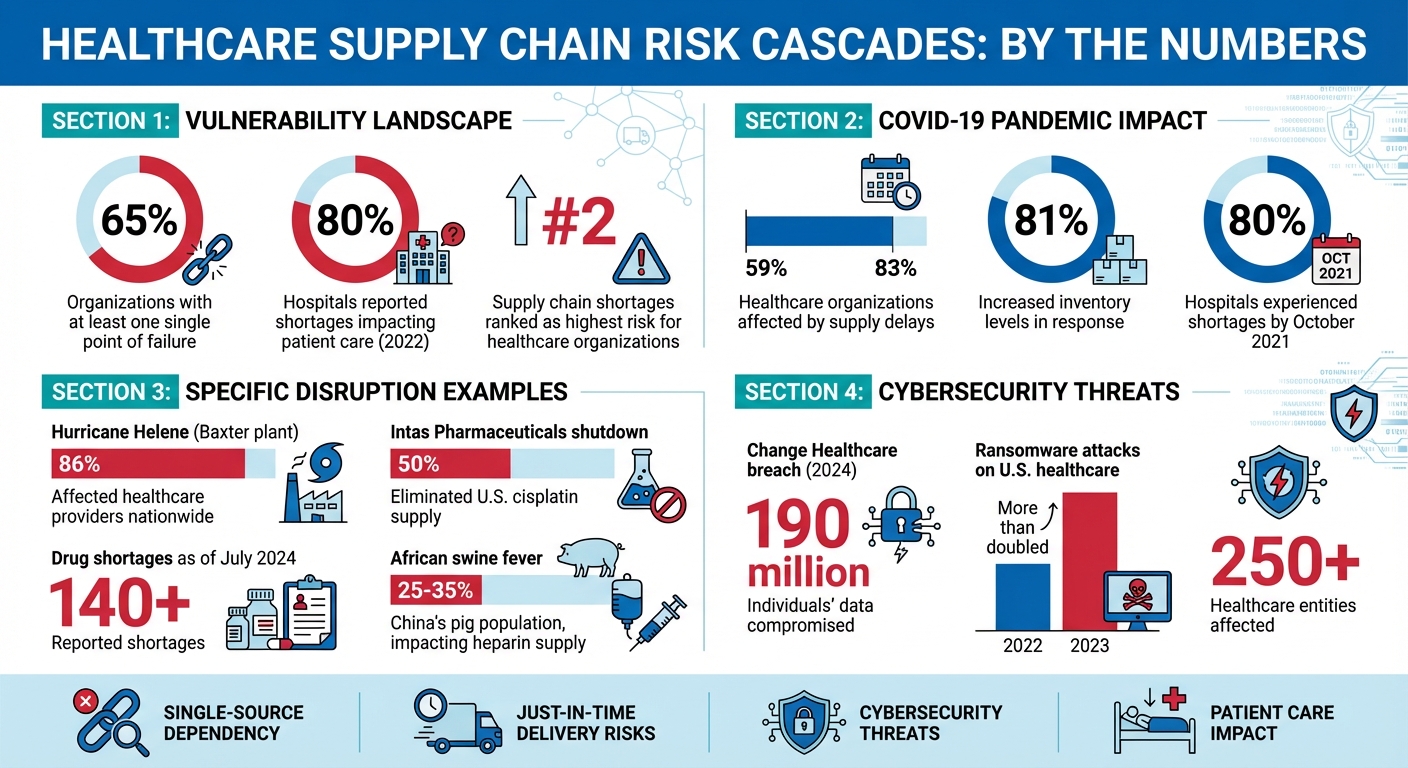
Healthcare Supply Chain Risk Statistics and Impact Data
How Supply Chain Vulnerabilities Create Cascading Risks
Common Weak Points in Healthcare Supply Chains
Healthcare supply chains often have weak points that can turn small problems into major crises. One major issue is single-source dependency - when a single supplier provides a large share of a critical product. If that supplier shuts down, it can disrupt half the supply chain, leaving providers across the country scrambling for alternatives [2]. Alarmingly, research shows that 65% of organizations in various industries have at least one single point of failure in their supply chains [1].
Another challenge is the just-in-time delivery model, which reduces inventory buffers. While this approach minimizes costs, it leaves organizations vulnerable to third-party risk and disruptions. During COVID-19, delays in acquiring supplies affected between 59% and 83% of healthcare organizations [3]. In response, 81% of these organizations increased their inventory levels. However, relying on historical ordering patterns sometimes led to overstocking or poor decision-making [2][3].
Global production also adds complexity, as multiple intermediaries can obscure quality control. A stark example of this occurred in 2008 when contaminated heparin - a blood-thinning drug - reached U.S. patients. The contamination originated in Chinese slaughterhouses, but the crude heparin passed through several intermediaries before the issue was detected [2].
How Disruptions Spread Through Healthcare Networks
These vulnerabilities make healthcare networks highly susceptible to cascading disruptions. A single manufacturing shutdown can quickly cause shortages that ripple through distribution channels. Transportation problems can make matters worse. For example, flooding caused by Hurricane Helene forced Baxter's North Carolina plant to halt operations, affecting 86% of healthcare providers nationwide [1].
The COVID-19 pandemic highlighted just how interconnected and fragile these systems are. By October 2021, 80% of hospitals reported experiencing shortages due to cascading effects [4]. Such disruptions are particularly severe when critical dependencies are involved, amplifying the impact across the entire network.
Critical Dependencies That Amplify Supply Chain Failures
Certain dependencies in healthcare supply chains can magnify disruptions far beyond their initial scope. For instance, the FDA has raised concerns about pediatric medical devices because shortages in this area could have widespread public health implications [1]. Similarly, pharmaceutical production is heavily concentrated in a few facilities, making the system vulnerable to localized disruptions.
Take the case of Intas Pharmaceuticals: when the company shut down, it wiped out 50% of the U.S. cisplatin supply, a chemotherapy drug, leading to nationwide shortages [2]. In fact, supply chain shortages were ranked the second-highest risk for healthcare organizations in 2022, with 80% of hospitals reporting that these shortages directly impacted patient care [4].
These concentrated dependencies can turn what might seem like localized problems into system-wide crises. Recognizing these connections is key to developing strategies that can reduce the risks of cascading failures.
sbb-itb-535baee
Supply Chain Chaos in Healthcare | Here's What's Coming
Understanding these disruptions is the first step toward improving third-party vendor risk management across the care continuum.
Case Studies: Cascading Risks in Healthcare Supply Chains
Real-world examples highlight how initial disruptions can trigger widespread failures across healthcare networks. These cases reveal critical vulnerabilities within healthcare supply chains, emphasizing the interconnected nature of these systems.
Supply Chain Failures During the COVID-19 Pandemic
The COVID-19 pandemic brought the fragility of global healthcare supply chains into sharp focus. In early 2020, Chinese factories - responsible for producing the bulk of N95 masks and other medical supplies for the U.S. - either shut down or redirected supplies for domestic use. This disruption fractured the global supply chain, leaving healthcare providers across the U.S. without essential personal protective equipment (PPE) [5].
Regulatory delays compounded the crisis. The Defense Production Act, which could have accelerated domestic production, wasn’t invoked until late March 2020. By then, it was too late to quickly address the shortages caused by the global disruptions [5]. The pandemic not only created immediate scarcities but also revealed the risks of relying heavily on a limited number of overseas suppliers, highlighting the need to effectively manage third-party risk.
These initial failures set the stage for additional shortages and exposed deeper vulnerabilities in the system.
Medical Device and Drug Shortages
Drug shortages remain a critical issue, with over 140 reported as of July 2024 [6]. These shortages directly impact patient care and can even pose life-threatening risks.
For example, African swine fever caused a significant disruption in the production of crude heparin, a key ingredient derived from pig intestines. Between November 2017 and March 2024, the disease reduced China’s pig population by 25% to 35%, severely affecting the global supply of crude heparin. This shortage impacted surgeries, cardiovascular treatments, and even anticoagulation therapy for COVID-19 patients [6].
Another stark example is the asparaginase shortage from 2016 to 2020, which severely affected pediatric cancer care. This leukemia drug faced nearly five years of scarcity due to manufacturing quality issues and sudden demand spikes. At the time, only one manufacturer was producing the drug, leaving pediatric patients with acute lymphoblastic leukemia in a dire situation. Nearly half of the affected patients experienced treatment delays or interruptions because the drug was unavailable [6].
"Drug shortages can have severe consequences for patients, including delayed care, increased costs, medication errors, and adverse events, such as disability and death." - ASPE Report [6]
These operational shortages are further exacerbated by digital vulnerabilities, adding new layers of risk to healthcare systems.
Healthcare IT and Cybersecurity Supply Chain Risks
Cybersecurity vulnerabilities in healthcare IT systems can create cascading risks that go far beyond breaches of sensitive data. In 2024, a ransomware attack on Change Healthcare - the largest claims processor in the U.S. - compromised the data of 190 million individuals [1]. The attack not only violated patient privacy but also disrupted billing systems, delaying reimbursements for thousands of healthcare providers and threatening the financial stability of the healthcare sector.
A similar incident occurred in September 2020 at University Hospital Düsseldorf in Germany. A ransomware attack crippled IT systems and blocked access to critical medical data. This forced the transfer of a critical patient to another hospital nearly 19 miles away, resulting in a fatal delay. German authorities even investigated the case as manslaughter, underscoring the severe consequences of cybersecurity failures [8].
"The digital tools that make so many things better and easier also can make things easier for criminals." - John Dockins, Executive Director of IT and Non-Clinical Sourcing, Cleveland Clinic [7]
Even routine software updates can lead to widespread disruptions. In 2024, a misconfigured update to CrowdStrike, a widely-used cybersecurity tool, caused a global IT outage. Healthcare providers worldwide had to cancel surgeries and implement emergency downtime procedures, disrupting everything from patient transport to the delivery of medical supplies [1]. With ransomware attacks on U.S. healthcare organizations more than doubling between 2022 and 2023 - impacting over 250 entities - cybersecurity weaknesses remain a growing threat to patient safety [1].
Strategies to Reduce Healthcare Supply Chain Risks
Managing supply chain risks in healthcare can be challenging, but with thoughtful planning and the right tools, their impact can be minimized. Below are some practical strategies to strengthen supply chain resilience.
Building Redundancy and Diversifying Suppliers
Relying on a single supplier is risky - it creates a weak link that could disrupt operations. To avoid this, healthcare organizations should diversify their vendor base for critical supplies, such as personal protective equipment and pharmaceuticals. Maintaining strategic inventory buffers is also key. This approach ensures consistent patient care without the pitfalls of overstocking.
Leveraging Technology for Better Risk Visibility
Traditional vendor reviews, often conducted annually, provide only a limited glimpse into potential risks. Instead, healthcare organizations can gain a more comprehensive view by using technology to monitor security threats in third-party vendor relationships in real time. For example, Censinet RiskOps™ automates risk management across both clinical and business areas. This cloud-based platform allows secure sharing of cybersecurity and risk data, shifting organizations from periodic assessments to continuous, automated monitoring [9]. When paired with collaborative efforts among stakeholders, this technology significantly enhances visibility and preparedness.
Aligning Risk Management Efforts Across Organizations
Because supply chain risks often have a ripple effect, it's crucial for healthcare providers, suppliers, and regulators to work together. Vendor security and risk protocols should be aligned, with cybersecurity taking a central role in vendor relationships. Clear contractual terms - covering compliance, expectations, and the protection of patient health information (PHI) - help ensure all parties are on the same page. Tools like standardized risk questionnaires and open communication between IT security and clinical teams can also help uncover hidden risks. Additionally, vendor agreements should address service continuity, including provisions for outages or vendor failures. Importantly, even under operational pressure, security vetting should never be bypassed, even for critical or lifesaving products.
Conclusion: Protecting Patient Care Through Supply Chain Resilience
Healthcare supply chains are at the heart of patient safety. In 2022, ECRI identified supply chain shortages as the second biggest risk for healthcare organizations. Alarmingly, over 80% of hospitals reported shortages that directly affected patients' access to essential medications, devices, and treatments [4].
These challenges highlight the need to rethink supply chain strategies. Currently, 65% of healthcare organizations rely on at least one single point of failure - a risk amplified in this sector, where disruptions can ripple across entire networks, impacting multiple facilities [1]. The sudden halt in Intas' cisplatin production is a clear example of how single-source dependencies can jeopardize patient care [2].
To prevent these failures, healthcare organizations must adopt a proactive approach to resilience. This means moving away from overly lean, cost-focused models that struggle to handle disruptions. Instead, organizations should diversify suppliers, maintain strategic inventory reserves for critical items, and leverage real-time monitoring tools to identify vulnerabilities early. Platforms like Censinet RiskOps™ provide continuous risk monitoring, helping organizations shift from reactive problem-solving to proactive risk management.
The FDA has also warned that weaknesses in pediatric medical device supply chains could lead to serious crises [1]. For healthcare leaders, the message is clear: investing in supply chain resilience isn’t optional - it’s essential for ensuring patient care continuity and safeguarding their organization’s reputation.
FAQs
What’s the fastest way to identify single points of failure in our supply chain?
To quickly spot single points of failure, start by categorizing vendor risks based on their criticality. Then, centralize your vendor inventories to keep track of dependencies. This approach makes it easier to identify vulnerabilities and understand their potential impact on your operations.
Another effective strategy is to diversify your suppliers. By avoiding over-reliance on a single source, you can reduce the chances of major disruptions.
How much safety stock should hospitals keep without wasting money or expiring supplies?
Hospitals need to keep a well-balanced safety stock to ensure supplies are always available while avoiding unnecessary waste. This often involves using hybrid inventory models that mix just-in-time (JIT) and just-in-case (JIC) strategies. The specific stock levels are determined through detailed supply chain analysis and risk evaluations, tailored to meet the hospital's unique needs and reduce potential disruptions.
How can third-party cyber incidents disrupt patient care even without a data breach?
Third-party cyber incidents can throw a wrench into patient care by causing major operational headaches. Imagine diagnostic tools suddenly going offline, access to vital patient records being cut off, or medication supply chains grinding to a halt. These types of disruptions can lead to delayed treatments, jeopardize patient safety, and negatively affect the overall quality of care delivered.
