
Most vendor risk failures do not start in the assessment. They start after it. While asking the right third-party risk assessment questions is critical, the handoff is where the process often fails. If I had to sum up the article in one line, it’s this: a finished review is not an approved vendor.
If you work in healthcare, the danger is simple and costly:
- A vendor gets PHI access before a BAA is signed
- A contract gets signed, but known risk never makes it into the terms
- IT grants access before MFA, logging, or role limits are checked
- Teams treat “security review complete” as if it means “safe to go live”
The article’s main point is that vendor approval is a chain of separate decisions, not one status. I’d keep these as four different checkpoints:
- Assessment complete
- Risk accepted
- Contract and BAA complete
- Go-live approved
That split matters because each step has a different owner, a different record, and a different test.
A few facts in the piece stand out:
- HHS says a written BAA must be in place before PHI is disclosed
- Evidence can go stale, so items like SOC reports and pen tests need review dates
- Every finding should tie to one owner, one due date, and one decision trail
- High-risk vendors need a gate that blocks access until all pre-access checks are done
If I were turning the article into a short checklist, it would be this:
- Do not treat a questionnaire as proof
- Do not treat contract signature as access approval
- Do not let PHI move before the BAA is signed
- Do not let findings die in email or side conversations
- Do not mark onboarding done unless every gate is closed
At its core, this is about control at the handoff. The article argues that each vendor should have one record, one accountable owner per decision, and a clear gate trail from review to production.
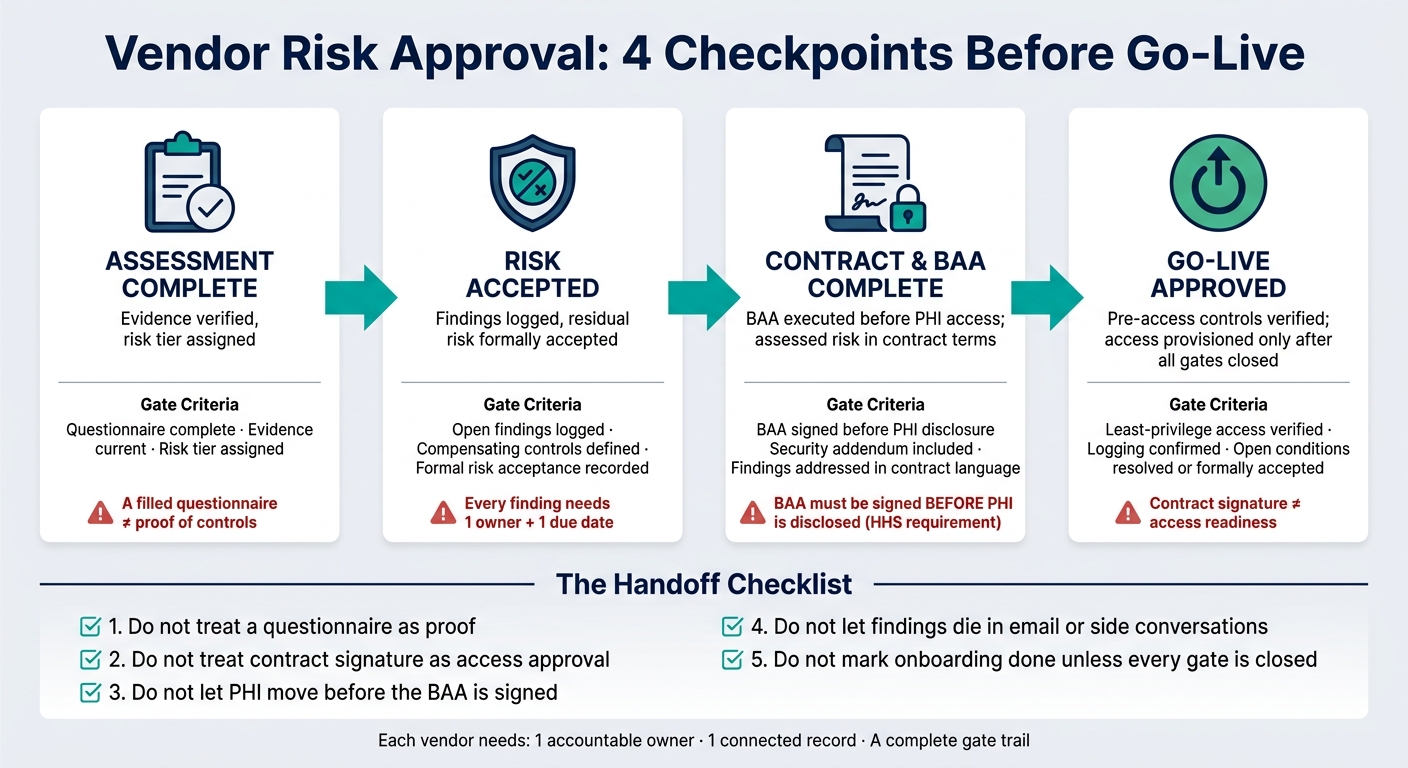
Vendor Risk Approval: 4 Checkpoints Before Go-Live
Where procurement handoffs break down
Incomplete questionnaires and unverified evidence create a false sense of approval
A filled-out questionnaire shows that a vendor answered questions. It does not show that the stated controls are in place.
That distinction gets lost all the time. A vendor checks “Yes” for encryption, MFA, and incident response, but shares no proof - no SOC 2 Type II report, no penetration test summary, no architecture diagram that shows where PHI actually lives. The reviewer marks the assessment complete, and that status keeps moving through later approval steps as if it proves something. It doesn’t.
In healthcare, the handoff gaps that matter most usually involve PHI handling, encryption, access control, incident response, continuity, subprocessors, and system integration. If a vendor says “encryption is enabled” but doesn’t spell out the algorithm, key-management duties, or which environments are covered, you still don’t have enough to make a call. HHS guidance backs this up: security-related documentation, third-party evaluations, and risk assessments should all be requested and reviewed for vendors with access to ePHI.[3]
There’s also a timing problem. Evidence goes stale. An old SOC report or an expired penetration test can sit in the file and give everyone false comfort. Put a review date on every artifact. If the SOC report or pen test is out of date, reassess.
When the evidence is thin, the next breakdown usually shows up in the contract.
Missing BAAs, lost findings, and contracts that ignore assessed risk
If a vendor creates, receives, maintains, or transmits PHI, a BAA is required before disclosure. And it has to be signed before PHI is disclosed, not after the contract is done and the implementation team is already in the system.[1]
This gets messier when the vendor’s scope changes. Maybe the service expands. Maybe a subcontractor now touches PHI even though the first agreement didn’t cover that scenario. HHS requires business associates to establish a BAA with any subcontractor before disclosing PHI to that subcontractor.[1] Once that chain breaks, the coverage breaks with it.
Then there’s the next handoff failure: assessment findings never make it into the paper. Security flags that the vendor’s incident response plan does not define notice timing. Legal closes the deal with a standard template. The requirement disappears. That’s how risk gets spotted, logged, and then quietly dropped.
Each finding needs to be tied to a contract clause, a business owner, and an approver. Put differently: if a risk matters in the assessment, it should show up in the agreement before the deal moves ahead.
| Assessment finding | Required contract clause | Business owner | Approval authority |
|---|---|---|---|
| Vendor will access production PHI through an administrative interface; MFA is not yet deployed | Require MFA before production access, with a dated remediation milestone and restricted interim access | Vendor security owner and internal application owner | CISO or delegated security approver |
| Vendor relies on subprocessors to host or support PHI workflows | Require disclosure, due diligence, written flow-down obligations, and advance notice of material subprocessor changes | Procurement and privacy owner | Privacy/legal approver |
| Incident response plan does not define notice timing or evidence sharing | Require prompt notice, named contacts, cooperation, preservation of evidence, and defined escalation procedures | Vendor risk owner and legal counsel | Contract owner and legal authority |
| Recovery testing does not demonstrate the required service continuity | Include recovery-time and recovery-point objectives, testing frequency, reporting, and remediation obligations | Business continuity owner and service owner | Operational risk or executive approver |
| Vendor retains data after contract termination | Require return or secure destruction, certification, backup treatment, and exceptions for legally required retention | Privacy owner and records-management owner | Legal/privacy approver |
One more thing helps here: assign a single ID to each finding and keep that same ID through assessment, remediation, contract review, and onboarding. That way, nothing slips between teams just because the label changed.
Even then, strong contract terms don’t fix a bad access gate.
Vendors reach go-live before pre-access controls are in place
Contract execution is a legal milestone. It is not an operational one.
A signed agreement can exist alongside a vendor that still has no approved access roles, no MFA, no network segmentation, no monitoring, no named escalation contact, and open remediation items that nobody closed. This is the last gate failure, and in many cases, it stays hidden until something goes sideways.
Take a clinical integration vendor. The contract may be approved, but the service account might still have broad privileges, and no one inside the organization may own the alert if that account starts acting strangely. IT grants access before anyone confirms the pre-access controls. That’s the gap. Contract completion and access readiness are not the same thing, yet many procurement workflows treat them as if they are.
The go-live gate should stand on its own. It needs separate, documented confirmation of:
- legal completion
- security approval
- access design
- monitoring ownership
- support contacts
- treatment of open remediation items
- exception approval
Until every control is documented and approved, block PHI access and production connection.
sbb-itb-535baee
Healthcare Third-Party Risk Management: Compliance & Cybersecurity
Controls that carry risk context from assessment through onboarding
Risk context often shows up during assessment, then disappears before onboarding. That gap causes trouble. A vendor may look fine on paper at one stage, then move into contract, access, and go-live without the same risk picture following along.
The fix is simple in concept: build a linked control chain that carries each finding into every later decision. If a risk is found during assessment, it should still be visible when teams review the contract, approve access, and decide whether the vendor can go live.
Require a handoff record and centralized documentation standards
Every vendor that touches PHI should have one controlled vendor record that all teams use and update.
At a minimum, that record should include vendor identity and service scope, owners, PHI or data classification, affected systems, risk tier, required evidence and expiration dates, open findings and due dates, compensating controls, the residual-risk decision, BAA and contract status, pre-go-live conditions, monitoring, renewal, and offboarding obligations.
It should also include version history and timestamps. That way, there’s no confusion about what was known, when it was known, and who had that information.
Just as important, keep these as separate statuses:
- Assessment
- Risk approval
- Contract approval
- Go-live approval
That separation matters. If all of it gets rolled into one status, teams can miss the fact that a vendor passed assessment but still lacks contract terms or go-live clearance.
Set approval gates, workflow triggers, and escalation paths
A practical control system needs six gates. Each gate should have its own entry criteria, and the vendor should not move ahead until those conditions are met.
| Gate | Purpose | Key clearance criteria |
|---|---|---|
| Intake | Confirm business need and classify the service | Service description, PHI determination, business owner and procurement owner identified |
| Assessment | Verify evidence quality and coverage | Questionnaire complete, evidence current and in scope, risk tier assigned |
| Risk acceptance | Document findings and accept residual risk | Open findings logged, compensating controls defined, formal risk acceptance recorded |
| Contract | Align legal terms with assessed risk | BAA executed, security addendum included, findings addressed in contract language |
| Go-live | Confirm controls are active before access | Least-privilege access verified, logging confirmed, open conditions resolved or formally accepted by the accountable owner |
| Renewal | Reassess before extending the relationship | Material changes reviewed, evidence refreshed, performance and remediation status confirmed |
But gates don’t do much on their own. Something has to enforce them.
That means routing key events to set actions. PHI determinations, unsigned BAAs, critical findings, overdue remediation, new subprocessors, scope changes, and expired evidence should all trigger a defined next step. No guesswork. No side deals over email.
High-risk vendors need tighter review, especially vendors that support clinical operations or connect to electronic health records. In those cases, stronger approval authority is required. A business sponsor pushing for speed does not replace security leadership sign-off when a critical finding is still open.
Assign 1 accountable owner per decision using a RACI model
A RACI model helps stop the usual shared-ownership mess. It separates who takes part from who owns the decision.
For each decision - intake, data classification, PHI determination, security review, BAA determination, contract approval, risk acceptance, access provisioning, go-live, monitoring, renewal, and offboarding - exactly one role is Accountable. Everyone else should be Consulted or Informed.
For example, the privacy officer may be accountable for the BAA determination. Legal may be accountable for contract-language approval. The business owner may be accountable for residual-risk acceptance. Security may be accountable for the technical risk review. Procurement can coordinate the workflow, but it should not become the default owner of decisions that belong to other teams.
Group sign-off is not enough. A real decision record should name the accountable person, the date, the rationale, and any conditions or expiration. That’s the trail the onboarding workflow needs to keep intact.
Putting the handoff model into practice with Censinet RiskOps™
Those controls only hold up when one system carries the same finding, owner, and decision record from assessment through go-live. That’s the whole idea here: keep the same risk record attached the entire way. Censinet RiskOps™ brings third-party vendor risk management records, open findings, due dates, and approval routing into one workflow. It doesn’t replace the operating model. It keeps that model connected.
How Censinet RiskOps™ supports evidence, routing, remediation, and oversight
Censinet RiskOps™ stores vendor documentation, tracks open findings with assigned owners and due dates, and routes approvals through defined gates. It also tracks open findings, due dates, and approval status so risk teams stay aligned during the handoff.
Where Censinet Connect™, Censinet One™, and Censinet AI™ fit into the handoff
During handoff, Censinet Connect™ gives both sides a structured way to exchange documentation and close gaps before approval. In plain English, it links the healthcare organization and its vendor network so evidence gaps get resolved before any decision moves to the approval stage.
Censinet AI™ can draft questionnaire responses, summarize evidence, capture subprocessor details, and draft risk summaries for human review. The AI output stays a draft until a person reviews it. Security, privacy, legal, and business owners still keep sign-off authority at each approval gate.
Map controls to platform capabilities without replacing human approval
| Handoff Control | Censinet Capability | Automation | Human Approval |
|---|---|---|---|
| Evidence collection | Censinet Connect™ & Censinet AI™ | AI captures subprocessor details and summarizes evidence; Connect facilitates vendor collaboration | Reviewer confirms evidence is current and in scope |
| Workflow routing | Censinet RiskOps™ | Automated triggers route assessments through pre-defined escalation paths and approval gates | Approver confirms gate criteria are met |
| Remediation tracking | Censinet RiskOps™ | Centralizes findings with automated tracking of deadlines and assigned owners | Owner confirms remediation is complete |
| Risk summarization | Censinet AI™ | AI generates draft risk summaries to speed up the review process | Reviewer edits and approves final summary |
| Final approval | Censinet RiskOps™ | Routes to required approvers | Human-only decision; requires explicit sign-off from legal, security, and business owners |
| Ongoing oversight | Censinet RiskOps™ | Tracks open findings, due dates, and approval status | Risk team reviews and acts on flagged items |
Automation should move the workflow, not make the decision. Legal, security, privacy, and business owners make the approval, and that accountability is what keeps the handoff controlled [4].
Conclusion: Confirm the handoff is controlled before calling onboarding complete
A vendor risk program usually doesn't fail because an assessment wasn't finished. It fails when ownership moves faster than the controls around it. The problem starts when assessment results stop shaping legal, procurement, and go-live decisions.
Keep assessment completion, risk acceptance, and onboarding completion as three separate, documented statuses. Don't mark a vendor as approved until the evidence, owners, contracts, access controls, and sign-off are all finished. That's what the final checklist needs to show.
The real test is simple: can someone rebuild the decision without digging through email?
Key points for leaders to take forward
Use this checklist for every vendor in scope.
| What to confirm | Why it matters |
|---|---|
| BAA executed before PHI access | Required before any PHI is disclosed [1] |
| Every open finding has a named owner and due date | Unowned findings get forgotten |
| Contracts reflect assessed risk, not generic templates | Assessed risk must translate into enforceable obligations [5] |
| Open high-risk issues require formal documented exception approval | Undocumented exceptions are silent liabilities |
| Every required gate is marked complete before go-live | Access is provisioned only after pre-go-live controls are verified [2] |
Track these as control-quality metrics, not just cycle time. A faster onboarding process only counts as an improvement when it does not increase the share of vendors reaching production with open high-risk issues, missing BAAs, or incomplete gates. Speed and control aren't opposites. But speed without control is just a faster way to pile up unmanaged risk.
Each vendor should have one accountable owner, one connected record, and a complete gate trail. Until that exists, onboarding isn't done.
FAQs
Who owns each vendor approval decision?
Vendor approval decisions work best when they follow a cross-functional governance framework with clear ownership.
In most cases, overall TPRM accountability sits with the CISO or a designated program lead. But approval authority shouldn’t live with one team alone. It’s usually shared across:
- Security
- Privacy
- Compliance
- Legal
- Procurement
- IT
- Clinical teams
For high-risk vendor go-lives, approval is usually handled by a cross-functional TPRM committee. That setup helps avoid blind spots. Security may focus on controls, legal may zero in on contract terms, and clinical teams may look at patient impact. You need all of those views on the table.
Each vendor should also have three named owners:
- A business owner
- A technical owner
- A risk owner
That simple structure makes accountability much clearer. When something needs review, escalation, or sign-off, everyone knows who’s on the hook.
What should block vendor go-live?
Block vendor go-live when needed risk and contract safeguards are incomplete or can't be enforced.
Do not allow production access if any of the following apply:
- The BAA or needed security addendum/data protection agreement is missing
- Required evidence is incomplete
- The contract is missing critical security terms
- Critical findings can't be fixed before go-live
The only exception is a written exception that documents:
- Compensating controls
- Residual risk
- Approver
- Expiration
How often should vendor evidence be refreshed?
Vendor evidence should be refreshed based on the vendor’s risk classification and trigger events. High-risk and critical vendors often need monthly or quarterly reviews. Lower-risk partners usually only need annual reviews.
You also need to reassess evidence right away when major changes happen. That includes expiring certifications, security incidents, leadership changes, or new AI features and subprocessors.
Why does that matter? Because risk can shift fast. If you wait for the next calendar review, you may be working from old information. A trigger-based check helps keep the vendor’s risk profile current instead of relying on stale updates.
