
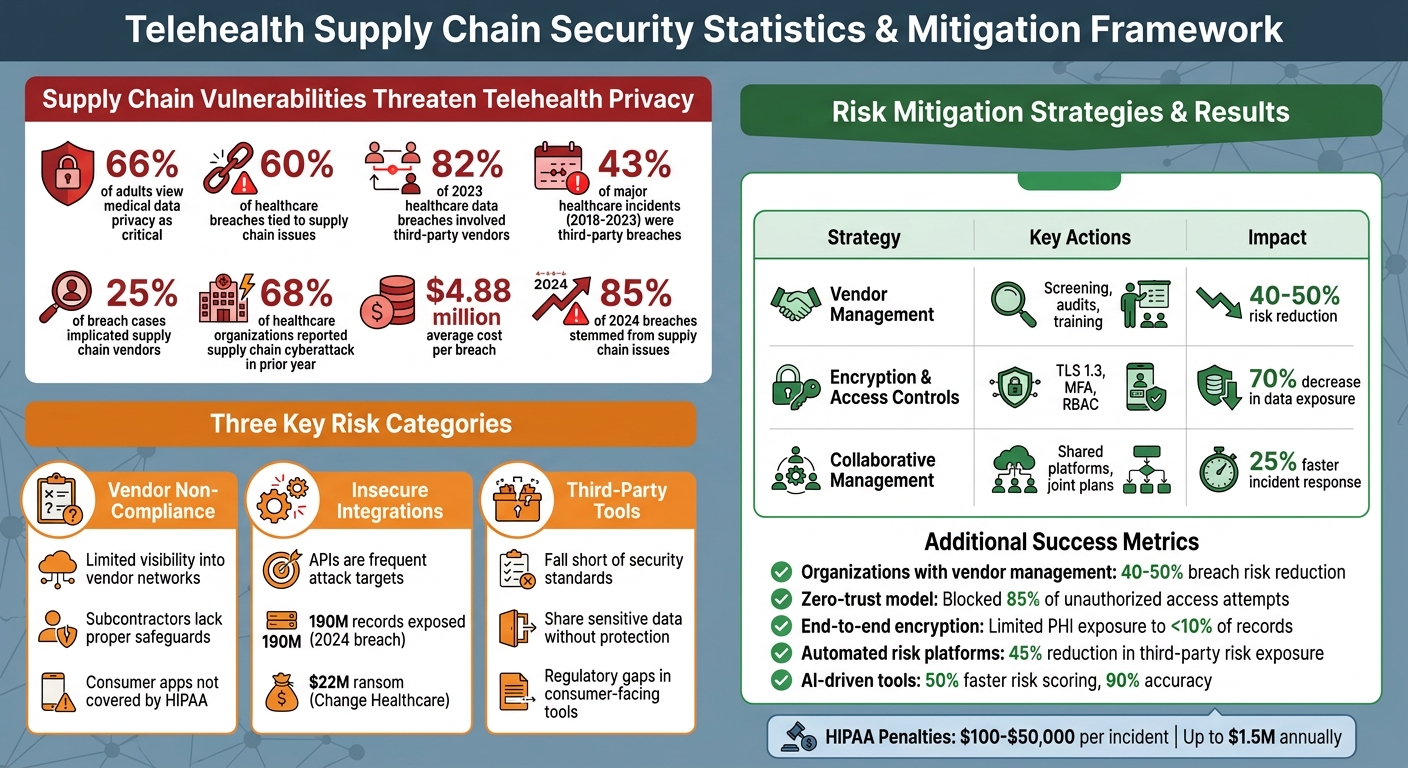
Telehealth is transforming healthcare delivery, but it also exposes patient data to potential breaches through complex vendor networks, insecure APIs, and third-party tools. 66% of adults view medical data privacy as a critical issue, yet many healthcare organizations respond to risks reactively rather than proactively. This leaves sensitive health information vulnerable, especially in healthcare supply chains where compliance gaps often go unchecked.
Key risks include:
- Vendor non-compliance: Subcontractors and third-party apps often lack proper safeguards.
- Insecure integrations: APIs and system connections are frequent targets for cyberattacks.
- Regulatory gaps: Consumer-facing tools may not meet healthcare privacy standards.
To mitigate these risks, organizations must:
- Enforce Business Associate Agreements (BAAs) across all vendors.
- Conduct regular risk assessments and continuous monitoring.
- Implement strong encryption, access controls, and zero-trust models.
- Collaborate with vendors on shared security strategies.
Tools like Censinet RiskOps™ help automate risk assessments, benchmark security, and manage vendor compliance efficiently. With 60% of healthcare breaches tied to supply chain issues, addressing these vulnerabilities is essential to protect patient trust and meet HIPAA requirements.
Telehealth Supply Chain Security: Key Statistics and Risk Mitigation Strategies
CISA Services: Federal Cybersecurity Resources for Telehealth
sbb-itb-535baee
Supply Chain Risks That Threaten Telehealth Privacy Compliance
Telehealth platforms depend on a web of interconnected vendors, each of which can introduce vulnerabilities that threaten patient data. From subcontractors who fail to meet compliance standards to weak integrations that expose sensitive information, these risks make it critical to evaluate and manage third-party vendor risk.
Vendor Non-Compliance and Subcontractor Oversight Gaps
A major challenge for healthcare organizations is limited visibility into their vendor networks, especially when primary vendors rely on subcontractors. For example, a telehealth platform might partner with a cloud storage provider, but that provider could outsource data processing or backups to other third parties. Each of these layers adds exposure to potential compliance failures if subcontractors lack proper safeguards.
HIPAA mandates that covered entities ensure their business associates protect PHI. However, enforcement becomes tricky with consumer-facing apps that aren’t fully covered by HIPAA [1]. This creates a blind spot where third-party tools handling sensitive health data may not adhere to the same stringent privacy standards applied to healthcare providers and insurers. These complexities make vendor oversight a critical area of focus.
Insecure APIs and System Integrations
APIs, which link telehealth platforms to external services, are frequent targets for cyberattacks. Vulnerabilities like SQL injections or man-in-the-middle (MITM) attacks can exploit weak points in these connections, with devastating consequences. For instance, in 2024, a breach stemming from a patient portal without multi-factor authentication exposed the health records of 190 million individuals [2]. That same year, Change Healthcare faced a $22 million ransom after a significant data breach [2].
Every integration - whether for scheduling, billing, or medical documentation - introduces the risk of data interception during transmission or storage [1]. Alena Madden, a Senior Business Analyst at ScienceSoft, emphasizes the ongoing nature of this challenge:
Securing medical software isn't a one-time effort - it's an ongoing process that requires constant attention and regular practices to stay ahead of new threats [2].
These risks are compounded by the use of third-party applications that may lack sufficient security measures, further endangering patient privacy.
Cyber Threats from Third-Party Tools
Third-party tools like video conferencing apps, scheduling platforms, and patient engagement software often fall short of healthcare security standards. Many share sensitive data - such as location and sensor information - without adhering to privacy protections patients assume are in place [1].
The regulatory gap here is a significant issue. HIPAA’s protections don’t always extend to consumer-facing tools, leaving patients vulnerable when these applications fail to meet healthcare privacy requirements [1]. This creates an inconsistent security environment where some parts of the telehealth ecosystem are well-protected, while others operate with minimal oversight. The result? A fragmented system that jeopardizes compliance and patient trust.
HIPAA and Regulatory Requirements for Supply Chain Security
Healthcare organizations must navigate strict regulatory requirements when managing telehealth supply chains. Under HIPAA's Security Rule (45 CFR § 164.308), covered entities are required to implement administrative, physical, and technical safeguards to protect electronic PHI (ePHI). These safeguards extend to all business associates in the supply chain through flow-down requirements, ensuring everyone involved adheres to these standards [3]. The HITECH Act further reinforces this by holding business associates directly accountable for compliance failures, mandating breach notifications within 60 days, and requiring regular risk analyses [4]. With the vulnerabilities discussed earlier, enforcing these regulations is critical to maintaining telehealth security.
From 2018 to 2023, HHS data revealed that third-party breaches accounted for 43% of major healthcare incidents, with supply chain vendors implicated in 25% of these cases. The financial toll is staggering - according to a 2024 Ponemon Institute study, 68% of healthcare organizations reported a supply chain cyberattack in the prior year, with an average cost of $4.88 million per breach.
Business Associate Agreements (BAAs)
Under HIPAA § 164.504(e), any vendor handling PHI must sign a Business Associate Agreement (BAA). This agreement makes vendors directly responsible for compliance, much like covered entities. For telehealth, this applies to platforms, API providers, cloud storage vendors, and even their subcontractors [3][5].
A BAA must detail key elements such as PHI usage, security safeguards, breach reporting within 60 days, audit rights, and termination clauses. Violations can result in penalties ranging from $100 to $50,000 per incident, with annual fines reaching up to $1.5 million [5].
One high-profile example involves Change Healthcare, where a ransomware attack exposed PHI, resulting in $872 million in costs, delayed nationwide payments, and an OCR investigation for HIPAA violations [4][6]. The case concluded with a proposed $22 million settlement and stricter vendor monitoring requirements.
Regular Risk Assessments
HIPAA's Security Rule § 164.308(a)(1) requires "periodic technical and non-technical evaluations", which HHS interprets as annual reviews or assessments triggered by environmental changes, such as new vendor integrations [3]. For telehealth, these assessments must address API vulnerabilities, third-party cyber risks, and PHI data flows.
The process typically involves:
- Inventorying all vendors handling ePHI
- Mapping data flows and identifying access points
- Using standardized self-assessment questionnaires
- Risk scoring and documenting findings
- Implementing remediation plans within 90 days [5][8]
Frameworks like NIST 800-30 or the HHS Security Risk Assessment tool can guide these evaluations. Given that 85% of 2024 breaches stemmed from supply chain issues, as reported in the Verizon Data Breach Investigations Report, these assessments are essential for identifying weaknesses and strengthening oversight [7].
Vendor Audits and Continuous Monitoring
Risk assessments lay the groundwork for vendor audits and continuous monitoring, both of which are vital for securing telehealth supply chains. HIPAA § 164.308(b) mandates due diligence on business associates, including regular audits [4]. Best practices suggest conducting annual onsite or offsite audits to review SOC 2 Type II reports, penetration tests, and incident logs. For telehealth, these audits should prioritize endpoint security and integration testing. OCR even recommends random audits of 20% of high-risk vendors [6].
Continuous monitoring takes this a step further by providing real-time oversight, as required under HIPAA § 164.308(a)(8) [7][9]. This involves automated tools to track patch compliance, detect anomalies, and monitor critical metrics. By reducing the industry average detection time of over 200 days, organizations can address vulnerabilities before they escalate into breaches.
In 2024, OCR issued $6.8 million in fines for supply chain failures, including a $4 million penalty in a telehealth case involving unmonitored vendor breaches and weak APIs. With 60% of healthcare breaches now tied to supply chain issues, proactive BAAs, audits, and monitoring are no longer optional - they are essential [3][4].
How to Reduce Telehealth Supply Chain Risks
To address the vulnerabilities in telehealth supply chains, healthcare organizations need to take proactive steps. In 2023, 62% of healthcare breaches involved supply chain partners. However, organizations that implemented vendor management and technical safeguards saw breach risks drop by 40–50%, according to recent studies. Below, we’ll explore specific strategies to strengthen supply chain defenses.
Improving Vendor Management Practices
Vendor management starts before contracts are signed. Organizations should evaluate a vendor's security certifications, such as HITRUST or SOC 2, ensure Business Associate Agreements (BAAs) are in place, and conduct background checks on personnel handling protected health information (PHI). After onboarding, ongoing assessments are crucial. Quarterly questionnaires and risk ratings can help identify and prioritize high-risk vendors. These assessments should align with HIPAA and NIST guidelines [3].
Continuous monitoring plays a critical role in identifying risks early. Automated tools can track vendor compliance in real-time, including incident reporting and uptime metrics. For instance, Mayo Clinic uses vendor portals with real-time compliance dashboards, which have reduced breach incidents by 30%, as reported by HIMSS [3][4].
A tiered risk classification system can help focus resources effectively. Vendors are categorized as high, medium, or low risk based on their access to PHI and their operational importance. High-risk vendors should undergo quarterly reviews and maintain BAAs, while lower-risk vendors can be assessed annually.
Using Encryption and Access Controls
Technical safeguards are essential for securing telehealth data. Strong encryption protocols like AES-256 for data at rest and TLS 1.3 for data in transit are non-negotiable. Pairing these with multi-factor authentication (MFA) and role-based access control (RBAC) ensures that PHI is accessible only to those who need it. A NIST study revealed that adopting a zero-trust model - validating access for every session - blocked unauthorized access in 85% of simulated attacks [5].
The benefits of these measures are clear. During the 2023 Change Healthcare breach, organizations using end-to-end encryption and just-in-time access controls limited PHI exposure to less than 10% of records. In contrast, vendors without these safeguards faced far greater losses [6]. Similarly, Teladoc Health reduced data leakage risks by 40% by adopting FIPS 140-2 validated modules, as noted in their SEC filings [6].
Implementing these controls involves frameworks like NIST SP 800-53 and secure API integrations using OAuth 2.0 and JWT. Tools such as Okta for identity management and HashiCorp Vault for encryption key management can automate enforcement. Regular penetration testing - at least every six months - helps validate these safeguards [8].
Collaborative Risk Management Across Supply Chains
Securing telehealth supply chains isn’t a solo effort. Collaboration between healthcare organizations and vendors is key to sharing threat intelligence and aligning risk strategies. This approach can speed up incident response by 25% and reduce breach costs from $10.1 million to $7.5 million, according to IBM's 2024 report [7].
Structured collaboration can make a big difference. Joint risk committees, shared dashboards for vendor security monitoring, and co-developed tabletop exercises to simulate attacks are all effective strategies. The Health Sector Coordinating Council (HSCC) model, for example, has enabled its members to achieve 90% visibility into vendor risks [9].
Platforms like Censinet RiskOps™ streamline these efforts. They provide tools for benchmarking cybersecurity, managing PHI risks, and overseeing supply chains through automated workflows and AI-driven insights. By fostering a strategic partnership between healthcare organizations and vendors, these platforms help both parties actively reduce risks.
| Strategy | Key Actions | Expected Impact |
|---|---|---|
| Vendor Management | Screening, audits, training | Risk reduced by 40–50% |
| Encryption & Access Controls | TLS 1.3, MFA, RBAC | Data exposure decreased by 70% |
| Collaborative Management | Shared platforms, joint plans | Incident response 25% faster |
Using Censinet RiskOps™ for Supply Chain Risk Management
Telehealth supply chains face significant challenges, ranking lowest in NIST CSF maturity. Suppliers outnumber Health IT vendors by a factor of ten, creating vulnerabilities that have led to high-profile breaches. For instance, in 2022, a breach linked to a printing and mailing supplier impacted 2.7 million individuals across 37 organizations [14]. To address these vulnerabilities, Censinet RiskOps™ provides a solution tailored to healthcare, offering tools to manage vendor risks effectively.
This platform is designed specifically for healthcare organizations, automating third-party risk assessments, benchmarking cybersecurity, and enabling collaborative risk management. It evaluates risks across technical, financial, legal, regulatory, and operational areas. Below, we explore how Censinet RiskOps™ strengthens telehealth supply chains through automation, benchmarking, and AI-driven insights.
Automated Third-Party Risk Assessments
Censinet RiskOps™ streamlines vendor assessments, cutting the process from weeks to just days. By using standardized questionnaires, automated scoring, and real-time data, the platform ensures efficient evaluations. Its recommendation engine selects the most relevant assessment types based on each supplier's role and impact [14]. This approach reduces third-party risk exposure by up to 40%, while telehealth organizations benefit from a 70% faster vendor onboarding process. Additionally, its centralized digital inventory acts as a single, reliable source for managing all vendors, including non-technical ones like printing and legal services, which are often exploited as weak links [14].
The platform also includes Automated Corrective Action Plans (CAPs) to monitor and address vulnerabilities over time. These plans assign remediation tasks to internal experts, such as procurement teams, and incorporate questionnaires that evaluate risks associated with subcontractors and international vendors. This comprehensive approach ensures no gaps are left in the supply chain, even when dealing with data offshoring or other complex scenarios [14].
Cybersecurity Benchmarking and Collaborative Oversight
Beyond assessments, Censinet RiskOps™ facilitates transparency through cybersecurity benchmarking. It compares vendors' security postures to industry standards using anonymized data, providing percentile rankings and identifying gaps. This helps organizations pinpoint underperforming vendors and prioritize necessary remediation efforts.
The platform’s collaborative features, such as real-time dashboards, shared risk profiles, and integrated communication tools, enable healthcare organizations, vendors, and subcontractors to work together on managing risks. This shared oversight ensures that all parties remain aligned and proactive in addressing vulnerabilities [14].
AI-Powered Risk Management with Censinet AI™
Censinet AI™ enhances risk management by analyzing large datasets to predict risks, prioritize threats, and recommend tailored mitigations. Drawing from historical breach data, vendor questionnaires, and real-time threat intelligence, it delivers risk scores 50% faster than manual methods with an accuracy rate of 90% [14].
For telehealth organizations, this AI-driven system simplifies the process of completing security questionnaires, summarizing vendor evidence, and generating detailed risk reports in seconds. The platform’s human-in-the-loop design ensures that healthcare leaders maintain oversight while scaling their risk management efforts. Configurable rules and review processes allow for efficient governance, as key findings and tasks are routed to the appropriate stakeholders for approval.
The AI risk dashboard aggregates real-time data, serving as a central hub for managing AI-related policies, risks, and tasks. This ensures that the right teams are addressing the most pressing issues at the right time, making risk management both efficient and comprehensive.
Building a Long-Term Telehealth Privacy Compliance Framework
Creating a resilient telehealth system means focusing on strategies that can stand the test of time, adapting to new threats while maintaining HIPAA compliance. Security needs to be woven into every aspect, from policy revisions to managing third-party risk. A strong framework starts with updating security policies to address supply chain risks.
Adding Supply Chain Risks to Security Policies
To close compliance gaps, security policies must directly tackle vulnerabilities within the supply chain. One way to do this is by including a "Supply Chain Security" section in policies. This section should require vendors to meet standards like NIST 800-53 controls for third-party risk management. For example, telehealth vendors could be mandated to undergo quarterly API penetration tests for PHI, with results reviewed by a compliance officer. This aligns with the HIPAA Security Rule's administrative safeguards and has been shown to reduce compliance gaps by 30-50%, according to healthcare cybersecurity reports [3][4].
Vendor onboarding workflows should also include automated checks for business associate agreement (BAA) execution, with subcontractor flow-down clauses to extend liability across the supply chain. In 2023, Sanford Health achieved 98% vendor compliance by integrating supply chain risks into their security policies. This effort, led by CISO Mark Kramer, used automated assessments and real-time monitoring tools, preventing 15 potential breaches and resulting in zero HIPAA incidents [HIMSS Case Study, October 2023].
Continuous Monitoring and Risk Mitigation
With 80% of telehealth breaches linked to undetected third-party vulnerabilities, continuous monitoring is essential. Instead of relying on periodic audits, organizations should implement real-time tools to track vendor performance. Security Information and Event Management (SIEM) systems can analyze API traffic, while AI-driven anomaly detection can identify issues before they escalate.
A 24/7 Security Operations Center (SOC) should monitor vendor compliance, supported by dashboards that provide real-time insights. Quarterly tabletop exercises can simulate breaches, preparing teams to respond effectively. A solid response plan should include these steps: detect threats using vendor API logs, contain risks by revoking access, eradicate issues through forensic analysis, and recover by verifying PHI integrity. Following the NIST SP 800-61 guidelines, this approach can cut breach response times in half [7][9]. For instance, in 2022, Cleveland Clinic used a vendor risk platform to detect and stop a ransomware attempt by a subcontractor, protecting PHI for 1.2 million patients [5][8].
Cross-Organizational Collaboration
Managing supply chain risks requires teamwork. Collaboration between healthcare providers, vendors, and regulators strengthens defenses against cyber threats. By combining robust vendor management with real-time monitoring, organizations can respond more effectively to emerging risks.
Start by signing information-sharing agreements with vendors to exchange anonymized threat data. Participating in HHS-led initiatives like the 405(d) Program can also bolster collective efforts. Shared risk platforms allow organizations to share vulnerability data without exposing PHI, while joint working groups can host annual threat intelligence briefings.
Cross-organizational agreements and collaborative tools can also help with benchmarking risks. For instance, Kaiser Permanente reduced supply chain incidents by 35% using automated alerts for API anomalies [5][8]. Insights from Censinet highlight the value of AI-powered platforms for quicker risk assessments, with one healthcare delivery organization reporting a 25% faster resolution of risks through vendor portals [3][6]. These partnerships ensure that all stakeholders stay aligned and proactive in addressing vulnerabilities across the telehealth landscape.
Conclusion
Supply chain vulnerabilities have become one of the biggest challenges to telehealth privacy compliance. In 2023, 82% of healthcare data breaches involved third-party vendors, highlighting the urgency of addressing this issue[10]. The consequences extend far beyond financial penalties. HIPAA violations cost U.S. healthcare organizations an average of $9.4 million per major breach, with 60% of these breaches tied to supply chain weaknesses[11]. These numbers make it clear: safeguarding patient data and maintaining trust requires a proactive approach.
To combat these risks, organizations need to enforce business associate agreements (BAAs) with all vendors, perform regular risk assessments as outlined in 45 CFR § 164.308(a)(1), and adopt continuous monitoring to catch threats early[3][4]. Tools like encryption, secure API integrations, and vendor audits are critical, especially as manual processes can no longer keep up with the pace of evolving threats. Dr. Nicole L. Larson, a cybersecurity expert from HIMSS, emphasizes this point: "Supply chain vulnerabilities are the weakest link in telehealth; platforms enabling collaborative risk sharing, like Censinet RiskOps™, are essential for HIPAA compliance and resilience"[3][7].
Censinet RiskOps™ offers a way forward by automating risk assessments and benchmarking, cutting third-party risk exposure by 45%, and reducing manual work by 70%. Meanwhile, Censinet AI™ speeds up vulnerability detection and response, giving healthcare organizations a critical edge in managing risks[12].
The path to a strong telehealth privacy framework involves integrating supply chain risks into security policies, maintaining constant monitoring, and encouraging collaboration across organizations. Real-time oversight is becoming the norm - 70% of healthcare delivery organizations (HDOs) aim to adopt AI-driven platforms by 2026 to tackle vendor non-compliance issues[13]. These steps ensure that as telehealth continues to grow, patient privacy remains a top priority.
FAQs
Which vendors in telehealth need a BAA?
Vendors involved in telehealth who manage Protected Health Information (PHI) or electronic PHI (ePHI) are required to have a Business Associate Agreement (BAA) to stay compliant with HIPAA regulations. This applies to a wide range of service providers, such as:
- EHR systems: Electronic Health Records platforms that store patient data.
- Cloud services: Platforms offering cloud storage or computing for sensitive information.
- Payment processors: Services handling transactions involving patient payments.
- Email and SMS platforms: Tools used to communicate securely with patients.
- Video conferencing tools: Solutions enabling telehealth consultations.
- Analytics vendors: Companies providing data analysis for healthcare insights.
- Lab integration partners: Systems connecting telehealth providers with labs.
- Pharmacy systems: Platforms managing prescriptions and medication data.
- Billing services: Vendors handling medical billing and insurance claims.
- AI/chatbot solutions: Tools designed to interact with patients or assist with healthcare tasks.
Each of these vendors plays a role in handling sensitive patient information, making a BAA essential to ensure compliance and protect patient privacy.
How can we secure telehealth APIs and integrations?
Protecting telehealth APIs and integrations is essential to safeguard patient privacy and meet regulatory requirements like HIPAA. Here are some key steps to ensure security:
- Encrypt Data: Use encryption for data both in transit and at rest to prevent unauthorized access.
- Access Controls: Implement strict access measures, such as multi-factor authentication, to limit who can access sensitive information.
- Audit Logs: Maintain detailed logs to monitor and track access and changes to the system.
Additionally, employing secure API gateways, following protocols like OAuth 2.0 and SMART on FHIR, and conducting regular risk assessments can help identify and address vulnerabilities, keeping patient data safe.
What should continuous vendor monitoring track?
Continuous vendor monitoring plays a crucial role in managing risks within the healthcare supply chain. It should focus on several key areas, including:
- Vendor security posture: This involves keeping an eye on unusual activities, potential threats, and compliance violations.
- Regulatory compliance: Ensuring vendors adhere to critical regulations like HIPAA and HITECH.
- Operational reliability: Monitoring aspects like system performance and how incidents are handled.
Additionally, it’s essential to evaluate supply chain vulnerabilities, such as the security of IoT devices and the integrity of data. Tools like Censinet RiskOps™ are often used to simplify risk assessments and track compliance effectively.
