
A two-person healthcare GRC team can still cover a lot - if I keep the scope tight, rank work by risk, and reuse the same evidence across reviews, audits, and reports.
The article’s core point is simple: I do not need a big team to run GRC well. I need a clear ownership model, a fixed review rhythm, tiered risk and vendor reviews, one place to track risks and evidence, and a short set of metrics leaders can act on. That matters when 97% of organizations reported at least one supply-chain breach, 63% of TPRM teams said they were understaffed, and 94% said staff limits kept them from reviewing every vendor they wanted to assess.
Here’s the full takeaway in plain English:
- I should own the process, while IT, security, privacy, procurement, and business teams own control execution
- I need a one-page charter with scope, frameworks, sponsor, reporting line, and risk acceptance authority
- I should split work with a primary/backup model so the program does not stop when one person is out
- I need a fixed cadence:
- Weekly: risks, overdue evidence, urgent issues
- Monthly: status for leaders
- Quarterly: top risks and trends for executives or the board
- I should rank systems, vendors, apps, and data flows by:
- patient care impact
- PHI exposure
- availability needs
- concentration risk
- I need three review levels:
- Critical: full assessment and outside signals
- Moderate: focused review
- Low: simple review unless something changes
- I should keep:
- one risk register
- one control library
- one evidence index
- one exception flow
- one remediation queue
- I should report a small set of metrics like:
- top residual risks
- overdue remediation
- open exceptions
- critical vendors with missing evidence
- assessment coverage
- I should protect team time with a rough split of:
- 60%–70% planned work
- 20%–30% coordination and evidence upkeep
- 10%–20% urgent issues
| Focus Area | What I should do |
|---|---|
| Team setup | Write a one-page charter and assign a primary and backup for each task |
| Governance rhythm | Run weekly, monthly, and quarterly reviews with written escalation rules |
| Risk review | Use one inventory and tier items into critical, moderate, or low |
| Audit and evidence | Reuse the same controls and proof across HIPAA, SOC 2, and ISO 27001 work |
| Reporting | Keep dashboards short and tied to decisions |
| Maturity check | Rate each part as absent, defined, repeatable, measured, or improving |
If I had to reduce the whole article to one line, it would be this: small GRC teams work best when they stop trying to do everything the same way and start putting time only where risk is highest.
Evaluating and Managing Risk in a Healthcare Organization
sbb-itb-535baee
Build a Two-Person GRC Operating Model
Once ownership is clear, the next move is to turn it into a simple, repeatable rhythm.
Write a One-Page Charter, Split Roles, and Plan Backup Coverage
Keep the charter to one page. It should spell out the scope, required frameworks such as HIPAA and NIST, the executive sponsor, report recipients, and who can accept risk.
That one page does something important: it turns a two-person team into a system people can follow, not just two people trying to keep everything in their heads.
After that, split work with a primary-and-secondary ownership model. For every critical process - risk assessments, vendor reviews, policy exceptions, audit support, and executive reporting - assign one person as the main owner and one as the backup.
That backup coverage matters more than most teams think. If one person is out, the program shouldn’t grind to a halt.
Set Weekly, Monthly, and Quarterly Governance Routines
Use a fixed cadence so work keeps moving and follow-up doesn’t turn into a random scramble.
- Weekly: Review open risks, overdue evidence requests, and immediate escalations. This keeps the highest-risk items at the top of the queue.
- Monthly: Report status updates to security and business leaders.
- Quarterly: Share high-level metrics and material risks with executive leadership or the board.
Write escalation triggers down. Don’t leave them to gut feel.
Clear triggers include potential PHI exposure, threats to patient safety, clinical-system downtime, and vendor breaches that affect PHI, patient safety, or core systems. A vendor breach should follow the same escalation path as an internal incident.
The next move is to make those routines crystal clear in day-to-day work.
Use a Responsibility Table to Prevent Gaps and Overlap
Use the table below to assign work before it turns into an ad hoc chase for updates. The point is simple: avoid missed assessments, delayed reviews, and duplicate follow-up.
| Task | Primary Owner | Backup Owner | Approver |
|---|---|---|---|
| Risk Assessments | GRC Lead | GRC Analyst | CISO / IT Director |
| Vendor Reviews | GRC Analyst | GRC Lead | Business Owner |
| Policy Exceptions | GRC Lead | GRC Analyst | Compliance Officer |
| Audit Support | GRC Analyst | GRC Lead | GRC Lead |
| Remediation Tracking | GRC Lead | GRC Analyst | CISO / IT Director |
| Executive Reporting | GRC Lead | GRC Analyst | CEO / Board |
Use the Approver column to show who can accept the risk.
Prioritize Risk Assessments and Third-Party Reviews by Impact
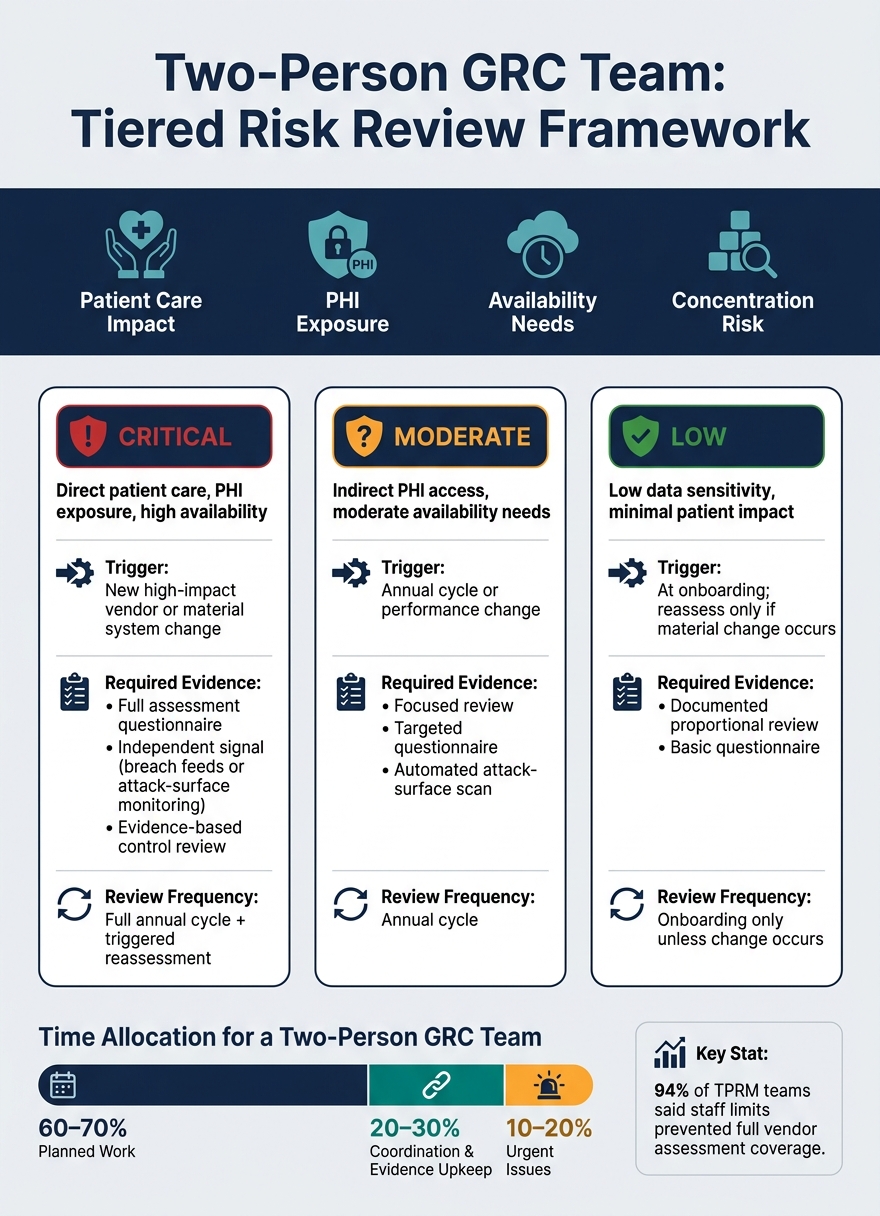
Two-Person GRC Team Operating Model: Tiered Risk Review Framework
With roles set and routines in place, the next step is simple: decide where your team spends time first. That’s where prioritization comes in. Use the ownership map from the last section to send each review to the right person from the start.
Set clear tiers and written criteria so there’s no guesswork about what gets reviewed first. That ranking should flow into the same risk register and workflow tools you already use for governance and reporting.
Build One Inventory and Score What Matters Most
Start with one inventory that covers systems, applications, vendors, and data flows. Then score each item against a short list of criteria tied to patient-care impact, PHI exposure, availability needs, and concentration risk.
The point isn’t to make the scoring model fancy. The point is to build a ranking you can defend when someone asks, “Why did we review this first and not that?” A simple, clear model usually works better than a bloated one.
Create Tiered Review Paths for Critical, Moderate, and Low Risk
After scoring, place items into three tiers and match each tier to the right level of review. Not every system or vendor needs the same amount of scrutiny, and treating them all the same wastes time.
Critical systems and vendors - those tied to direct patient care, PHI exposure, or high availability needs - should get a full assessment. That means a full questionnaire, an independent signal like breach feeds or attack-surface monitoring, and an evidence-based control review.
Moderate-risk items should get a focused review with targeted questions and an automated attack-surface scan.
Low-risk items should get a proportional review at onboarding, then be reassessed only if something material changes.
Standardize the Process in the Risk Register and Workflow Tools
Write down what each tier requires so reviewers use the same triggers and the same evidence every time. That keeps the process steady and makes reporting much cleaner.
| Review Path | Trigger | Required Evidence |
|---|---|---|
| Critical | New high-impact vendor; material system change | Full assessment, independent signal (breach feeds or attack-surface monitoring), evidence-based control review |
| Moderate | Annual cycle; performance change | Focused review, questionnaire, automated attack-surface scan |
| Low | At onboarding; low data sensitivity | Documented proportional review, basic questionnaire |
Use onboarding, performance history, incident patterns, and material changes to move items into a higher tier when needed.
Turn Policies, Evidence, Audits, and Reporting into Reusable Workflows
Once your tiered review process is up and running, the next thing that eats time on a two-person team is starting over with the same documents every audit cycle. The fix is pretty simple: build it once, then reuse it.
Use One Control Library and One Evidence Index for Repeated Use
Map each control one time, then connect it to every requirement that applies. That way, one evidence set can support audits, policy reviews, and vendor requests. It also makes reuse much easier across SOC 2, ISO 27001, and HIPAA, instead of gathering separate artifacts for every framework.
Pair that library with an evidence index so the team can reuse proof and respond to audit requests faster. When an auditor asks for documentation, you can pull it from the index instead of digging through shared drives, folders, and inboxes.
Once the same evidence starts supporting multiple requirements, the next move is to automate the handoffs around it.
Automate Reminders, Exceptions, and Audit Support with Lightweight Workflows
Create reusable evidence packets for controls that come up every cycle. A ticketing system or even a spreadsheet can send reminders and route tasks to the right owner without constant manual follow-up.
Exceptions need control too. A lightweight workflow tool keeps the exception log auditable and time-bound. Without that kind of structure, exceptions can turn into untracked risk.
Tool depth should match team size and process maturity. Centralized GRC workflow management is the best fit for multi-framework healthcare environments.
Report a Small Set of Metrics That Drive Executive Decisions
Use the same workflow data to fill the monthly dashboard. A one-page monthly view is enough. The goal is decisions, not detail.
The table below shows which metric goes to which audience, how often it should be reviewed, and what decision it should prompt:
| Reporting Metric | Audience | Cadence | Example Trigger | Required Decision |
|---|---|---|---|---|
| Top Residual Risks | Board / CEO | Quarterly | High/Critical | Risk mitigation funding or acceptance |
| Aging Remediation | CISO / IT Ops | Monthly | >30 days overdue | Resource reallocation to stalled tasks |
| Open Exceptions | Risk Committee | Monthly | >10% of total controls | Approval of compensating controls or expiration |
| Critical Vendors (Missing Evidence) | Procurement / CISO | Monthly | Any Tier 1 missing | Contract hold or emergency reassessment |
| Assessment Coverage | Compliance Director | Monthly | <90% of scope | Audit schedule adjustment |
Censinet RiskOps™ centralizes risks, controls, evidence, and reporting in one place for healthcare environments. That means the same exception records and evidence packets used in day-to-day workflows can also feed executive reporting.
Conclusion: Run a Repeatable Weekly Cycle and Improve Coverage Over Time
Follow a Weekly Execution Cycle with Room for Urgent Issues
With the operating model set, the next step is simple: run it every week.
Each week, review new risks, vendor changes, incidents, expiring policies, overdue actions, audit requests, and planned clinical technology changes. A good rule of thumb is to set aside 60%–70% of team capacity for planned work, 20%–30% for coordination and evidence upkeep, and 10%–20% for urgent issues. That split should move based on incident volume and regulatory pressure.
Urgent work has a way of blowing up the plan. A suspected or confirmed compromise, a critical vendor security incident, a regulatory deadline, or any other material risk to patient safety or availability can force the team to shift fast. When that happens, log the work that got pushed, the new due date, and the reason for the delay. That one habit matters. It stops urgent work from quietly turning into unmanaged compliance gaps.
Use a Minimum Viable GRC Checklist to Guide Maturity
Once the weekly cycle feels steady, use a minimum viable checklist to see what the team can repeat week after week. The point isn't to build a giant program map. It's to stay focused on a small set of repeatable building blocks:
| Building Block | What It Does |
|---|---|
| One risk taxonomy | Covers confidentiality, integrity, availability, patient safety, privacy, regulatory exposure, financial impact, and resilience. |
| One prioritized inventory | Scores critical assets, clinical services, sensitive data, and vendors by impact. |
| One control and evidence library | Maps obligations to owners and reuses evidence across frameworks. |
| One exception workflow | Tracks owner, rationale, compensating controls, expiration date, and review trigger. |
| One remediation queue | Tracks priority, owner, milestone, blocker, and target date. |
| One reporting cadence | Brief monthly dashboard of risks, trends, overdue actions, and vendor gaps. |
| One decision forum | Resolves risks, exceptions, funding, and deadlines. |
After the checklist is in place, look at whether the program is getting faster and easier to run. Maturity is not about how many policies exist. It shows up in the numbers that matter: current owners and assessments for critical assets and vendors, approved treatment plans for high-risk findings, median age of overdue remediation, and exceptions with expiration dates.
A simple quarterly review can do the job. Classify each capability as absent, defined, repeatable, measured, or improving. That gives the team a clear read on where to focus next, without creating a giant transformation backlog.
A two-person team that narrows scope, standardizes decisions, and reuses evidence can improve visibility, speed up decisions, and cut exposure over time.
FAQs
How do I start a two-person GRC program?
Start with high-impact work instead of trying to copy a big, mature program. Put a centralized governance model in place: the core team owns the frameworks and automation, while local teams take care of on-site execution.
Focus first on a complete vendor and asset inventory. Then use risk tiering to zero in on the highest-risk areas, set a minimum control baseline, automate high-volume tasks, and assign clear ownership with documented risk decisions.
What should a small GRC team prioritize first?
Start with the workflows that save the most time and cut the most manual work.
First, catalog your vendor and asset inventory so you can see which third parties have access to sensitive data or critical clinical systems. Then tier vendors by risk, so your limited time and staff go to the areas that matter most.
Next, automate vendor intake and assessments to shrink backlogs. After that, standardize monitoring and incident prioritization with shared evidence, which helps cut repetitive tasks and keeps teams from doing the same work twice.
How can we reuse evidence across audits?
Centralize documentation in a single platform that maps findings to multiple control frameworks, such as HIPAA or NIST. That gives you one shared evidence repository where teams can reuse key documents, track changes over time, and stop chasing the same logs or screenshots again and again.
Automation can also normalize data from scanners and ticketing systems. So instead of rerunning full reviews every time something changes, you can trigger targeted reassessments where they’re needed. Shared vendor assessments help in the same way: vendors provide results once, and those results can be used in more than one context.
