
Here’s the short version: pharmacy risk is often concentrated in a few shared vendors, and when one fails, prescriptions, claims, prior auth, and payments can stall at the same time. That is the main lesson from the Change Healthcare attack on February 21, 2024.
I’d boil the article down to this:
- Pharmacy has hidden choke points in claims switches, PBMs, e-prescribing networks, specialty platforms, wholesalers, and dispensing systems.
- The danger is not just your direct vendor. It can also sit with a shared cloud host, identity service, carrier, or subcontractor behind several vendors.
- The impact hits fast: delayed fills, manual workarounds, lost reimbursements, and gaps in records.
- Patient care is part of the risk. Delays can affect time-sensitive drugs like insulin, anticoagulants, seizure meds, transplant drugs, and oncology therapies.
- The fix starts with mapping dependencies, scoring exposure, and testing fallback paths before an outage happens.
A few numbers make the point clear. During the Change Healthcare fallout, the American Hospital Association said 74% of surveyed groups saw a direct effect on patient care. The AMA also cited trouble across core revenue functions, with 75% reporting claim-submission barriers, 79% unable to receive electronic remittance advice, and 85% still facing stalled reimbursement. Kodiak Solutions estimated a $6.3 billion drop in submitted claims in the first three weeks.
What matters most is simple: vendor count does not equal safety. If your “backup” uses the same hidden infrastructure, you may still have one point of failure. So the article focuses on three things: where pharmacy concentration sits, how outages spread into care and revenue, and what I’d test and document to cut the risk.
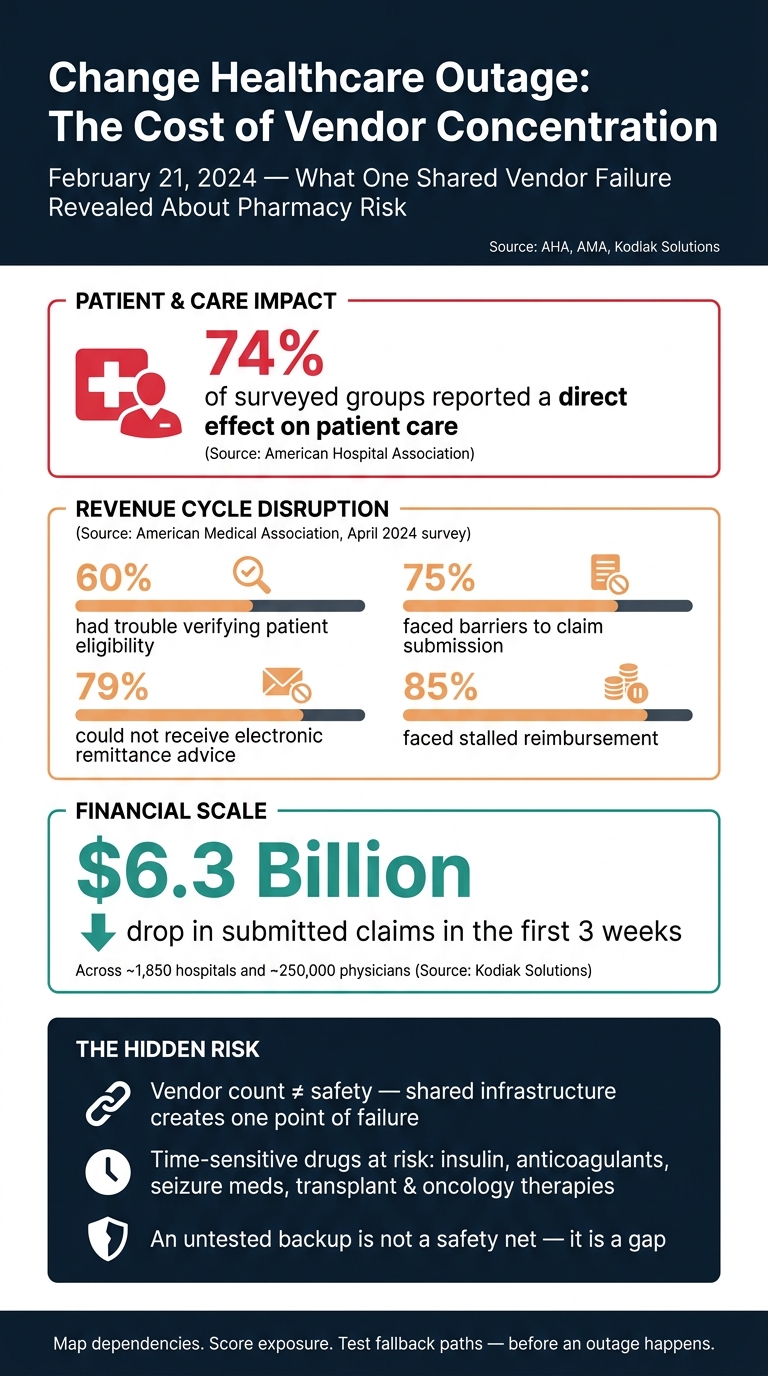
Change Healthcare Outage: By the Numbers - Pharmacy Vendor Concentration Risk
Where Pharmacy Vendor Concentration Creates Systemic Dependency
Core pharmacy dependencies: PBMs, claims switches, and e-prescribing networks
Pharmacy concentration can turn dispensing, reimbursement, and access into a single point of failure. PBMs set benefit rules, claims switches route transactions, and e-prescribing networks send prescriptions. They serve different roles, but in practice they work like one connected chain.
That chain can snap at any point. When one layer goes down, pharmacies can lose coverage checks, copay calculations, claim submission, and claim reversals at the same time. During the Change Healthcare outage, Utah Medicaid reported that staff temporarily lost access to pharmacy claim information, overrides, and prior-authorization data, affecting members seeking prescriptions.[5][6] That’s not just a billing issue. It’s a direct patient-access problem.
The same pattern shows up in specialty, distribution, and dispensing workflows too.
Specialty, distribution, and dispensing platforms
Specialty pharmacy platforms run much of the work behind the scenes: referral intake, benefits investigation, prior authorization, patient assistance enrollment, shipment scheduling, and refill management. In many cases, these workflows sit on one platform - or a small group of niche vendors - with no easy fallback.
Wholesaler and distribution systems add another layer of risk. If the ordering portal, inventory database, or logistics provider fails, a pharmacy may not be able to restock, even if the prescription, insurance claim, and dispensing system are still up and running. The same goes for pharmacy-management systems. These systems handle dispensing queues, barcode verification, clinical alerts, label generation, controlled-substance documentation, and point-of-sale tasks. They’re part of the operating backbone. A backup workstation sounds helpful, but it doesn’t mean much if claims access or PBM connectivity is still offline.
Hidden fourth-party dependencies behind your visible vendors
The harder risk to spot is shared infrastructure. On paper, separate vendors may look like a safe setup. In practice, that setup can still fail all at once if those vendors depend on the same cloud host, identity service, or network layer. A health system might split e-prescribing, claims switching, specialty referrals, and dispensing across different vendors - and still have all of them tied to the same cloud region, identity provider, or connectivity carrier. If that common layer fails, all four applications can drop at once, no matter how many contracts are in place.
The table below shows where these shared layers break and what happens next.
| Pharmacy function | Concentrated dependency | Immediate failure mode | Patient, operational, and financial impact |
|---|---|---|---|
| Eligibility and benefit verification | PBM or claims-adjudication platform; underlying shared provider: cloud or identity provider | Coverage, copay, formulary, or authorization response unavailable | Prescription delays; manual calls; abandoned fills; unreimbursed dispensing |
| Claims switching | Single claims switch serving multiple payers | Claims, reversals, or resubmissions cannot be routed | Patients may be asked to pay cash; pharmacies lose reimbursement and face cash-flow pressure |
| E-prescribing | Dominant e-prescribing network; underlying shared provider: connectivity subcontractor | New prescriptions, renewals, or medication history cannot be transmitted | Delayed therapy and increased prescribing workload |
| Specialty pharmacy intake and fulfillment | Specialty platform; underlying shared provider: shared data-feed provider | Referral, authorization, shipment, or adherence workflow stops | Delayed treatment starts, missed doses, failed shipments, and compliance exposure |
| Wholesaler ordering and inventory | Single distributor portal, inventory database, or logistics provider | Orders, allocation status, or shipment visibility unavailable | Stockouts, emergency sourcing, manual reconciliation, and treatment disruption |
| Dispensing and pharmacy management | Pharmacy-management system, label service, or hosted database | Queues, labels, patient records, or clinical checks inaccessible | Slower dispensing, manual-error risk, incomplete records, and lost revenue |
| Shared cloud, identity, or network layer | Common cloud host, identity provider, carrier, or managed service provider | Several direct vendors become unavailable simultaneously | Organization-wide outage despite apparent vendor diversification |
Redundancy only counts when the backup path does not rely on the same underlying infrastructure. If it does, one outage can still shut down the whole pharmacy chain. And when a shared dependency fails, the damage goes beyond downtime. It shows up as delayed prescriptions, manual workarounds, and lost reimbursement.
sbb-itb-535baee
How a Vendor Outage Becomes a Patient Care and Revenue Cycle Event
From transaction failure to delayed or denied prescriptions
When shared systems go down, this stops being just a vendor problem. It turns into a patient-access and payment problem almost right away.
If a pharmacy vendor fails, the chain reaction is pretty direct: eligibility checks fail, claims stop moving, prior authorization stalls, and e-prescribing can grind to a halt. Staff end up switching to phones, faxes, and paper. Patients wait longer, pay out of pocket, or walk away without their medication.
During the February 2024 outage, most U.S. pharmacies had to change how they processed electronic claims.[7] And for drugs like insulin, anticoagulants, and oncology treatments, even a short delay can matter. A late fill may mean a missed dose or an avoidable trip to the ER.
Operational, financial, and compliance consequences
The money impact starts the minute claims stop moving. In an April 2024 survey cited by the American Medical Association, 60% of respondents still had trouble verifying patient eligibility, 75% reported barriers to claim submission, 79% could not receive electronic remittance advice, and 85% continued to face stalled reimbursement.[3] Claims that aren't submitted begin stacking up in accounts receivable. Missing remittance files stop automated posting. Cash flow gets tight fast.
Kodiak Solutions estimated that the attack caused the value of submitted claims to drop by $6.3 billion in the first three weeks alone, across about 1,850 hospitals and 250,000 physicians.[4] For smaller pharmacy operators, that kind of pressure can hit hard.
The compliance side gets tougher too. Manual workarounds can leave gaps in documentation, weaken audit trails, and increase HIPAA risk. The Change Healthcare incident also drew federal attention to HIPAA privacy, security, and breach-notification duties, which is a blunt reminder that an outage can turn into a cyber and compliance problem at the same time.[2]
And getting the vendor back online doesn't fix everything overnight. Backlogs, duplicate claims, missing remittances, and unresolved authorization queues can drag on for weeks after service returns.
Impact chain view for downtime planning
Use this impact chain to decide which pharmacy functions - and which shared systems behind them - need the fastest recovery.
| Pharmacy dependency | Immediate impact | Patient-care consequence | Revenue or compliance consequence | Time to harm | Workarounds |
|---|---|---|---|---|---|
| Claims switch or adjudication service | Ransomware or network outage disables eligibility, claim submission, reversals, and payment responses | Delayed fill, denial, transfer, or temporary cash payment | Frozen reimbursement, rebilling backlog, patient-balance disputes | Hours for urgent medications; no more than one business day without escalation | Alternate switch, payer portal or phone verification, approved emergency-fill and cash-pay process |
| E-prescribing network | Routing or service failure prevents new prescriptions and renewals from reaching the pharmacy | Delayed therapy start or missed refill | Manual documentation burden and prescription-integrity risk | Hours for first doses and time-sensitive treatment | Telephone or compliant paper prescription, alternate network, prescriber confirmation |
| PBM or prior-authorization platform | Platform outage blocks benefits, formulary, authorization, and override status | Delayed specialty or high-cost therapy | Unbilled claims, avoidable denials, authorization-aging backlog | Same day for urgent specialty treatment; defined escalation threshold | Payer call center, documented provisional fill, alternate authorization channel |
| Specialty-pharmacy platform | Vendor or fourth-party failure stops benefits investigation, enrollment, copay support, and shipment coordination | Interrupted specialty treatment or delayed start | Lost revenue, assistance-documentation gaps, privacy exposure | Based on therapy-specific time to harm; often less than one business day | Manual case queue, direct payer and manufacturer contacts, alternate dispensing partner |
| Wholesaler or distribution platform | Ordering, warehouse, or logistics outage halts replenishment and shipment tracking | Stockout, delayed dispensing, or forced substitution | Lost sales, emergency purchasing, inventory and invoice reconciliation issues | Hours to one day for critical medicines | Secondary wholesaler, local transfer, emergency allocation, approved substitutions |
| Dispensing or pharmacy-management system | Software, database, or infrastructure failure slows queue management, verification, labeling, and documentation | Delayed or unsafe dispensing if controls are bypassed | Productivity loss, inaccurate records, audit and billing gaps | Determined by pharmacy safety plan; immediate escalation if safe verification is not possible | Downtime mode, paper logs, controlled manual verification, later dual review and reconciliation |
Use the shortest medication-specific threshold as the planning baseline. That shortest threshold should drive the risk scoring in the next section.
How to Assess Concentrated Pharmacy Risk Before It Fails
Inventory services and map transaction flows
Once you know which failures cause the fastest damage, score each dependency by exposure, criticality, and fallback strength. Start with a dependency map, not a vendor list. Then tie each service to the shortest recovery threshold you identified earlier. That changes the conversation from “what do we have?” to “what is concentrated, critical, and replaceable?”
Build the inventory around workflows and transaction paths. Include PBM adjudication, claims switching, eligibility and benefit checks, e-prescribing, prior authorization, specialty-pharmacy workflows, dispensing and POS systems, wholesaler/distribution, payment and remittance, and the identity, hosting, telecom, and security services behind them. Treat prescriptions, medication history, and electronic prior authorization as separate flows.
For each dependency, record the business and technical owner, vendor and product, affected locations, interfaces, data types, hours of operation, recovery contacts, SLAs, subcontractors, hosting, carriers, and shared infrastructure. Add transaction volume too: prescriptions per day, claims per month, specialty patients supported, and average reimbursement value.
Map four cases:
- Routine retail
- Specialty with prior authorization
- Emergency refill
- Medicare Part D
For each step, note the system of record, transaction owner, data exchanged, maximum tolerated delay, and fallback process. This is where the picture gets clear. A simple map often shows exactly where concentration turns into operational dependence.
Measure concentration, criticality, and substitutability
Once the inventory is done, quantify what each vendor actually controls. Measure the percentage of prescriptions, claims, pharmacy locations, specialty patients, and reimbursement dollars that depend on each service. Calculate peak exposure separately from annual averages. A vendor may handle 30% of annual claims but 70% during a certain payer, specialty, or end-of-month cycle.
Rate clinical criticality by the harm caused by delay, not by transaction volume. A service that supports insulin, anticoagulants, seizure medications, transplant drugs, oncology treatment, or emergency medications should be rated Critical because even a short outage can put patient safety at risk. A service tied only to routine administrative reporting may be rated Low. The same vendor might be critical for one workflow and only moderate for another.
A fallback only counts if it is technically compatible, contractually approved, operationally documented, and able to handle peak volume. An untested secondary contract or a dormant interface is not a safety net. It is a gap.
Turn assessment findings into a risk matrix
Use the inventory to assign risk, not just to make a system list. Vendor count is not resilience.
| Risk profile | Concentration level (1–5) | Clinical criticality (1–5) | Fourth-party exposure (1–5) | Recovery readiness (1–5) | Required mitigation |
|---|---|---|---|---|---|
| Routine administrative service with low volume and validated manual processing | 1–2 | 1–2 | 1–2 | 4–5 | Maintain documented procedures, contacts, and periodic review |
| Claims or eligibility service with moderate volume and a tested alternate route | 3 | 2–3 | 2–3 | 4–5 | Test annually, monitor performance, and maintain current alternate capacity |
| E-prescribing, prior authorization, or dispensing service supporting many locations | 4 | 3–4 | 3–4 | 2–3 | Establish a second route, execute downtime drills, and require recovery evidence |
| Specialty-pharmacy platform supporting high-risk or time-sensitive therapies | 3–4 | 5 | 3–4 | 2–3 | Prioritize clinical escalation, patient outreach, alternate fulfillment, and frequent testing |
| Claims switch or processor carrying most transactions with shared underlying infrastructure | 5 | 4–5 | 4–5 | 1–2 | Treat as systemic risk; diversify architecture, validate a scalable alternate, and require executive oversight |
| Critical dependency with no tested alternate, incomplete contracts, or unknown fourth parties | 4–5 | 4–5 | 4–5 | 1 | Fix immediately; allow executive risk acceptance only with a dated action plan |
Treat any dependency rated 5 for clinical criticality or fourth-party exposure as high risk, no matter the concentration score. That keeps a low-volume oncology or transplant workflow from being ranked below a high-volume administrative service that is easy to replace. For each high-risk finding, assign a named executive owner, a target recovery time, a required test date, and a residual-risk acceptance decision.
Build Resilience and Operationalize Pharmacy Third-Party Risk Management
Alternate routes, downtime procedures, and continuity testing
Use the risk matrix from the previous section to turn each high-risk dependency into a recovery plan that has actually been tested.
Start with pre-approved fallback paths for every critical workflow. That means more than naming a backup vendor in a contract and hoping for the best. For claims submission, eligibility verification, e-prescribing, prior authorization, and payment processing, you need active credentials, tested payer enrollment, compatible transaction formats, and staff who already know how to switch over. If the backup has never been tested, it isn't much of a backup.
Downtime procedures also need to cover the full transaction lifecycle. Staff should know how to verify coverage when real-time eligibility is unavailable, how to accept prescriptions through approved fallback channels, how to use manual logs for every claim, reversal, and authorization that must wait for recovery, and how to avoid duplicate billing when systems come back online. A pharmacy may look open from the outside and still be unable to process prescriptions, claims, or reversals.
Run scenario exercises for claims-switch, e-prescribing, specialty, and dispensing failures. Then track every corrective action until it's done. Each exercise should end with a written after-action report.
The American Hospital Association recommends downtime procedures that can sustain operations for at least four weeks.[1]
Contracts, monitoring, and executive ownership
Contracts need to make resilience requirements enforceable. For any highly concentrated or hard-to-replace pharmacy vendor, that includes prompt incident notice with clear escalation paths, recovery time and recovery point objectives based on clinical criticality instead of generic service tiers, and dated test results showing what was tested, what failed, and what was fixed. Fourth-party visibility matters too. If your main vendor depends on a subcontractor that shares infrastructure with another critical service, you need to know that before an outage makes it painfully clear.
Monitoring should continue between formal assessments. Security ratings help, but they don't tell the whole story. Watch for unresolved critical vulnerabilities, repeated service incidents, ownership or financial changes, subcontractor changes, and missed recovery commitments. Every alert should have a named owner, a response threshold, and a closure requirement. Those results should flow straight into the risk register, not sit in a procurement file that no one opens until renewal time.
Recovery often falls apart for a simple reason: no one is clearly in charge. Pharmacy leadership owns clinical priorities and dispensing safeguards. Information security owns cyber controls and technical recovery. Revenue cycle owns claim, payment, and reconciliation exposure. Procurement and legal enforce contract controls. Compliance covers HIPAA, state pharmacy law, and controlled-substance documentation. Business continuity keeps the dependency register and exercise calendar current. No critical dependency should be marked as owned by IT alone without a named pharmacy, revenue-cycle, and continuity owner attached to it.
Conclusion: A pharmacy dependency is not resilient until it is tested
The main issue in this article is pretty plain: when too much of a pharmacy operation depends on one vendor, one outage can turn into a patient-care event, a revenue-cycle event, and a compliance event all at once. The table below turns that risk into a set of actions.
| Mitigation | Risk addressed | Implementation prerequisites | Evidence that proves readiness |
|---|---|---|---|
| Pre-approved fallback path for claims and eligibility | Claims-switch outage blocks adjudication, reversals, payment, or coverage verification | Secondary connectivity, payer enrollment, credentials, trained staff, manual logs, payment controls | Dated end-to-end test results by major payer; successful claims, reversals, reconciliation, and staff competency evidence |
| E-prescribing fallback | Prescriptions or renewals cannot reach the pharmacy | Approved legal and clinical alternatives, prescriber contacts, authentication, documentation rules | Scenario-exercise report showing safe intake, verification, dispensing, and later record completion |
| Specialty-pharmacy continuity plan | Prior authorization, enrollment, shipment, or adherence support is interrupted | Patient-priority list, manual tracking, alternate contacts, inventory and shipment escalation | Tested case simulation, patient-impact analysis, escalation records, closed corrective actions |
| Wholesaler and inventory alternative | Distribution outage causes stockouts or delayed therapy | Secondary suppliers, transfer rules, shortage criteria, cold-chain controls | Supplier activation test, inventory-transfer record, temperature-control evidence |
| Dispensing-system recovery plan | Cyberattack or system failure affects profiles, labels, verification, or audit trails | Backups, isolated recovery environment, downtime forms, restoration sequence | Restore test, data-integrity validation, pharmacist sign-off, recovery-time measurement |
| Contract controls | Vendor delays notification or recovery and limits organizational options | Negotiated terms, escalation contacts, audit rights, exit provisions | Executed contract, vendor continuity evidence, incident-notification test, review record |
| Fourth-party visibility | A hidden common provider creates correlated failure | Subcontractor inventory, dependency mapping, change-notice obligations | Current fourth-party register, reviewed architecture, documented concentration analysis |
| Continuous vendor monitoring | Deterioration occurs between assessments | Defined signals, thresholds, owners, dashboards, escalation process | Monitoring reports, alerts, tickets, executive review minutes |
| Scenario-based continuity testing | Plans exist but fail under realistic conditions | Exercise calendar, participants, objectives, patient-safety criteria | After-action report, measured results, remediation tickets, successful retest |
| Governance | Findings remain fragmented and unowned | Common taxonomy, RACI assignments, evidence repository, risk committee | Current risk register, ownership records, overdue-action reports, approved residual-risk decisions |
When PBMs, claims switches, e-prescribing networks, specialty platforms, wholesalers, and dispensing systems are mapped, scored, and tested together, a pharmacy operation moves from concentrated risk to documented, exercised resilience.
FAQs
How do I find hidden fourth-party dependencies in pharmacy vendors?
Look past static procurement lists and map the clinical and day-to-day workflows that keep care moving, like pharmacy verification, to the systems, data feeds, and providers behind them.
Then dig into API logs, outbound traffic, and authentication activity to spot undocumented integrations and shared infrastructure. That kind of review often shows what's actually connected, not just what's written down.
It also helps to require vendors to disclose major subprocessors and infrastructure dependencies. And use SBOMs or HBOMs to identify embedded components that procurement records may miss.
What pharmacy workflows should be restored first during a vendor outage?
Patient safety comes first. After that, focus on the clinical and day-to-day workflows that keep care moving.
The top priority is restoring any service that could disrupt patient care or cash flow within 72 hours, including:
- manual medication verification and dispensing
- pharmacy order workflows
- patient identity verification
Organizations also need documented, practiced manual workarounds for pharmacy automation, inventory tracking, and receiving.
How can we tell if a backup vendor is a true backup?
A backup vendor is only a true backup if it has been tested, not just promised on paper. Make sure it’s kept separate from the main system, and confirm that your team has already tested the restore process from end to end.
You should also require documented RTO and RPO targets. Then check that those targets are met in routine disaster recovery tests or live drills. On top of that, set clear decision points for when to switch to the fallback vendor.
