
Healthcare didn’t fall behind because it ignored cyber risk. It fell behind because it handled shared risk like a local IT problem.
If I boil this article down to the core point, it’s this: care delivery became deeply connected, but cyber risk programs stayed isolated. That mismatch left providers exposed to the same vendor failures, the same hidden fourth-party links, and the same cash-flow shocks. The result was plain in 2024: 739 breaches, 276 million+ records exposed, and a major outage at Change Healthcare that disrupted claims, eligibility, prior authorizations, and patient access across the country.
Here’s the simple takeaway for me:
- One shared vendor can disrupt thousands of providers at once
- Point-in-time vendor reviews miss concentration risk
- Fourth-party links often stay hidden until something breaks
- Patient care, cash flow, and recovery all suffer when response is disconnected
- A network model gives teams shared visibility, earlier warning, and coordinated response
- The shift starts with governance, vendor tiering, dependency mapping, and shared risk data , as seen in Tower Health's TPRM transformation.
The article also makes the financial case clear. IBM reported the average U.S. healthcare breach cost at $7.42 million. And after the Change Healthcare attack, 94% of hospitals in one AHA survey said they took a financial hit, while 74% reported patient-care impact. That tells me this is not just a security issue. It is a business continuity and patient safety issue too.
A few numbers stand out even more:
- 68% of healthcare IT leaders dealt with a supply-chain attack in 2024
- 82% of those attacks disrupted patient care
- Only 31% of healthcare groups in one study had a fully implemented third-party vendor risk management program
- 24% had no such program at all
- Supply chain risk management coverage was just 52%
- Network-connected medical device security was at 48%
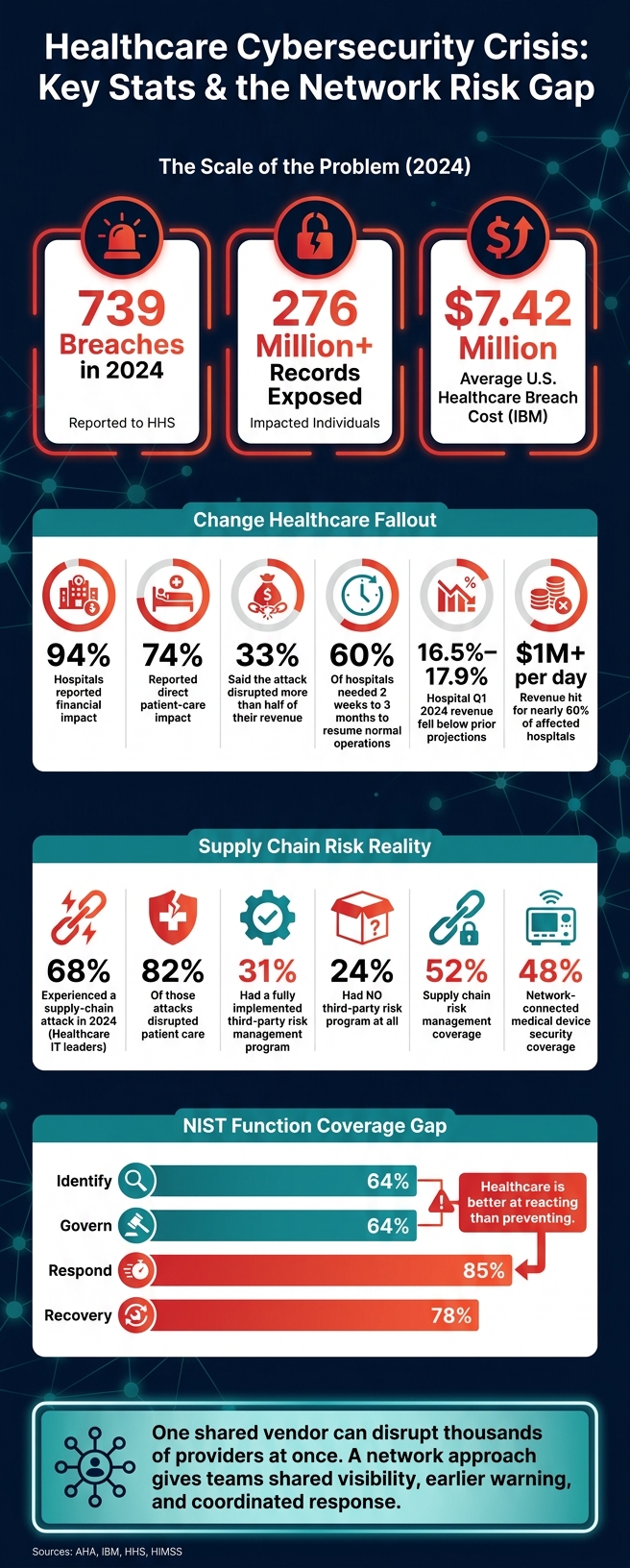
Healthcare Cybersecurity Crisis: Key Stats & the Network Risk Gap
Top 3 Healthcare Cyber Threats in 2026
These threats often stem from healthcare supply chain security challenges that leave providers vulnerable to systemic disruptions.
sbb-itb-535baee
Quick comparison
| Area | Isolated approach | Network approach |
|---|---|---|
| Vendor risk view | One contract at a time | Shared view across vendors and downstream links |
| Incident detection | After local impact starts | Earlier warning across connected parties |
| Response | Each group scrambles on its own | Shared playbooks and joint action |
| Concentration risk | Often missed | Mapped before outages hit |
| Fourth-party exposure | Hard to see | Better mapped across vendor relationships |
| Business impact | More downtime and revenue pressure | Less disruption when backups and workflows are in place |
So if I had to sum up the article in one line, I’d say this: healthcare needs to stop treating cyber risk as a series of security threats in vendor relationships and start treating it as a shared network problem.
That shift is what the rest of the article explains.
Where fragmented defense failed across the healthcare ecosystem
Third-party breaches and supply chain incidents that hit multiple providers at once
When Change Healthcare's systems went offline in February 2024, the damage didn't stay contained. Providers across the care network lost the ability to submit claims, receive payments, verify coverage at the point of care, and complete prior authorizations - all at the same time.[5]
The fallout was harsh. An AHA survey of nearly 1,000 hospitals found that 94% reported financial impact, 74% reported direct patient-care impact, and 33% said the attack disrupted more than half of their revenue.[3][12] More than 80% of hospitals said the attack hurt cash flow, and nearly 60% of those affected said the revenue hit was $1 million per day or more.[12] Hospital Q1 2024 revenue fell 16.5% to 17.9% below prior projections, and small providers were still about 7% below expected Medicare revenue by June 30, 2024.[5]
This is concentration risk in plain terms: one dependency, many failures.
And clearinghouses weren't the only weak point. In July 2024, OneBlood - a regional blood supplier in Florida - had a software outage that disrupted its ability to ship blood products to hospitals in the area.[13] Same pattern, different service. One supplier went down, and the effects spread through care delivery.
These incidents point to the same issue. A provider can tighten its own internal controls and still get hit hard if a shared partner fails. The bigger issue wasn't just a single outage. It was the lack of visibility into how many providers were tied to the same outside services.
Why siloed assessments missed concentration risk and fourth-party exposure
Most provider organizations looked at vendors one by one. What they often missed was the bigger picture: how many organizations rely on this same vendor for the same mission-critical task?
That's where concentration risk shows up. If a clearinghouse processes claims for thousands of providers, or a cloud-based EHR platform supports more than 40,000 providers at once, one incident at that vendor can trigger an operational shock across the sector.[10] A single hospital's vendor review wasn't built to spot that kind of system-level exposure. It only showed one hospital's piece of the relationship.
That gap shows up in the data too. Only 31% of healthcare respondents in one study had a fully implemented formal third-party risk management program, while 24% had no program at all.[11]
Then there's fourth-party exposure, which makes the picture even messier. A hospital may review its EHR vendor closely but still have little to no view into the cloud infrastructure, sub-processors, or payment-routing services sitting behind that vendor. In the Change Healthcare case, some providers and payers that didn't even contract directly with Change Healthcare still felt the blast radius because their own vendors routed transactions through it.[5][9]
In other words, the dependency was there even when the contract wasn't. Hidden links turned a vendor outage into a cash-flow shock, and many organizations didn't see those links until the outage was already underway.[4][5]
Fragmented defense vs. network-based risk management: a side-by-side comparison
The difference between these two models shows up in a few simple areas: what organizations can see, how fast they can react, and how well they hold up under stress.
| Dimension | Fragmented Defense | Network-Based Risk Management |
|---|---|---|
| Visibility | Limited to each organization's own vendor list | Shared view across vendors, peers, and fourth parties |
| Assessment speed | Slow, manual, point-in-time questionnaires | Continuous, shared data reduces duplicated effort |
| Incident detection | Reactive - discovered after impact hits locally | Earlier signals through cross-organization monitoring |
| Coordination | Ad hoc, each organization responds independently | Pre-planned playbooks and shared response protocols |
| Concentration risk | Rarely identified before a major incident | Mapped proactively; single points of failure flagged early |
| Clinical operations | Disrupted when shared vendors go offline | Contingency paths identified before outages occur |
| Sector-wide resilience | Low - recovery is slow and uneven across providers | Higher - coordinated response reduces downtime and revenue loss |
During the Change Healthcare outage, fragmented defense meant providers had to scramble on their own. Many put manual workarounds in place, looked for emergency funding, and waited for direction from associations and regulators.[6][7][8] The AHA said 60% of hospitals needed two weeks to three months to resume normal operations.[3]
That side-by-side contrast makes the gap hard to ignore. Without shared visibility across vendors, suppliers, products, and fourth parties, providers are left reacting after the damage has already started.
What a network approach recovers for healthcare cybersecurity and resilience
A network approach brings back something fragmented defense often missed: shared visibility and coordinated action.
Instead of looking at vendors, suppliers, products, partners, and care settings as separate issues, it treats them as one connected risk web. That makes a big difference. Teams can spot shared dependencies earlier and act before a local problem turns into a sector-wide outage. The payoff is simple: shared visibility, faster identification, coordinated response, and fewer operational disruptions.
Shared visibility across vendors, suppliers, products, and fourth parties
A hospital might have a solid handle on its direct vendors and still miss what sits behind them: shared clearinghouses, cloud services, subcontractors, and other downstream dependencies.
That gap matters. In 2023, 58% of the 77.3 million individuals affected by healthcare data breaches were impacted through attacks on business associates, a 287% increase over 2022.[14] When downstream relationships aren't tracked, exposure can spread fast.
A collaborative risk exchange helps teams see concentration risk more clearly. The same vendor or the same piece of infrastructure can sit underneath many providers at once. Leaders can identify which vendors are mission-critical across dozens of hospitals, which products rely on the same underlying systems, and where one point of failure could send shock waves through the sector.
The MOVEit file-transfer vulnerability showed exactly how this happens. It affected roughly 2,700 organizations, and an estimated one in five came from the healthcare sector.[15]
Faster identification, coordinated response, and more resilient operations
Once teams have that shared view, they can move sooner and with more focus.
When risk data moves across organizations on a continuous basis, early warning signals get to the right responders faster. That gives teams a stronger position for spotting vendor-related risk before a disruption turns into a broad outage.
Response also depends on structure being in place ahead of time. National hospital associations and information-sharing groups recommend integrated incident command plans that assign actions at the system, hospital, and department levels. Those plans also need to include business associates and key vendors.
A few pieces matter here:
- Mutual aid arrangements
- Shared recovery workflows
- Pre-negotiated alternate sourcing for mission-critical suppliers
These steps can shorten recovery time. But they only work when governance treats resilience as a shared operating requirement, not just an IT issue.
What the network model improves: outcomes at a glance
| Outcome Dimension | Isolated, Point-in-Time Reviews | Network-Based Risk Management |
|---|---|---|
| Assessment speed | Slow; manual questionnaires repeated per organization | Faster; shared assessments reduce duplicated effort across the network |
| Breach exposure | High; third-party and non-hospital entities drove 95% of the most significant health sector data breaches in 2023[2] | Lower; concentration risk can be identified and addressed before incidents occur |
| Incident coordination | Ad hoc; each organization responds independently | Pre-planned; common workflows and mutual aid reduce response time |
| External dependency mapping | Limited to direct vendors; downstream dependencies largely invisible | Broader map of vendors, subprocessors, and downstream relationships |
| Supply chain continuity | Ad hoc backup planning; limited redundancy planning | Structured; alternate suppliers and tested downtime procedures are in place[1] |
How healthcare leaders can move from isolated assessments to network-based risk management
The gap is clear. The next move is to put the network model into day-to-day practice without throwing current operations off course. At this stage, healthcare teams need operating rules, not just a framework on paper.
Build governance around business resilience, not just compliance
Cyber risk needs to be treated as a patient safety, care continuity, and revenue matter, not just a box-checking exercise for compliance.
That starts with updating risk appetite statements and the enterprise risk register so they include supply-chain scenarios, along with the operational, financial, and patient impact tied to them.
HHS HIC-SCRiM and NIST SP 800-161 Rev.1 can serve as governance references. From there, leaders can tier vendors based on clinical impact and revenue dependence. Tier 1 and Tier 2 vendors should face cyber review requirements, plus incident-notification clauses in contracts.
CIOs and CISOs should share ownership of a supply-chain risk program that spans IT, supply chain, clinical engineering, legal, and finance. A documented enterprise risk council should handle escalation paths, decision rights, and metrics. That includes:
- The percentage of critical vendors assessed
- Time to remediate high-risk findings
- The share of incidents tied to supply chain dependencies
Use Censinet RiskOps™, Censinet AITM, and Censinet AI to scale shared risk operations
Once governance sets vendor priorities and escalation paths, shared tools make the work repeatable. Put simply, they turn a network model into something teams can use every day.
Censinet RiskOps™ centralizes evidence, lets teams reuse it across assessments, and gives leaders a shared view of vendor risk across the portfolio.[17][18][21][22]
Censinet AITM cuts down the time spent on questionnaire completion, summarizes evidence, captures fourth-party exposure, and drafts risk reports.
Censinet AI automates evidence validation, policy drafting, and mitigation routing. It sorts findings by severity and impact, sends them to the right team - IT security, clinical engineering, supply chain, or legal - and keeps human approval in the process, with full audit trails maintained throughout.[20][21][22]
Traditional TPRM workflows vs. network-enabled and AI-assisted workflows: a side-by-side comparison
| Workflow Dimension | Traditional TPRM | Network-Enabled & AI-Assisted |
|---|---|---|
| Governance | Contract-by-contract, compliance-focused | Portfolio-based, resilience-focused, board-visible |
| Data quality | Fragmented, inconsistent questionnaires | Standardized, healthcare-specific templates and centralized evidence |
| Assessment turnaround | Weeks to months per vendor | Days, with AI-assisted pre-population and shared risk profiles |
| Evidence reuse | Low; each assessment starts over | High; shared documentation and control mappings across the network |
| Fourth-party visibility | Limited and largely manual | Enhanced via network catalogs and mapped vendor relationships |
| Analyst workload | High manual effort on data collection | Shifted to analysis and decision-making through automation |
| Consistency | Varies by analyst and department | Standardized workflows and scoring across the enterprise |
| Human oversight | Manual but inconsistent | High; AI recommendations require human approval with full audit trails |
| Incident coordination | Ad hoc, email-based with vendors | Orchestrated via shared platforms, playbooks, and real-time data feeds |
Implementation tends to work best in phases. In the first 3 to 6 months, focus on governance, vendor tiering, and centralized evidence. After that, teams can expand into automation and network-wide sharing.[16][17][19][21][13][23]
Conclusion: The next decade requires managing healthcare cyber risk as a shared network
All of these failures point to the same takeaway: healthcare risk is shared, not isolated. Right now, healthcare still scores lowest in Identify and Govern, both at 64%, while Respond reaches 85% and Recovery comes in at 78% [24]. That gap matters. It shows that many organizations are still better at reacting after something goes wrong than seeing risk early and steering it well.
A network model helps close that gap. Instead of relying on isolated assessments, it gives teams shared visibility, coordinated response, and governance built around care continuity and financial resilience.
The weak spots are still easy to see. Supply chain risk management sits at 52%, asset management at 53%, and network-connected medical device security at 48% [24].
The change comes down to three moves: map dependencies before an incident forces the issue, share risk data across teams and partners, and build governance that answers to patient safety and operational uptime, not just audit checklists. When teams work this way, they stop chasing breaches after the damage is done. They can spot concentration risk, fourth-party exposure, and supply chain gaps while there is still time to act.
Waiting means hidden dependencies stay hidden. And in healthcare, that’s a risky bet. The next decade will favor organizations that treat cyber risk as a shared network risk.
Key metrics to track as the model shifts
Use these metrics to see whether this shift is starting to take hold.
| Metric | What to Measure | Industry Benchmark |
|---|---|---|
| Supply chain risk management coverage | % of supply chain risk controls in place | 52% [24] |
| Asset management coverage | % of assets inventoried and monitored | 53% [24] |
| Network-connected medical device security | % of network-connected devices secured | 48% [24] |
| Identify function coverage | Coverage across the Identify function | 64% [24] |
| Govern function coverage | Coverage across the Govern function | 64% [24] |
| Respond function coverage | Coverage across the Respond function | 85% [24] |
| Recovery function coverage | Coverage across the Recovery function | 78% [24] |
FAQs
What is concentration risk in healthcare?
Concentration risk in healthcare happens when an organization leans on one shared service, platform, or provider for mission-critical work. That creates a single point of failure.
This is different from standard vendor risk. The focus here is what happens when one outside entity goes down, like a clearinghouse, cloud provider, or identity service. In that case, care delivery can stall, cash flow can freeze, or both.
And the problem can spread fast. If several vendors depend on the same underlying infrastructure, one outage can knock out multiple systems at the same time.
How do fourth-party dependencies stay hidden?
Fourth-party dependencies often stay out of sight because most risk programs focus on direct vendors. They rely on static, manual lists, which sounds fine on paper but falls apart in practice.
Here’s the problem: those lists usually miss the subcontractors, cloud providers, and upstream services that vendors depend on. And a lot of those links never show up in formal procurement records.
To spot them, organizations need to look past direct vendor lists and dig into what’s happening across their systems. That means reviewing:
- API logs
- Outbound traffic
- Authentication activity
- SBOMs
- HBOMs
That kind of review helps surface the hidden relationships that a spreadsheet or vendor database won’t show.
Where should a network approach start?
Start by mapping the clinical and business services that matter most, not just the names on your vendor list. Focus on the functions that could disrupt patient care or cash flow within 72 hours, like diagnostic imaging, pharmacy transactions, or EHR access.
Then work backward. Map the vendors, platforms, subcontractors, and shared infrastructure that support each service. This service-first approach makes it easier to spot hidden dependencies and concentration risk.
